This photograph was taken looking north-northeast from Coyote Hills Regional Park in Newark towards Hayward and the distant Diablo Range; Mt. Diablo (1174m) is visible on the left center skyline. The rocks underlying the Coyote Hills consist of red chert (lower left of this photograph), ochre-colored metamorphosed volcanic rocks, and pervasively sheared shale of the Franciscan Complex of Cretaceous age. These rocks are typical of central and southeastern parts of Alameda County. The shallow margins (white areas at left center) of the fresh water marshes in the Park commonly dry in late summer to form saltpans. Coastal Ohlone American Indians utilized this resource that now supports a large mineral industry.
The San Francisco Bay Area is well known worldwide for the complexity of its landforms and underlying geology. Alameda County lies along the eastern margin of this area. This region is composed of at least six terrains (continental, seafloor, and island chain) fragments with distinct characteristics pushed together over millions of years by the forces of plate tectonics. As a consequence, many types of rock and soil are found in the region. Pliocene- and Pleistocene-era fossils of plants and mammals are abundantly present in some locations.
Rocks exposed in Alameda County are divided into nine assemblages: I, II, and V through XI (Assemblages III and IV occur only in adjacent Contra Costa County). These assemblages are large, fault-bounded blocks that contain a unique stratigraphic sequence. The stratigraphic sequence differs from that of neighboring assemblages by containing different rock units (e.g. the freshwater limestone in Assemblage VIII is missing from the other Assemblages), or by different stratigraphic relationship among similar rock units (e.g. the Orinda Formation overlies the Claremont Chert in Assemblage I, whereas in Assemblage VI three other formations totaling more than 500 meters thick lie between the Orinda and Claremont Formations). These stratigraphic differences represent changes in depositional conditions in one or more large depositional basins. The current adjacent location of the different assemblages reflects the juxtaposition of different basins or parts of basins by large offsets along the faults that bound the assemblages.
In general, in Alameda County the Tertiary strata rest with angular unconformity on two intricately deformed Mesozoic rock complexes. One of these Mesozoic complexes is made up of the Coast Range Ophiolite that includes serpentinite, gabbro, diabase, basalt, and keratophyre. The other complex is the overlying Great Valley Sequence. Within this complex in the Berkeley and Hayward areas the Great Valley Sequence rests unconformably on ophiolite and volcanic rocks in several places. This complex represents the accreted and deformed remnants of Jurassic oceanic crust and overlying arc volcanic rocks plus a thick sequence of turbidites.
The second Mesozoic complex is the Franciscan Complex that is composed of weakly to strongly metamorphosed graywacke, argillite, limestone, basalt, serpentinite, chert, and other rocks. The rocks of the Franciscan Complex in Alameda County were probably Jurassic oceanic crust and pelagic deposits, overlain by Late Jurassic to Late Cretaceous turbidites. Although Franciscan rocks are dominantly little metamorphosed, high-pressure, low-temperature metamorphic minerals are common in the Franciscan Complex. The presence of high grade metamorphic blocks in sheared but relatively unmetamorphosed argillite matrix reflects the complicated history of the Franciscan. The complex was subducted beneath the Coast Range ophiolite during Cretaceous time. Because the Novato Quarry terrane forms the lowest in the stacked sequence of terranes in the Bay Area, it is thought that subduction took place, at least in part, after the Late Cretaceous (Campanian) deposition of the sandstone of the Novato Quarry terrane. Because of the subduction relationship, the contact between the two Mesozoic complexes is everywhere faulted and the Franciscan Complex presumably underlies the entire county.
Tertiary rocks rest with angular unconformity on both Mesozoic complexes. In Assemblages IX and X, Tertiary rocks have been deposited on the Franciscan Complex. The more usual situation is observed in all other assemblages, where Tertiary rocks overlie strata of the Great Valley Sequence, although in most assemblages the contact is now faulted.
Three types of intrusive rocks have been mapped in Alameda County. One is a small stock of coarse-grained, crystalline granular, quartz diorite that intrudes the Coast Range Ophiolite in the Cedar Mtn. quadrangle. Another type occurs as small rhyolite plugs intruding Cretaceous and Tertiary strata in the Sunol area. The third type forms a large body of fine-grained quartz diorite in the Oakland area. These rocks are not included in any assemblage because of their intrusive nature.
Files available for downloading:
View the Digital Database ReadMe file (60 kB).
View the database explanation pamphlet as a PDF: aldb.pdf (508 kB).
View the geologic explanation pamphlet as a PDF file: algeo.pdf (100 kB)
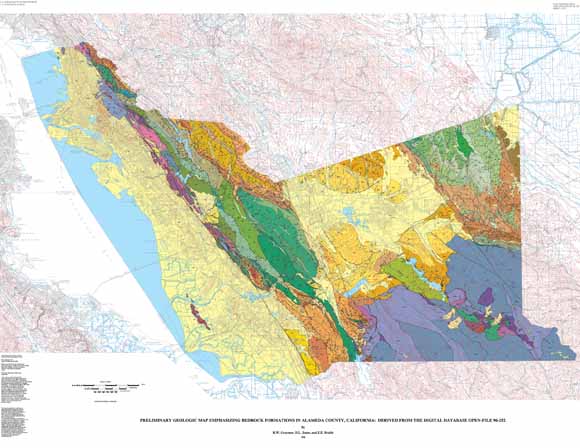
View the geologic map sheet as a JPEG file: almap.jpg (592 kB).
View the geologic map sheet as a PDF file: almap.pdf (5.8 MB)
View the geologic explanation sheet as a PDF file: alexpl.pdf (936 kB)
Download a compressed tar file containing the dataset in ARC/INFO 6.x coverage format: al_g1.tar.Z (14.8 MB compressed download file, 97 MB uncompressed)
For questions about the scientific content of this report, contact Russ Graymer
Download a free copy of the latest version of Adobe Reader.
This report is also available in printed format from:
USGS Information Services
Box 25286 Federal Center
Denver, CO 80225
Telephone: 1-888-ASK-USGS
E-mail: infoservices@usgs.gov
| Help
| PDF help |
| Publications main page
| Western Open-File Reports for 1996 |
| Department of the Interior
| U.S. Geological Survey |
| Geologic Division
| Western Earth Surface Processes Team|
| Privacy Statement
| Disclaimer
| Accessibility |
The URL for this page is:
http//pubs.usgs.gov/of/1996/of96-252/
Please send comments and suggestions, or report problems, to:
Michael Diggles
Updated: December 3, 2008
(mfd)