
| Lake Pontchartrain Basin: Bottom Sediments and Related Environmental Resources |
Summary of Geological and Chemical Data (cont.)
Organic Carbon
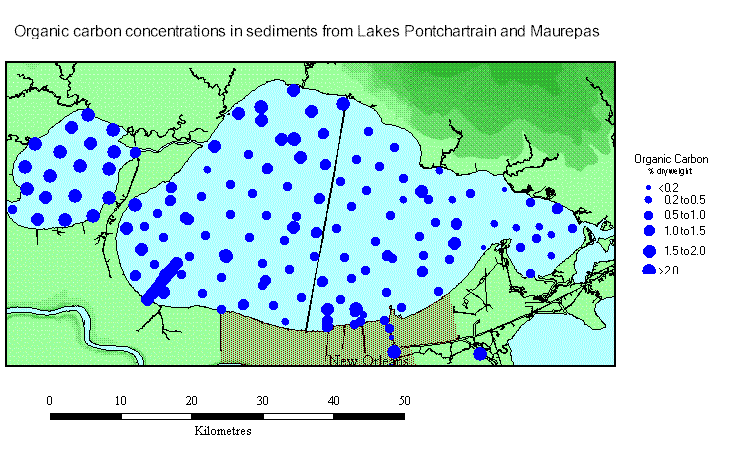
The distribution of organic carbon concentrations in the sediments is shown in the histograms of figure 15 and in the scaled-dot diagram below (fig. 16).
| In figure 15, the 1987 data of Flowers (summary reported in Flowers and Isphording, 1990), show a smaller distribution of organic carbon than do surface sediment data of Sikora and Sikora (1982). The apparent discrepancy may be explained partly by the fact that the Flowers and Isphording studies incorporated nearshore data, whereas Sikora and Sikora studied only dredged areas in the central lake. The data sets of Demcheck and others (1996) and Macauley and Summers (1998) for Lake Pontchartrain yielded 1.33% and 1.07% organic carbon, respectively. Taken as a whole, one can estimate the median organic carbon for the total lake sediments at about 1%. The hypothesis that the authors' data sets form separate populations is rejected at the 95% probability level. | Figure 15. Histogram
distribution of organic carbon concentrations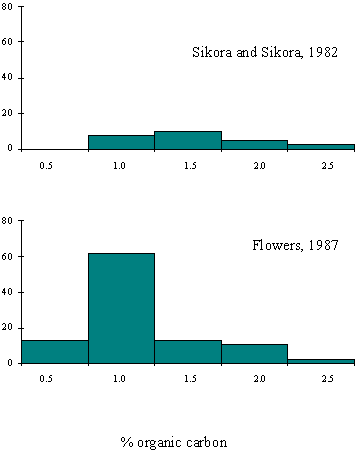 see appendix B for more source information |
| Figure 16. Organic Carbon
|
The distribution of organic carbon shown in figure 16 is erratic, as seen by the size of the dots. The reasons for this variability are not clear. Some of the lowest values occur in the deeper parts of Lake Pontchartrain, which are characterized by fine, clayey sediments. The variability is no doubt partly affected by the disturbance and artificial mixing of sediments by shell dredging in Lake Pontchartrain before 1990. We note the relative uniformity and high organic carbon content of Lake Maurepas sediments compared to those in Lake Pontchartrain. The higher content of organic matter in Maurepas can be attributed to rich sources of organic matter in the swampy, organic-rich environments surrounding this water body. |
A large, earlier study of Lake Pontchartrain sediments, the raw data from which have not been found to date, is briefly summarized by Steinmayer (1939). These data reported "organic matter" concentrations up to a mean of 6.7% in the clays. However, these values were derived from ignition loss determinations rather than from actual organic carbon measurements. As pointed out by Manheim and others (1997), such data include CaCO3 and bound water loss during heating of the clays.
Given the organic-rich, swampy deposits surrounding Lakes Pontchartrain and Maurepas, it may seem surprising that the sediments do not contain more organic carbon. This condition may be attributable to the relatively warm waters that help ensure the breakdown of fresher planktonic organic matter into refractory organic compounds that make up only a small fraction of the original material. Respiration and consumption by bottom organisms is very efficient. Normal particulate matter in the water column of Lakes Maurepas and Pontchartrain can be shown to have a mean organic matter of more than 40% when not stirred off the bottom by storms or high winds or brought in by Mississippi River influxes (see the section on particulate matter and sediments in the Discussion). The low concentrations of organic carbon in bottom sediments (1-1.5%) demonstrate clearly that organic matter in particulates settles to the bottom. The decomposition to highly refractory materials is known to be particularly aggressive in warm estuarine or marine waters.
 Back to Sediment Texture & Bathymetry
 |
Forward to Inorganic
Chemistry  |
 Table of Contents: Sediment Database and Geochemical Assessment |
|