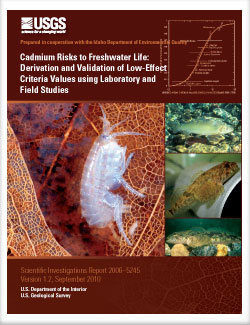
 Abstract Abstract
In 2001, the U.S. Environmental Protection Agency (EPA) released updated aquatic life criteria for cadmium. Since then, additional data on the effects of cadmium to aquatic life have become available from studies supported by the EPA, Idaho Department of Environmental Quality (IDEQ), and the U.S. Geological Survey, among other sources. Updated data on the effects of cadmium to aquatic life were compiled and reviewed and low-effect concentrations were estimated. Low-effect values were calculated using EPA’s guidelines for deriving numerical national water-quality criteria for the protection of aquatic organisms and their uses. Data on the short-term (acute) effects of cadmium on North American freshwater species that were suitable for criteria derivation were located for 69 species representing 57 genera and 33 families. For longer-term (chronic) effects of cadmium on North American freshwater species, suitable data were located for 28 species representing 21 genera and 17 families. Both the acute and chronic toxicity of cadmium were dependent on the hardness of the test water. Hardness-toxicity regressions were developed for both acute and chronic datasets so that effects data from different tests could be adjusted to a common water hardness. Hardness-adjusted effects values were pooled to obtain species and genus mean acute and chronic values, which then were ranked by their sensitivity to cadmium. The four most sensitive genera to acute exposures were, in order of increasing cadmium resistance, Oncorhynchus (Pacific trout and salmon), Salvelinus (“char” trout), Salmo (Atlantic trout and salmon), and Cottus (sculpin). The four most sensitive genera to chronic exposures were Hyalella (amphipod), Cottus, Gammarus (amphipod), and Salvelinus. Using the updated datasets, hardness dependent criteria equations were calculated for acute and chronic exposures to cadmium. At a hardness of 50 mg/L as calcium carbonate, the criterion maximum concentration (CMC, or “acute” criterion) was calculated as 0.75 μg/L cadmium using the hardness-dependent equation CMC = e(0.8403 × ln(hardness)-3.572) where the “ln hardness” is the natural logarithm of the water hardness. Likewise, the criterion continuous concentration (CCC, or “chronic” criterion) was calculated as 0.37 μg/L cadmium using the hardness-dependent equation CCC = (e(0.6247 × ln(hardness)-3.384)) × (1.101672 – ((ln hardness) × 0.041838))).
Using data that were independent of those used to derive the criteria, the criteria concentrations were evaluated to estimate whether adverse effects were expected to the biological integrity of natural waters or to selected species listed as threatened or endangered. One species was identified that would not be fully protected by the derived CCC, the amphipod Hyalella azteca. Exposure to CCC conditions likely would lead to population decreases in Hyalella azteca, the food web consequences of which probably would be slight if macroinvertebrate communities were otherwise diverse. Some data also suggested adverse behavioral changes are possible in fish following long-term exposures to low levels of cadmium, particularly in char (genus Salvelinus). Although ambiguous, these data indicate a need to periodically review the literature on behavioral changes in fish following metals exposure as more information becomes available. Most data reviewed indicated that criteria conditions were unlikely to contribute to overt adverse effects to either biological integrity or listed species. If elevated cadmium concentrations that approach the chronic criterion values occur in ambient waters, careful biological monitoring of invertebrate and fish assemblages would be prudent to validate the prediction that the assemblages would not be adversely affected by cadmium at criterion concentrations.
|
Part or all of this report is presented in Portable Document Format (PDF); the latest version of Adobe Reader or similar software is required to view it. Download the latest version of Adobe Reader, free of charge. |

 U.S. Department of the Interior |
U.S. Geological Survey
U.S. Department of the Interior |
U.S. Geological Survey