National Water-Quality Assessment Program
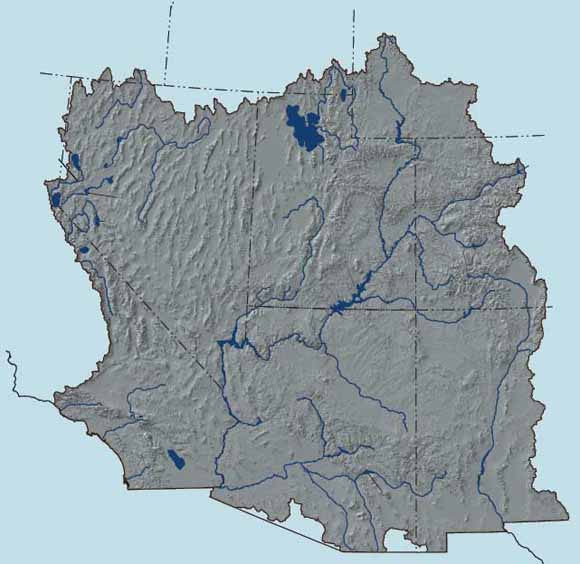
The U.S. Geological Survey National Water-Quality Assessment Program performed a regional study in the Southwestern United States (Southwest) to describe the status and trends of dissolved solids in basin-fill aquifers and streams and to determine the natural and human factors that affect dissolved solids. Basin-fill aquifers, which include the Rio Grande aquifer system, Basin and Range basin-fill aquifers, and California Coastal Basin aquifers, are the most extensively used ground-water supplies in the Southwest. Rivers, such as the Colorado, the Rio Grande, and their tributaries, are also important water supplies, as are several smaller river systems that drain internally within the Southwest, or drain externally to the Pacific Ocean in southern California. The study included four components that characterize (1) the spatial distribution of dissolved-solids concentrations in basin-fill aquifers, and dissolved-solids concentrations, loads, and yields in streams; (2) natural and human factors that affect dissolved-solids concentrations; (3) major sources and areas of accumulation of dissolved solids; and (4) trends in dissolved-solids concentrations over time in basin-fill aquifers and streams, and the relation of trends to natural or human factors.
Dissolved-solids concentrations of ground water in the basin-fill aquifers of the Southwest ranged from less than 500 milligrams per liter near basin margins where ground water is recharged from nearby mountains to more than 10,000 milligrams per liter in topographically low areas of some basins or in areas adjacent to specific streams or rivers in the Basin and Range and Rio Grande aquifer systems. The area of the basin-fill aquifer systems with dissolved-solids concentrations less than or equal to 500 milligrams per liter was about 57 percent for the Rio Grande aquifer system, 63 percent for the Basin and Range basin-fill aquifers, and 44 percent for the California Coastal Basin aquifers. At least 70 percent of the area of these three basin-fill aquifer systems had dissolved-solids concentrations less than or equal to 1,000 milligrams per liter.
Dissolved solids in streams were described on the basis of median daily concentration, median annual load, and median annual yield data for 420 surface-water-quality monitoring sites. The time period with dissolved-solids data for individual sites varied but was at least 10 or more years between 1974 and 2003. Median daily dissolved-solids concentrations vary substantially among the sites in the Southwest, ranging between 22 and 13,800 milligrams per liter, and also vary between different sites on the same stream. Median daily concentrations generally increased in a downstream direction for sites on the Rio Grande, Colorado River, Yampa River, White River, Green River, San Juan River, Gila River, Bear River, and Sevier River. Median annual dissolved-solids loads ranged from 60 tons per year for a site on Elk Creek, a headwater tributary to the Colorado River, to 7.86 million tons per year at Colorado River below Hoover Dam, Arizona-Nevada. Typically, streams with the highest flows have the highest dissolved-solids loads. Median annual loads for sites on these rivers generally increased in the downstream direction, except where streamflow decreased substantially due to diversions and (or) streambed infiltration, typically in the downstream part of the river system. Median annual yields ranged from 0.69 to 7,510 tons per year per square mile, and the mean for all 420 sites was 125 tons per year per square mile. Most (104 of 112) sites with median annual yields greater than 100 tons per year per square mile were in the Colorado River basin upstream from Lees Ferry and in the Bear and Great Salt Lake hydrologic subregions.
A conceptual model was developed for the effects of natural and human factors on dissolved-solids concentrations in basin-fill aquifers and streams. Factors affecting concentrations in streamflow of upland mountain areas include amount of low-concentration runoff in the stream; presence of sedimentary rocks that are less resistant to the solvent action of water, especially evaporite deposits; streamflow storage and mixing processes in reservoirs; evapotranspiration; and transbasin diversions that result in the removal of high-quality water that would otherwise serve to help dilute high-concentration water sources in the originating basin.
Streams eventually flow out of the upland mountain areas and into lowland areas that have flatter terrain and contain large basin-fill aquifers. Ground-water recharge of the basin-fill aquifers along the basin margin by streamflow infiltration, or by subsurface flow from adjacent bedrock highland aquifers, typically has low dissolved-solids concentrations in comparison to ground-water in other parts of the aquifer. Dissolved-solids concentrations in ground-water typically increase along flowpaths through basin-fill aquifers as a result of geochemical reactions with the aquifer matrix, dissolution of disseminated salts and massive evaporite deposits, and evapotranspiration by natural vegetation or by agricultural crops. Dissolved-solids concentrations also can change as a result of mixing two or more subsurface waters; recharge from irrigation seepage, septic tank seepage, and percolation ponds or streambeds that infiltrate imported water or treated municipal wastewater; or seawater intrusion (in coastal areas). Dissolved-solids concentrations in streams also change along their paths through lowland areas due to evapotranspiration or mixing with ground water, irrigation-return flows, or releases from municipal wastewater-treatment plants.
In lowland areas, the enhancement or restriction of surface-water and ground-water outflow affects the accumulation of dissolved solids in water supplies. Natural drainage or artificial drainage by canals or pipelines can enhance the outflow of water containing dissolved solids, thereby diminishing the accumulation of salts. Restriction of outflow through water use, or through natural features like topographic barriers that prevent surface outflow, restricts the outflow of water, thereby promoting the accumulation of salts. The salts generally accumulate in areas with high evapotranspiration, a process that increases dissolved-solids concentrations.
Significant dissolved-solids source and accumulation areas were determined by using a mass-balance analysis of the contributions and losses of dissolved solids for river systems in hydrologic accounting units of the Southwest. Contributions to river systems in each hydrologic accounting unit included inflows, internal deliveries, and imports; and losses included outflows, internal accumulation, and exports. These six terms were quantified by using predictions from a spatially-referenced regression model of contaminant transport on watershed attributes (SPARROW).
The most significant dissolved-solids source areas in the Southwest included the Colorado headwaters, Middle Gila, Lower Bear, and Santa Ana accounting units, where deliveries from internal sources were greater than 150 tons per year per square mile. The most significant dissolved-solids accumulation areas included the Salton Sea, Lower Gila-Agua Fria, Middle Gila, Lower Bear, and Great Salt Lake accounting units, where accumulation rates were greater than 150 tons per year per square mile. The dissolved-solids accumulation rate for the Salton Sea accounting unit, 704 tons per year per square mile, was more than twice as high as the second highest rate, 305 tons per year per square mile for the Lower Gila-Agua Fria accounting unit.
Predictions from the SPARROW model were used to determine the relative significance of the various natural and human internal sources of dissolved solids in Southwest accounting units. Geologic units, which represent natural sources of dissolved solids, contribute 44 percent of the total internal deliveries for all accounting units in the Southwest. Of this percentage for geologic units, about 7 percent is from crystalline and volcanic rocks, 2 percent is from eugeosynclinal rocks, 12 percent is from Tertiary sedimentary rocks, 12 percent is from Mesozoic sedimentary rocks, and 10 percent is from Paleozoic and Precambrian sedimentary rocks. Cultivated lands (44 percent) and pasture lands (12 percent) are anthropogenic sources of dissolved solids and contribute the remaining 56 percent of the total internal deliveries for all Southwest accounting units.
Trends for 1974–88, 1989–2003, and 1974–2003 were determined for concentrations of dissolved solids in basin-fill aquifers and flow-adjusted concentrations in streams. For the basin-fill aquifers, concentrations of dissolved solids did not change over time for most ground-water-quality monitoring wells in the analysis. The portion of wells in basin-fill aquifers with no trend in concentrations was 77 percent for 1974–88, 68 percent for 1989–2003, and 59 percent for 1974–2003. Of the wells that did have a trend in concentrations, increasing trends were more common than decreasing trends for each period. For 1989–2003, the probability of a trend occurring in dissolved-solids concentrations of basin-fill aquifers decreased with the depth to water below the land surface.
In comparison to conditions for ground-water-quality monitoring wells in the basin-fill aquifers, the presence of trends in dissolved-solids concentrations in streams was much more common. The data analyzed included an annual series of concentrations that were adjusted for variation due to variation in discharge and seasonal variability. Of the three time periods, 1974–88 had the greatest percentage of sites with either no change, or an increase in adjusted annual dissolved-solids concentrations. For this time period, no change in adjusted annual dissolved-solids concentrations was noted at 24 percent of sites, and an increase in adjusted annual dissolved-solids concentrations was noted at 34 percent of sites. Decreases in adjusted annual dissolved-solids concentrations were noted at 42 percent of sites. During 1989–2003, adjusted annual dissolved-solids concentrations decreased at more than half (51 percent) of the sites. For the 1989–2003 time period, there were five major river basins where adjusted annual dissolved-solids concentrations decreased at 75 percent or more of the sites. For the 1974–2003 time period, adjusted annual dissolved-solids concentration decreased at about 70 percent of the sites, and the median change in concentration during this period for all sites was about -8 percent. Most of the sites included in the trend analysis for this period are situated on the main stem of major rivers, and as a result, the conclusions that are drawn from this data set relate more specifically to conditions in the major rivers. For several areas in the Colorado River Basin, adjusted annual dissolved-solids concentrations decreased during 1989–2003 at all sites downstream from salinity-control units, whereas increasing and decreasing concentrations trends occurred at sites upstream from the units. Decreases in adjusted annual dissolved-solids concentration occurred at three sites above salinity-control units but were much less than the decreases at sites below those units.
Download the text of this report as a 187-page PDF file. The appendices are linked separately below (sir2006-5315.pdf; 36 MB)
Go to the Appendices folder. There are 11 appendices to this report; they are provided here as Excel (.xls), comma-separated value (.csv), and PDF (.pdf) files (sir2006-5315_appendices; 3.4 MB total)
This report includes an interactive plate for which you need the free ArcReader explained in the readme file linked below.
Download the readme file for the plate as a 10-page PDF file (sir2006-5315_readme.pdf; 696 kB)
Download the digital plate data package as a compressed .zip file. When you unzip this file, it will create a folder called Package. A copy of the readme file linked above is also provided in the .zip package (Package.zip; 120 MB)
The interactive digital plate linked above was constructed from 23 different layers. Four of the layers were customized just for this publication whereas the other 19 were gathered from existing sources. If you would like to use the data with Geographic Information System (GIS) software you purchase—such as ESRI's ArcGIS—the four layers we produced and the metadata for all 23 are linked below.
Go to the metadata folder; this folder also contains the entire collection of 23 ASCII files as a .zip file (metadata; 832 kB)
Go to the shapefiles folder; this folder contains a .zip file for each of the four layers we produced for this publication (DissolvedSolids.zip, Major_Rivers.zip, SWSites.zip, and Tributaries.shp.zip) (shapefiles; 11.7 MB)
For questions about the content of this report, contact David Anning
Download the Suggested citation and version history
Download a free copy of the latest version of Adobe Reader.
|
Help |
PDF help |
Publications main page |
| Western Scientific Investigations Reports |
| Water Resources |
National Water-Quality Assessment (NAWQA) Program
|
Version 1.0 of this report is also available in print from:
USGS Information Services, Box 25286,
Federal Center, Denver, CO 80225
telephone: 888 ASK-USGS; e-mail: infoservices@usgs.gov

 U.S. Department of the Interior | U.S. Geological Survey
URL: https://pubs.usgs.gov/sir/2006/5315/
Page Contact Information: Michael Diggles
Page Created: September 21, 2007
Page Last Modified: March 22, 2010