GRADE AND TONNAGE MODEL OF SEDIMENT-HOSTED Au
by Dan L. Mosier, Donald A. Singer. William C. Bagby, and W. David Menzie
COMMENTS
This model applies to the descriptive model for carbonate-hosted Au-Ag
(Berger, 1986a) and
supersedes the grade and tonnage model for that deposit type (Bagby
and others, 1986). The change in the model name reflects the discovery
of many deposits in siliceous shale and other noncarbonate host rocks
and the reassignment of some silver-rich deposits to the distal disseminated
Ag-Au type (that is, Hilltop, Candelaria, and Taylor); the few deposits
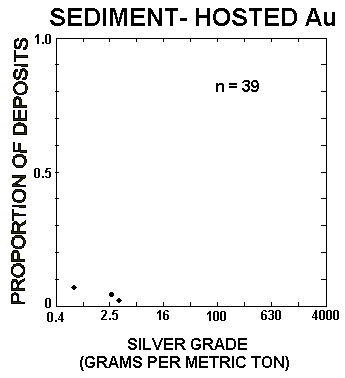
remaining with reported silver grades are Alligator Ridge, Dee, and Standard.
Other deposits in the original set were deemed atypical (B aid Mountain,
Windfall, Giltedge, Tolman) or reclassified as other types (Atlanta and
Florida Canyon—now considered hot spring Au). This model represents considerable
refinement of the data used by Bagby and others (1986). Deposits where
mineralization is known to be within 500 m of each other were combined.
Most of the names listed in table 7 are property names that contain multiple
zones or deposits. Well-known property names containing multiple deposits
that are over 500 m apart, such as Jerritt Canyon, are listed individually
with corresponding deposit names in parentheses. For some property names
with multiple deposits, such as Marigold, only the well-explored deposits
were included and are shown in parentheses. This model excludes deposits
for which information on distances between discrete orebodies was not
available at the time of the compilation (for example, Big Springs, Northumberland,
and Tonkin Springs). The distribution of tonnages is significantly skewed
toward larger tonnages because of the two very large deposits. No geologic
reason has been found to distinguish these large deposits from the other
deposits; however, these two deposits appear to be more thoroughly explored,
both laterally and vertically, than most of the other deposits, suggesting
that many of the other deposits will eventually be found to be much larger
than now estimated. See appendix
B for locality abbreviations. See introduction
for explanation of the grade and tonnage model as shown in figures 11-13.
Table 7. Grades and tonnages of sediment-hosted
Au deposits
[Tonnages
in million metric tons; gold (Au) and silver (Ag) grades in grams per
metric ton. Country and state abbreviations explained in app. B]
Name
Country
Tonnage
Au
grade Ag
grade
Alligator
Ridge USNV
6.35
3.29
0.72
Austin
USNV
1.59
5.49
0
Bootstrap-Capstone
USNV
22.90
1.46
0
Bullion
Monarch-Lantern USNV
14.90
1.11
0
Carlin
USNV
32.85
4.11
0
Chimney
Creek North USNV
27.60
2.14
0
Chimney
Creek South USNV
53.00
2.40
0
Cortez
USNV
3.18
9.60
0
Dee
USNV
5.13
2.78
2.60
Emigrant
Springs 1 USNV
10.44
.82
0
Emigrant
Springs 2 USNV
3.60
1.37
0
Felix
Canyon USNV
.32
1.03
0
Getchell
USNV
13.97
6.65
0
Gold
Acres USNV
8.34
3.35
0
Gold
Bar USNV
3.95
2.87
0
Goldstone-Gold
Ridge USNV
6.75
3.40
0
Gold
Quarry-Deep West-
Maggie
Creek USNV
464.00
1.32
0
Goldstrike-Post-Deep
Post-Blue Star-
Genesis-Bobcat-North
Star USNV 306.62
2.89
0
Green
Springs (C Pit) USNV
1.10
2.10
0
Horse
Canyon USNV
4.54
3.43
0
Illipah
USNV
1.03
1.13
0
Jerritt
Canyon (Bell mine) USNV
15.40
7.06
0
Jerritt
Canyon (Burns Basin) USNV 3.67
5.11
0
Jerritt
Canyon (Mill Creek) USNV
1.00
5.80
0
Jerritt
Canyon (Saval Canyon) USNV 2.27
4.15
0
Jerritt
Canyon (Winters Creek) USNV 1.27
5.20
0
Jerritt
Canyon (Wright Window) USNV 1.18
3.26
0
Marigold
(East Hill Zone) USNV
6.65
.72
0
Marigold
(8 South Zone) USNV
4.50
2.91
0
Mercur
USUT
29.70
2.07
0
Nighthawk
USNV
4.35
1.20
0
Pete
USNV
14.29
1.03
0
Pinson
USNV
9.80
2.60
0
Preble
USNV
3.00
3.29
0
Rain-Gnome
USNV
22.95
1.76
0
South
Bullion USNV
18.14
.89
0
Southern
Mining Zone USNV
1.44
.65
0
Standard
USNV
.80
1.65
3.43
Tusc
USNV
18.80
1.20
0
Figure 11. Tonnages of sediment-hosted
Au deposits.
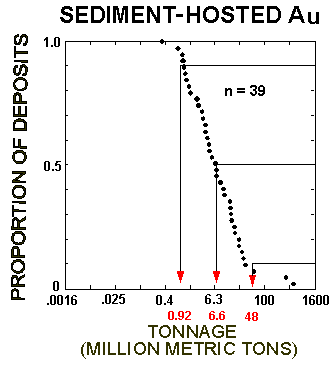
Figure 12. Gold grades of sediment-hosted
Au deposits.
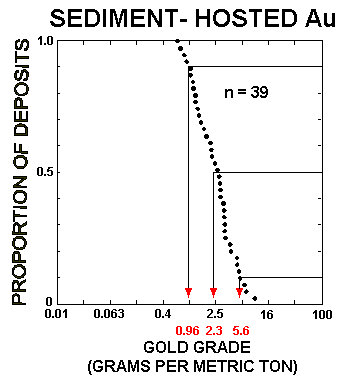
Figure 13. Silver grades of sediment-hosted
Au deposits.