The production of geologic maps around the world has undergone dramatic change during the last decade. Several trends have been driving this change--the shrinking budgets of most geological surveys (which require partnerships for most efficient use of resources), the continued high costs for publication of traditional color geologic maps, and the realization that geologic maps are integral parts of multidisciplinary geographic information systems (GIS's) that are used by decisionmakers at the local, State, and National levels.
Recently, the National Cooperative Geologic Mapping Program (NCGMP) sponsored geologic mapping forums and workshops in each region of the country to promote communication between the users and providers of geologic maps and related earth science information and to assess regional needs for geologic map information. By encouraging user input and partnerships in the design of geologic mapping products, the U.S. Geological Survey (USGS) and State Geological Surveys hope to enhance the usefulness of their geologic maps and to use their funds more effectively.
This Forum on Geologic Mapping Applications in the Washington-Baltimore Urban Area, hosted by the USGS and Maryland Geological Survey with assistance from the Virginia Division of Mineral Resources, is the first attempt at obtaining a direct assessment of the needs of the Mid-Atlantic geologic map user community. In effect, for much of the discussion, the USGS and the State Surveys are here "to listen" to clients. By including over 130 participants from private industry as well as local, State, and Federal Government Agencies, and universities, NCGMP will be able to hear the opinions of important users of geologic map data and to determine ways to better leverage our earth science resources.
In addition to sharpening the focus of geologic mapping in the Washington-Baltimore urban area, the forum will contribute to the evolving plans and goals of the National Cooperative Geologic Mapping Program. In particular, the Federal component of the program has undergone major changes in the past 2 years, including a new focus on urban geology, on relevant science that addresses pressing national issues, on team projects, and on partnerships with National, State, and local agencies. We anticipate continued focus on these areas, and we seek to enhance our ability to provide geologic map data that meet the needs of clients within both the public and private sectors.
The U.S. Geological Survey (USGS) Geology of the Mid-Atlantic Corridor (GOMAC) project, under the National Cooperative Geologic Mapping Program, conducts geologic mapping and related investigations in the urban corridor extending from Virginia to New Jersey. This zone of rapidly growing and coalescing cities and towns has sustained three centuries of urban growth. Spatial geologic information is needed to address a host of issues and applications involving land use, water and aggregate resources, avoidance and remediation of natural and induced hazards, and fragile environments in the Chesapeake Bay watershed.
Project efforts are directed to complete 1:100,000-scale geologic mapping of the Washington-Baltimore urban area, to complete geologic maps of New Jersey in cooperation with the New Jersey Geological Survey (NJGS), to complete geologic mapping in progress in cooperation with the Virginia Division of Mineral Resources (VDMR), to investigate and interpret the regional geologic history and framework as a foundation for all applications, and to work with other agencies and customers to identify useful information products that can be derived from the geologic mapping.
Production of geologic maps in this region by GOMAC is enhanced by building on a legacy of previous work and by collaboration among scientists of the USGS and State Geological Surveys. Bedrock and surficial geologic maps covering the State of New Jersey (USGS Miscellaneous Investigations Maps I-2540-A-D) were recently compiled in cooperation with the NJGS; the first map (I-2540-A), by Drake and others (1996), has been published, and the remainder are in production. In the Washington-Baltimore urban area, 1:100,000-scale geologic maps of 30'x60' quadrangles are being rapidly completed for the National Geologic Map Database. A geologic map of the Leonardtown, Md.-Va., quadrangle has been released as a USGS Open-File Report (McCartan and others, 1995). Geologic maps of the Washington West quadrangle, D.C.-Va.-Md., and Fredericksburg, Va.-Md., quadrangle (Mixon and others, in press) were recently submitted for publication, and color plots have been generated from preliminary digital coverages. In collaboration with the Maryland Geological Survey, geologic mapping of the Frederick, Md.-Va.-W.Va., and Washington East, D.C.-Md., quadrangles is well underway. Collectively, these geologic maps of the Washington-Baltimore area will provide a foundation for addressing issues where urban growth is spreading across diverse geological environments of the Atlantic Coastal Plain, Appalachian Piedmont (including Mesozoic Culpeper basin), Blue Ridge, Great Valley, and Valley and Ridge provinces. In accord with interagency agreements, collaborative 1:100,000-scale geologic maps with VDMR are being completed for the Appomattox, Va., and South Boston, Va.-N.C., 30'x60' quadrangles. The GOMAC project continues to produce 1:24,000-scale geologic maps in response to the strong demand for detailed information in areas of urban and suburban growth. The quality and accuracy of 1:100,000-scale geologic maps are strongest where these compilations are undergirded by more detailed mapping and related investigations. Special-purpose maps derived from the basic geologic maps include lithogeochemical maps of the Chesapeake Bay watershed for the USGS Fragile Environments Program and maps delineating potential sources of aggregate for the USGS Mineral Resource Surveys Program. Scientific papers are important for documenting the research and assuring the credibility of interpretations on geologic maps for all applications.
Drake, A.A., Jr., Volkert, R.A., Monteverde, D.H., Herman, G.C., Houghton, H.F., Parker, R.A., and Dalton, R.F., 1996, Bedrock geologic map of northern New Jersey: U.S. Geological Survey Miscellaneous Investigations Series Map I-2540-A, scale 1:100,000, 2 sheets.
McCartan, Lucy, Newell, W.L., Owens, J.P., and Bradford, G.M., 1995, Geologic map and cross sections of the Leonardtown 30 x 60-minute quadrangle, Maryland and Virginia: U.S. Geological Survey Open-File Report 95-665, scale 1:100,000.
Mixon, R.B., Pavlides, L., Powars, D.S., Froelich, A.J., Weems, R.E., Schindler, J.S., Newell, W.L., Edwards, L.E., and Ward, L.W., in press, Geologic map of the Fredericksburg 30'x60' quadrangle, Virginia and Maryland: U.S. Geological Survey Miscellaneous Investigations Series Map I-2607, scale 1:100,000, 2 sheets.

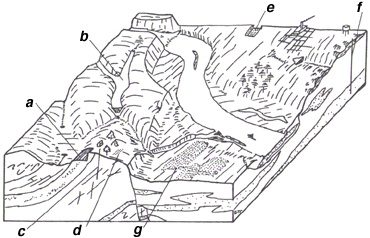
Geologic maps are a fundamental foundation for ecosystem management concerns. The living resources components, including the human component, have a spatial organization imposed upon them by the geologic framework. The geologic framework, defined by geologic mapping, provides a way to organize and assess resource, hazard, and environmental data relative to human activity. In Maryland, the Piedmont and Coastal Plain terrains illustrate the contrasting opportunities and constraints (fig. 1). The Piedmont terrain is underlain by crystalline rocks. It is characterized by narrow valleys with steep slopes, interfluves of restricted areal extent, and occasional broad flat-bottomed valleys underlain by marble. The Coastal Plain is underlain by unconsolidated sediments (sand, silt, clay). The terrain is characterized by broad plains of low relief and extensive wetlands along major rivers.
Figure 1. Abiotic framework and examples of contrasting human activities. Piedmont (left side): a, quarry in quartzite; b, water-supply reservoir; c, private well in fractured rock for a home; d, small fields for crops. Coastal plain (right side): e, sand and gravel quarry; f, public water supply from sand aquifer; g, large fields for crops. |
In the Coastal Plain, water for urban use, agriculture, and private homes comes from ground water supplied by wells drilled into underlying sand aquifers. In the Piedmont, however, urban water needs are supplied by surface-water reservoirs. Private homes and small towns beyond urban water supply systems are supplied by wells drilled into fractured crystalline rocks. Aggregate for building and road construction comes from sand and gravel pits in the Coastal Plain and from rock quarries in the Piedmont.
In these and other ways, humans utilize the geologic components of the particular ecosystems that are available. These geologic components are organized and displayed on geologic maps.
Urban systems focus the flow of resources and disperse the effluents of processes that define the quality and viability of life among inhabitants. The allocation of basic resources may be fairly straight forward in "frontier" urban areas that unfold across previously undeveloped spaces. Much of the land in the Western States, for example, is public, and the development of geologic map information is a largely uncontested public asset. By contrast, in the oldest urban areas of the Eastern United States, land is generally recycled from previous use or uses. Not only has the landscape been used before, but the decisionmaking process functions within an antecedent structure of local to national government agencies and private enterprises; decisions regarding the disposition of largely private lands are complicated. Publicly produced geologic information becomes iterative and difficult to apply uniformly across the many jurisdictions. A new vision is needed for the assembly and application of spatial, geotechnical information as a "public good." Resources gathered across a region and effluent dispersed at great distances from the source should be evaluated with uniform, quality information at a compatible scale; much of the needed data and the tools for analysis are available. The "frontier" of eastern urban development is not empty land. The "frontier" is the process of developing consensus for the sustained use of natural systems.
|
|
This page is URL https://pubs.usgs.gov/circular/c1148/intro.html
Last modified 15 April 1998
Maintained by John Watson and Kathie Watson