Scientific Objectives for South Kona landslide complex:reconstruction of west Hawaii island
H. Yokose
Introduction
The island of Hawaii makes up seven young volcanoes Mauna Loa, which is the largest volcano around the world, Mahukona, Kohara, Hualalai, Mauna Kea, Kilauea and Loihi. Hawaian islands included in the island of Hawaii are believed to be a representative hotspot type volcanism. Hotspot magmatism is very important to know about core – mantle boundary process. Because most of ocean island volcanoes, build directory on the ocean floor where is upto 5000m below sea level, many data may bias toward the subaerial part of the volcano which is the latest stage of its history.
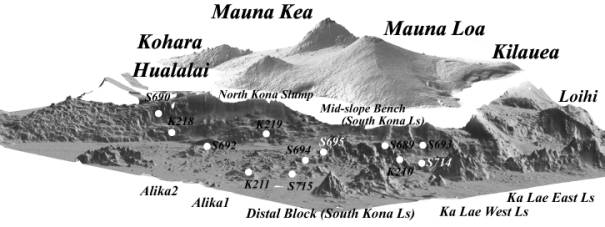
During 1980s USGS GLORIA survey revealed that there are huge landslide deposits around Hawaii islands(Moore et al.,1989;Lipman et al., 1988). Moore and Chadwick, (1995) compailed previously reported bathymetric data and discussed detaild topographic character of southern part of the island of Hawaii. Western flank of the Hawaii island has been identified six landslide related deposits:North Kona Slump, Alika slide (phase 2), Alika slide Phase 1, South Kona landslide, Ka Lae (West and East) slide (Lipman et al., 1988; Moore et al., 1989; Moore and Chadwick, 1995).
The sequence of landslides and the lithologic succession on the mid slope benches may provide critical information on
1. relationship between South Kona landslide area and growth history of Mauna Loa
2. early stage of Mauna Loa volcano
3. genetic relationship of the Ka Lae ridge to South Kona landslide
4. any possible involvement of rocks from Hualalai volcano
Previous results
Before 2001, study on the western flank of the island of Hawaii using submersible is limited a distal block of south Kona landslide. The dive could not recover in-situ rock samples due to manipulator malfunction of SEA Cliff (Moore et al., 1995). Volcanic rocks composed distal blocks were inferred to erupt at shallow water or subaerial condition based on the S content in dredged samples from it. Several dives around source region of Alika debris avalanche deposit were carried out by MBARI and outline of its results were reported(Morgan et al., 2001), but detailed descriptions are not available.
During 2001 cruise(KR01-12), four dives and one SCS survey were carried out. Two sites from north Kona slump region(K218 and K219), two sites from South Kona landslide region , distal block (K211) and bench (K210) SCS survey line cross the bench to distal block region. Most of the outcrops observed on the course of K218 and 219 were intact pillow lavas. Dive K210 revealed that outcrop exposed on the bench structure are predominated highly fractured massive lavas. Outcrops made up hyaloclastite, which is similar to Hilina slump, did not find on this bench. The basal part of the distal block(K211) have two hyaloclastite layers 6m thick, but pillow lavas are not observed. The outcrops in the course of K211 are predominated unsolidified debris flow deposits. Bed rocks are picritic basalt, but breccia in unsolidified debris flow deposit are predominated in vesiculated aphyric basalt.
Evidence obtained from Kaiko dives during 2001 indicates that models, “Fragmental lava model“ (Moore et al., 1995) or “Pillow lava model” (Moore and Fiske, 1969; Garcia and Davis, 2001) are difficult to interpret the results.
Scientific objectives of the 2002 cruise
The 2002 Shikai dives on west Hawaii island were designed to more complete information on the landslide complex. The landslide complex can be divided into seven topographical group:Ka Lae ridge, benches in south Kona landslide, distal large landslide block region, Alika debris avalanche deposite, North Kona slump, bench of the North Kona.
Ka Lae ridge, benches in south Kona landslide and distal large landslide blocks are very important to descuss the detail process of South Kona landslide. Although topographic and single channel seismic reflection study on Alika debris avalanche deposits were carried out, in-situ rock samples will be useful for identification of the source region. Bench structure at the foot of the north Kona slump may provide us early stage of Hualalai or Mauna Loa volcano. In order to remove the entangled landslide deposits, we need at least one dive for each topographic group.