| Recordings
of earthquake shaking within a heavily damaged building are rare—even
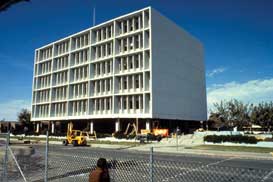
today. The first set of such records was obtained in 1979 from southern
California when a magnitude 6.4 earthquake seriously damaged this modern
office building in the Imperial Valley. The estimated cost to repair the
reinforced-concrete frame and shear-wall building was so large that the
building was razed. The photo at far right shows the evolving failure
of columns at one end of the building. The California Geological Survey
(formerly the California Division of Mines and Geology) had installed
13 motion sensors at various points throughout the structure to document
its swaying and twisting in an earthquake. Shown above the building is
the roof-level record of horizontal acceleration parallel to the long
axis of the structure. The sudden lengthening of vibrations at A
(7 seconds after shaking begins) marks the onset of structural damage.
About 4 seconds later (at B), faint high-frequency vibrations
(rapid small pulses), superimposed on the slower vibrations, signal the
collapse of columns. Such records from buildings that suffer earthquake
damage enable engineers to document and investigate failure processes
and to devise and improve methods for minimizing structural damage in
future shocks. |