
|
Responding to Global Earthquake Hazards
March 2005
PAGER (Prompt Assessment of Global Earthquakes for Response)
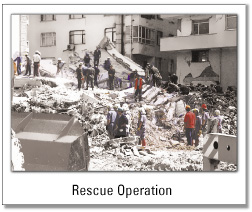
Photograph showing destruction caused by the 1999 Izmit, Turk...
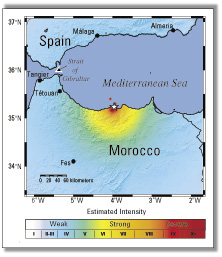
1. After the magnitude and hypocenter of an earthquake are de...
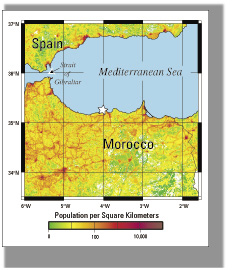
2. The population of the affected region is obtained from the La...
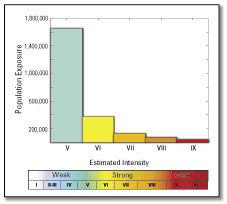
3. By combining the map of predicted shaking with the populati...
4. By using the population exposure and the vulnerability of the...
The U.S. Geological Survey’s National Earthquake Information Center (NEIC), located in Golden, Colorado, reports over 30,000 earthquakes a year. Tragically, on average, 25 of these cause significant damage, injuries, or fatalities. The U.S. Geological Survey (USGS) often detects these damaging quakes well before eyewitness reports are available and must decide rapidly whether Federal and international agencies should be alerted to a potentially damaging event. Currently, the USGS relies primarily on the experience and intuition of the on-duty seismologists to estimate the impact of an event. To improve the accuracy of this assessment and the content of the USGS earthquake alerts, the USGS is developing an automated system to immediately estimate an earthquake’s impact on humans for events anywhere worldwide; this system will provide important information to help emergency relief organizations, government agencies, and the media plan their response to earthquake disasters.
PAGER will distribute alarms via pager, mobile phone, and e-mail that will include a concise estimate of the earthquake’s impact. The alarms will also report the earthquake location, magnitude, and depth, an estimate of the number of people exposed to varying levels of shaking, a description of the region’s vulnerability, and a measure of confidence in the system’s impact assessment. Associated maps of shaking level, population density, and susceptibility to landslides will be posted on the Internet. This information will be available within minutes of the determination of the earthquakes location and magnitude.
At the heart of PAGER are the timely and accurate earthquake location and magnitude determinations that the USGS has been producing for decades. PAGER uses these earthquake parameters to calculate estimates of ground shaking by using the methodology and software developed for ShakeMap (http://earthquake.usgs.gov/shakemap/). The number of people exposed to various levels of shaking is then calculated by combining the maps of predicted ground shaking with Oak Ridge National Laboratorys Landscan2003 population database. Finally, PAGER generates an impact statement by considering the vulnerability of the exposed population and infrastructure, potential for earthquake-induced landslides, and, if available, damage reports from previous nearby historic earthquakes for comparison purposes and damage projection.
Although the basic concept of PAGER is straightforward, the implementation will require significant system development, communication, and collaboration. The modular design of PAGER will allow the incorporation of more detailed data-sets, new algorithms, and interactive tools, thereby improving the systems ability to rapidly assess an earthquakes impact.
PAGER is still in development but is progressing toward a fast, accurate system that international and domestic users can rely on. The PAGER team is continuously seeking collaboration with other agencies, both domestic and worldwide, to create a system that will benefit the populations of earthquake-stricken areas.
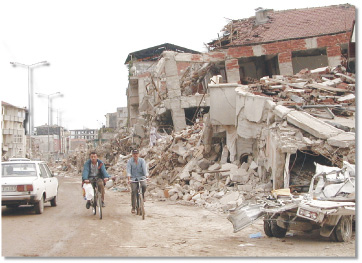
Photograph showing destruction caused by the 1999 Izmit, Turkey, earthquake. For events such as this, PAGER will provide emergency relief organizations with a rapid assessment of an earthquake’s impact that will allow them to determine which areas require the most attention.
This Fact Sheet is available online at
https://pubs.usgs.gov/fs/2005/3026/
Earthquake Hazards Program
U.S. Geological Survey
Golden, CO 80401
http://earthquake.usgs.gov/
Document Accessibility: Adobe Systems Incorporated has information about PDFs and the visually impaired. This information provides tools to help make PDF files accessible. These tools convert Adobe PDF documents into HTML or ASCII text, which then can be read by a number of common screen-reading programs that synthesize text as audible speech. In addition, an accessible version of Acrobat Reader 6.0, which contains support for screen readers, is available. These tools and the accessible reader may be obtained free from Adobe at Adobe Access.
| AccessibilityFOIAPrivacyPolicies and Notices | |
 |
|