
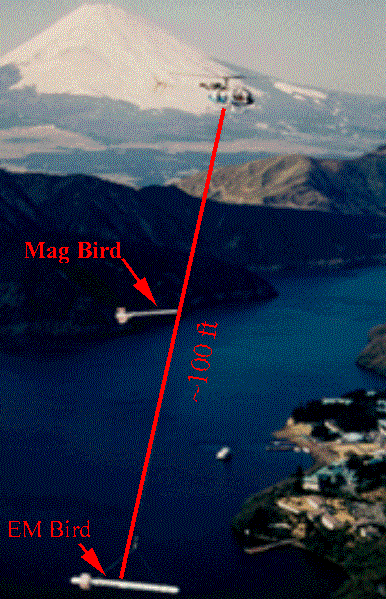
Before we continue it is appropriate to briefly explain the basic characteristics of a Helicopter Electromagnetic (HEM) survey. A Helicopter EM survey of course requires a helicopter. The EM transmitter and receiver are connected onto the helicopter by means of a long cable. Note the position of the Mag Bird and EM bird. Suspending the birds away from the helicopter helps reduce noise and gets the measuring devices closer to the ground. The length of the cable is approximately 100 ft (30 meters).
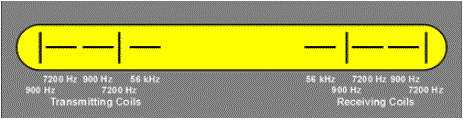
The EM bird contains a number of tuned coils in transmitter/receiver pairs. These coils can be configured in a coplanar or coaxial orientation. The coplanar configuration is most sensitive to flat lying conductors like a saline water-body, while the coaxial configuration responds best to vertically oriented conductors such as vertically-dipping massive sulfide bodies.
The EM system works by means of EM induction, that is, a strong alternating magnetic field is set up by the transmitter coil. If there is a conductor nearby, eddy currents will be set up in it by the AC magnetic field, and the receiver coil will pick up the secondary field caused by these induced eddy currents.
By measuring both in-phase and out-of-phase (quadrature) components of the secondary signal, information can be gleaned about the geometry and conductivity of buried conductor.
Taking this information one step further we can calculate a Conductivity Depth Image (CDI) that resembles a"geologic" section. We do this by realizing that the 56,000 Hz signal will penetrate rather shallowly vis-à-vis the 900 Hz signal, and plot the solutions closer to the surface accordingly.

|

|