
Method Validation
The analytical method was validated by using spiked samples to determine accuracy and precision for the method, and spiked fortified organic-free water to establish MDLs. Acceptable percent recoveries of the various quality-control samples, such as the matrix spike samples, the quality-control samples, the continuing calibration verification standards, and the surrogate standards, are in the range of 70 to 130 percent for this method. However, tighter limits for each type of quality-control sample can be observed and are addressed in this report.
Accuracy and Precision
The accuracy of the analytical method was assessed by spike recovery experiments using surface-water samples from Orange County, California. The water samples were diluted 1:5 with organic-free water prior to dosing (to lower the background concentration of HAA to appropriate levels). The samples were spiked with 8 μL of working standard solution B prior to extraction (table 6). The spiked concentrations were equal to the concentrations in the level-5 calibration standard (table 5). Background concentrations of HAA in these samples had been measured previously. Forty-one samples were used in the spike recovery experiments. Method accuracy is expressed as the mean percent recovery of the spike concentration. The number of samples used to calculate the mean percent recovery varied between 23 and 41 for the nine HAA (table 6) because the measured concentrations (spike plus background) for some analytes in some samples exceeded the concentration in the level-9 calibration standard and, therefore, could not be quantified.
Table 6
(View this table on a separate page.)Accuracy and precision for haloacetic acid method determined from analyses of spiked surface-water samples from Orange County, California.
[µg/L; micrograms per liter]
[µg/L; micrograms per liter]
| Analyte name | Number of samples | Spiked concentration (μg/L) | Mean percent recovery | Standard deviation (percent) |
|---|---|---|---|---|
| Bromochloroacetic acid | 39 | 4.0 | 109 | 19 |
| Bromodichloroacetic acid | 37 | 4.0 | 107 | 26 |
| Dibromochloroacetic acid | 38 | 10. | 104 | 22 |
| Dibromoacetic acid | 41 | 2.0 | 117 | 24 |
| Dichloroacetic acid | 39 | 6.0 | 109 | 23 |
| Monobromoacetic acid | 41 | 4.0 | 99 | 19 |
| Monochloroacetic acid | 36 | 6.0 | 106 | 22 |
| Tribromoacetic acid | 40 | 20. | 107 | 30 |
| Trichloroacetic acid | 23 | 2.0 | 110 | 29 |
The percent recovery for each analyte is calculated from the following equation.

(1)
where
- Cmeas is the measured concentration,
- Cbackgr is the background concentration of the sample, and
- Cfortified is the concentration of analyte added to the sample
(2)
where
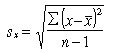
(3)
and
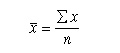
(4)
and where
- x is the value for an analysis,
- n is the number of replicate analyses,
 is the mean of the replicate analyses,
- sx is the standard deviation of the replicate analyses, and
- RSD is the relative percent standard deviation for the replicate analyses.
The mean percent recovery ranged from 99 to 117 percent and the percent RSD ranged from 17 to 28 percent. Ongoing accuracy and precision determinations are made by analyzing a set of spiked sample duplicates for 10 percent of the water samples analyzed.
Method Detection Limits
The MDL, as defined by the USEPA, is the minimum concentration that can be measured and reported as greater than zero at the 99-percent confidence level (U.S. Environmental Protection Agency, 1997). The MDL was calculated using the formula:
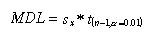
(5)
where
- MDL is the method detection limit
- sx is the standard deviation of the replicate analyses, and
- n is the number of repliate analyses, and
- t(n-1, a = 0.01) is the Student's t-test value for the 1-a (99-percent) confidence level for n replicate analyses (t = 2.988 for n = 8)
The MDLs were determined from eight replicate analyses of 40-mL samples of organic-free water spiked with 8 μL of working standard solution A. The spiked concentrations of the analytes (table 7) equaled the concentrations in the level-2 calibration standard (table 5). These eight replicate samples were extracted, methylated, and analyzed using the same procedures used for all samples. All eight were prepared on the same day. This spiked concentration was used because it contained all the analytes at concentrations less than five times the expected MDLs, but greater than the baseline noise and drift. The MDLs were calculated from the standard deviations about the mean concentrations for the nine HAA from the eight replicate samples using equation 5. The MDLs for the nine HAA range from 0.11 to 0.45 μg/L (table 7).
Table 7
(View this table on a separate page.)Method detection limits for nine haloacetic acids and the surrogate compound determined from analysis of eight replicate samples of spiked organic-free water.
[μg/L, micrograms per liter]
[μg/L, micrograms per liter]
| Analyte | Spiked concentration (μg/L) | Standard deviation (μg/L) | Method detection limit (μg/L) |
|---|---|---|---|
| Bromochloroacetic acid | 0.40 | 0.054 | 0.16 |
| Bromodichloroacetic acid | 0.40 | 0.036 | 0.11 |
| Dibromochloroacetic acid | 1.0 | 0.12 | 0.36 |
| Dibromoacetic acid | 0.20 | 0.048 | 0.14 |
| Dichloroacetic acid | 0.60 | 0.14 | 0.42 |
| Monobromoacetic acid | 0.40 | 0.083 | 0.25 |
| Monochloroacetic acid | 0.60 | 0.15 | 0.45 |
| Tribromoacetic acid | 2.0 | 0.13 | 0.39 |
| Trichloroacetic acid | 0.20 | 0.047 | 0.14 |
| 2-bromopropionic acid (surrogate) | 1.0 | 0.083 | 0.25 |