
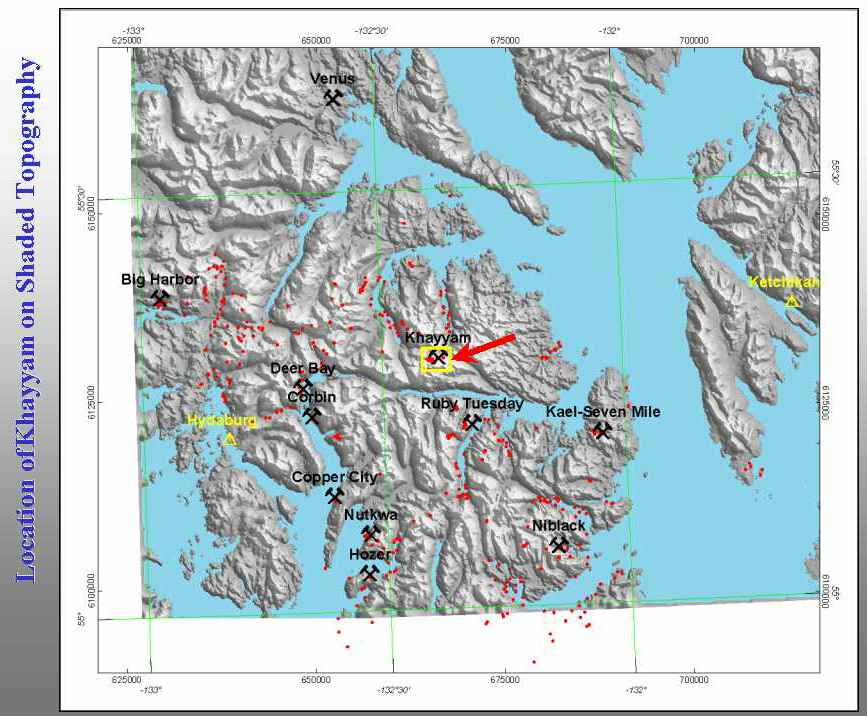
A goal of the USGS is to provide an analysis of the airborne geophysics over the significant, known VMS deposits to provide a baseline for their response.
So far, we conclude that a well-defined conductivity anomaly is not usually apparent over the known VMS occurrences. Most of the occurrences are located in close proximity to the shore and the HEM response is adversely affected by the highly conductive seawater. It is also suspected that the texture, grain characteristics and species of sulfide at known VMS deposits may not lend themselves well to direct geophysical detection – for instance the sulfides may be in blebs and not interconnected, so EM cannot set up an eddy current in the target.
This is a work in progress.
An exception to this observation is at Khayyam where an obvious connection between outcropping sulfide and a HEM response is clear. Physical property data over this deposit also support this conclusion.
 |
 |