 |
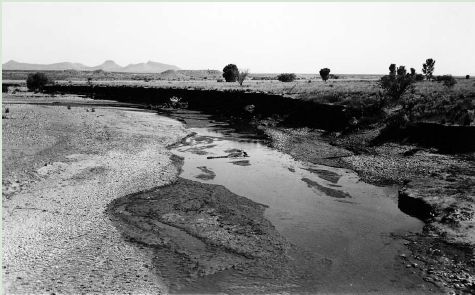
(May 24, 1939). This upstream view of the San Pedro River,
from the bridge east of Palominas, looks over an open grassland
towards mountains across the border in Mexico. Scattered cottonwood
trees line the shallowly incised channel; vertical banks about
3 feet high appear in the midground at left. The 1926 flood
was not measured at this site but had a discharge of 98,000
ft³/s downstream at Charleston (R.H. Monroe, #2503). |
| |
|
|
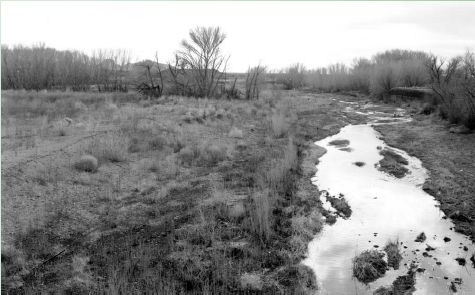
| (January 23, 1981). This winter view shows small, defoliated cottonwoods
and willows that block out most of the background. The channel is
deeper, but the floodplain remains relatively free of woody plants.
A flood of 22,000 ft³/s occurred in 1940, a flood of 16,500 ft³/s
occurred in 1958, and another flood of 14,500 ft³/s occurred on October
9, 1977. Despite these floods, riparian vegetation has increased since
1939 (Raymond M. Turner). |
 |
| |
|
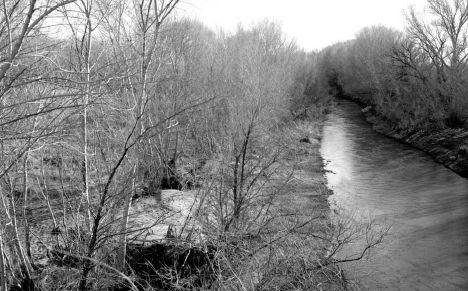 |
(February 7, 1995). The main channel of the San Pedro River has
narrowed, possibly in response to riparian vegetation and(or) earthwork.
A dense thicket of trees--- mostly cottonwood---line its banks, and
older trees have grown up to the right. The plants are leafless in
this photo (Dominic Oldershaw). |
| |
|
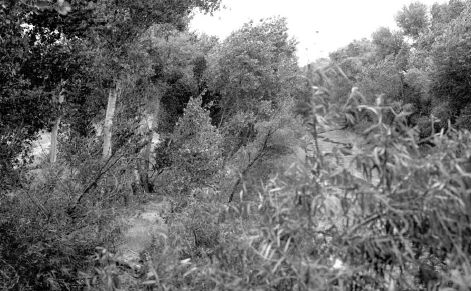
| (October 8, 2000). The cottonwoods and willows completely block
the view. Despite a flood of 14,800 ft³/s in late October 2000, no
changes occurred in the channel or riparian community. No woody non-native
species at present in this reach (Dominic Oldershaw, Stake 1009). |
 |
Next: Santa Cruz River near Lochiel
(09480000)
Previous: San Pedro River at
Charleston (09471000)
Introduction
|

