


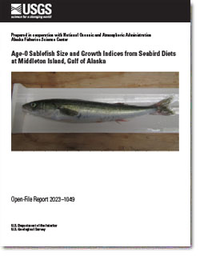
Age-0 Sablefish Size and Growth Indices from Seabird Diets at Middleton Island, Gulf of Alaska
Links
- Document: Report (2.6 MB pdf) , HTML , XML
- Data Release: USGS data release - Age-0 Sablefish size and growth indices from seabird diets at Middleton Island, Alaska
- Download citation as: RIS | Dublin Core
Acknowledgments
We thank Shannon Whelan (Institute for Seabird Research and Conservation) and the many field crews that have collected data on Middleton Island since the late-1970s, as well as the scientific and program management teams of the Gulf Watch Alaska long-term monitoring program for their expertise and resources in support of this work. We also thank Rob Suryan, Krista Oke, and Kalei Shotwell (National Oceanic and Atmospheric Administration Alaska Fisheries Science Center, Auke Bay Lab) for reviews of earlier drafts of this work. The research described in this publication was supported by the Exxon Valdez Oil Spill Trustee Council. The findings and conclusions presented by the authors do not necessarily reflect the views or position of the Trustee Council.
Abstract
Sablefish (Anoplopoma fimbria) is a commercially valuable groundfish species in Alaska, with the population assessed annually by the National Oceanic and Atmospheric Administration Alaska Fisheries Science Center. Sablefish recruit into the commercially fished population at 2 years old and are poorly sampled by most surveys before that age. However, information on the abundance, distribution, and size of pre-recruitment age fish is valuable as an ecosystem indicator for older fish. Size and an index of growth rate of age-0 sablefish were quantified using samples from seabird diets at Middleton Island, Alaska, an island in the northern Gulf of Alaska. Age-0 sablefish information may serve as an indicator for potential recruitment into older age populations. This report (1) provides information on the data collection for age-0 sablefish from seabird diets at Middleton Island, Alaska from 1978 to 2022, (2) describes a method for quantifying age-0 sablefish size and growth rate, and (3) describes the size and growth rate of sablefish sampled over time. An annual release of age-0 sablefish size and growth data by U.S. Geological Survey based on continued collections on Middleton Island, Alaska, may be used to assess ecosystem status and as a recruitment indicator for sablefish.
Introduction
Sablefish (Anoplopoma fimbria) is an economically valuable commercial groundfish species in the Northeast Pacific Ocean, and its population is assessed annually by the National Oceanic and Atmospheric Administration (NOAA) Alaska Fisheries Science Center (Goethel and others, 2022). Sablefish recruit into the commercially fished population at age-2 and are poorly sampled by most surveys before that age. Previous efforts to better understand age-0 sablefish growth, and possible links to recruitment, documented greatest catches of age-0 sablefish along the seaward edge of the continental shelf in the central and eastern Gulf of Alaska (Sigler and others, 2001). In this region, age-0 sablefish are a main prey species for colonial nesting rhinoceros auklets (Cerorhinca monocerata) and tufted puffins (Fratercula cirrhata) at Middleton Island (fig. 1). Long-term seabird diet sampling conducted at Middleton Island provides annual data on forage fish size and growth over time (Hatch and Sanger, 1992). This information on age-0 sablefish provides one of many metrics that are compiled annually to help evaluate sablefish stock status in the Ecosystem and Socioeconomic Profile (Shotwell and others, 2022).
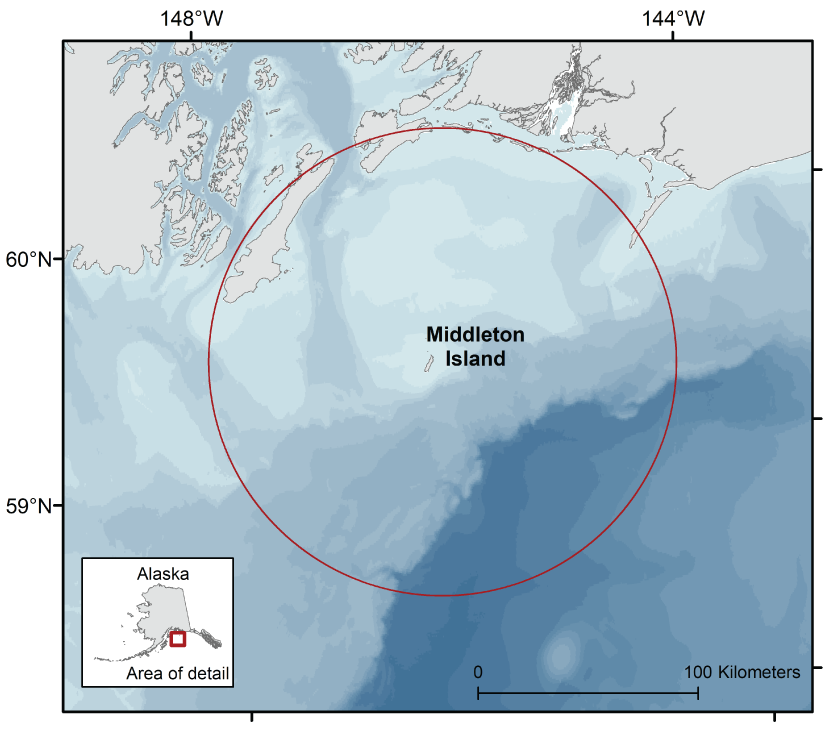
Location of Middleton Island, Alaska in the northern Gulf of Alaska. The approximate foraging range of seabirds is shown by the red circle. Bathymetry is shown in shades of blue, with darker shades indicating deeper water (Lindquist and others, 2004), and land base map is courtesy of Alaska Department of Natural Resources (2018).
Methods
Sample collection began in 1978, with collections conducted annually since 1993 (Hatch and Sanger, 1992). Each year during the seabird chick rearing period (late June to August), juvenile sablefish are captured by auklets and puffins foraging offshore. Whole, fresh fish prey are brought back to Middleton Island by seabirds in their “bill loads.” Fish in bill load samples can thus be readily identified, enumerated, and total length (in millimeters [mm]) measured soon after collection. From these measures, taken annually (Arimitsu and Hatch, 2023), various metrics and indices can be calculated, such as catch-per unit effort for each year, frequency of occurrence, and a growth rate index (Hatch and Sanger, 1992).
Because the auklet and puffin chick diet samples are collected over the course of the chick rearing season, an index of age-0 sablefish growth rate is calculated using the relationship between mean fish length and Julian day for each year. From this model, growth (in mm per day) is the slope, and length is the predicted length on the median Julian day = 205 (July 24). Annual anomalies of growth and length are calculated for each variable by subtracting the mean of all years. Data from 1994 were omitted from this analysis because of low sample size (n sablefish = 6) and samples were collected over a short period of time (6 days).
Results
The annual data release (Arimitsu and Hatch, 2023) provides number of sablefish sampled and measured on Middleton Island. In 2022, sablefish made up 20 percent of the total biomass in seabird diet samples (n = 374; June 22–August 21), which is well above the long-term mean (8.7 percent) for Middleton Island samples. The large prevalence in 2022 of sablefish in auklet and puffin chick diets (n sablefish = 284; catch per unit effort = 0.77 fish per sample; frequency of occurrence = 0.35) suggests sablefish were widely available in the seabird foraging area near Middleton Island. The relationship between length and Julian day differs by year (ordinary least squares regression: F = 24.44; df = 61, and 184; R2 = 0.85; p < 0.001). During 2022, the average growth index was 1.54 mm per day, which was slightly below the long-term average of 1.88 mm per day. Predicted size on the median sample date was 107 mm, which was 6 mm above the long-term mean of 101 mm (fig. 2).
Age-0 sablefish were larger in 2022 than in 2021. Predicted size (71 mm) on the median sampling date during 2021 was 29 mm below the long-term (1978–2022) mean and only six individual sablefish were sampled by seabirds despite above average diet sampling effort (n samples = 306; long-term average = 180; fig. 2).
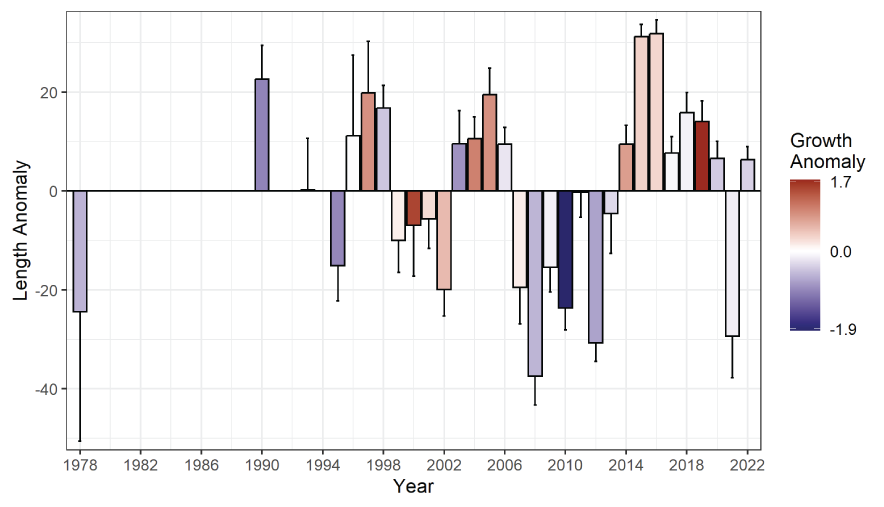
Interannual variability in predicted length anomaly, in millimeters (y-axis) and growth anomaly in millimeters per day (color; below average = blue, average = white, above average = red) for age-0 sablefish in seabird diets at Middleton Island, Alaska. Error bars indicate standard errors for each year.
Summary
The age-0 sablefish samples obtained from seabird diets at Middleton Island provide information on a critical life stage that is not well sampled by other means. Growth and size of age-0 sablefish in 2022 were close to the means for the entire timeseries. Based on these analyses of size and growth, it is unlikely that age-0 sablefish were large enough during summer of 2021 to be targeted by seabirds as suitable prey for their chicks, which may explain why so few sablefish (n = 6) were sampled that year. In 2019, the growth anomaly was high but size was only moderately above average because fish were small at the beginning of the sampling period and grew unusually fast that year (fig. 2).
Summaries of age-0 sablefish in seabird diets from Middleton Island (Arimitsu and Hatch, 2023) are provided annually to NOAA for the Ecosystem Socioeconomic Profile in the sablefish stock assessment (Shotwell and others, 2022). In the Alaska sablefish stock assessment, the age-0 sablefish growth rate from Middleton Island data are used in the stock assessment as part of a suite of ecosystem indicators, in this case as one of several lower trophic system indicators. Ecosystem indicators are used by NOAA in risk tables or in the stock assessment model to highlight external stressors or factors for managers to consider when determining future Acceptable Biological Catch recommendations for the sablefish stock (Shotwell and others, 2022).
References Cited
Alaska Department of Natural Resources, 2018, Gulf of Alaska, excluding small islands: State of Alaska Open Data Geoportal database, scale 1:63,360, accessed June 6, 2023, at https://gis.data.alaska.gov/.
Arimitsu, M.L., and Hatch, S.A., 2023, Age-0 Sablefish size and growth indices from seabird diets at Middleton Island, Alaska: U.S. Geological Survey data release, https://doi.org/10.5066/P94KVH9X.
Goethel, D.R., Rodgveller, C.J., Echave, K.B., Shotwell, S.K., Siwicke, K.A., Handelman, D., Malecha, P.W., Cheng, M., Williams, M., Omori, K., and Lunsford, C.R., 2022, Assessment of the sablefish stock in Alaska: Anchorage, Alaska, Stock Assessment and Fishery Evaluation Report, North Pacific Fishery Management Council, 182 p., accessed June 6, 2023, at https://www.fisheries.noaa.gov/resource/data/2022-assessment-sablefish-stock-alaska-0.
Shotwell, S.K., Goethel, D.R., Dreary, A., Ferriss, B., Echave, K., Lunsford, C., Siwicke, K., Siddon, E., Sullivan, J., Szymkowiak, M., and Williams, B., 2022, Ecosystem and Socioeconomic Profile of the sablefish stock in Alaska–Report Card, app. 3C of Goethel, D.R., Rodgveller, C.J., Echave, K.B., Shotwell, S.K., Siwicke, K.A., Handelman, D., Malecha, P.W., Cheng, M., Williams, M., Omori, K., and Lunsford, C.R., Assessment of the sablefish stock in Alaska, 2022: Anchorage, Alaska, Stock Assessment and Fishery Evaluation Report, North Pacific Fishery Management Council, p. 110–119, accessed June 6, 2023 at https://www.fisheries.noaa.gov/resource/data/2022-assessment-sablefish-stock-alaska-0.
For more information about the research in this report, contact
Director, Alaska Science Center
U.S. Geological Survey
4210 University Drive
Anchorage, Alaska 99508
https://www.usgs.gov/centers/alaska-science-center
Manuscript approved on June 12, 2023
Publishing support provided by the U.S. Geological Survey
Science Publishing Network, Tacoma Publishing Service Center
Disclaimers
Any use of trade, firm, or product names is for descriptive purposes only and does not imply endorsement by the U.S. Government.
Although this information product, for the most part, is in the public domain, it also may contain copyrighted materials as noted in the text. Permission to reproduce copyrighted items must be secured from the copyright owner.
Suggested Citation
Arimitsu, M.L., and Hatch, S.A., 2023, Age-0 sablefish size and growth indices from seabird diets at Middleton Island, Gulf of Alaska: U.S. Geological Survey Open-File Report 2023–1049, 4 p., https://doi.org/10.3133/ofr20231049.
ISSN: 2331-1258 (online)
Study Area
| Publication type | Report |
|---|---|
| Publication Subtype | USGS Numbered Series |
| Title | Age-0 sablefish size and growth indices from seabird diets at Middleton Island, Gulf of Alaska |
| Series title | Open-File Report |
| Series number | 2023-1049 |
| DOI | 10.3133/ofr20231049 |
| Publication Date | June 21, 2023 |
| Year Published | 2023 |
| Language | English |
| Publisher | U.S. Geological Survey |
| Publisher location | Reston, VA |
| Contributing office(s) | Alaska Science Center Ecosystems |
| Description | Report: v, 4 p.; Data Release |
| Country | United States |
| State | Alaska |
| Other Geospatial | Middleton Island |
| Online Only (Y/N) | Y |