Fact Sheet 1995–244
 | Influence of Study Design and Seasonal VariabilitySubstantial variations in study design among previous monitoring investigations hinder attempts to obtain a consistent picture of the spatial distributions of pesticides in ground waters across the nation. Design features that have the greatest influence on study results include: (1) the spatial extent of sampling, (2) the types and number of compounds examined, (3) the criteria used for well selection, and (4) the analytical detection limits. The spatial extent of pesticide detection in ground water and the number of pesticide compounds detected both tend to be greater in areas where more sampling has been conducted. As expected, sampling that targets areas of suspected contamination usually leads to more frequent detections than the sampling of randomly selected wells. In addition, studies that employ lower detection limits for a given compound predictably yield more frequent detections than those using higher detection limits. 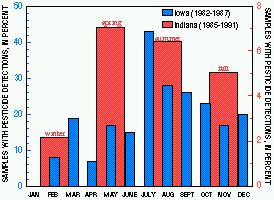
Figure 6. Statewide average seasonal patterns in pesticide detection frequencies in shallow ground waters of Iowa (Detroy and others, 1988) and Indiana (Risch, 1994). Few investigations have been designed to examine long-term trends in pesticide levels in ground water. Such trends may be obscured by the substantial seasonal variations in detection frequencies and concentrations that are usually observed during the year. For example, minimum values of both parameters are typically encountered before, and maximum values after, spring applications of herbicides (see Figure 6). |

 U.S. Department of the Interior |
U.S. Geological Survey
U.S. Department of the Interior |
U.S. Geological Survey
URL: http://pubsdata.usgs.gov/pubs/fs/1995/0244/influence.html
Page Contact Information: GS Pubs Web Contact
Page Last Modified: Tuesday, 13-Nov-2018 16:19:46 EST