Fact Sheet 1995–244
 | Pesticides in the Hydrologic System
Synthetic organic pesticides are used to control weeds, insects, and other organisms in a wide variety of agricultural and non-agricultural settings in the United States. National use of pesticides has grown from about 540 million pounds of active ingredient in 1964 to about 1.1 billion pounds in 1993. Of this total, agricultural use accounts for about 75 percent (U.S. Environmental Protection Agency, 1994). The use of pesticides has helped to make the United States the largest producer of food in the world and has provided other benefits, but has also been accompanied by concerns about their potential adverse effects on the environment and human health. 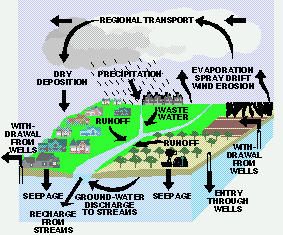 Figure 1. Pesticide movement in the hydrologic cycle (adapted from Majewski and Capel, 1995). The greatest potential for unintended adverse effects of pesticides, in many respects, is through contamination of the Earth's hydrologic systems, which supply water for both humans and natural ecosystems. Water is one of the primary media in which pesticides are transported from application areas to other locations in the environment (see Figure 1). |

 U.S. Department of the Interior |
U.S. Geological Survey
U.S. Department of the Interior |
U.S. Geological Survey
URL: http://pubsdata.usgs.gov/pubs/fs/1995/0244/pesticides.html
Page Contact Information: GS Pubs Web Contact
Page Last Modified: Tuesday, 13-Nov-2018 16:22:41 EST