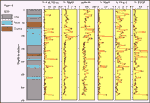
Results of analyses are presented in Appendix I, and plotted versus
depth in Figure 4. Summary statistics for each oxide or element are given in Table 1.
Table 1. Minimum, maximum, mean, and standard deviation of analytical
results for concentrations of major- and minor- element oxides (in percent) by XRF, for
loss on ignition at 900° C (LOI-900), for concentrations of trace elements (in parts
per million) by ICP, for percent CaCO3 calculated from percent inorganic carbon,
and for percents total carbon and organic carbon.
Oxide or Element
Minimum
Maximum
Mean
Standard Deviation
SiO2
33.3
79.7
63.9
6.5
Al2O3
3.7
17
11.1
2.8
Fe2O3
1.5
22.4
5.2
2.6
MgO
0.5
4.5
1.2
0.61
CaO
0.62
15.9
2.74
2.33
Na2O
0.68
3.33
1.38
0.51
K2O
0.29
2.1
0.66
0.27
TiO2
0.22
0.95
0.61
0.15
P2O5
0.25
6.05
0.28
0.59
MnO
0.008
1.24
0.086
0.14
LOI-900
0.08
24.9
11.8
3.6
Ba
63
780
313
91
Ni
11
59
34
10
Co
5
43
16
5
Cr
26
96
58
13
Cu
11
76
45
13
La
4
22
12
3
V
77
400
226
60
Pb
4
10
5
1
Sc
4
26
13
4
Sr
77
1100
251
127
Ce
8
50
28
8
Y
3
34
15
4
Zn
18
99
54
12
CaCO3
0
42.2
2.6
5.8
Total C
0
7.7
2.5
1.9
Org, C
0
7.6
2.2
1.8
Based on preliminary sediment descriptions (Adam and others, 1989), the
main sediment components of the Tule Lake core can be described in terms of a clastic
component, CaCO3, diatoms, and organic matter. Except for biogenic SiO2
from diatom debris, estimates of these components can be obtained from the geochemical
results (Figure 1). Because diatom debris is abundant in some parts of the section, the
total SiO2 values listed in Appendix I and plotted in Figure 1 are composites
of nonbiogenic (clastic) SiO2 and biogenic SiO2 (diatom debris). In
an attempt to obtain an estimate of these two different forms of SiO2, I
assumed, for reasons that will be discussed below, that the clastic fraction had average
SiO2 and Al2O3 contents similar to an average for
Medicine Lake volcanics that cover much of the drainage basin of Tule Lake. The average
SiO2/Al2O3 ratio in 145 XRF analyses of this material is
3.5 (data provided by Julie Donnelly-Nolan, USGS, Menlo Park). I therefore assumed that
average clastic sediment entering Tule Lake had this same average ratio, and I multiplied
each value of Al2O3 by 3.5 to obtain an estimate of niobiogenic SiO2.
The biogenic SiO2 content was computed by subtracting the nonbiogenic SiO2
value from total SiO2 for each sample.
Figure 4. Lithologic summary and plots of concentrations of major-element
oxides,CaCO3, and organic carbon (Org. C) in percent, and trace
elements (in parts per million, ppm) versus depth in samples from Tule Lake,
California.
In order to objectively examine relations among the numerous
geochemical variables, and to provide a geochemical zonation of the core based on
principle element associations, I ran a Q-mode factor analysis using the extended CABFAC
program of Klovan and Miesch (1976). Prior to running the factor analysis, concentrations
of all oxides and elements were transformed to proportions of the total range for each
oxide and element. As a result of the transformation, all data were expressed on a scale
of 0.0 to 1.0. After trying several different sets of reference axes in multidimensional
space, I chose four orthogonal reference axes (4-factor solution) that maximize the
variance of the transformed data in each dimension (varimax solution of Klovan and Miesch,
1976). The 4-factor model accounted for more then 55% of the variance in the scaled data
for each variable, with an average of 70%. Basically, the 4-factor model reduced 24
measured variables (oxide and element concentrations) to four "composite"
geochemical variables (factors). The intensities of the composite geochemical variables
are the factor loadings. The loadings for each of the four factors for each sample are
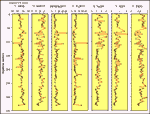
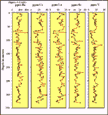
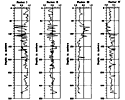
plotted versus depth in Figure 5.
Figure 5. Plots of factor loadings from a 4-factor Q-mode factor analysis of geochemical data versus depth for samples from Tule Lake, California.
The factor loadings describe the relative importance of each of the
factors for each sample, but give no indication of which of the elements had the most
influence on determining each of the four factors. In order to determine which elements
contributed to which factor, the factor loadings for each sample were treated as composite
chemical variables with attributes of one or more actual measured variables, and
correlation coefficients were computed between the loadings and the 24 measured variables.
Results of the correlation analysis are given in Table 2.
Table 2. Correlation coefficients between Q-mode factor loadings and
concentrations of major- and minor-element oxides, and trace elements in sediment samples
from the Tule Lake core.
Oxide or Element
Factor I
Factor II
Factor III
Factor IV
SiO2-nonbio.
0.85
-0.67
-0.23
-0.29
SiO2-bio
-0.65
0.82
-0.01
0.06
Al2O3
0.85
-0.67
-0.23
-0.29
Fe2O3
0.00
-0.37
-0.09
0.65
MgO
-0.23
-0.60
0.67
0.07
CaO
-0.43
-0.42
0.80
0.14
Na2O
0.38
-0.65
0.38
-0.52
K2O
0.43
-0.58
0.23
-0.57
TiO2
0.86
-0.48
-0.54
0.02
P2O5
-0.20
-0.13
0.07
0.37
MnO
-0.23
-0.30
0.07
0.64
Ba
0.65
-0.68
-0.13
-0.07
Ni
0.66
-0.23
-0.50
0.06
Co
0.67
-0.41
-0.43
0.06
Cr
0.60
-0.37
-0.30
0.02
Cu
0.68
-0.34
-0.53
0.19
La
0.83
-0.50
-0.55
-0.03
V
0.01
0.32
-0.37
0.54
Pb
0.58
-0.33
-0.25
-0.42
Sc
0.43
-0.42
-0.45
0.58
Sr
-0.06
-0.57
0.71
-0.16
Ce
0.79
-0.47
-0.55
0.02
Y
0.58
-0.42
-0.53
0.36
Zn
0.84
-0.43
-0.55
-0.06
CaCO3
-0.47
-0.29
0.47
0.54
Org-C
-0.40
0.51
0.30
-0.27
The correlations between factor loadings and geochemical variables
(Table 2) indicate four element associations (factors) that can be used to zone the core
based on the geochemical results (Adam and others, 1989). Factor I groups samples based on
concentrations of Ti, nonbiogenic Si, Al, La, Zn, Ce, Cu, Ba, Ni, Co, Y, Pb, Cr, and Sc,
in order of decreasing correlation coefficients in Table 2. Figure 5 shows that sediments
characterized by Factor I predominate throughout most of the recovered section in Tule
Lake except in some beds in the carbonate-rich interval between 70 and 120 m.
Factor II groups biosiliceous, OC-rich samples. These samples occur in
several beds within the carbonate-rich interval (70-120 m), within the organic-rich
interval between 130 and 160 m, and at the bottom of the core (Figure 5). This zonation is
based mainly on the concentrations of biogenic SiO2 and organic carbon (Table
2).
Factor III sediments are those that contain the highest concentrations
of CaCO3 in the interval between 70 and 120 m. These carbonate-rich sediments
also contain the highest concentrations of the carbonate-related elements Sr and Mg.
Notice in Table 2 that the strongest variable in this carbonate association is CaO and not
CaCO3. The CaO values are total calcium measured by XRF and include both
clastic calcium and calcium from CaCO3. The CaCO3 values were
calculated from inorganic carbon. The fact that CaO is the strongest variable in the
carbonate association suggests that analytically the CaO values provide a better estimate
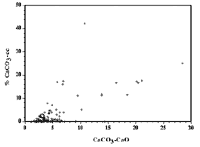
in the variations in CaCO3 than inorganic carbon. A scatter plot of CaCO3
computed from both CaO and carbonate carbon (both values listed in Appendix I) is shown in
Figure 6. The values calculated from CaO are usually higher because of calcium from the
clastic fraction.
Figure 6. Scatter plot of Percent CaCO3 calculated from total calcium(-Ca)
and carbonate (-CC) in samples of sediment from Tule Lake, California.
Factor IV is weak, but appears to reflect variations in redox
conditions within the lake. Factor IV sediments have relatively high concentrations of Fe,
Mn, Sc, V, and P. CaCO3 computed from carbonate carbon also contributes to this
association (Table 2).
I interpret factor I sediments to represent a volcanic-ash association
characterized by relatively high concentrations of Ti, nonbiogenic Si, Al, rare-earth
elements, and trace transition elements. The raw geochemical data (Figure 4) and
distribution of factor loadings (Figure 5) show that Tule Lake sediments are characterized
by a predominant igneous rock component with varying amounts of biogenic silica (diatom
debris) and organic matter, and, in a few beds, minor amounts of carbonate. The igneous
rock component consists mainly of locally derived basic tephra with at least 12 acidic
tephra layers that are widely distributed in the Pacific Northwest and provide the basis
for regional correlations and tephrochronology of the Tule Lake core (Sarna-Wojicicki and
others, 1988; Adam and others, 1989; Rieck and others, 1992).
In order to determine how much of the composition of the Tule Lake
sediments can be explained in terms of the igneous rock component, a standard reference
material is needed. An ideal reference would be the average composition of rocks in the
drainage basin of Tule Lake. Lacking this information, I chose analyses of 145 samples of
volcanic rocks from the Medicine Lake Highlands just south of Tule Lake (Figure 1)
provided by Julie Donnelly-Nolan (Donnelly-Nolan and Nolan, 1986) as the basic igneous end
member. The average of these analyses I will call MLV. Concentrations of major- and
minor-element oxides were determined for all 145 MLV samples, but concentrations of only a
few trace elements (Ba, Cu, Ni, Sr, Y, and Zn) were determined on a subset of the MLV
samples. Because of the limited trace-element data for MLV, I also compared the Tule Lake
ash to USGS standard basalt BCR-1 because there are more extensive trace-element data for
this standard (Flanagan, 1969). For the acidic end member, I used USGS standard RGM-1, a
rhyolite from Glass Mountain in the Medicine Lake Highland (Figure 1) (Tatlock and others,
1976). I chose sample 986 from a depth of 51.1 m (Appendix I) as a reference volcanic ash
from the Tule Lake core. This sample probably represents a good average ash-rich sediment
for the Tule Lake core because it comes from an interval in the core (50 to 65 m) that was
deposited very slowly and contains several heterogeneous reworked tephra units (Adam and
others, 1989; Rieck and others, 1992). A second reference analysis from the Tule Lake core
is simply an average of analyses of all Tule Lake samples (Appendix I). These reference
analyses are listed in Table 3.
Table 3. concentrations of major- and minor-element oxides (in percent)
and trace elements (in parts per million, ppm) in comparative standard materials. Leaders
(--) indicate no analysis available.
Oxide or Element
Medicine Lake Volcanics (MLV)
Basalt (BCR-1)
Rhyolite (RGM-1)
Tule Lake 986
Average Tule Lake Sediment
SiO2
58.0
54.5
73.4
56.7
64
Al2O3
16.7
14.0
13.7
16.4
11.2
Fe2O3
7.14
13.0
1.73
7.1
5.2
MgO
4.39
3.46
0.29
1.65
1.18
CaO
6.73
6.92
1.17
2.3
2.81
Na2O
3.65
3.27
4.18
1.72
1.39
K2O
1.76
1.7
4.34
1.07
0.67
TiO2
0.88
2.2
0.26
0.92
0.61
MnO
0.12
0.18
0.05
0.18
0.09
P2O5
0.19
0.36
0.04
0.2
0.27
Ba
551
675
705
360
314
Co
--
38
--
26
16
Cr
--
18
3
76
58
Cu
79
18
10
56
46
La
--
26
--
18
12
Ni
106
16
--
58
34
Pb
--
18
21
7
5
Sc
--
33
5.5
20
13
Sr
182
330
111
240
250
V
--
400
13
160
230
Y
26
37
26.7
21
15
Zn
64
120
--
71
53
Ce
--
54
--
36
28
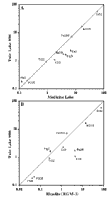
Figure 7 shows log-log plots of concentrations of major- and
minor-elements oxides (in percent) in Tule Lake sample 986 versus those in the MLV and
RGM-1 standards, and concentrations of trace elements (in parts per million) in Tule Lake
sample 986 versus those in the MLV and BCR-1 standards. Figure 7A and B shows that the
major- and minor-element composition of sample 986 is closer to the basic end member (MLV)
than to the acidic end member (RGM-1), particularly when considering those oxides that are
least likely to be affected by weathering (SiO2, Al2O3,
Fe2O3, and TiO2). Tule Lake sample 986 is depleted in
alkaline-earth- and alkali-element oxides CaO, MgO, Na2O, and K2O
relative to MLV, and this probably reflects removal of these elements by weathering. Tule
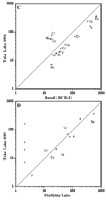
Lake ash, represented by sample 986, is depleted in most trace elements relative to BCR-1.
They are distinctly enriched in Cr, Cu, and Ni relative to BCR-1 (Figure 7C), but are
somewhat depleted in Cu and Ni relative to MLV (Figure 7D). Table 3 shows that average
Tule Lake sediment has a composition similar to that of ash sample 986, but is enriched in
SiO2 because of inclusion of biogenic SiO2 from diatoms. In summary,
it appears that the detrital clastic material that reached the Tule Lake basin throughout
the history of the lake was derived from weathered volcanic rocks from the Medicine Lake
Highlands (Figure 1). In the lake, the detrital clastic material was diluted by major
amounts of biogenic SiO2 and minor amounts of carbonate and organic matter. In
other words, the sediments of Tule Lake are composed mainly of weathered volcanic ash and
diatoms.
Figure 7. Log-log plots of concentrations of major- and minor-element oxides (in percent) in Tule Lake sample 986 versus those in average Medicine lake volcanics (A) and USGS standard rhyolite RGM-1 (B); and concentrations of trace elements (in parts per million) in Tule Lake sample 986 versus those in average Medicine Lake volcanics (C) and USGS standard basalt BCR-1 (D).
As explained earlier, I used the SiO2/Al2O3
ratio in the MLV standard (3.5; Table 3) and the Al2O3 content of
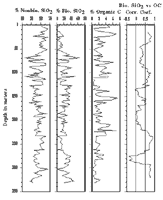
each sample to compute the concentration of nonbiogenic SiO2. Percent biogenic
SiO2 is then calculated by subtracting % nonbiogenic SiO2 from total SiO2.
Using these calculations, average Tule Lake sediment contains 39.2% nonbiogenic SiO2
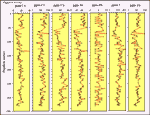
and 24.8% biogenic SiO2. Down-core variations of the computed estimates of
these two forms of SiO2 are shown in Figure 8 along with down-core variations
in organic carbon repeated from Figure 4.
Q-mode factor II suggested that biogenic silica and organic matter were
closely associated. Intuitively, this is what one might expect because most of the organic
productivity in Tule Lake probably was from diatoms. However, based on all samples, the
concentration of biogenic SiO2 does not correlate very well with that of
organic carbon (r=0.20, n=131). I used the moving correlation coefficient technique of
Dean and Anderson (1974) to determine if there were any parts of the Tule Lake sequence
where biogenic SiO2 and organic carbon were more positively correlated than
others (Figure 8). This technique computes correlation coefficients between two variables
over a predetermined stratigraphic window that is moved down the section one point at a
time. For the Tule Lake sequence I used a window that was 11-samples long so the
coefficients plotted in Figure 8 represent correlations between samples 1-11, 2-12, 3-13,
etc. Figure 8 shows the weak overall positive correlation between these two variables, but
also shows that there are some intervals of much stronger positive correlation (r>0.4).
In general, these intervals of strong positive correlation correspond to intervals of
higher organic carbon content, particularly in the upper part of the sequence.
The factor analysis indicated that the sediments from Tule Lake could
be described in terms of a four-component system of clastic material, carbonate, organic
matter, and diatom debris. Based on the above discussion, the amounts of these components
can be quantified. Assuming that the average clastic fraction has an Al2O3
concentration similar to that of average Medicine Lake volcanics (i.e. about 16.5; Table
3), then an average measured concentration of Al2O3 of 11.2% (Table
3) indicates that the average Tule Lake sediment is about 68% clastic material, derived
mainly from basic igneous rocks in the drainage basin. The average concentration of
organic matter would be about twice the organic carbon concentration or about 4.5%. The
average concentration of CaCO3 (computed from carbonate carbon) is 2.6% (Table
1), and the average computed biogenic SiO2 content is 24.8%. These values add
up to 99.9% and show that, on average, basic igneous rock debris makes up the bulk of Tule
Lake sediment. The average loading for the clastic factor from the Q-mode analysis (Factor
I) is 0.7, and the variations in Factor I loadings (Figure 5) can be used as a rough
estimate of the proportion of the clastic fraction, ranging from as much as 0.9 (90%) to
zero or near zero in lacustrine beds rich in carbonate, diatoms, and organic matter.
Figure 8. Plots of concentrations of nonbiogenic SiO2, biogenic
SiO2, and organic carbon; and moving correlation coefficients between biogenic
SiO2 and organic carbon verus depth for samples from Tule Lake, California. (See text
for methods of computing nonbiogenic SiO2, biogenic SiO2, and moving
correlation coefficients.)