|
Multibeam Bathymetric and Backscatter Maps of the
Upper Hudson Shelf Valley and Adjacent Shelf, Offshore of New York
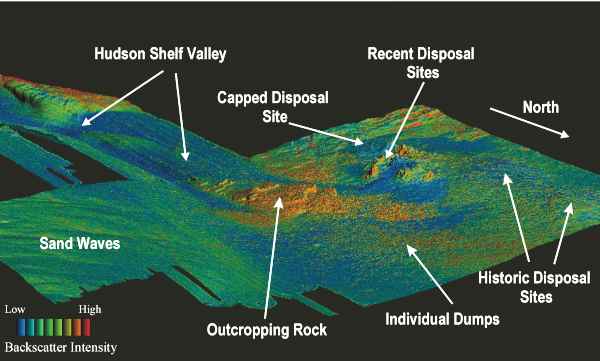
Figure 3. Perspective view of the northern portion of the survey region showing sea floor topography and sediment backscatter, looking southwest and across the shelf and toward the head of the Hudson Shelf Valley. This image was created by vertically exaggerating the bathymetry (in this case 20 times), artificially shading the relief (by artificially illuminating the relief, in this case from the north), and then draping the color-coded backscatter intensity over the bathymetry. Within each backscatter color (red is high backscatter, blue is low backscatter), the intensity varies from dark to light depending on the sun illumination. High backscatter generally indicates a hard bottom, such as coarse-grained sediments or rock; weak backscatter indicates a soft, non-reflective bottom, such as fine-grained sediments. The vertical exaggeration accentuates the small-scale variability of the bathymetry (relief of a few meters) that would be difficult to show in a traditional contour map. Features include: relatively smooth topographical highs composed of material dumped since the 1800's; mounds (as high as 10m) of dredged material from more recent disposal; a smooth, roughly circular region resulting from disposal of contaminated sediments and capping with course sand; outcrops of southeastward-dipping coastal plain strata at the head of the Hudson Shelf Valley of probable cretaceous-age; low-relief (amplitude <1m) sand waves suggesting sediment transport to the Southwest; individual features that are interpreted to be dumps of material, some arrange in lines, which are probably rocks; low-backscatter, smooth sediment extending to the east from the region of recent disposal; low backscatter fine-grained sediments in the axis of the Hudson Shelf Valley.
 |
|