 |
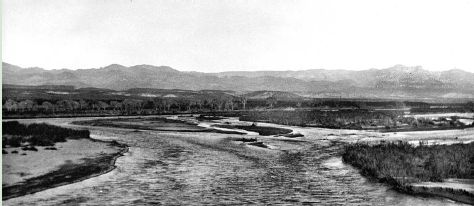
(March 6, 1932). The Gila River was ravaged by floods in the
1910s and 1920s, including one flood estimated at 100,000 ft³/s
in 1916. This upstream view from the railroad bridge at Calva
shows a wide, braided channel. An open cottonwood gallery forest
appears in the midground at left (channel right), and the low
shrubs at right appear to be native willows (W.E. Dickinson,
#1053). |
| |
|
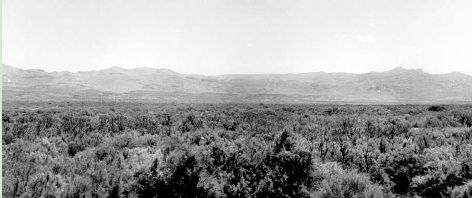 |
(June 18, 1964). In the intervening 32 years, the highest discharge
through this reach was 27,900 ft³/s on October 1, 1941. Dense
tamarisk has become established, creating a floodplain where the main
channel once was. The channel has shifted to the right and is much
smaller than it was in 1932 (Raymond M. Turner). |
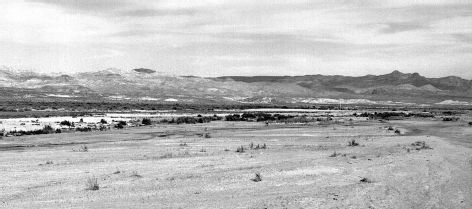 |
(October 17, 1973). To reduce evapotranspiration, phreatophytes
(mostly tamarisk) were removed from this reach in 1970, and the floodplain
was reseeded to native grasses. Those grasses are mostly gone at the
time of this photograph, one year after a flood of 80,000 ft³/s
passed through this reach. The small shrubs throughout the view are
mostly tamarisks that are re-establishing in the reach (Raymond M.
Turner). |
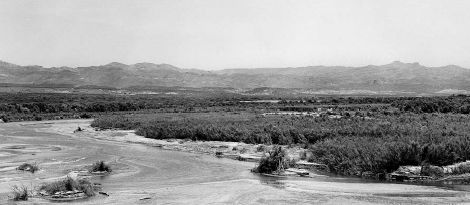 |
(May 21, 1984). In October 1983, a flood of 150,000 ft³/s passed
through this reach in the wake of Tropical Storm Octave. This flood
followed one that peaked at 100,000 ft³/s in 1978. These floods
shifted the channel back into the view, and driftwood racks appear
throughout the foreground. Despite this flood, dense tamarisk appears
on both floodplains (Raymond M. Turner). |
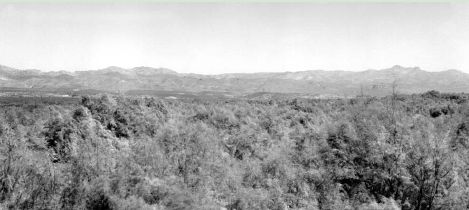 |
(October 6, 2000). Except for withdrawals of domestic and irrigation
water at low-head diversion dams, the Gila River is unregulated upstream
from Calva. In January and February, 1993, three floods passed through
this reach that exceeded 100,000 ft³/s. Despite these floods,
tamarisk has grown considerably, blocking the view of the river channel
from this camera station. Despite the enormous effort at tamarisk
removal and river restoration, the tamarisk has attained a higher
biomass than it had in 1964. The channel has shifted from the right
side to the left side of this view (Dominic Oldershaw, Stake 331a). |
Next: Gila River at Kelvin (09474000)
Previous: Pantano Wash near
Vail (09484600)
Introduction
|

