[an error occurred while processing this directive]

CHANGES IN RIPARIAN VEGETATION IN THE SOUTHWESTERN UNITED STATES:
Repeat Photography at Streamflow Gaging Stations


SALT RIVER NEAR CHRYSOTILE (09497500)


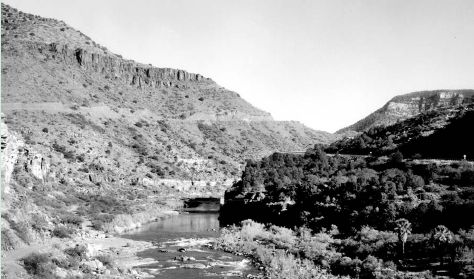
(November 26, 1935). This upstream view from the old, two-lane bridge that crosses the Salt River in Salt River Canyon shows a relatively small discharge of 277 ft³/s. Scattered native shrubs, including willows and brickellbush, appear to occupy the floodplain at right center. The road leading to Show Low, Arizona, appears as a one-lane cut through the hillslope at center (R.E. Cook, #2280).
   
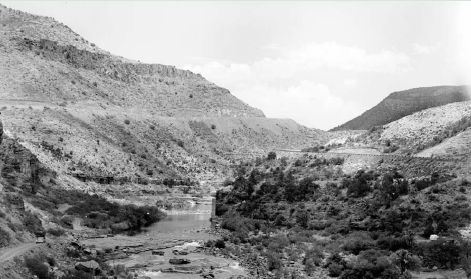
(June 25, 1964). The water is low (about 97 ft³/s), exposing the bedrock that forms the channel bed and the low-water control downstream from the gaging station. In the intervening 29 years, three floods with peaks of greater than 50,000 ft³/s passed through this reach. Tamarisk is interspersed with the native shrubs on the floodplain, and tamarisk lines river left, which was mostly devoid of woody vegetation in 1935. Palm trees (lower right), which are not native to this area, were planted as part of a roadside park well before this photograph was taken. The roadcut on the skyline has been widened (Raymond M. Turner).
 
(October 25, 2000). The water level is only slightly higher than in 1964. In the intervening 36 years, two floods exceeded 70,000 ft³/s and four have exceeded 50,000 ft³/s. Despite these floods, riparian vegetation along the banks has increased, particularly non-native tamarisk. The palm trees have grown considerably (Dominic Oldershaw, Stake 363).

Next: San Carlos River Near Peridot (09468500)

Previous: Paria River at Lee Ferry (09384000)

Back: Introduction


FirstGov button  Take Pride in America button