


Computing flow-field distortion coefficients from well-construction and formation properties
Links
- More information: Publisher Index Page (via DOI)
- Document: XML
- Open Access Version: USGS Accepted Manuscript
- Download citation as: RIS | Dublin Core
Introduction
The arrival time of groundwater contaminants at a sensitive target, such as a public-supply wellfield, may affect the urgency and approach to remediation. Borehole flowmeters directly measure groundwater vectors (velocity and direction) at the center of the borehole. A flow-field distortion coefficient can be computed from geologic formation and well-construction properties and is required to accurately estimate seepage velocity in the formation. A step towards legitimizing application of borehole flowmeter measurements to contaminant transport studies is to compute the flow-field coefficient from site-specific hydraulic properties. For convenience or where well-construction information is not readily available (e.g. Daley et al., 2005) flow-field distortion coefficients are often selected from a commonly reported range of values. The Excel workbook that accompanies this paper facilitates computing of site-specific flow-field distortion coefficients and provides values of hydraulic properties for many commonly used well-construction materials (Darner et al. 2025).
Drost et al. (1968) examined the common situation where hydraulic conductivity of the geologic formation is less than hydraulic conductivity of the gravel pack (or annular fill), and the latter was less than the hydraulic conductivity of the well screen. Although Drost et al. (1968) used the term ‘permeability’ and symbol ‘k’ in mathematical derivations, it is clear from the presentation of Darcy’s Law and the measurement units in that presentation that ‘hydraulic conductivity’ and ‘K’ were the intended terms. Equation 2, the text in this paper, and the workbook reflect this change (Darner et al. 2025).
The coefficient for computing seepage velocity from velocity measured at the center of the well screen has been examined in the literature for various situations and assumptions (Wheatcraft and Winterberg, 1985; Kearl et al., 1993; Kearl, 1997; Wilson et al., 2001). The coefficients in those studies may not be equivalent to the flow-field distortion coefficient derived by Drost et al. (1968) and may be identified with different names to reflect site specific conditions and instrumentation used in those studies.
The equation used by Drost et al. (1968) to theoretically relate the velocities of dye traces in the formation and at the center of the wellbore were:
where:vg
= flow at the center of the well screen,
α
= the flow-field distortion coefficient,
vf
= the rate of undisturbed groundwater flow (volume of water divided by time and aquifer cross section),
vk
= apparent flow rate caused by density convection,
vs
= apparent flow rate caused by vertical currents in the well screen, and
vm
= apparent flow rate caused by molecular diffusion of the tracer.
r1
= inner radius of well screen,
r2
= outer radius of well screen,
r3
= borehole radius,
k1
= well screen hydraulic conductivity,
k2
= gravel pack hydraulic conductivity,
k3
= aquifer hydraulic conductivity, and
α and α0
(both unitless) are related by:
α = α0[1 – f(Re)]
and where laminar flow prevails,
Re=0, α0 and α
are equivalent.
Re
= the Reynolds number, a dimensionless number used to distinguish between laminar and turbulent flow and defined as:
Re =
(ρνδ/μ),
ρ
= fluid density,
μ
= fluid viscosity,
ν
= specific discharge, and
δ
= mean pore dimension, mean grain diameter, or square root of the permeability (Freeze and Cherry, 1979).
f(Re)
is a function of the Reynolds number that must be determined empirically and ranges from 0 to 1, or 0 < f(Re) < 1 (Drost et al., 1968).
Assumptions to this theoretical development and considerations for application to field measurements include the existence of a homogeneous geologic formation in the measurement interval, laminar and horizontal (only) groundwater flow, a cylindrical annular space and well screen, the well contains only water and a flowmeter that has no effect on flow through the well, and velocity measurements are made at the center of the well (Figure 1). A newly installed or recently developed well will be more likely to have hydraulic properties resembling those cited in screen-manufacturer’s information than an older well screen having an accumulation of solids in the screen openings, mineral precipitation, or biological fouling.
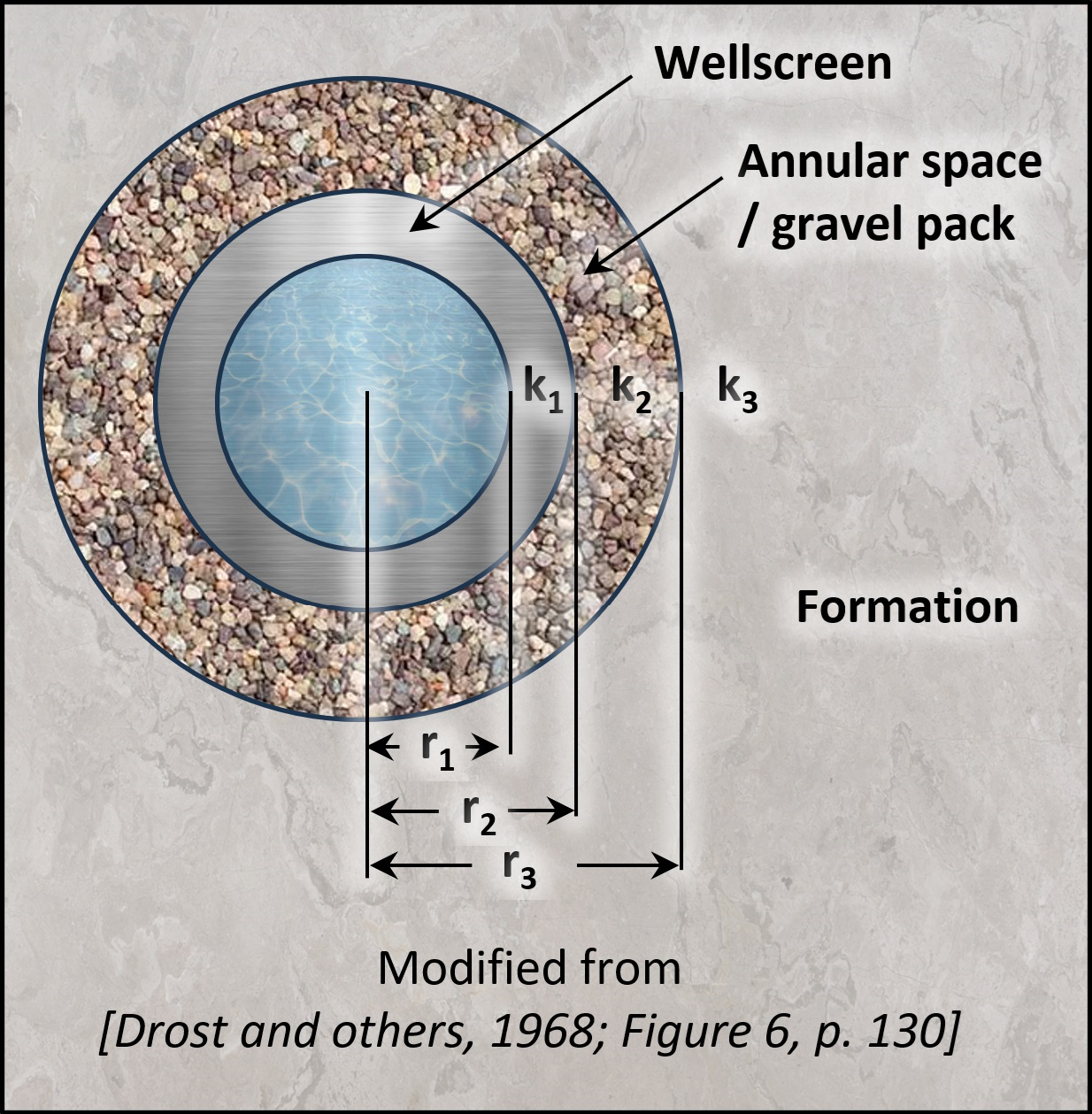
Horizontal cross-section through groundwater monitoring well and borehole showing variables used to solve Equation 2 (modified from Drost et al., 1968).
Spreadsheet Explanation and Use
Equation (2) was programmed into a spreadsheet to solve for α0 based on well-construction and formation properties (Darner et al. 2025). Text in the ‘Alpha Calculator’ spreadsheet, Instructions tab, directs the user to select or manually enter well screen information, aquifer hydraulic conductivity, and gravel pack hydraulic conductivity on the Resources tab. Suggested values for the variables listed in equation (2) are shown in cells E7 through E12 on the Calculator tab. The user can apply the suggested values or modify as needed in cells F7 through F12. The equation is solved for α0 (cell D21). The values are entered in the Alpha Calculator using the International System of Units (SI).
The Resources spreadsheet, included in the workbook, includes utilities to convert variables from English units to SI units and compute well-screen hydraulic conductivity from well-screen properties. An example of tables of hydraulic conductivity and well screen inner- and outer radii are provided and can be found online at Johnson Screens (2023) or other screen properties can be applied manually. Representative values for hydraulic conductivity of porous media are provided as a general reference; however, specifications of gravel pack hydraulic conductivity may be available from the vendor. Hydraulic conductivity of the formation is best obtained from slug or aquifer tests (Freeze and Cherry, 1979).
Values computed or converted on the Resources tab must be manually copied to the Calculator tab. Directions for moving converted or computed values of each variable to specific cells on the Alpha Calculator spreadsheet are provided on the Instructions and Resources tabs.
Discussion
The calculation of α0 values for individual wells and the application to direct measurements of groundwater velocity is a scientific approach to determining a more accurate correction for flow-field deviation when compared to arbitrarily applying a coefficient selected from a range of commonly observed values. The accompanying workbook (Darner et al. 2025) facilitates computing α0 based on properties of the geologic formation and well components and a theoretical development.
Flow-field distortion coefficients may also be determined through laboratory calibration of flowmeters and comparing direct velocity measurements at the center of the well to known flow rates through the calibration chamber. Laboratory calibration, however, can be tedious and time consuming and can negate some benefit of rapid flow measurements made using borehole flowmeters.
Use of the workbook provided here requires knowledge of the physical dimensions and hydraulic properties of the well environment that can be measured during well installation or deduced from a detailed well-driller’s record. Those data may not be common and can require foresight that direct measurements will be made in the well and eventually compensated by application of a correction. Application of a workbook-computed α0 based on inaccurate well logs and property estimates may be misleading and are suggested to be limited to scenario testing rather than a representation of true formation conditions.
References
Daley, P.F., J. Jantos, W.H. Pedler, and W.A. Mandell. 2005. Intercomparison of groundwater flow monitoring technologies at site OU 1, former Fort Ord, California, September 21, 2005. Lawrence Livermore National Laboratory, UCRL-TR-215567, accessed January 29, 2024, at https://doi.org/10.2172/877915.
Darner, R.A., Ostheimer, C.J., and Bayless, E.R., 2025, Alpha Calculator, version 1.5: U.S. Geological Survey software release, https://doi.org/10.5066/P13NRE6Y
Johnson Screens [A brand of Aqseptence Group], 2023, Flush Thread PV Well Screens, Casings and Accessories: Johnson Screens web page, accessed January 29, 2024, at https://johnsonscreens.com/wp-content/uploads/2021/12/PVC_Environmental.pdf
Wilson, J.T., W.A. Mandell, F.L. Paillet, E.R. Bayless, R.T. Hanson, P.M. Kearl, W.B. Kerfoot, M.W. Newhouse, and W.H. Pedler. 2001. An evaluation of borehole flowmeters used to measure horizontal ground-water flow in limestones of Indiana, Kentucky, and Tennessee, 1999: U.S. Geological Survey Water-Resources Investigations Report 01-4139, 129 p., accessed January 29, 2024, at https://doi.org/10.3133/wri014139
Additional Information
Conflicts of interest: None.
Article Impact Statement: A workbook and tables of hydraulic properties are presented to facilitate calculation of theoretically accurate flow-field distortion coefficients.
Data Availability Statement: The data and spreadsheet template that support the findings of this study are available in reference Darner et al. 2025.
Disclaimer: Any use of trade, firm, or product names is for descriptive purposes only and does not imply endorsement by the U.S. Government.
Authors
Disclaimers
Any use of trade, firm, or product names is for descriptive purposes only and does not imply endorsement by the U.S. Government.
Although this information product, for the most part, is in the public domain, it also may contain copyrighted materials as noted in the text. Permission to reproduce copyrighted items must be secured from the copyright owner.
Suggested Citation
Bayless, E.R., Ostheimer, C.J., and Darner, R., 2026, Computing flow-field distortion coefficients from well-construction and formation properties: Groundwater, https://doi.org/10.1111/gwat.70088.
| Publication type | Article |
|---|---|
| Publication Subtype | Journal Article |
| Title | Computing flow-field distortion coefficients from well-construction and formation properties |
| Series title | Groundwater |
| DOI | 10.1111/gwat.70088 |
| Edition | Online First |
| Publication Date | July 03, 2026 |
| Year Published | 2026 |
| Language | English |
| Publisher | National Groundwater Association |
| Contributing office(s) | Ohio-Kentucky-Indiana Water Science Center |