


Distribution, Abundance, and Breeding Activities of Southwestern Willow Flycatchers (Empidonax traillii extimus) at Select Locations on the San Luis Rey River, San Diego County, California—2024 Data Summary
Links
- Document: Report (3.1 MB pdf) , HTML , XML
- Data Release: USGS data release - Southwestern Willow Flycatcher (Empidonax traillii extimus) surveys and nest monitoring in San Diego County, California (ver. 4.0, February 2025)
- Download citation as: RIS | Dublin Core
Acknowledgments
This research was funded by the San Diego Association of Governments (SANDAG). The authors thank the land managers, property owners, and other stakeholders who facilitated access to the survey locations, including but not limited to: Kirsten Winter (U.S. Forest Service); the Vista Irrigation District Board of Directors, Lesley Dobalian, Richard Larsen, and Jessica Sherwood (Vista Irrigation District); Lake Henshaw Store; Rey River Ranch; and Will Wilson. The authors would like to thank Lisa Allen, Annabelle Bernabe, Abigail Boylan, Alexandra Houston, W. Paul Kessler, Suellen Lynn, Jessica Medina, Shannon Mendia, Maia Nguyen, and Aaron Spiller (U.S. Geological Survey), who assisted in the data collection for this project. The authors also extend gratitude to Ryan Besser, Michelle De Guia, Lori Hargrove, John Martin, Tracy Park, Briana Quirarte, Kerry Rennie, and Phil Unitt for assistance with boat surveys.
For consistent presentation of results, parts of this report were written following a previously developed template.
Executive Summary
We surveyed for Southwestern Willow Flycatchers (Empidonax traillii extimus; flycatcher) at select locations along the San Luis Rey River, including along the middle San Luis Rey River near Bonsall and the upper San Luis Rey River near Santa Ysabel, California, in 2024. Surveys were completed at six locations: two along the middle San Luis Rey River (Bonsall [BO] and Rincon), which were last surveyed in 2021, and four along the upper San Luis Rey River, including three downstream from Lake Henshaw that have been surveyed annually since 2015 (Rey River Ranch, Cleveland National Forest [CNF], Vista Irrigation District [VID]), and one upstream at VID Lake Henshaw (VLH) that has been surveyed annually since 2018. There were a minimum of 47 territorial flycatchers (26 male, 21 female) detected at 1 location (VLH) and 6 transient flycatchers of unknown subspecies detected at 3 locations (BO, CNF, and VLH). In total, 30 territories were established, containing 21 pairs and 9 flycatchers of undetermined breeding status. Of the 21 pairs, 13 pairs were monogamous (1 male and 1 female), and 8 pairs were polygynous (1 male paired with more than 1 female). No territorial flycatchers were detected downstream from Lake Henshaw or along the middle San Luis Rey River. Brown-headed Cowbirds (Molothrus ater; cowbird) were detected at all six survey locations. No banded flycatchers were detected during surveys.
Flycatchers used four habitat types in the survey area: (1) mixed willow riparian, (2) willow-cottonwood, (3) willow-oak, and (4) willow-sycamore. Of the flycatcher locations, 86 percent were in habitat characterized as mixed willow riparian, and 97 percent were in habitat with greater than 95-percent native plant cover.
We monitored flycatcher nests at VLH to collect baseline data on nest success, productivity, and parasitism rate. There were 22 nests monitored in 13 territories; 9 were successful. Of the 13 failed nests, 8 were depredated, 3 failed for unknown reasons, and 2 failed because of cowbird parasitism. We confirmed 26 juvenile flycatchers in 2024, which included 22 from monitored nests, and an additional 4 juveniles detected in unmonitored territories. Based on 19 nests in which the contents were observed during the egg stage, 16 percent of nests in 2024 were parasitized.
Introduction
The Southwestern Willow Flycatcher (Empidonax traillii extimus; flycatcher) is one of four subspecies of Willow Flycatcher in the United States, with each occupying a primarily distinct breeding range: E. t. adastus, ranging across the northern Rocky Mountains and Great Basin; E. t. brewsteri, found west of the Sierra Nevada and Cascade Mountains along the Pacific Slope; E. t. extimus, the Southwestern Willow Flycatcher, which breeds across the Southwest; and E. t. traillii, ranging east of the northern Rocky Mountains. The breeding range of the Southwestern Willow Flycatcher includes southern California, Arizona, New Mexico, southwestern Colorado, extreme southern parts of Nevada and Utah, and possibly western Texas (Hubbard, 1987; Unitt, 1987; Sogge and others, 2010). Restricted to riparian habitat for breeding, the flycatcher has declined within the past five decades in response to widespread habitat loss throughout its range and, possibly, brood-parasitism by the Brown-headed Cowbird (Molothrus ater; cowbird [Wheelock, 1912; Willett, 1912, 1933; Grinnell and Miller, 1944; Remsen, 1978; Garrett and Dunn, 1981; Unitt, 1984, 1987; Gaines, 1988; Schlorff, 1990; Whitfield and Sogge, 1999]). By 1993, the species was believed to number approximately 70 pairs in California (U.S. Fish and Wildlife Service, 1993) in small, disjunct populations. The flycatcher was listed as endangered by the State of California in 1992 and by the U.S. Fish and Wildlife Service in 1995. Based on survey data collected from 1993 to 2001, population estimates for flycatchers in California increased to 256 territories, with the increase largely attributed to expanded survey effort rather than population growth at known sites (U.S. Fish and Wildlife Service, 2002). In the 2014 5-year status review, estimates of California flycatcher territories decreased to 172, with declines occurring statewide (Durst and others, 2008; U.S. Fish and Wildlife Service, 2014), including at the Kern River and the Santa Margarita River on Marine Corps Base Camp Pendleton (Howell and Kus, 2024b).
Flycatchers in southern California co-occur with the Least Bell’s Vireo (Vireo bellii pusillus; vireo), another riparian obligate endangered by habitat loss and cowbird parasitism. Unlike the vireo, which has increased tenfold since the mid-1980s in response to management practices alleviating threats (U.S. Fish and Wildlife Service, 2006), the number of flycatchers has remained low. As of 2023, most flycatchers in California are concentrated at two known sites: (1) the Owens River valley in Inyo County (approximately 57 territories; Great Basin Bird Observatory, 2023) and (2) the upper San Luis Rey River at Lake Henshaw in San Diego County (approximately 51 territories; Howell and Kus, 2024a). Outside of these sites, flycatchers occur as small, isolated populations of five territories or fewer (Durst and others, 2008; U.S. Fish and Wildlife Service, 2014). Many of the small populations in San Diego County, including at the lower San Luis Rey River (Houston and others, 2023), have declined or been extirpated in the past two decades.
Most male flycatchers begin arriving in southern California in early to mid-May, whereas females arrive approximately 1 week later. While on the breeding grounds, males sing repeatedly from exposed perches. Once the pair bond is established, the female builds an open cup nest that is usually placed in a branch fork of a willow (Salix spp.) or plant with a similar branching structure approximately 1–3 meters (m) above the ground. The typical clutch of three to four eggs is laid in May–June. Females incubate for approximately 12 days, and nestlings fledge within 12–15 days in early July. Adults usually depart from their breeding territory in mid-August and early September for their wintering grounds in Central America and northern South America.
Flycatcher breeding habitat is characterized by patches of dense riparian vegetation along rivers, streams, and reservoir inflows, interspersed with small openings, open water, or areas of sparse vegetation. Vegetation species composition varies across the range, but most breeding habitats include tree or shrub cover that is at least 3 m tall, with patches of dense vegetation within 3–4 m of the ground. In addition, flycatcher breeding habitat is almost always near or adjacent to areas of standing water or saturated soil (U.S. Fish and Wildlife Service, 2002; Sogge and others, 2010).
The purpose of this study, which began in 2015, was to document the status of Southwestern Willow Flycatchers in San Diego County, California. The goals of the 2024 effort were to (1) assess the status of the flycatcher population at select locations in San Diego County, including two along the middle San Luis Rey River near Bonsall and four along the upper San Luis Rey River near Santa Ysabel; (2) assess the breeding activities of the flycatcher at Lake Henshaw, including nest success and productivity; and (3) evaluate the level of cowbird parasitism at Lake Henshaw. This report is the annual update to surveys that have been completed since 2015 (Howell and Kus, 2021, 2022a, b, 2023, 2024a). The data contained in this report can be found in the associated data release (Howell and Kus, 2022b). These data, when compared with data from other sites and years, will inform natural resource managers about the status of the flycatcher on the San Luis Rey River and may help guide modification of land-use and management practices as appropriate to ensure the species’ continued existence.
Methods
Study Area
Surveys for the Southwestern Willow Flycatcher were completed in 2024 at six locations in San Diego County: two along the middle San Luis Rey River near Bonsall and four along the upper San Luis Rey River near Santa Ysabel (fig. 1). The middle San Luis Rey River survey area consisted of an approximately 3.8-kilometer (km) reach of the San Luis Rey River downstream from Interstate 15 (I–15; fig. 1). Two locations along the middle San Luis Rey River were surveyed for flycatchers, including Bonsall (BO) and Rincon (RIN); both were last surveyed in 2021 (Allen and Kus, 2022). The survey area included property managed by the City of Oceanside, County of San Diego Department of Parks and Recreation, and the State of California Department of Transportation. Surveys were done from County of San Diego managed property and public access right-of-way. Riparian habitat in this section included a mix of mature willow (Salix spp.) and Fremont’s cottonwood (Populus fremontii), with some mule fat (Baccharis salicifolia) present. Understory vegetation included native vegetation such as poison oak (Toxicodendron diversilobum) and stinging nettle (Urtica dioica) interspersed with non-native giant reed (Arundo donax), poison hemlock (Conium maculatum), milk thistle (Silybum marinum), and black mustard (Brassica nigra).

Location of Southwestern Willow Flycatcher (Empidonax traillii extimus) survey areas on the San Luis Rey River, San Diego County, California, 2024.
The upper San Luis Rey River survey area consisted of an approximately 6.9-km reach of the San Luis Rey River downstream from Lake Henshaw and the habitat surrounding Lake Henshaw (fig. 1). Four locations along the upper San Luis Rey River were surveyed for flycatchers in 2024, including three locations downstream from the Henshaw dam that have been surveyed annually since 2015 (Rey River Ranch [RRR], Cleveland National Forest [CNF], and Vista Irrigation District [VID]) and one location upstream from the Henshaw dam that has been surveyed annually since 2018 (VID Lake Henshaw [VLH]). The survey area included property managed by Vista Irrigation District, Cleveland National Forest, and private property downstream from the U.S. Forest Service property. Surface flows were regulated by a dam at Lake Henshaw operated by the Vista Irrigation District, and water was present year-round. In most years, spring and summer flows were swift, and slow-moving backwater/marshy habitats were absent. The flood plain in the downstream part of the study area was narrow and bordered by steep slopes that supported chaparral vegetation. Riparian habitat downstream included a diverse mix of mature willow (Salix spp.) woodland and coast live oak (Quercus agrifolia) woodland, dominated by coast live oak, willow, velvet ash (Fraxinus velutina), California sycamore (Platanus racemosa), and white alder (Alnus rhombifolia). Thick understory vegetation was present, including California wildrose (Rosa californica), poison oak, stinging nettle, and California blackberry (Rubus ursinus) interspersed with patches of open habitat dominated by annual grasses and bracken fern (Pteridium sp.). The habitat surrounding Lake Henshaw was dominated by Goodding’s black willow (Salix gooddingii), with some arroyo willow (Salix lasiolepis), red willow (Salix laevigata), Fremont’s cottonwood, and coast live oak where the west fork of the San Luis Rey River and several other minor creeks flowed into the lake. There were several patches of non-native tamarisk (Tamarix ramosissima) present. In 2023, above-average precipitation (114.5 centimeters [cm], 172 percent of mean from 1960 to 2022 [66.7 cm]; J. Sherwood, Vista Irrigation District, written commun., 2024) resulted in a lake level that partially inundated flycatcher habitat at Lake Henshaw. All understory vegetation was submerged, but the tops of mature willow, cottonwood, and tamarisk trees extended above the water line in some sections. Although the lake level lowered in 2024 after a year of average precipitation (67.2 cm; J. Sherwood, Vista Irrigation District, written commun., 2024), most of the flycatcher habitat continued to be submerged, and evidence of tree death was prominent. This habitat decline was especially apparent among cottonwood and tamarisk trees; most specimens of these two species were not leafed out and appeared to be dead. Black willow, a dominant tree species at Lake Henshaw, were affected at the high water line and many snapped and fell over; however, some vertical shoots emerged from the horizontal trunks, indicating that the trees were still alive. Large numbers of horizontal trees prevented surveyors from accessing the interior habitat, which may have resulted in an underestimate of the number of flycatcher territories present in some habitat patches.
Surveys
U.S. Geological Survey biologists Lisa Allen, Annabelle Bernabe, Abigail Boylan, Alexandra Houston, Scarlett Howell, W. Paul Kessler, Barbara Kus, Suellen Lynn, Jessica Medina, Shannon Mendia, Maia Nguyen, and Aaron Spiller completed flycatcher surveys following a standardized call-back survey protocol for Southwestern Willow Flycatchers (Sogge and others, 2010). The survey protocol is designed to increase the likelihood of detecting Southwestern Willow Flycatchers and aid in determining their breeding status by performing repeated surveys during the early to mid-nesting season, with three to four surveys carried out at least 5 days apart during three consecutive survey periods between May 15 and July 31. One survey was done between May 15 and May 31, one survey between June 1 and June 24, and one to two surveys between June 25 and July 31. Flycatcher surveys were completed under U.S. Fish and Wildlife Service (USFWS) 10(a)1(A) Recovery Permit ESPER0004080_0.3. Surveys were done between dawn and early afternoon, avoiding periods of inclement weather such as temperatures below freezing, rain, or strong winds that inhibit detection of flycatchers. Surveys were done by walking next to the river or lake, using caution to avoid disturbing the habitat or damaging nests. In wider stands, observers traversed the habitat, choosing routes that permitted detection of all birds throughout its extent, such as multiple straight transects, serpentine, zig-zag, or crisscross routes. In flooded habitat, surveys were done by boat, primarily by moving along the outside edge of the habitat patch and entering the interior habitat whenever possible.
Upon initiation of the survey, investigators stood quietly for 1–2 minutes, listening for spontaneously singing flycatchers and acclimating to surrounding conditions, such as road and river noise. During boat surveys, investigators stopped the boat engine and floated quietly during the listening period. If there were no birds detected during the initial listening period, investigators broadcasted the flycatcher song (“fitz-bew”) using an MP3 player or Android phone and an amplified speaker at the volume of typical bird songs for approximately 10–15 seconds and then looked and listened for approximately 1 minute for a response. Flycatchers typically responded by moving silently toward the song, singing in response to the song, or producing some other call or vocalization. Song playback was ceased immediately upon detection of a flycatcher. Additional flycatcher vocalizations were broadcasted occasionally during boat-based surveys to elicit response and confirm flycatcher presence. This procedure was repeated (including a 10-second quiet pre-broadcast listening period) every 20–30 m throughout land-based survey sites or 80–100 m throughout boat-based survey sites and more frequently if background noise was loud. If a flycatcher was detected, the investigator moved approximately 50–80 m beyond the detection before additional playback occurred to avoid double counting birds. At most flycatcher territories, flycatchers in adjacent territories could be heard vocalizing simultaneously.
For each flycatcher encountered, observers recorded age (adult or juvenile), sex (male, female, or unknown), breeding status (paired, undetermined, or transient), and whenever possible, if the bird was banded. Flycatcher age was determined by physical appearance of plumage (for example, juveniles [fledged young-of-the-year] exhibited buffy wing bars) combined with behavioral cues, such as territorial defense or singing. Sex determination was based on behavioral observations detected during each survey visit. For example, males often continuously broadcast song from conspicuous perches, whereas females only sing occasionally (Seutin, 1987; Sedgwick and Knopf, 1989). Females perform most of the nest building, incubation (U.S. Fish and Wildlife Service, 2002), and so forth. If we could not confidently assign a field sex, the flycatcher’s sex remained unknown. Breeding status was also based on the culmination of behavioral observations observed over multiple visits. Flycatchers were considered paired if (1) a second flycatcher was present and unchallenged by the territorial male during more than one survey period, (2) male/female interactions were observed, (3) an adult flycatcher was observed carrying nesting material or food, (4) an active flycatcher nest was located, or (5) adults were observed actively feeding fledglings. To avoid overcounting male flycatchers, observers also attempted to determine pairing type (monogamous or polygynous). Monogamous pairings consisted of one male paired with one female, whereas polygynous pairings consisted of one male paired with more than one female. Behaviors used to establish polygyny included males interacting with more than one female simultaneously or sequentially. For example, during a territory visit, observers often documented a male/female interaction in territory “A,” while simultaneously hearing a third flycatcher vocalizing (for example, whitting) in the adjacent territory “B,” and when the territory A interaction ended, a male/female interaction was subsequently heard in territory B, and the female in territory A simultaneously began vocalizing. Flycatcher breeding status was considered undetermined when behaviors such as spontaneous singing or other territory defense were observed during the non-migration period (approximately from June 15 to July 20; Sogge and others, 2010), but no pair behaviors were confirmed. A flycatcher was considered transient if detected only once, or if twice, was detected over two successive survey periods in which detections were less than 2 weeks apart. Adult flycatcher locations were mapped using Environmental Systems Research Institute (commonly known as “Esri”) Field Maps (Esri, 2024) on Samsung Galaxy XCover6 Pro mobile phones with Android operating systems and built in Global Positioning System to determine geographic coordinates (World Geodetic System of 1984). Habitat was characterized by visual inspection within 50 m of each flycatcher location. Dominant native and exotic plants were recorded at each location, and percent cover of native vegetation was estimated using cover categories of less than 5 percent, 5–50 percent, 51–95 percent, and greater than 95 percent. Overall habitat type was specified according to the following categories:
-
Mixed willow riparian: Habitat dominated by one or more willow species, including Goodding’s black willow, arroyo willow, red willow, and sandbar willow (Salix exigua), with mule-fat as a frequent co-dominant.
-
Willow-ash: Willow riparian habitat in which velvet ash is a co-dominant.
-
Willow-cottonwood: Willow riparian habitat in which Fremont’s cottonwood is a co-dominant.
-
Willow-oak: Willow-riparian habitat in which coast live oak is a co-dominant.
-
Willow-sycamore: Willow riparian habitat in which California sycamore is a co-dominant.
-
Oak-sycamore: Woodlands in which coast live oak and California sycamore occur as co-dominants.
-
Non-native: Areas vegetated exclusively with non-native species, such as giant reed and tamarisk.
Nest Monitoring
From May 17 to August 23, U.S. Geological Survey biologists Scarlett Howell and Suellen Lynn monitored nesting attempts of paired flycatchers at Lake Henshaw to determine nest success, productivity, and cowbird parasitism rate (percentage of nests parasitized). Pairs were observed for evidence of nesting, and when vegetation structure allowed access, their nests were located and monitored following standard protocol (Rourke and others, 1999). To minimize the chances of leading predators or cowbirds to nest sites, nests were visited only as frequently as needed to collect sufficient data, and nests were not approached while predators or cowbirds were present (Rourke and others, 1999). Typically, there were three to four visits per nest, corresponding to about one visit per week. The first visits were timed to determine the number of eggs (cowbird and flycatcher) laid; subsequent visits were to determine if eggs had hatched and age of young, and the last visit to confirm fledging. Whenever possible, cowbird eggs were removed from parasitized nests and destroyed to promote nest success because parasitized flycatcher nests are rarely successful in fledging host young (Rothstein and others, 2003). Because flycatchers readily renest after failure, biologists frequently located and monitored more than one nest in a flycatcher territory.
Nests were assigned six possible fates based on the following parameters. Nests that fledged at least one young were considered successful (SUC). Fledging was confirmed by detection of young outside the nest. Unsuccessful nests were placed into one of five nest fate categories. Nests found empty or destroyed prior to the estimated fledge date and where the adult flycatchers were not found tending fledgling(s) were considered depredated (PRE). Previously active nests that were subsequently abandoned by adult flycatchers after one or more cowbird eggs were laid in the nest were considered to have failed because of nest parasitism (PAR). Any nests that fledged cowbird young without fledging flycatcher young were also considered to have failed because of nest PAR. Nests failing for reasons such as poor nest construction, the collapse of a host plant that caused a nest’s contents to be dumped onto the ground, or the presence of a clutch of infertile eggs were classified as “failing” because of other causes that were known (OTH). Nests that appeared intact and undisturbed but were abandoned with flycatcher eggs before the earliest hatch date or nests that were completed but failed before flycatcher eggs could be confirmed were classified as having “failed” because of unknown causes (UNK). Nests that were found empty and intact after the estimated fledge date, but no fledgling(s) could be confirmed, and no adults were detected in the territory, were also classified as “UNK.” Finally, nests that were seen during the construction phase but were never completed or that showed evidence of being dismantled before flycatcher eggs were confirmed in the nest were classified as “incomplete” (INC).
We used information collected during territory and nest visits to determine nest initiation dates (date first egg laid), apparent nest success (the proportion of completed nests that fledged young), productivity (the number of young fledged per pair), and fledge dates (the date on which at least one fledgling was detected outside the nest, estimated based on nest chronology). We used the presence of cowbird eggs in flycatcher nests that contained at least one flycatcher egg to calculate parasitism rate (percentage of nests parasitized) based on nests in which the contents were observed. If cowbird eggs were removed from a nest, apparent nest success and productivity were calculated again treating parasitized nests as failed, even if they were rescued and ultimately successful.
Banded Bird Resighting
Flycatchers were banded at three locations (RRR, CNF, and VID) as part of a separate demographic study from 2015 to 2019 (Howell and others, 2022). In that study, adults were captured at monitored territories using mist nets and song playback and were banded with a unique color-band combination. Nestlings from accessible nests were banded with a single metal dark-blue band on the left or right leg. In subsequent years, flycatchers that were resighted with a single dark-blue band (natal) were recaptured using the same methods described for adults and given a second leg band to yield a unique color-band combination. In 2024, we attempted to resight all flycatchers to identify individuals based on color-band combinations. If banded birds were detected, color-band resighting data were used to determine age and document movement from banding sites.
Results
Abundance and Distribution
In 2024, there were a minimum of 47 territorial flycatchers and 6 transient flycatchers of unknown subspecies observed during surveys along the San Luis Rey River (figs. 2, 3; tables 1, 2). The flycatcher population at the upper San Luis Rey River decreased 36 percent from 2023 (74 territorial flycatchers; Howell and Kus, 2022b, 2024a) to 2024 (Howell and Kus, 2022b). No territorial flycatchers were detected at any of the survey locations downstream from Lake Henshaw; all territorial detections were at VLH. There were 30 territories established at VLH, containing 21 pairs (17 males and 21 females) and 9 male flycatchers of undetermined breeding status. Of the 21 pairs, 13 were monogamous pairings, and 8 were polygynous pairings consisting of 4 males each pairing with 2 different females. Of the six transient flycatchers, one was detected at BO, one was detected at CNF, one was detected at VID, and three were detected at VLH (figs. 2, 3; tables 1, 2).
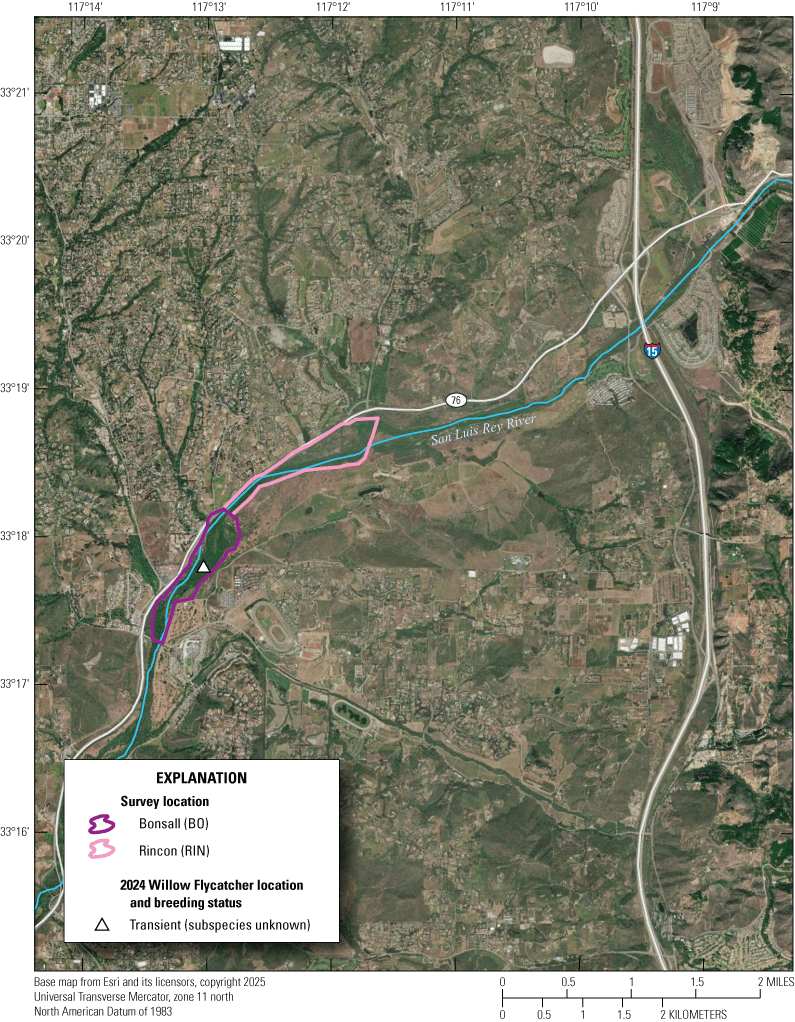
Willow Flycatcher (Empidonax traillii) locations and breeding status at select survey locations on the middle San Luis Rey River, San Diego County, California, 2024.

Willow Flycatcher (Empidonax traillii) locations and breeding status on the upper San Luis Rey River, San Diego County, California, 2024.
Table 1.
Total number and breeding status of Willow Flycatchers (Empidonax traillii) detected at select survey locations on the middle and upper San Luis Rey River, San Diego County, California, 2024.[Survey location: BO, Bonsall; CNF, Cleveland National Forest; RIN, Rincon; RRR, Rey River Ranch; VID, Vista Irrigation District; VLH, VID Lake Henshaw. Abbreviations: Juv., juveniles; Unk., unknown]
Table 2.
Locations, breeding status, and band status of Willow Flycatchers (Empidonax traillii) detected at select locations on the middle and upper San Luis Rey River, San Diego County, California, 2024.[Survey location: BO, Bonsall; CNF, Cleveland National Forest; VID, Vista Irrigation District; VLH, VID Lake Henshaw. Breeding Status: P, pair; T, transient (subspecies unknown); U, undetermined. Sex: F, female; M, male; U, unknown. Banded Bird(s) present: N, no; U, unknown. Other abbreviations: ID, identification; &, and; —, no additional comment]
The distribution of flycatcher territories along the upper San Luis Rey River has shifted since 2018 when Lake Henshaw was first surveyed. From 2018 to 2023, the combined population of flycatchers downstream from Lake Henshaw (CNF, RRR, VID) decreased annually before falling to zero territories in 2023, whereas the population upstream from Henshaw dam (VLH) increased from 2018 to 2021, declined slightly in 2022, increased in 2023, and declined in 2024 (fig. 4).
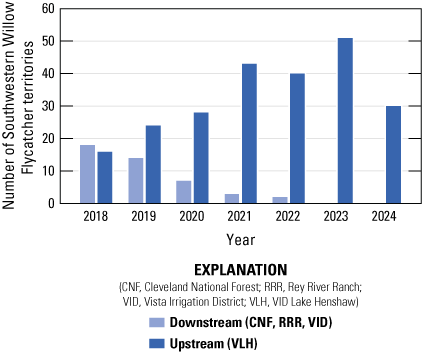
Distribution of Southwestern Willow Flycatcher (Empidonax traillii extimus) territories on the upper San Luis Rey River, San Diego County, California, 2018–24.
Flycatchers used four habitat types along the San Luis Rey River in 2024. Of the flycatcher locations, 86 percent (31/36) were in habitat characterized as mixed willow riparian, 8 percent (3/36) in willow riparian habitat co-dominated by cottonwood, and the remaining 6 percent equally divided between willow riparian habitat co-dominated by either oak or sycamore (table 3). The most frequently recorded dominant vegetation species at flycatcher locations was Goodding’s black willow. Exotic vegetation was not prevalent in the survey area; 97 percent (35/36) of flycatcher locations occurred in habitat with greater than 95-percent native plant cover (table 3).
Table 3.
Habitat characteristics of Willow Flycatcher (Empidonax trailli) locations at select survey locations on the middle and upper San Luis Rey River, San Diego County, California, 2024.[Survey location: BO, Bonsall; CNF, Cleveland National Forest; VID, Vista Irrigation District; VLH, VID Lake Henshaw. Habitat type: Mixed willow riparian: Habitat dominated by one or more willow species, including Goodding’s black willow, arroyo willow, red willow, and sandbar willow, with mule fat as frequent co-dominant. Willow-cottonwood: Willow riparian habitat in which Fremont cottonwood is a co-dominant. Willow-oak: Willow riparian habitat in which Coast live oak is a co-dominant. Willow-sycamore: Willow riparian habitat in which California sycamore is a co-dominant. Other abbreviations: ID, identification; >, greater than; —, no data]
Nest Monitoring
Of the 21 territories at VLH that contained paired flycatchers, 13 were monitored during the 2024 breeding season. There were 22 flycatcher nests located, and of these, 41 percent (9) successfully fledged young. Of the 13 failed nests, 62 percent were depredated (8), 23 percent failed for unknown reasons (3), and 15 percent failed because of cowbird parasitism (2). There were 22 fledglings confirmed, yielding a seasonal productivity of 1.7 young/pair (22 young/13 monitored pairs). An additional four fledglings were confirmed during territory visits to unmonitored territories at VLH (table 2).
Brown-headed Cowbirds
Cowbirds were detected at all six survey locations. During nest monitoring activities, we were able to observe the contents of 19 flycatcher nests during the egg stage. Three of these nests (16 percent) were parasitized, each containing one cowbird egg (table 4). Of the three nests, two were abandoned, and one nest was ultimately successful after the cowbird egg disappeared (MLH02F nest 2; table 4).
Table 4.
Nesting activities of Southwestern Willow Flycatchers (Empidonax trailli extimus) at the upper San Luis Rey River, VID Lake Henshaw, San Diego County, California, 2024.[Nest Outcome: PAR, nest failed as a result of cowbird parasitism; PRE, nest failed as a result of predation; SUC, nest successfully fledged at least one flycatcher young; UNK, nest failed for unknown reasons. Other abbreviations: BHCO, brown-headed cowbird; SWFL, Southwestern Willow Flycatcher; #, number; —, no data]
Summary
In 2024, the overall Southwestern Willow Flycatcher population in the upper San Luis Rey River study area was confined to VID Lake Henshaw (VLH); no territorial flycatchers were documented at the three survey locations below the Henshaw dam (Cleveland National Forest, Rey River Ranch, and Vista Irrigation District). Likewise, no territorial flycatchers were detected in the two locations surveyed along the middle San Luis Rey River (Bonsall and Rincon). In 2024, the flycatcher population at VLH decreased considerably compared to 2023 (36 percent; from 74 territorial flycatchers to 47 territorial flycatchers), with 48 percent fewer females detected (from 40 females to 21 females) and 16 percent fewer males (from 31 males to 26 males) than in 2023. Because there were fewer females detected in 2024, fewer polygynous pairings were documented compared to previous years, which subsequently reduced the overall number of breeding pairs. Although it is possible that some flycatchers at VLH escaped detection because downed trees made it difficult to reach some interior parts of habitat, the distribution of territories in 2024 compared to 2023 indicated that many of the 2023 occupied territories along the outer edge of habitat were unoccupied in 2024.
The population decline observed at VLH was likely related to habitat changes resulting from inundation related to above average precipitation in 2023. The riparian habitat occupied by flycatchers has been continuously submerged since February 2023, and some of the riparian vegetation is experiencing a die-off. Most of the cottonwood and tamarisk trees appeared to be dead, and many black willow trees have snapped and fallen over, although most remain green, and many extended vertical shoots. Observed changes included reduced overall canopy height, reduced tree density, and more gaps in the habitat.
Nest monitoring activities were initiated in 2024 to gather baseline information, including nest success, productivity, and parasitism at Lake Henshaw. Although we have no previous nesting data to compare with the current year, flycatcher pairs in 2024 appeared to produce more fledglings than in 2023. In 2023, no juveniles were observed during surveys at VLH, compared to 26 juveniles observed in 2024. The lack of juveniles produced in 2023 also may have contributed to population declines observed in 2024. Before 2023, there were from 3 to 13 juveniles observed annually during surveys at VLH. The level of parasitism observed in 2024 (16 percent of nests) was within the range observed during demographic monitoring downstream in 2016–19 (from 4 to 27 percent).
Except for Lake Henshaw and Owens River, the Southwestern Willow Flycatcher population in California seems to be experiencing a statewide decline. Populations on the lower San Luis Rey River, the Santa Margarita River on Marine Corps Base Camp Pendleton, and the Kern River have steeply declined or have been extirpated in recent years. Based on the most recent published data (2023), the population along the upper San Luis Rey River near Lake Henshaw is one of the few remaining Southwestern Willow Flycatcher populations in California, making it central to understanding the conditions that favor and promote flycatchers and their habitat.
References Cited
Allen, L.D., and Kus, B.E., 2022, Distribution and abundance of Least Bell’s Vireos (Vireo bellii pusillus) and Southwestern Willow Flycatchers (Empidonax traillii extimus) on the Middle San Luis Rey River, San Diego County, southern California—2021 Data summary: U.S. Geological Survey Data Report 1147, 12 p., accessed January 16, 2025, at https://doi.org/10.3133/dr1147.
Durst, S.L., Sogge, M.K., Stump, S.D., Walker, H.A., Kus, B.E., and Sferra, S.J., 2008, Southwestern Willow Flycatcher breeding site and territory summary—2007: U.S. Geological Survey Open-File Report 2008–1303, 31 p., accessed December 16, 2022, at https://doi.org/10.3133/ofr20081303.
Grinnell, J., and Miller, A.H., 1944, The distribution of the birds of California: Berkeley, Calif., Cooper Ornithological Club, Pacific Coast Avifauna, no. 27, 608 p. [Available at https://sora.unm.edu/sites/default/files/journals/pca/pca_027.pdf.]
Houston, A., Allen, L.D., Mendia, S.M., and Kus, B.E., 2023, Least Bell's Vireos and Southwestern Willow Flycatchers at the San Luis Rey Flood Risk Management Project Area in San Diego County, California—Breeding activities and habitat use—2022 annual report: U.S. Geological Survey Open-File Report 2023–1040, 74 p., accessed October 4, 2023, at https://doi.org/10.3133/ofr20231040.
Howell, S.L., and Kus, B.E., 2021, Distribution and abundance of Southwestern Willow Flycatchers (Empidonax traillii extimus) on the upper San Luis Rey River, San Diego County, California—2020 data summary: U.S. Geological Survey Data Series 1140, 11 p., accessed October 4, 2021, at https://doi.org/10.3133/ds1140.
Howell, S.L., and Kus, B.E., 2022a, Distribution and abundance of Southwestern Willow Flycatchers (Empidonax traillii extimus) on the upper San Luis Rey River, San Diego County, California—2021 data summary: U.S. Geological Survey Data Report 1158, 11 p., accessed November 29, 2022, at https://doi.org/10.3133/dr1158.
Howell, S.L., and Kus, B.E., 2022b, Southwestern Willow Flycatcher (Empidonax traillii extimus) surveys and nest monitoring in San Diego County, California (ver. 4.0, February 2025): U.S. Geological Survey data release, accessed March 13, 2025, at https://doi.org/10.5066/P96VC5Y4.
Howell, S.L., and Kus, B.E., 2023, Distribution and abundance of Southwestern Willow Flycatchers (Empidonax traillii extimus) on the upper San Luis Rey River, San Diego County, California—2022 data summary: U.S. Geological Survey Data Report 1173, 12 p., accessed September 29, 2023, at https://doi.org/10.3133/dr1173.
Howell, S.L., and Kus, B.E., 2024a, Distribution and abundance of Southwestern Willow Flycatchers (Empidonax traillii extimus) on the Upper San Luis Rey River, San Diego County, California—2023 data summary: U.S. Geological Survey Data Report 1194, 13 p. [Available at https://doi.org/10.3133/dr1194.]
Howell, S.L., and Kus, B.E., 2024b, Distribution, abundance, and breeding activities of the Southwestern Willow Flycatcher at Marine Corps Base Camp Pendleton, California—2022 annual report: U.S. Geological Survey Open-File Report 2023–1080, 27 p. [Available at https://doi.org/10.3133/ofr20231080.]
Howell, S.L., Kus, B.E., and Mendia, S.M., 2022, Distribution and demography of Southwestern Willow Flycatchers in San Diego County, 2015–19: U.S. Geological Survey Open-File Report 2022–1082, 43 p., accessed November 29, 2022, at https://doi.org/10.3133/ofr20221082.
Remsen, J.V., Jr., 1978, Bird species of special concern in California: California Department of Fish and Game, Wildlife Management Division, Administrative Report 78-1, 54 p., accessed January 16, 2025, at https://nrm.dfg.ca.gov/FileHandler.ashx?DocumentID=169067&inline.
Schlorff, R.W., 1990, Report to the Fish and Game Commission—Status review of the Willow Flycatcher (Empidonax traillii) in California: State of California, The Resources Agency, Department of Fish and Game, Wildlife Management Division, Department Candidate Species Status Report 90–04, 23 p., accessed October 4, 2021, at https://nrm.dfg.ca.gov/FileHandler.ashx?DocumentID=22572.
Sedgwick, J.A., and Knopf, F.L., 1989, Regionwide polygyny in Willow Flycatchers: The Condor, v. 91, no. 2, p. 473–475. [Available at https://doi.org/10.2307/1368329.]
Seutin, G., 1987, Female song in Willow Flycatchers (Empidonax traillii): The Auk, v. 104, no. 2, p. 329–330. [Available at https://doi.org/10.1093/auk/104.2.329.]
Sogge, M.K., Ahlers, D., and Sferra, S.J., 2010, A natural history summary and survey protocol for the Southwestern Willow Flycatcher: U.S. Geological Survey Techniques and Methods, book 2, chap. A10, 38 p., accessed October 4, 2021, at https://doi.org/10.3133/tm2A10.
Unitt, P., 1987, Empidonax traillii extimus—An endangered subspecies: Western Birds, v. 18, no. 3, p. 137–162. [Available at https://riversedgewest.org/sites/default/files/Unitt_1987_et%20extimus_an%20endangered%20subspecies.pdf.]
U.S. Fish and Wildlife Service, 1993, Endangered and threatened wildlife and plants; proposed rule to list the Southwestern Willow Flycatcher as endangered with critical habitat: Federal Register, v. 58, no. 140, p. 39495–39522. [Available at https://www.govinfo.gov/app/details/FR-1993-07-23.]
U.S. Fish and Wildlife Service, 2002, Final recovery plan—Southwestern Willow Flycatcher (Empidonax traillii extimus): U.S. Fish and Wildlife report, 539 p., accessed December 8, 2022, at https://www.fs.usda.gov/rm/pubs_other/rmrs_2002_finch_d001.pdf.
U.S. Fish and Wildlife Service, 2014, Southwestern Willow Flycatcher (Empidonax traillii extimus) 5-year review—Summary and evaluation: U.S. Fish and Wildlife Service report, 104 p, accessed December 8, 2022, at https://ecos.fws.gov/docs/five_year_review/doc4437.pdf.
Wheelock, I.G., 1912, Birds of California—An introduction to more than three hundred common birds of the State and adjacent islands: Chicago, Ill., A.C. McClurg and Company, 578 p. [Available at https://www.biodiversitylibrary.org/page/37239493.]
Whitfield, M.J., and Sogge, M.K., 1999, Range-wide impact of Brown-headed Cowbird parasitism on the Southwestern Willow Flycatcher (Empidonax traillii extimus): Studies in Avian Biology, v. 18, p. 182–190. [Available at https://sora.unm.edu/node/139542.]
Willett, G., 1912, Birds of the Pacific slope of southern California: Hollywood, Calif., Cooper Ornithological Club, Pacific Coast Avifauna, v. 7, 120 p. [Available at https://sora.unm.edu/node/102.]
Willett, G., 1933, A revised list of the birds of southwestern California: Los Angeles, Cooper Ornithological Club, Pacific Coast Avifauna, v. 21, 204 p. [Available at https://sora.unm.edu/node/116.]
Datums
Horizontal coordinate information is referenced to the North American Datum of 1983 (NAD 83) and the World Geodetic System of 1984 (WGS 84).
For more information concerning the research in this report, contact the
Director, Western Ecological Research Center
U.S. Geological Survey
3020 State University Drive East
Sacramento, California 95819
https://www.usgs.gov/centers/werc
Publishing support provided by the U.S. Geological Survey
Science Publishing Network, Sacramento Publishing Service Center
Disclaimers
Any use of trade, firm, or product names is for descriptive purposes only and does not imply endorsement by the U.S. Government.
Although this information product, for the most part, is in the public domain, it also may contain copyrighted materials as noted in the text. Permission to reproduce copyrighted items must be secured from the copyright owner.
Suggested Citation
Howell, S.L., and Kus, B.E., 2025, Distribution, abundance, and breeding activities of Southwestern Willow Flycatchers (Empidonax traillii extimus) at select locations on the San Luis Rey River, San Diego County, California—2024 data summary: U.S. Geological Survey Data Report 1212, 16 p., https://doi.org/10.3133/dr1212.
ISSN: 2771-9448 (online)
Study Area
| Publication type | Report |
|---|---|
| Publication Subtype | USGS Numbered Series |
| Title | Distribution, abundance, and breeding activities of Southwestern Willow Flycatchers (Empidonax traillii extimus) at select locations on the San Luis Rey River, San Diego County, California—2024 data summary |
| Series title | Data Report |
| Series number | 1212 |
| DOI | 10.3133/dr1212 |
| Publication Date | May 28, 2025 |
| Year Published | 2025 |
| Language | English |
| Publisher | U.S. Geological Survey |
| Publisher location | Reston, VA |
| Contributing office(s) | Western Ecological Research Center |
| Description | Report: vi, 16 p.; Data Release |
| Country | United States |
| State | California |
| County | San Diego County |
| Other Geospatial | San Luis Rey River |
| Online Only (Y/N) | Y |