


Distribution, Abundance, and Habitat Characteristics of Coastal Cactus Wrens (Campylorhynchus brunneicapillus) in San Diego County, California—2024 Data Summary
Links
- Document: Report (5.9 MB pdf) , HTML , XML
- Data Release: USGS data release - Surveys and monitoring of coastal Cactus Wren in southern San Diego County
- Download citation as: RIS | Dublin Core
Acknowledgments
This study was funded by the San Diego Association of Governments.
We thank the biologists who assisted in data collection for this project: Annabelle Bernabe, Alexandra Houston, Scarlett Howell, Walter Paul Kessler, Jessica Medina, Shannon Mendia, and Aaron Spiller of the U.S. Geological Survey. We also thank the land managers, property owners, and other stakeholders who facilitated access to the survey plots. Parts of this report were written following a previously developed template to maintain consistent presentation of results.
Executive Summary
We surveyed for coastal Cactus Wren (Campylorhynchus brunneicapillus) in 507 established plots in San Diego County in 2024, encompassing four genetic clusters (Otay, Lake Jennings, Sweetwater/Encanto, and San Pasqual). Of the 507 plots, 376 have been surveyed every year starting in 2020. Two surveys were completed at each plot between March 1 and July 31, 2024. Cactus Wrens were detected in 216 plots (43 percent of plots). Cactus Wrens were detected in 34 percent of the plots that have been consistently surveyed since 2020, indicating a higher plot occupancy rate than in 2023 (26 percent) and a similar plot occupancy rate to 2022 (31 percent), 2021 (34 percent), and 2020 (35 percent). There were 175 Cactus Wren territories detected across all survey plots in 2024. We documented 111 territories in the plots that have been consistently surveyed since 2020, which is an increase from 85 territories in 2023 and from 94 territories in 2022, and similar to the number of territories documented in 2021 (113) and 2020 (109). The number of territories declined from 2023 to 2024 in the San Pasqual genetic cluster but increased in the Otay, Lake Jennings, and Sweetwater/Encanto genetic clusters. At least 86 percent of Cactus Wren territories were occupied by pairs, and 176 fledglings were observed in 2024.
We observed six banded Cactus Wrens in 2024, all of which we could identify individually by color band combination. Adults of known age ranged from 5 to 8 years old. All individually identifiable adult Cactus Wrens occupied the same territory in 2024 that they occupied during 2022 or 2023. We detected no movement of banded Cactus Wrens between genetic clusters during 2024.
Vegetation at Cactus Wren survey plots was dominated by coastal sage scrub shrubs, such as California sagebrush (Artemisia californica), California buckwheat (Eriogonum fasciculatum), lemonade berry (Rhus integrifolia), San Diego County sunflower (Bahiopsis laciniata), and laurel sumac (Malosma laurina). Cactus Wrens preferentially occupied plots dominated by California buckwheat in the Otay genetic cluster and avoided plots dominated by lemonade berry (results of this test were marginally significant). Cactus Wrens also appeared to prefer plots dominated by broom baccharis (Baccharis sarothroides) in the Sweetwater/Encanto cluster and plots dominated by California buckwheat in the San Pasqual genetic cluster, although these preferences were marginally statistically significant. No definitive signs of fungal pathogens were observed on cactus within and around survey plots. Blue elderberry (Sambucus mexicana) was detected at 43 percent of plots, and Cactus Wrens preferentially occupied more plots with elderberry than were available. Very little dead or unhealthy cactus was observed within all survey plots, and Cactus Wrens preferentially occupied plots with lower amounts of dead and unhealthy cactus than were available. Over 80 percent of plots had more than 5 percent of cactus crowded or overtopped by vines and shrubs, and Cactus Wren occupied plots in proportion to the degree of shrub and vine crowding or overtopping. Non-native annual cover was less prevalent in survey plots in 2024 than in 2023, and Cactus Wrens preferentially occupied plots with less non-native cover.
Introduction
The coastal Cactus Wren (Campylorhynchus brunneicapillus, also referred to as “wren” in this report) is a fragmentation-sensitive resident species in southern California that requires thickets of cholla (Cylindropuntia spp.) or prickly pear cactus (Opuntia spp.) for nesting. Limited naturally by the patchy distribution of this habitat, wren populations have become further fragmented in recent decades by urbanization, habitat degradation, and stochastic events, such as wildfire (Solek and Szijj, 2004; Hamilton and others, 2020). As a result, wren populations have been diminished in size and distribution and occur largely as islands in a matrix of generally unsuitable habitat.
Among the possible consequences of habitat fragmentation on wren viability is genetic isolation, which can lead to loss of genetic variability and ability to adapt to changing environments (Barr and others, 2015). Although wrens, like other birds, are mobile and can presumably fly long distances between habitat patches (Barr and others, 2012, 2013; Preston and Kamada, 2012; Kamada and Preston, 2013), movement of wrens between patches in southern California seems to be rare (Lynn and others, 2022). Juvenile dispersal, whereby young birds leave their natal territories and establish breeding territories of their own, is the primary process responsible for genetic connectivity. Few juveniles have been documented dispersing among cactus sites in San Diego County (Lynn and others, 2022).
In addition to isolation, population declines in the southern part of the range have raised concerns regarding the capacity for long-term persistence of wrens in San Diego County. Coastal Cactus Wren populations have declined in southern California during the last three decades (Preston and Kamada, 2012); however, in San Diego County, particularly steep declines have been documented in the southern part of the county near Otay Valley. Wren territories on conserved lands in this region, which numbered 53 in 1992, declined to 14 in 2014 (The Nature Conservancy and San Diego Management and Monitoring Program, 2015). Although the wren population in Otay Valley increased to 43 territories by 2021 (Lynn and Kus, 2022), this population decreased to 34 territories by 2022 (Lynn and Kus, 2023) and 37 territories in 2023 (Lynn and Kus, 2024), remaining below the minimum effective population size of 50–100 individuals needed to prevent inbreeding depression (Frankham and others, 2014; Vandergast and others, 2022).
Although associated with declines beginning in the late 1980s (Rea and Weaver, 1990; Solek and Szijj, 2004; Hamilton and others, 2020), neither fire nor development seem to be the primary factor responsible for the more recent and localized Otay wren population decline. Recent multiple years of drought could have affected wren abundance by reducing arthropod food resources, which could lower fecundity and survival (Preston and Kamada, 2012; Lynn and others, 2022). Annual precipitation has been less than 75 percent (less than 18.0 centimeters [cm]) of the 1920–2024 average (24.0 cm) in half of the last 24 years (2000–24); precipitation was less than 50 percent (less than 12.0 cm) of average in 8 of those years (6 years between 2000 and 2010; 2 years between 2011 and 2024; National Centers for Environmental Information, 2024). In 2014, an extreme drought year, productivity was exceptionally low, with only 3 fledglings observed during surveys of a population occupying 14 territories in the Otay region (The Nature Conservancy and San Diego Management and Monitoring Program, 2015). In 2022, a less extreme drought year, more fledglings (33) were observed during surveys at 34 territories in the Otay region (Lynn and Kus, 2023).
Cactus Wrens are restricted to cactus scrub habitat, which is a rare vegetation community in San Diego County. Cactus scrub habitat is vulnerable to degradation by invasion of non-native annual plants and grasses and is slow to recover from wildfire (Mitrovich and Hamilton, 2007; Hamilton, 2009). Dense non-native annual plants and grass within cactus scrub likely reduce the suitability of these areas for wrens, which primarily glean arthropod prey from bare ground and litter at the base of cactus and shrubs (Lynn and others, 2022).
Researchers in Orange County identified blue elderberry (Sambucus mexicana; also referred to as “elderberry” in this report) as a potentially important resource for Cactus Wrens. Elderberry was observed in many wren territories in Orange County, and researchers there suggested that it provided territorial advertising perches for adults, escape cover for fledglings, and a food source from berries; in addition, it could be an important host for prey arthropods (K. Preston, U.S. Geological Survey, oral commun., 2015; Hamilton and others, 2020). This pattern occurred in San Diego County as well, where wrens were more likely to occupy plots with elderberry than plots without it (Lynn and Kus, 2021, 2022, 2023, 2024; Winchell and others, 2021). Arthropod abundance also was higher in elderberry than in other plant species in cactus scrub habitat in southern San Diego County (Lynn and others, 2022).
The Cactus Wren was selected as one of several indicator species by the San Diego Management and Monitoring Program to evaluate the state of the regional preserve system in San Diego County (Preston and others, 2022). The wren serves as an indicator for cactus scrub, a rare vegetation community, and is also a species of very high conservation priority within the regional preserve system. The goals of the 2024 Cactus Wren effort were to perform surveys to assess the population status and to provide data to address two metrics used to evaluate the condition of the population in western San Diego County. Metrics for evaluating the overall status of the species include the proportion of cactus plots occupied by wrens and the quality of the cactus habitat. In addition, we collected data to better understand demographics within the wren population in western San Diego County. This data collection effort included resighting banded birds to determine age and movement of individuals, determining breeding status of wrens by observing paired behavior and documenting active nests and fledglings observed during surveys, and summarizing habitat attributes in occupied and available cactus wren survey plots.
Data presented in this report can be found in a data release (Kus and Lynn, 2022; ver. 5.0 at https://doi.org/10.5066/F76H4FK5). This report is the annual update to surveys that have been performed since 2015 (2015 and 2017–23; Lynn and Kus, 2021, 2022, 2023, 2024; Kus and Lynn, 2022; Lynn and others, 2022). The study background, objectives, and methods were originally presented in Lynn and Kus (2021) and are updated in this report.
Study Area and Methods
Survey plots were established throughout San Diego County by the U.S. Fish and Wildlife Service in 2011. We selected a subset of these plots that included four genetic clusters: (1) Otay, (2) Lake Jennings (also called “San Diego” genetic cluster in the data release [Kus and Lynn, 2022; ver. 5.0]), (3) Sweetwater/Encanto, and (4) San Pasqual (Barr and others, 2015; fig. 1). Plots in the Otay, Lake Jennings, and Sweetwater/Encanto genetic clusters were surveyed initially in 2015, and most have been surveyed annually from 2017 to 2024, with occasional new plots added when wrens were found in new locations. In total, 507 plots have been surveyed at least once since 2015. We surveyed 376 plots consistently from 2020 to 2024. We surveyed plots in the San Pasqual genetic cluster in 2019, 2022, 2023, and 2024. In 2022, 2023, and 2024, we surveyed 16 new plots in the northern part of the Lake Jennings genetic cluster to detect potential northward movement of wrens.
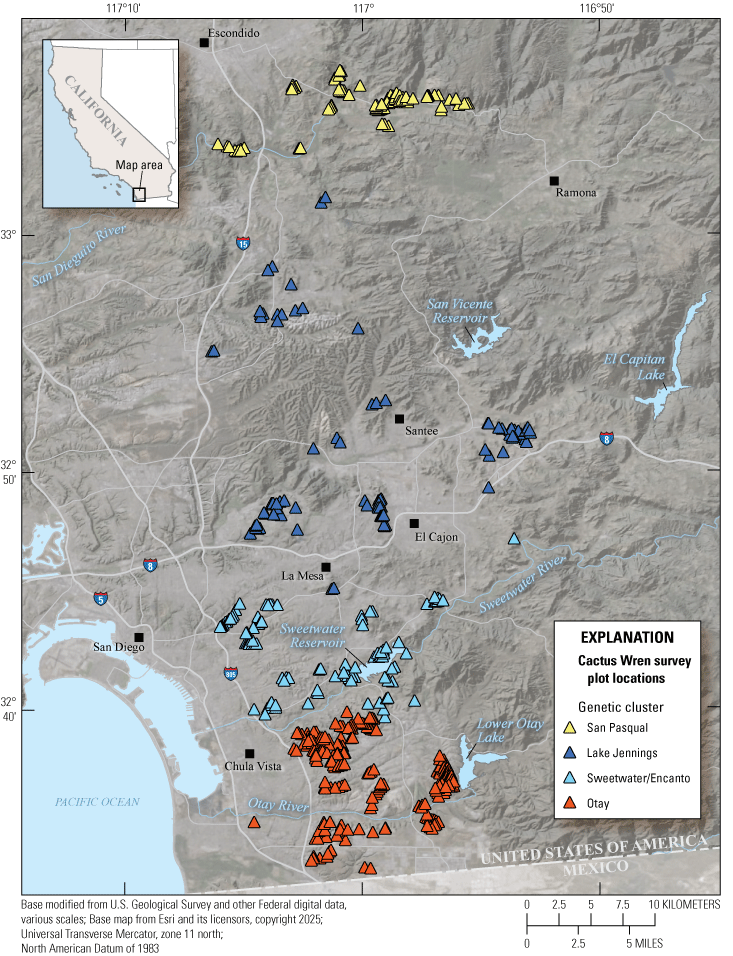
Cactus Wren survey plot locations by genetic cluster in San Diego County, California, 2024.
We visited each survey plot twice during a survey year: once between March 1 and May 31 and once between June 1 and July 31. Upon arrival, surveyors scanned the plot for wrens and wren nests, and if wrens were not immediately detected, the surveyor broadcasted a wren song for 15–30 seconds to elicit a response. If wrens were not detected, surveyors carefully traversed the plot for up to 20 minutes, looking for wrens or wren nests and periodically broadcasting the wren song. In addition to recording the presence or absence of wrens, observers attempted to count all wrens within the plot, determine their age, resight leg bands to identify individuals by unique colored leg band combinations from banding in previous studies (Lynn and others, 2022), and record the presence of active nests. Surveyors used Samsung Galaxy XCover6 Pro mobile phones with Android operating systems that have a built-in Global Positioning System to collect geographic coordinates (World Geodetic System of 1984) of where wrens and wren nests were located.
Cactus Wren territories often included all or parts of multiple survey plots; therefore, occupancy of survey plots alone likely overestimated the actual number of wrens in the survey areas. To arrive at a more standard population count, surveyors observed the behavior of wrens for up to 20 minutes during surveys to determine the actual number of wrens using a block of survey plots. We compiled data on population parameters, including number of wrens, age, breeding status (whether the wrens were paired or not), evidence of breeding (nests or fledglings observed), and color-band status by territory rather than by survey plot. Because Cactus Wrens do not show obvious sex- or age-distinguishing characteristics when observed under normal field conditions, we typically determined sex and age by specific behavioral cues or morphology when captured. Sex-related behavioral cues include position during copulation or incubation (females only). When in the hand, sex can be determined by the presence of a brood patch (females only) or cloacal protuberance (males only). If we did not observe sex-related behavioral cues, we assigned an adult as “male” if it sang or called more frequently or was more visually conspicuous (potentially advertising territory boundaries), although females also can show these behaviors. Juvenile behavior that helped distinguish age included begging from adults, rudimentary vocalizations, and sibling group behavior. Young juveniles had shorter bills and tails and a more diffuse throat patch than adults and generally appeared bright and clean compared to adults with worn and brownish plumage.
Cactus Wren Age and Movement
In 2024, we attempted to resight all wrens at survey plots to identify individuals based on color-band combinations. When bands were missing or observations were unclear, we returned on non-survey days to take photographs using a Canon 7D Mark II digital single lens reflex camera with a Canon 100–400 millimeters F/4.5–5.6 zoom lens. We used the photographs to distinguish fine color differences (faded bands) or to read numbers on metal bands. We used color-band resighting data to determine age and to document movement from banding sites.
Vegetation Characteristics
During the first of the two annual surveys in 2024, observers noted habitat characteristics at each plot. These data included (a) dominant or co-dominant tree or shrub species, (b) presence or absence of elderberry, (c) the percentage of cactus that was dead, (d) the percentage of cactus that was unhealthy (gray, shriveled, with discolored patches typical of fungus or other diseases), (e) the percentage of cactus overtopped or crowded by vines or shrubs, and (f) the percentage of the plot covered by non-native annual plant species. We did not collect cactus-related data (c, d, and e) at four plots where no cactus was detected. Of these four plots, three were in the northern part of the Lake Jennings genetic cluster and contained coastal sage scrub habitat with cactus in surrounding parcels. We surveyed these three plots to detect potential movement between the Lake Jennings and San Pasqual genetic clusters. The fourth plot contained cactus in previous years, but the cactus had either died and disintegrated or had been removed in recent years. We visually estimated the cover of vegetation characteristics c–f and assigned them to one of seven cover categories: (1) 0 percent, (2) greater than 0 but less than 1 percent, (3) 1 to 5 percent, (4) greater than 5 percent and up to 25 percent, (5) greater than 25 percent and up to 50 percent, (6) greater than 50 percent and up to 75 percent, and (7) greater than 75 percent. Surveyors also looked for signs of fungal pathogens on cactus (for example, Fusarium brachygibbosum and Cladosporium cladosporioides).
After examining the distribution of percentage cover for vegetation characteristics c‒f, we combined category numbers 1‒3 (0‒5-percent cover) and category numbers 4‒7 (greater than 5-percent cover). We used chi-square goodness-of-fit analyses for each vegetation characteristic to determine if the proportion of occupied plots with 0‒5-percent cover versus plots with greater than 5-percent cover differed from the proportion of all plots (available) in the two cover categories. We did not perform chi-square tests if sample sizes were small (if the expected number of plots in any category was less than 5). We also used chi-square analyses to determine if wren-occupied plots contained elderberry in the same proportion as what was available in all plots, and if occupied plots within each genetic cluster were dominated or co-dominated by each shrub species in proportion to the dominant or co-dominant shrub species across all survey plots. Given the sensitive status of coastal Cactus Wrens, we assigned statistical significance as P less than or equal to 0.10 to avoid overlooking potentially meaningful relationships relevant to management of the species in San Diego County.
Results
We surveyed 507 plots for Cactus Wrens in 2024 (table 1). Wrens were detected at 43 percent of all plots (216/507), 25 percent of Otay plots (53/209), 36 percent of Lake Jennings plots (31/87), 47 percent of Sweetwater/Encanto plots (47/100), and 77 percent of San Pasqual plots (85/111; table 1). Wrens were detected at 34 percent of plots (128/376) that have been surveyed annually since 2020. We observed 175 wren territories throughout all survey plots (table 2). We determined that wrens in 151 territories (86 percent) were paired. We could not determine the breeding status of wrens in the remaining 24 territories. We detected active brood nests (containing eggs or nestlings) or fledglings at 94 territories, and we observed 176 fledglings during the surveys.
Table 1.
Number of plots surveyed and number occupied by Cactus Wrens by genetic cluster in 2024, San Diego County, California.[Survey 1, April 1 through May 31, 2024; survey 2, June 1 through July 31, 2024]
Table 2.
Number and breeding status of Cactus Wren territories by genetic cluster in 2024, San Diego County, California.[No., number]
Cactus Wren Age and Movement
During surveys in 2024, we observed 310 adult wrens well enough to determine banding status. Banding status was determined for 173 males (99 percent of all males) and 137 females (91 percent of all females). We detected six banded adult wrens in 2024 (table 3). Although five wrens were missing at least one color band, they occupied the same territories where wrens with consistent color-band combinations had been identified in 2022 or 2023; hence, we assumed that they were the same individuals in 2024. Adult birds ranged from 5 to 8 years old.
Table 3.
Age, location, and number of banded Cactus Wrens by genetic cluster in 2024, San Diego County, California.[yrs, years; ≥, greater than or equal to]
Resighting banded birds allowed us to identify individuals that either remained in the same territory they used in the previous year or moved to a different location. Four of the six banded wrens occupied the same territory in 2024 that they occupied in 2023 (within 100 meters). The two other wrens were not detected in 2023 but occupied the same territory in 2024 that they occupied in 2022. We did not detect adult movement between genetic clusters from 2023 to 2024.
Vegetation Characteristics
Vegetation characteristics were recorded at all 507 Cactus Wren survey plots in 2024. Common coastal sage scrub species were the dominant shrub species at most of the plots, including California sagebrush (Artemisia californica), California buckwheat (Eriogonum fasciculatum), lemonade berry (Rhus integrifolia), San Diego County sunflower (Bahiopsis laciniata), and laurel sumac (Malosma laurina; table 4). California sagebrush, California buckwheat, and lemonade berry were the dominant or co-dominant shrub species at most of the plots that were occupied by wrens. In general, Cactus Wrens occupied plots with dominant or co-dominant plant species in proportion to their availability. However, in the Otay genetic cluster, wrens preferentially occupied more plots that were dominated by California buckwheat than were available in all Otay plots (fig. 2) and avoided plots with lemonade berry, a preference that likely was biologically significant although only marginally statistically significant. Wrens also showed a marginally statistically significant preference for plots dominated by broom baccharis in the Sweetwater/Encanto cluster and for plots dominated by California buckwheat in the San Pasqual cluster. No definitive signs of fungal pathogens were observed on cactus within and around survey plots in 2024.
Table 4.
Shrub species that were dominant or co-dominant at all Cactus Wren survey plots and the number of plots with those dominant or co-dominant shrub species that were used by Cactus Wrens (in parentheses) in 2024, San Diego County, California.[—, not present]
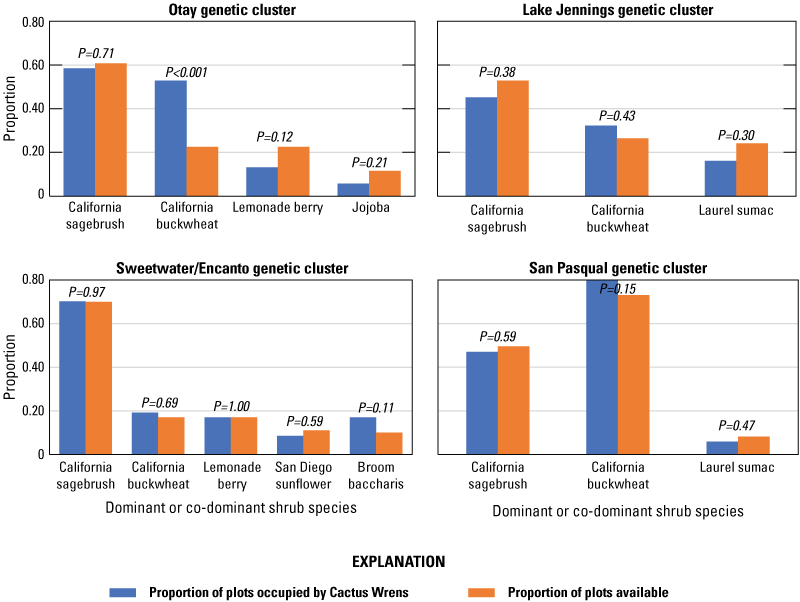
Proportion of occupied Cactus Wren survey plots dominated by each shrub species compared to the proportion of available survey plots dominated by that shrub species by genetic cluster in 2024, San Diego County, California. Probability values (P-values) presented for chi-square, goodness-of-fit test results. Shrub species comparisons are only presented if sample sizes were sufficient to analyze using chi-square, goodness-of-fit tests. A plot may have more than one co-dominant shrub species so that proportions do not add to 1.
Of the 507 plots, 220 (43 percent) contained elderberry. Of the 216 plots that were occupied by wrens, 140 (65 percent) contained elderberry, a significantly higher percentage than was available (fig. 3, chi-square=41.9, P less than 0.001).
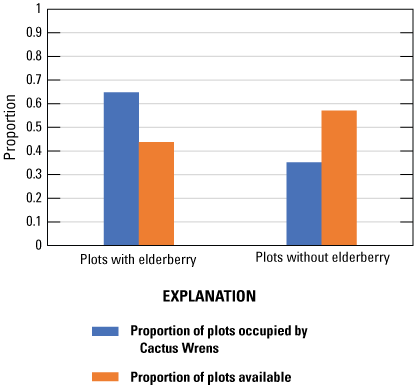
Proportion of occupied and available Cactus Wren survey plots that contained and did not contain elderberry in 2024, San Diego County, California.
At most wren survey plots in 2024 (447 plots, 89 percent of plots), 5 percent or less of the cactus was dead (table 5; fig. 4). Between 5 and 25 percent of the cactus was dead in 52 plots (10 percent of plots), and more than 25 percent of the cactus was dead in 4 plots (1 percent of plots). Of the 216 plots that were occupied by wrens, 201 (93 percent) contained 5 percent or less dead cactus, a significantly higher percentage than what was available (chi-square=3.6, P=0.06; fig. 4).
Table 5.
Number of Cactus Wren survey plots with dead cactus in 2024, San Diego County, California.[Parentheses contain the number of survey plots occupied by Cactus Wrens. Abbreviations: —, not present; <, less than; >, greater than]
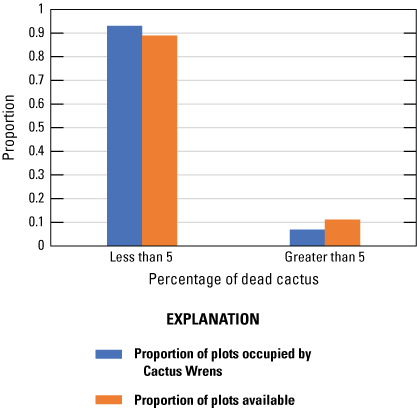
Proportion of survey plots that were occupied by Cactus Wrens and the proportion of survey plots that were available by the percentage of dead cactus present, San Diego County, California, 2024.
At most wren plots (481 plots, 96 percent of plots) 5 percent or less of the cactus was unhealthy (table 6; fig. 5). Between 5 and 25 percent of cactus was unhealthy at 17 plots (3 percent of plots). Five plots (1 percent of the plots) contained more than 25 percent of cactus that was unhealthy. Of the 216 plots that were occupied by wrens, 213 (99 percent) contained 5 percent or less unhealthy cactus, a significantly higher percentage than what was available (chi-square=3.8, P=0.05; fig. 5).
Table 6.
Number of Cactus Wren survey plots with unhealthy cactus in 2024, San Diego County, California.[Parentheses contain the number of survey plots occupied by Cactus Wrens. Abbreviations: —, not present; <, less than; >, greater than]
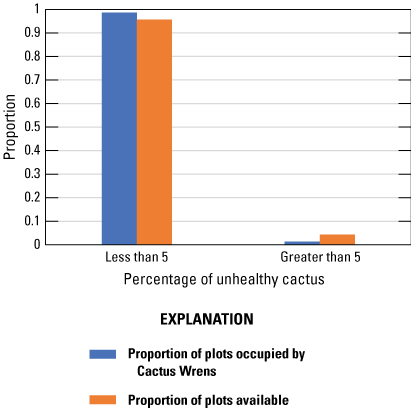
Proportion of survey plots that were occupied by Cactus Wrens and the proportion of survey plots that were available by the percentage of unhealthy cactus present, San Diego County, California, 2024.
Shrubs and vines crowded or overtopped 5 percent or less of cactus at 89 plots (18 percent of plots; table 7; fig. 6). Between 5 and 25 percent of cactus was overtopped by shrubs and vines at 160 plots (32 percent of plots). Shrubs and vines crowded or overtopped more than 25 percent of cactus at 254 plots (50 percent of plots). Of the 216 plots that were occupied by wrens, 38 (18 percent) contained 5 percent or less cactus that was overtopped by shrubs and vines, which is not significantly different than what was available (chi-square less than 0.1, P=0.88; fig. 6).
Table 7.
Number of Cactus Wren survey plots with cactus that was crowded or overtopped by shrubs and vines in 2024, San Diego County, California.[Parentheses contain number of survey plots occupied by Cactus Wrens. Abbreviations: —, not present; <, less than; >, greater than]
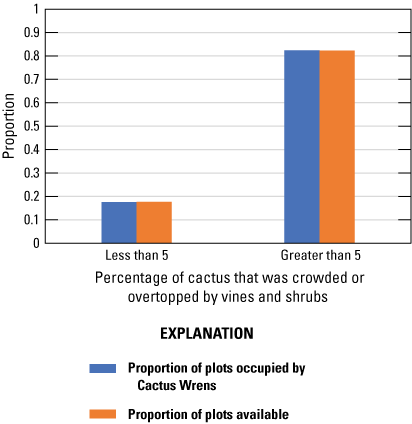
Proportion of survey plots that were occupied by Cactus Wrens and the proportion of survey plots that were available by the percentage of cactus present that was crowded or overtopped by shrubs or vines, San Diego County, California, 2024.
Non-native annual grasses and forbs covered 5 percent or less of the wren survey plots at 232 plots (46 percent of plots; table 8; fig. 7). Between 5 and 25 percent of the plot was covered by non-native annual grasses and forbs at 169 plots (33 percent of plots). There was more than 25-percent non-native annual cover at 106 plots (21 percent of the plots). Of the 216 plots that were occupied by wrens, 116 (54 percent) contained 5-percent or less non-native annual cover, a significantly higher percentage than what was available (chi-square=5.2, P=0.02; fig. 7).
Table 8.
Number of Cactus Wren survey plots with non-native annual cover in 2024, San Diego County, California.[Parentheses contain number of survey plots occupied by Cactus Wrens. Abbreviations: <, less than; >, greater than]
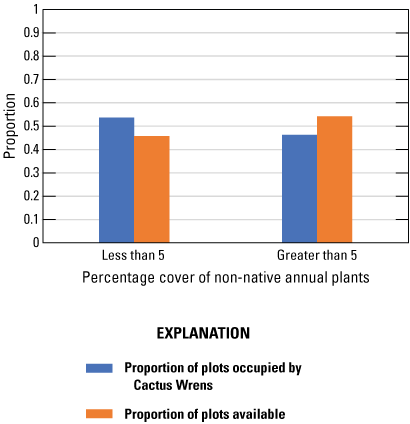
Proportion of survey plots that were used by Cactus Wrens and the proportion of survey plots that were available by the percentage cover of non-native annual plants, San Diego County, California, 2024.
Summary
Cactus Wrens were detected in 43 percent of all survey plots in 2024. Excluding plots that were not surveyed in 2020 and 2021 (the San Pasqual genetic cluster and other plots in the Lake Jennings genetic cluster that were not surveyed consistently), 34 percent of plots were occupied in 2024, an increase from the 26 percent occupied in 2023 and the 31 percent occupied in 2022, and similar to the 35 percent occupied in 2021 and the 35 percent of plots occupied in 2020 (Lynn and Kus, 2021, 2022, 2023, 2024). The number of wren territories in plots that were surveyed consistently from 2020 to 2024 increased 26 percent from 2023 to 2024 (from 85 to 107 territories, respectively), after a 10-percent decrease from 2022 to 2023, a 17-percent decrease from 2021 to 2022, and a 4-percent increase from 2020 to 2021. The number of territories detected from 2023 to 2024 (in plots that were consistently surveyed from 2020 to 2024) increased in the Otay, Lake Jennings, and Sweetwater/Encanto clusters by 17 percent, 79 percent, and 14 percent, respectively. The number of territories in the San Pasqual genetic cluster decreased by 8 percent from 2023 to 2024.
We did not detect any movement of wrens between genetic clusters from 2023 to 2024. We have not detected movement of wrens between genetic clusters since 2020.
Typical wren habitat was characterized by coastal sage scrub plant species with a component of taller woody shrubs, such as lemonade berry and laurel sumac. The composition of small shrubs in survey plots was consistent across genetic clusters, with California sagebrush and California buckwheat the dominant species in most plots. Less common dominant shrub species showed some variation in the degree and direction of selection among genetic clusters; however, those relationships were typically not statistically significant. Wrens in the Otay genetic cluster preferred plots dominated by California buckwheat and appeared to avoid plots with lemonade berry. Cactus Wrens in the Sweetwater/Encanto cluster showed a marginally significant preference for plots dominated by broom baccharis, and wrens in the San Pasqual cluster showed a marginally significant preference for plots dominated by California buckwheat.
Although most of the survey plots did not contain elderberry, wrens preferentially occupied plots with elderberry, which is consistent with occupancy of elderberry-containing plots in all years from 2020 to 2023, except 2021, when wrens used plots with elderberry in proportion to their availability. The cactus in most survey plots was healthy and, as in previous years, with a few exceptions, wrens preferred survey plots with less dead and unhealthy cactus. Over 80 percent of survey plots continued to have more than 5 percent of cactus crowded or overtopped by vines and shrubs in 2024, but as in all previous years except 2022, wrens did not preferentially select plots with less shrub and vine crowding and overtopping. Non-native annual cover was less prevalent in survey plots in 2024 than in 2023 (54 percent versus 82 percent of plots with more than 5-percent non-native annual cover, respectively), and unlike in 2020 through 2023, wrens preferentially occupied survey plots with less non-native annual cover in 2024.
References Cited
Barr, K.R., Kus, B.E., Preston, K.L., Howell, S., Perkins, E., and Vandergast, A.G., 2015, Habitat fragmentation in coastal southern California disrupts genetic connectivity in the Cactus Wren (Campylorhynchus brunneicapillus): Molecular Ecology, v. 24, no. 10, p. 2349–2363. [Available at https://doi.org/10.1111/mec.13176.]
Barr, K.R., Vandergast, A.G., and Kus, B.E., 2012, Genetic connectivity in the Coastal Cactus Wren: U.S. Geological Survey Data Summary report prepared for the San Diego Management and Monitoring Program, 30 p., accessed August 26, 2024, at https://sdmmp.com/download.php?cid=CiteID_1603251358357780.
Barr, K.R., Vandergast, A.G., and Kus, B.E., 2013, Genetic structure in the Cactus Wren in coastal southern California: U.S. Geological Survey Data Summary report prepared for the California Department of Fish and Wildlife, 27 p., accessed August 26, 2024, at nrm.dfg.ca.gov/FileHandler.ashx?DocumentID=65007.
Frankham, R., Bradshaw, C.J.A., and Brook, B.W., 2014, Genetics in conservation management—Revised recommendations for the 50/500 rules, Red List criteria and population viability analyses: Biological Conservation, v. 170, p. 56–63. [Available at https://doi.org/10.1016/j.biocon.2013.12.036.]
Hamilton, R.A., 2009, 2008 Surveys—Cactus Wrens and California Gnatcatchers San Dieguito River Valley, San Diego County: Long Beach, Calif., prepared for the Conservation Biology Institute, 112 p., accessed August 26, 2024, at https://sdmmp.com/view_article.php?cid=CiteID_1603251358355960.
Hamilton, R.A., Proudfoot, G.A., Sherry, D.A., and Johnson, S.L., 2020, Cactus Wren (Campylorhynchus brunneicapillus) (ver. 1.0, March 4, 2020), in Poole, A.F., ed., Birds of the world: Ithaca, N.Y., Cornell Lab of Ornithology, accessed August 26, 2024, at https://doi.org/10.2173/bow.cacwre.01.
Kamada, D., and Preston, K., 2013, Nature reserve of Orange County—Coastal Cactus Wren dispersal and survival surveys, genetics & parasite sampling, and arthropod foraging ecology in 2012: Annual report prepared in fulfillment of reporting requirements for the memorandum of understanding between Dana Kamada and the California Department of Fish and Wildlife, 92 p., accessed August 26, 2024, at https://sdmmp.com/upload/SDMMP_Repository/0/25hms3p4y9qxw7rv18gdkzncbft0j6.pdf.
Kus, B.E., and Lynn, S., 2022, Surveys and monitoring of coastal Cactus Wren in southern San Diego County (ver. 5.0, December 2024): U.S. Geological Survey data release, accessed August 26, 2024, at https://doi.org/10.5066/F76H4FK5.
Lynn, S., and Kus, B.E., 2021, Distribution and demography of coastal Cactus Wrens (Campylorhynchus brunneicapillus) in southern San Diego County, California—2020 data summary: U.S. Geological Survey Data Series 1138, 12 p., accessed March 25, 2025, at https://doi.org/10.3133/ds1138.
Lynn, S., and Kus, B.E., 2022, Distribution and demography of coastal Cactus Wrens (Campylorhynchus brunneicapillus) in southern San Diego County, California—2021 data summary: U.S. Geological Survey Data Report 1159, 14 p., accessed March 25, 2025, at https://doi.org/10.3133/dr1159.
Lynn, S., and Kus, B.E., 2023, Distribution and demography of coastal Cactus Wrens (Campylorhynchus brunneicapillus) in southern San Diego County, California—2022 data summary: U.S. Geological Survey Data Report 1174, 14 p., accessed March 25, 2025, at https://doi.org/10.3133/dr1174.
Lynn, S., Houston, A., and Kus, B.E., 2022, Distribution and demography of coastal Cactus Wrens in Southern California, 2015–19: U.S. Geological Survey Open-File Report 2022–1044, 44 p., accessed March 25, 2025, at https://doi.org/10.3133/ofr20221044.
Lynn, S., and Kus, B.E., 2024, Distribution, abundance, and habitat characteristics of coastal Cactus Wrens (Campylorhynchus brunneicapillus) in San Diego County, California—2023 data summary: U.S. Geological Survey Data Report 1196, 14 p., accessed March 25, 2025, at https://doi.org/10.3133/dr1196.
Mitrovich, M.J., and Hamilton, R.A., 2007, Status of the Cactus Wren (Campylorhynchus brunneicapillus) within the coastal subregion of Orange County, California: Prepared for Nature Reserve of Orange County, 18 p., accessed August 26, 2024, at https://sdmmp.com/view_article.php?cid=CiteID_1603251358359050.
National Centers for Environmental Information, 2024, Global summary of the month (GSOM), version 1: National Centers for Environmental Information, National Oceanic and Atmospheric Administration database, accessed August 26, 2024, at https://www.ncei.noaa.gov/access/search/data-search/global-summary-of-the-month?dataTypes=PRCP&bbox=32.718,-117.161,32.564,-117.007.
Preston, K., and Kamada, D., 2012, Nature reserve of Orange County—Monitoring coastal Cactus Wren reproduction, dispersal, and survival, 2009–2011: San Diego, Calif., Final report prepared for California Department of Fish and Game, 90 p., accessed August 26, 2024, at https://nrm.dfg.ca.gov/FileHandler.ashx?DocumentID=46786&inline.
Preston, K.L., Perkins, E.E., Brown, C.W., McCutcheon, S.J., Bernabe, A.E., Luciani, E., Kus, B.E., and Wynn, S., 2022, State of the regional preserve system in western San Diego County: San Diego, Calif., Report prepared for the San Diego Association of Governments Environmental Mitigation Program by the U.S. Geological Survey, 425 p. + an appendix, accessed August 26, 2024, at https://www.sdmmp.com/view_article.php?cid=SDMMP_CID_71_63979fd98137e#.
Rea, A.M., and Weaver, K.L., 1990, The taxonomy, distribution, and status of coastal California Cactus Wrens: Western Birds, v. 21, no. 3, p. 81–126, accessed February 4, 2025, at https://archive.westernfieldornithologists.org/archive/V21/21(3)-p0081-p0126.pdf.
Solek, C.W., and Szijj, L.J., 2004, Cactus Wren (Campylorhynchus brunneicapillus), in Szijj, L.J., ed., The coastal shrub and chaparral bird conservation plan—A strategy for protecting and managing coastal scrub and chaparral habitats and associated birds in California: Berkeley, Calif., California Partners in Flight, accessed August 26, 2024, at https://sdmmp.com/view_article.php?cid=SDMMP_CID_230_5efa5152de1df.
The Nature Conservancy and San Diego Management and Monitoring Program, 2015, South San Diego County coastal Cactus Wren (Campylorhynchus brunneicapillus) habitat conservation and management plan: The Nature Conservancy and San Diego Management and Monitoring Program, prepared for the San Diego Association of Governments, 37 p. + appendixes, accessed August 26, 2024, at https://sdmmp.com/upload/projects/20160330_2357_194.pdf.
Vandergast, A.G., Kus, B.E., Smith, J.G., and Mitelberg, A., 2022, Recent declines in genetic diversity with limited dispersal among coastal Cactus Wren populations in San Diego County, California: Conservation Science and Practice, v. 4, no. 9, 16 p. [Available at https://doi.org/10.1111/csp2.12780.]
Winchell, C.S., Huyvaert, K.P., Doherty, P.F., Jr., Taylor, J.M., and Grant, T.J., 2021, Ecological correlates to habitat use in the Cactus Wren (Campylorhynchus brunneicapillus): The Wilson Journal of Ornithology, v. 133, no. 3, p. 408–416. [Available at https://doi.org/10.1676/19-00145.]
For more information concerning the research in this report, contact the
Director, Western Ecological Research Center
U.S. Geological Survey
3020 State University Drive East
Sacramento, California 95819
https://www.usgs.gov/centers/werc
Publishing support provided by the Science Publishing Network,
Sacramento Publishing Service Center
Disclaimers
Any use of trade, firm, or product names is for descriptive purposes only and does not imply endorsement by the U.S. Government.
Although this information product, for the most part, is in the public domain, it also may contain copyrighted materials as noted in the text. Permission to reproduce copyrighted items must be secured from the copyright owner.
Suggested Citation
Lynn, S., and Kus, B.E., 2025, Distribution, abundance, and habitat characteristics of Coastal Cactus Wrens (Campylorhynchus brunneicapillus) in San Diego County, California—2024 data summary: U.S. Geological Survey Data Report 1216, 15 p., https://doi.org/10.3133/dr1216.
ISSN: 2771-9448 (online)
Study Area
| Publication type | Report |
|---|---|
| Publication Subtype | USGS Numbered Series |
| Title | Distribution, abundance, and habitat characteristics of Coastal Cactus Wrens (Campylorhynchus brunneicapillus) in San Diego County, California—2024 data summary |
| Series title | Data Report |
| Series number | 1216 |
| DOI | 10.3133/dr1216 |
| Publication Date | September 11, 2025 |
| Year Published | 2025 |
| Language | English |
| Publisher | U.S. Geological Survey |
| Publisher location | Reston, VA |
| Contributing office(s) | Western Ecological Research Center |
| Description | Report: vi, 15 p.; Data Release |
| Country | United States |
| State | California |
| County | San Diego County |
| Online Only (Y/N) | Y |