


Assessment of Undiscovered Conventional Oil and Gas Resources of Offshore East Africa and the Seychelles, 2022
Links
- Document: Report (720 KB pdf) , HTML , XML
- Data Release: USGS data release - USGS National and Global Oil and Gas Assessment Project—East Africa and Seychelles Provinces: Assessment Unit Boundaries, Assessment Input data, and Fact Sheet Data Tables
- Download citation as: RIS | Dublin Core
Abstract
Using a geology-based assessment methodology, the U.S. Geological Survey estimated undiscovered, technically recoverable mean resources of 5.1 billion barrels of oil and 79.1 trillion cubic feet of gas in offshore East Africa and the Seychelles.
Introduction
The U.S. Geological Survey (USGS) assessed the potential for undiscovered, technically recoverable conventional oil and gas resources of offshore East Africa and the Seychelles as part of an ongoing assessment of conventional resources in priority provinces of the world (fig. 1). The tectonic evolution of the East Africa continental margin began in the late Paleozoic with rifting of east Gondwana (Antarctica, Australia, New Zealand, Madagascar, India, Seychelles) from west Gondwana (Africa, South America; Etheve and others, 2021), leading to eventual breakup of east Gondwana into several microcontinents during the Mesozoic (Mahanjane, 2012; Macgregor, 2018; Reeves, 2018; Davison and Steel, 2018; Senkans and others, 2019; Dofal and others, 2021). The following summary of the tectonic evolution of the East African margin is based on these cited references. The evolution of rifting and breakup was influenced by the activity of several mantle plumes or hot spots (Davison and Steel, 2018). The first major phase of rifting lasted from the latest Carboniferous to the Triassic and formed the regionally extensive northeast-trending Karoo rifts, some of which may contain Triassic organic-rich synrift lacustrine shales (Macgregor, 2018). The second phase of rifting was oblique to the Karoo rifts and lasted from Early to Middle Jurassic. Rift basins formed in the second phase may contain organic-rich synrift shales overlain by Upper Jurassic organic-rich shales deposited during a subsequent phase of thermal subsidence (Davison and Steel, 2018). Jurassic organic-rich shales may be the most important petroleum source rocks in the East Africa continental margin (Davison and Steel, 2018). This phase of rifting preceded final breakup and initial seafloor spreading in the Middle Jurassic and formation of oceanic crust in the offshore of Mozambique, with Madagascar separating from West Gondwana along the regional Davies and Mozambique fracture zones. Madagascar ceased moving in the Early Cretaceous (Aptian) and became part of the East Africa continental margin as seafloor spreading shifted to the east of Madagascar. The Karoo and Jurassic rifts are associated with extensive sills, lava flows, and seaward-dipping seismic reflectors interpreted as volcanic rocks that are known to occur throughout the East Africa continental margin.
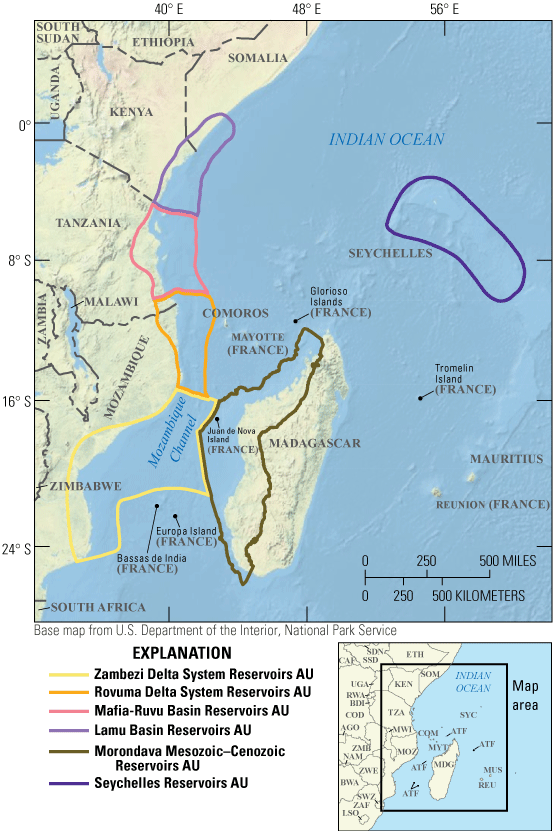
Maps showing location of six conventional assessment units (AUs) of offshore East Africa and Seychelles.
The third phase of rifting in the Late Jurassic to Early Cretaceous (Oxfordian to Valanginian) was centered on the South Africa continental margin, although it also had expression in the formation of the Anza Basin in the northern part of the assessment area. The final phase of rifting began in the Paleogene (Oligocene) and resulted in the East African rift system. From the Cretaceous to the Neogene, extensive eastward prograding deltas formed along the margin because of large fluvial catchment areas in East Africa, forming the Zambezi, Rovuma, Mafia-Ruvu, and Lamu delta systems. These clastic wedges are from 5 to 11 kilometers thick and may have buried potential Mesozoic source rocks into the thermal generation windows for oil and gas.
Total Petroleum System and Assessment Units
The USGS defined the Mesozoic–Cenozoic Composite Total Petroleum System (TPS) in the offshore East Africa and Madagascar area. The Zambezi Delta System Reservoirs Assessment Unit (AU), Rovuma Delta System Reservoirs AU, Mafia-Ruvu Basin Reservoirs AU, Lamu Basin Reservoirs AU, and the Morondava Mesozoic–Cenozoic Reservoirs AU were geologically defined within this TPS. The AUs encompass large fluvial-deltaic to deep-water clastic depositional systems formed along the East African continental margin (Castelino and others, 2015). Petroleum source rocks within this composite TPS are poorly known largely because of deep burial and limited sampling (Butt and Gould, 2018). Available geochemical data for most source rocks were summarized by Brownfield (2016). Triassic source rocks are important for the Morondava Basin in western Madagascar, and Jurassic source rocks are commonly cited as the most important along the East Africa margin (Davison and Steel, 2018). Reservoirs in the composite TPS are typical for clastic deltaic systems, including sandstones deposited in fluvial-deltaic, nearshore marine, slope-channel, and basin-floor fan environments (Castelino and others, 2015; Fierens and others, 2022). Recent gas discoveries in the Rovuma Delta System Reservoirs AU are in stacked basin-floor, deep-water sandstones with excellent reservoir properties (Fletcher, 2017). Similar sandstone reservoirs occur in the Zambezi Delta System Reservoirs AU, Mafia-Ruvu Basin Reservoirs AU, and Lamu Basin Reservoirs AU. Traps span the spectrum from stratigraphic traps in deep-water sandstones to combination traps with a structural component, to structural traps such as those in the gravity-driven extension-contraction features in the Rovuma delta system (Fletcher, 2017; Cai and others, 2020; Fierens and others, 2022). The Rovuma Delta System Reservoirs AU has been the site of most exploration efforts and gas discoveries.
The Mesozoic Composite TPS was defined for the Seychelles area, and the Seychelles Reservoirs AU was defined within this composite TPS. Petroleum source rocks in this TPS may include Triassic synrift lacustrine shales and possible Upper Jurassic to Lower Cretaceous marine shales (Plummer, 1994; Brownfield and Schenk, 2016). Reservoirs range from synrift alluvial-fluvial sandstones to marginal lacustrine and deep-water lacustrine sandstones. Sandstones deposited during the thermal subsidence phase include fluvial-deltaic to marginal marine sandstones. Reservoirs may also include Cretaceous carbonate platform-margin reef and karst reservoirs. The assessment input data for six conventional AUs are summarized in table 1 and in Schenk (2024).
Table 1.
Key input data for six conventional assessment units of offshore East Africa and Seychelles.[Gray shading indicates not applicable. AU, assessment unit; MMBO, million barrels of oil; BCFG, billion cubic feet of gas]
Undiscovered Resources Summary
The USGS quantitatively assessed undiscovered conventional oil and gas resources in six AUs of offshore East Africa and the Seychelles (table 2). Estimated mean resources are 5,071 million barrels of oil (MMBO), or 5.1 billion barrels of oil, with an F95–F5 range from 1,401 to 11,828 MMBO; 79,133 billion cubic feet of gas (BCFG), or 79.1 trillion cubic feet of gas, with an F95–F5 range from 28,606 to 157,242 BCFG; and 451 million barrels of natural gas liquids (MMBNGL), or 0.5 billion barrels, with an F95–F5 range from 159 to 906 MMBNGL.
Table 2.
Results for six conventional assessment units of offshore East Africa and Seychelles.[Results shown are fully risked estimates. F95 represents a 95-percent chance of at least the amount tabulated; other fractiles are defined similarly. Gray shading indicates not applicable. MMBO, million barrels of oil; BCFG, billion cubic feet of gas; NGL, natural gas liquids; MMBNGL, million barrels of natural gas liquids]
For More Information
Assessment results are also available at the USGS Energy Resources Program website at https://www.usgs.gov/programs/energy-resources-program.
Offshore East Africa and Seychelles Assessment Team
Christopher J. Schenk, Tracey J. Mercier, Cheryl A. Woodall, Phuong A. Le, Andrea D. Cicero, Ronald M. Drake II, Geoffrey S. Ellis, Thomas M. Finn, Michael H. Gardner, Sarah E. Gelman, Jane S. Hearon, Benjamin G. Johnson, Jenny H. Lagesse, Heidi M. Leathers-Miller, Kristen R. Marra, Kira K. Timm, and Scott S. Young
References Cited
Brownfield, M.E., 2016, Assessment of undiscovered oil and gas resources of the Mozambique Coastal Province, East Africa, chap. 10 of Brownfield, M.E., compiler, Geologic assessment of undiscovered hydrocarbon resources of Sub-Saharan Africa: U.S. Geological Survey Digital Data Series 69–GG, 18 p., accessed November 29, 2022, at https://pubs.usgs.gov/dds/dds-069/dds-069-gg/REPORTS/69_GG_CH_10.pdf.
Brownfield, M.E., and Schenk, C.J., 2016, Assessment of undiscovered oil and gas resources of the Seychelles Province, East Africa, chap. 13 of Brownfield, M.E., compiler, Geologic assessment of undiscovered hydrocarbon resources of Sub-Saharan Africa: U.S. Geological Survey Digital Data Series 69–GG, 12 p., accessed November 29, 2022, at https://pubs.usgs.gov/dds/dds-069/dds-069-gg/REPORTS/69_GG_CH_13.pdf.
Butt, A.J., and Gould, K., 2018, 3D source-rock modelling in frontier basins—A case study from the Zambezi Delta depression: Petroleum Geoscience, v. 24, no. 3, p. 277–286, accessed November 29, 2022, at https://doi.org/10.1144/petgeo2016-166.
Cai, J., He, Y., Liang, J., Qiu, C., and Zhang, C., 2020, Differential deformation of gravity-driven deep-water fold-and-thrust belts along the passive continental margin of East Africa and their impact on petroleum migration and accumulation: Marine and Petroleum Geology, v. 112, article 104053, 10 p., accessed December 5, 2022, at https://doi.org/10.1016/j.marpetgeo.2019.104053.
Castelino, J.A., Reichert, C., Klingelhoefer, F., Aslanian, D., and Jokat, W., 2015, Mesozoic and Early Cenozoic sediment influx and morphology of the Mozambique Basin: Marine and Petroleum Geology, v. 66, p. 890–905, accessed December 5, 2020, at https://doi.org/10.1016/j.marpetgeo.2015.07.028.
Davison, I., and Steel, I., 2018, Geology and hydrocarbon potential of the East African continental margin—A review: Petroleum Geoscience, v. 24, no. 1, p. 57–91, accessed November 29, 2022, at https://doi.org/10.1144/petgeo2017-028.
Dofal, A., Fontaine, F.R., Michon, L., Barruol, G., and Tkalcic, H., 2021, Nature of the crust beneath the islands of the Mozambique Channel—Constraints from receiver functions: Journal of African Earth Sciences, v. 184, 8 p., accessed November 29, 2022, at https://doi.org/10.1016/j.jafrearsci.2021.104379.
Etheve, N., Jeanniot, L., Cornu, T., and Callot, J.P., 2021, Kinematic modelling of the Mozambique rifted margin and associated thermal histories: Marine and Petroleum Geology, v. 123, 23 p., accessed November 29, 2022, at https://doi.org/10.1016/j.marpetgeo.2020.104712.
Fierens, R., Droz, L., Jouet, G., Rabineau, M., Raisson, F., Babonneau, N., Robin, C., and Jorry, S.J., 2022, Sedimentary evolution and effects of structural controls on the development of the Zambezi mixed turbidite-contourite system (Mozambique Channel, Southwest Indian Ocean) since the Oligocene: Marine and Petroleum Geology, v. 138, article 105532, 22 p., accessed December 5, 2022, at https://doi.org/10.1016/j.marpetgeo.2022.105532.
Fletcher, T., 2017, The Windjammer discovery—Play opener for offshore Mozambique and East Africa, chap. 15 of Merill, R.K., and Sternbach, C.A., eds., Giant fields of the decade 2000-2010: AAPG Memoir 113, p. 273–304, accessed November 29, 2022, at https://archives.datapages.com/data/specpubs/memoir113/data/pdfs/273.pdf.
Macgregor, D., 2018, History of the development of Permian–Cretaceous rifts in East Africa—A series of interpreted maps through time: Petroleum Geoscience, v. 24, no. 1, p. 8–20, accessed November 29, 2022, at https://doi.org/10.1144/petgeo2016-155.
Mahanjane, E.S., 2012, A geotectonic history of the northern Mozambique Basin including the Beira High—A contribution for the understanding of its development: Marine and Petroleum Geology, v. 36, no. 1, p. 1–12, accessed November 29, 2022, at https://doi.org/10.1016/j.marpetgeo.2012.05.007.
Plummer, P.S., 1994, Mesozoic source rocks and hydrocarbon potential of the Seychelles offshore: Journal of Petroleum Geology, v. 17, no. 2, p. 157–176, accessed November 29, 2022, at https://doi.org/10.1111/j.1747-5457.1994.tb00124.x.
Reeves, C.V., 2018, The development of the East African margin during Jurassic and Lower Cretaceous times—A perspective from global tectonics: Petroleum Geoscience, v. 24, no. 1, p. 41–56, accessed November 29, 2022, at https://doi.org/10.1144/petgeo2017-021.
Schenk, C.J., 2024, USGS National and Global Oil and Gas Assessment Project—East Africa and Seychelles Provinces—Assessment unit boundaries, assessment input data, and fact sheet data tables: U.S. Geological Survey data release, https://doi.org/10.5066/P97AP0CO.
Senkans, A., Leroy, S., d’Acremont, E., Castilla, R., and Despinois, F., 2019, Polyphase rifting and break-up of the central Mozambique margin: Marine and Petroleum Geology, v. 100, p. 412–433, accessed November 29, 2022, at https://doi.org/10.1016/j.marpetgeo.2018.10.035.
Disclaimers
Any use of trade, firm, or product names is for descriptive purposes only and does not imply endorsement by the U.S. Government.
Although this information product, for the most part, is in the public domain, it also may contain copyrighted materials as noted in the text. Permission to reproduce copyrighted items must be secured from the copyright owner.
Suggested Citation
Schenk, C.J., Mercier, T.J., Woodall, C.A., Le, P.A., Cicero, A.D., Drake, R.M., II, Ellis, G.S., Finn, T.M., Gardner, M.H., Gelman, S.E., Hearon, J.S., Johnson, B.G., Lagesse, J.H., Leathers-Miller, H.M., Marra, K.R., Timm, K.K., Young, S.S., 2024, Assessment of undiscovered conventional oil and gas resources of offshore East Africa and the Seychelles, 2022: U.S. Geological Survey Fact Sheet 2024–3010, 4 p., https://doi.org/10.3133/fs20243010.
ISSN: 2327-6932 (online)
Study Area
| Publication type | Report |
|---|---|
| Publication Subtype | USGS Numbered Series |
| Title | Assessment of undiscovered conventional oil and gas resources of offshore East Africa and the Seychelles, 2022 |
| Series title | Fact Sheet |
| Series number | 2024-3010 |
| DOI | 10.3133/fs20243010 |
| Publication Date | July 24, 2024 |
| Year Published | 2024 |
| Language | English |
| Publisher | U.S. Geological Survey |
| Publisher location | Reston, VA |
| Contributing office(s) | Central Energy Resources Science Center |
| Description | Report: 4 p.; Data Release |
| Other Geospatial | East Africa, the Seychelles |
| Online Only (Y/N) | Y |