


United States Register of Introduced and Invasive Species
Links
- Document: Report (11.3 MB pdf) , HTML , XML
- Data Releases:
- USGS data release - A comprehensive list of non-native species established in three major regions of the United States: Version 3.0, (ver. 3.0, 2020)
- USGS data release - United States Register of Introduced and Invasive Species (US-RIIS) (ver. 2.0, November 2022)
- Version History: version history (4.00 KB txt)
- NGMDB Index Page: National Geologic Map Database Index Page (html)
- Download citation as: RIS | Dublin Core
Introduction
Although natural disasters such as earthquakes and floods are commonly known to cause many billions of dollars in damages each year, the pervasive and insidious threat of invasive species is asserted to cost the United States more than $120 billion, annually (Pimentel and others, 2005). An invasive species is an organism that is nonnative to a locality and that causes (or is likely to cause) harm (Executive Office of the President [EOP], 2016). An introduced species is one that is nonnative to an ecosystem and occurs there because of human activities that result in its intentional or unintentional escape, release, dissemination, or placement (EOP, 2016). Any introduced species that becomes established may eventually become invasive, so tracking them provides a baseline for effective modeling of species trends and interactions, geospatially, temporally, and economically.
The United States Register of Introduced and Invasive Species (US-RIIS) is unique, because it serves as a national register (Simpson and others, 2022) for all introduced and invasive species that are established within three localities of the United States: Alaska, Hawaii, and the lower 48 conterminous States (L48). Before becoming an invasive species that causes harm, a nonnative species must be both introduced and established in a locality. The US-RIIS has been created as a contribution to the Global Register of Introduced and Invasive Species (2021) Initiative and updates will be periodically submitted to the Global Biodiversity Information Facility ([GBIF], 2022). The GBIF network is an international biodiversity organization and data infrastructure funded by the world's governments that provides open access to data about life on Earth.
The US-RIIS can be used (1) to narrow down horizon scanning species lists that are used to assess the threat of invasive species not yet established (U.S. Department of the Interior, 2016), because names on the US-RIIS should not be on horizon scanning lists; (2) to create lists of introduced and established species for smaller areas within the United States by combining US-RIIS names with local species-occurrence data; and (3) to determine priorities for the control and mitigation of potentially invasive sleeper species (Sieg and others, 2010). Introduced sleeper species establish small populations that “* * * persist at low abundance for years or even decades—a period during which they often go undetected and have negligible effect—until they are triggered by an environmental factor to become highly abundant and disruptive” (Spear and others, 2021, p. 1).
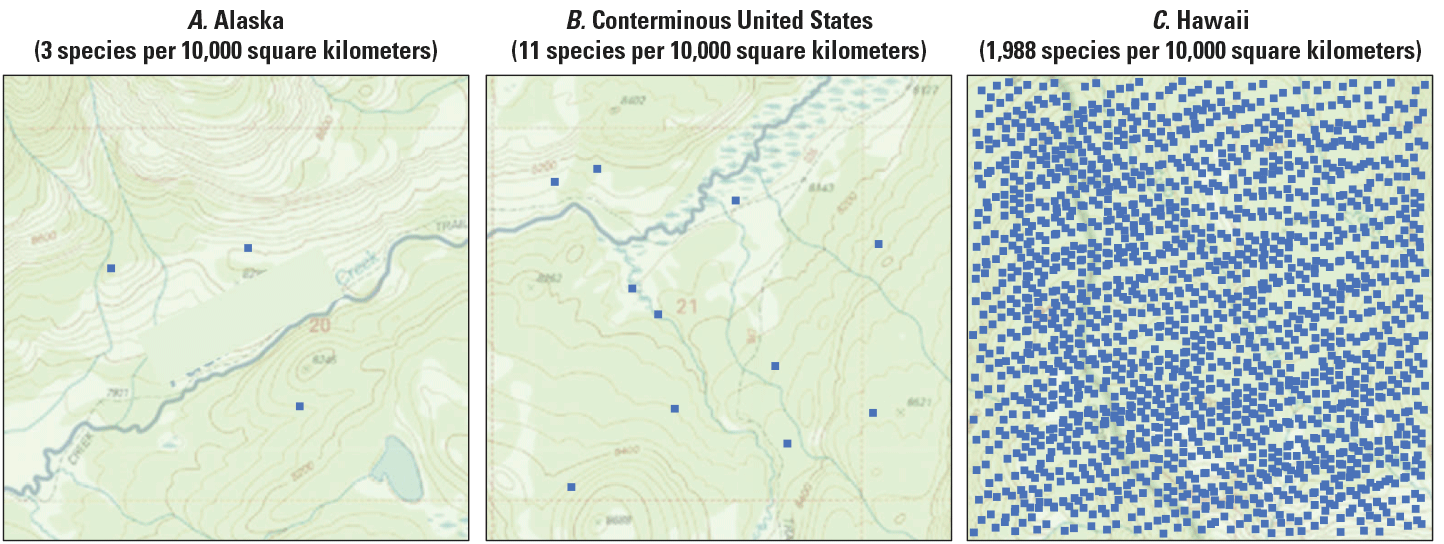
Comparative density of introduced and established species by locality (updated from Simpson and Eyler, 2018) in A, Alaska; B, conterminous (lower-48) United States; and C, Hawaii.
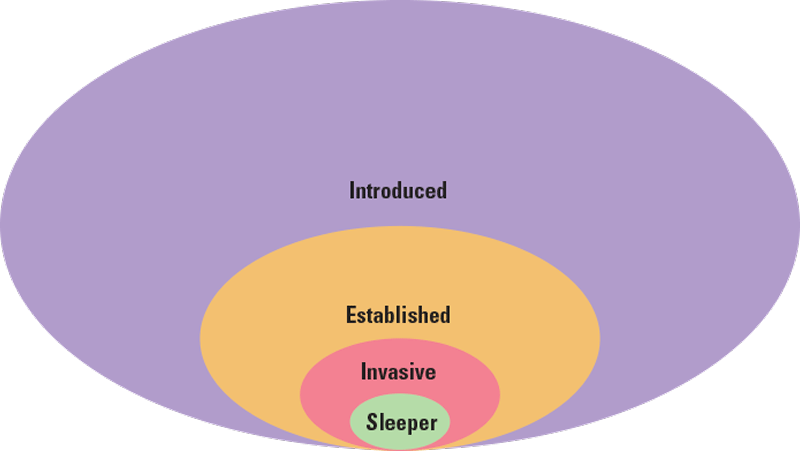
Venn diagram showing relations among different introduced species (established, invasive, and sleeper).
Table 1.
Comparative taxonomic makeup of species included in lists of the United States Register of Introduced and Invasive Species (Simpson and others, 2022).[No., number of species; L48, lower 48 conterminous United States; all other classes includes all other introduced species]
The regional lists and the full list are each largely made up of Insecta (insects) and Magnoliopsida (flowering plants), and all other classes of species are combined in the category “all other classes.” (Simpson and others, 2022).
Methods
The US-RIIS was compiled from more than 5,800 authoritative sources, was reviewed by (or based on input from) more than 30 invasive species scientists and continues to be updated. There are 14,700 records in the Version 2.0 full dataset, which includes 12,571 unique names (note that there are fewer names than records because a species may occur in more than one locality). To be included in the US-RIIS, a species must be nonnative everywhere in the locality and established (reproducing) anywhere in the locality. Species that are native anywhere in a locality are not included in that locality sublist.
Taxonomic and regional experts were consulted to create and review the US-RIIS, with each record being supported by an article, book, database, dissertation, ecological-risk screening, environmental assessment, fact sheet, handbook, pest-advisory alert, technical report, or website. Scientific names were standardized based on the Integrated Taxonomic Information System (2022) and the GBIF (2022).
The US-RIIS was designed to be compatible with country contributions to the Global Register of Introduced and Invasive Species (2021) Initiative, which compiles annotated and verified country-wise inventories of introduced and invasive species (2021). Each US-RIIS record has information on taxonomy, dates of introduction to the locality (where available; version 2.0 for 47 percent of its records), invasion status (invasive or introduced), whether the species has been introduced for biocontrol purposes, and citations for all the authoritative sources supporting the record. The US-RIIS significantly reorganized and expanded a preceding dataset called, “A Comprehensive List of Non-Native Species Established in Three Major Regions of the United States: Version 3.0” (Simpson and others, 2018), used by the US-RIIS.
Results
Several major differences have emerged among the three locality sublists of the US-RIIS. According to the United States Census Bureau (2021), the largest locality is the L48 (8,081,867 square kilometers [km2]), the second largest locality is Alaska (1,723,337 km2), and the smallest localityis Hawaii (28,313 km2). The largest locality (L48) has the largest number of introduced and established species, with 8,527. However, the smallest locality, Hawaii, has the second largest number of introduced and established species, with 5,628, while the much larger locality of Alaska has the third largest number of introduced and established species, with 545. Given the great range of locality size, it is important to consider average densities per 10,000 km2 of introduced species occurring in each. The average density of introduced species in Hawaii is 1,988, which is almost 200 times the density of introduced species in the L48 and more than 650 times the density of introduced species in Alaska. The density of the introduced species in Alaska is three (fig.1 A–C). In Alaska, introduced and invasive species are largely Magnoliopsida (flowering plants), while in Hawaii they are largely Insecta (insects), and in the L48, as well as in the combined localities of the US-RIIS, they are about equally divided between flowering plants and insects (table 1).
What’s the Difference? Introduced and Invasive Species
Introduced or nonnative species are those that arrive in a locality by direct or indirect human assistance (Devine, 1998). Some examples of pathways by which they can be introduced include the deliberate release of a biocontrol species (to control other undesirable species), hitchhiker species attached to any kind of vehicle (for example, boat, airplane, and car), escaped or released pets and their parasites, escaped cultivated plants and their parasites, species carried by human tourism, and species associated with shipped commodities or the commodities themselves (U.S. Department of Agriculture, 2021).
Labeling a species as introduced and established does not address its abundance or its effect on native species. All species included in the US-RIIS are introduced to and established somewhere within the locality. Species that are labeled as introduced and established in the US-RIIS may actually or eventually become invasive, may have no measurable effect on native species, or may be beneficial. In contrast, species that are labeled as invasive have been determined to have an actual or potential negative effect in the locality. It is important to note that although relative numbers in any given locality may vary somewhat, only a small number of introduced species become established, and a much smaller number of those ever become invasive and abundant (Jeschke and Pyšek, 2018). Figure 2 illustrates relations among different kinds of introduced species.
Sleeper Species
Although it is known and widely accepted that the majority of introduced and established species in a locality are harmless and that some are even beneficial (Jeschke and Pyšek, 2018), it is important to be watchful for the occurrence of sleeper species. These are introduced and established species that are eventually triggered by some environmental change to become harmful (Spear and others, 2021). A significant methodological strategy for the US-RIIS is to include all introduced and established species—regardless of their current or known potential effect—because any of these may eventually be revealed to have been a sleeper species.
Biocontrol Species
Biocontrol species are ones that resources managers purposely introduce into an ecosystem as a strategy to control invasive species. Biocontrol species fulfill the criteria for inclusion on the US-RIIS when they are established and are nonnative to the entire locality. Occasionally, biocontrol species have become problematic and invasive (Stewart, 2005). Although comprehensive risk assessments that study potential collateral damage are required before biocontrol species can be approved for use in the United States, it is possible that more biocontrol species could become invasive in the future, by way of genetic mutations, environmental change, or undetected traits (Scoles and others, 2018).
References Cited
Bradley, B.A., Beaury, E., Fusco, E.J., Laginhas, B., and Pasquarella, V., 2018, Regional invasive species & climate change management challenge—Preparing for sleeper species: Amherst, University of Massachusetts, accessed August 19, 2022, at https://doi.org/10.7275/R5F18WXT.
Executive Office of the President [EOP], 2016, Executive Order 13751—Safeguarding the Nation from the impacts of invasive species: Federal Register, v. 81, no. 236, p. 88609–88614, accessed August 19, 2022, at https://www.federalregister.gov/documents/2016/12/08/2016-29519/safeguarding-the-nation-from-the-impacts-of-invasive-species.
Global Biodiversity Information Facility [GBIF], 2022, GBIF homepage, accessed January 5, 2022, at https://www.gbif.org.
Global Register of Introduced and Invasive Species, 2021, GRIIS website, accessed November 18, 2021, at https://www.griis.org.
Jeschke, J.M., and Pyšek, P., 2018, Tens rule, chap. 13 of Invasion biology—Hypotheses and evidence: CABI Digital Library, p. 124., accessed August 19, 2022, at https://doi.org/10.1079/9781780647647.0124.
Pimentel, D., Zuñiga, R., and Morrison, D., 2005, Update on the environmental and economic costs associated with alien-invasive species in the United States, in Shogren, J.F., and Tschirhart, J., eds., Integrating ecology and economics in control bioinvasions (special issue): Ecological Economics, v. 52, no. 3, p. 273–288, accessed August 19, 2022, at https://doi.org/10.1016/j.ecolecon.2004.10.002.
Scoles, J.C., Cuda, J.P., and Overholt, W.A., 2018, How scientists obtain approval to release organisms for classical biological control of invasive plants: University of Florida/Institute of Food and Agriculatural Sciences [UF/IFAS] Extension, pub. no. ENY-828, accessed November 18, 2021, at https://edis.ifas.ufl.edu/publication/IN607.
Sieg, C.H., Densow, J.S., Huebner, C.D., and Miller, J.H., 2010, The role of the Forest Service in nonnative invasive plant research, in Dix, M.E., and Britton, K., eds., A dynamic invasive species research vision—Opportunities and priorities, 2009–29: General Technical Report WO-79/83: U.S. Department of Agriculture Forest Service, Research and Development, p. 35–41. [Also available at https://www.fs.usda.gov/treesearch/pubs/43992.]
Simpson, A., and Eyler, M.C., 2018, First comprehensive list of non-native species established in three major regions of the United States: U.S. Geological Survey Open-File Report 2018–1156, 15 p. [Also available at https://doi.org/10.3133/ofr20181156.]
Simpson, A., Eyler, M.C., Sikes, D., Bowser, M., and Sellers, E., 2018, A comprehensive list of non-native species established in three major regions of the United States: Version 3.0, (ver. 3.0, 2020): U.S. Geological Survey data release, https://doi.org/10.5066/P9E5K160.
Simpson, A., Fuller, P., Faccenda, K., Evenhuis, N., Matsunaga, J., and Bowser, M., 2022, United States Register of Introduced and Invasive Species (US-RIIS) (ver. 2.0, November 2022): U.S. Geological Survey data release, https://doi.org/10.5066/P92DN8D8.
Spear, M.J., Walsh, J.R., Ricciardi, A., and Vander Zanden, M.J., 2021, The invasion ecology of sleeper populations—Prevalence, persistence, and abrupt shifts: Bioscience, v. 71, no. 4, p. 357–369. https://doi.org/10.1093/biosci/biaa168.
Stewart, D., 2005, Good bugs gone bad—Introduced into this country to control pests, these insects now wreak havoc of their own: National Wildlife [magazine], Aug. 1, 2005, The National Wildlife Federation, accessed November 18, 2021, at https://www.nwf.org/Magazines/National-Wildlife/2005/Good-Bugs-Gone-Bad.
U.S. Department of Agriculture, 2021, Resources by subject—Pathways: U.S. Department of Agriculture, National Invasive Species Information Center website, accessed May 7, 2021, at https://www.invasivespeciesinfo.gov/subject/pathways.
U.S. Department of the Interior, 2016, Safeguarding America’s lands and waters from invasive species—A national framework for early detection and rapid response: U.S. Department of the Interior, 55 p., accessed August 19, 2022, at https://www.doi.gov/sites/doi.gov/files/National%20EDRR%20Framework.pdf.
United States Census Bureau, 2021, State area measurements and internal point coordinates 2010: United States Census Bureau, accessed December 5, 2022, at https://www.census.gov/geographies/reference-files/2010/geo/state-area.html.
Disclaimers
Any use of trade, firm, or product names is for descriptive purposes only and does not imply endorsement by the U.S. Government.
Although this information product, for the most part, is in the public domain, it also may contain copyrighted materials as noted in the text. Permission to reproduce copyrighted items must be secured from the copyright owner.
Suggested Citation
Simpson, A., Wiltermuth, M.T., and Dorado, M., 2025, United States Register of Introduced and Invasive Species (ver. 1.1, April 2025): U.S. Geological Survey Fact Sheet 2024–3037, 4 p., https://doi.org/10.3133/fs20243037.
ISSN: 2327-6932 (online)
Study Area
| Publication type | Report |
|---|---|
| Publication Subtype | USGS Numbered Series |
| Title | United States Register of Introduced and Invasive Species |
| Series title | Fact Sheet |
| Series number | 2024-3037 |
| DOI | 10.3133/fs20243037 |
| Edition | Version 1.0: March 18, 2025; Version 1.1: April 8, 2025 |
| Publication Date | March 18, 2025 |
| Year Published | 2025 |
| Language | English |
| Publisher | U.S. Geological Survey |
| Publisher location | Reston VA |
| Contributing office(s) | Science Analytics and Synthesis |
| Description | Report: 4 p.; 2 Data Releases |
| Country | United States |
| Online Only (Y/N) | Y |