


Potential Effects of Chronic Wasting Disease and Supplemental Feeding on Elk Populations in Wyoming
Links
- Document: Report (2.63 MB pdf) , HTML , XML
- NGMDB Index Page: National Geologic Map Database Index Page (html)
- Download citation as: RIS | Dublin Core
Introduction
In 2023, the U.S. Geological Survey (USGS), in collaboration with the U.S. Department of Agriculture Forest Service (Forest Service) and the U.S. Fish and Wildlife Service, evaluated the costs and benefits of supplemental elk (Cervus elaphus canadensis) feeding in western Wyoming (Cook and others, 2023). Elk supplemental feeding is intended to maintain elk populations in the winter and limit elk damage to private property (fig. 1). Supplemental feeding is also used to minimize the transmission of brucellosis (Brucella abortus) from elk to cattle. If brucellosis is detected in cattle, the U.S. Department of Agriculture requires that the entire herd be euthanized or placed in quarantine until the herd passes several negative tests for the disease (U.S. Department of Agriculture, 2003). However, supplemental feeding may enhance the transmission and effects of chronic wasting disease (CWD), which has no treatment or vaccine, is always fatal, and can remain infectious in the environment for many years. Key findings from the USGS evaluation help assess the costs and benefits of four supplemental elk feeding alternatives and their potential implications for the Greater Yellowstone Ecosystem.
Background
More than 75 percent of the elk in the Greater Yellowstone Ecosystem are supplementally fed during the winter in the elk herd units in western Wyoming with supplemental feedgrounds (fig. 2). Seven of the feedgrounds administered by the Wyoming Game and Fish Department are located on Forest Service property. The Forest Service permits for these operations are either being reviewed or will expire by 2028. Supplemental feeding creates dense aggregations of elk likely to enhance CWD transmission among elk. Chronic wasting disease-infected deer and elk were first detected in Grand Teton National Park in 2018 (deer) and 2020 (elk). Deer and elk are important parts of the ecosystem—as prey for grizzly bears (Ursus arctos), cougars (Puma concolor), wolves (Canis lupus), and black bears (Ursus americanus), and as hunted game species that support local economies. Chronic wasting disease has been associated with mule deer (Odocoileus hemionus) and white-tailed deer (Odocoileus virginianus) population declines in Wyoming (Edmunds and others, 2016; DeVivo and others, 2017) but tends to be a slow-moving disease, taking years to decades before infecting more than 20–30 percent of a population.
Cook and others (2023) helped to inform the Forest Service draft environmental impact statement for two of the permitted sites—Dell Creek and Forest Park (U.S. Department of Agriculture Forest Service, 2023; fig. 2). The USGS report also evaluated the consequences associated with phasing out all feedgrounds, or just the feedgrounds permitted by the Forest Service, in the five elk herd units south of Jackson (Fall Creek, Upper Green River, Afton, Piney, and Pinedale). The U.S. Fish and Wildlife Service is also determining the future of the feeding program in the National Elk Refuge near Jackson, Wyo., where roughly 600 bison and 8,000 elk are fed in the winter.
Defining the Issue—Structured Decision Making
Cook and others (2023; figs. 3 and 4, this report) used a structured decision-making process to break the complex problem down into smaller parts and to help the Forest Service organize and clarify their objectives and management alternatives. The Forest Service, in collaboration with the USGS and U.S. Fish and Wildlife Service, developed and evaluated four management alternatives:
-
• No supplemental feeding
-
• Continue supplemental feeding
-
• Emergency supplemental feeding
-
• Phase out supplemental feeding after 3 years
The Forest Service also considered six objectives:
-
• Minimize disease in elk
-
• Maintain elk population numbers
-
• Maximize elk hunting opportunities
-
• Maintain other big game populations
-
• Minimize conflict with agricultural and public stakeholders
-
• Maximize the prosperity of resource-supported economies
Cook and others (2023) evaluated how the four alternatives would affect Forest Service objectives using computer models to forecast CWD, elk population sizes, and hunting revenue during the 20 years following the Forest Service decision, which is still pending as of November 2024. In addition, Cook and others (2023) included spatial models to predict elk damage to private property and the risk of brucellosis transmission from elk to cattle.
Study Results
Cook and others (2023) convened a panel of experts from State, Federal, and academic backgrounds to predict how CWD transmission would change over time due to supplemental feeding. The expert panel predicted that CWD transmission would likely be several times higher when elk were supplementally fed. Using this expert judgment, USGS models (Cross and others, 2023) were used to simulate how higher levels of CWD would affect elk mortality and population, and thus hunting, through time (figs. 3 and 4). CWD prevalence (the proportion of elk infected with CWD) was projected to reach 40 percent by year 20 of the model in an isolated population of fed elk, and the population was projected to decline by 60 percent. In contrast, CWD in an unfed elk population was projected to reach 13 percent prevalence, and the population was projected to decline by 18 percent (fig. 3). Elk herd units contain multiple feedgrounds, and about a quarter of elk in herd units with feedgrounds do not use those feedgrounds (fig. 2). Therefore, the effects of management alternatives on the elk population in a herd unit tended to be small when they targeted only one feedground. For example, the elk fed at the Dell Creek and Forest Park feedgrounds constitute only 12–20 percent of the elk in the Upper Green River and Afton herd units. The effects were greater when applied across multiple feedgrounds.
The USGS report (Cook and others, 2023) addressed the cumulative effects of applying the same management actions to all supplemental feedgrounds in the five elk management units south of Jackson, Wyo. In those five management units, continued feeding and the corresponding increases in CWD were predicted to result in a 58 percent reduction in the elk population by 2044, but also resulted in the smallest brucellosis risk to cattle compared to the other management alternatives. The no feeding alternative was predicted to result in larger initial elk population declines due to the lack of feeding and the potential for more conflict on private property and lower survival rates in areas without sufficient winter habitat (fig. 4). However, the no feeding alternative was predicted to result in a smaller population decline of 35 percent by 2044 due to lower CWD prevalence (fig. 4). The no feeding alternative resulted in more elk being harvested throughout 20 years and higher regional economic inputs and harvest tag sales. The 3-year phaseout alternative suggested that even small delays in closing feedgrounds could result in higher CWD prevalence compared to immediate action.
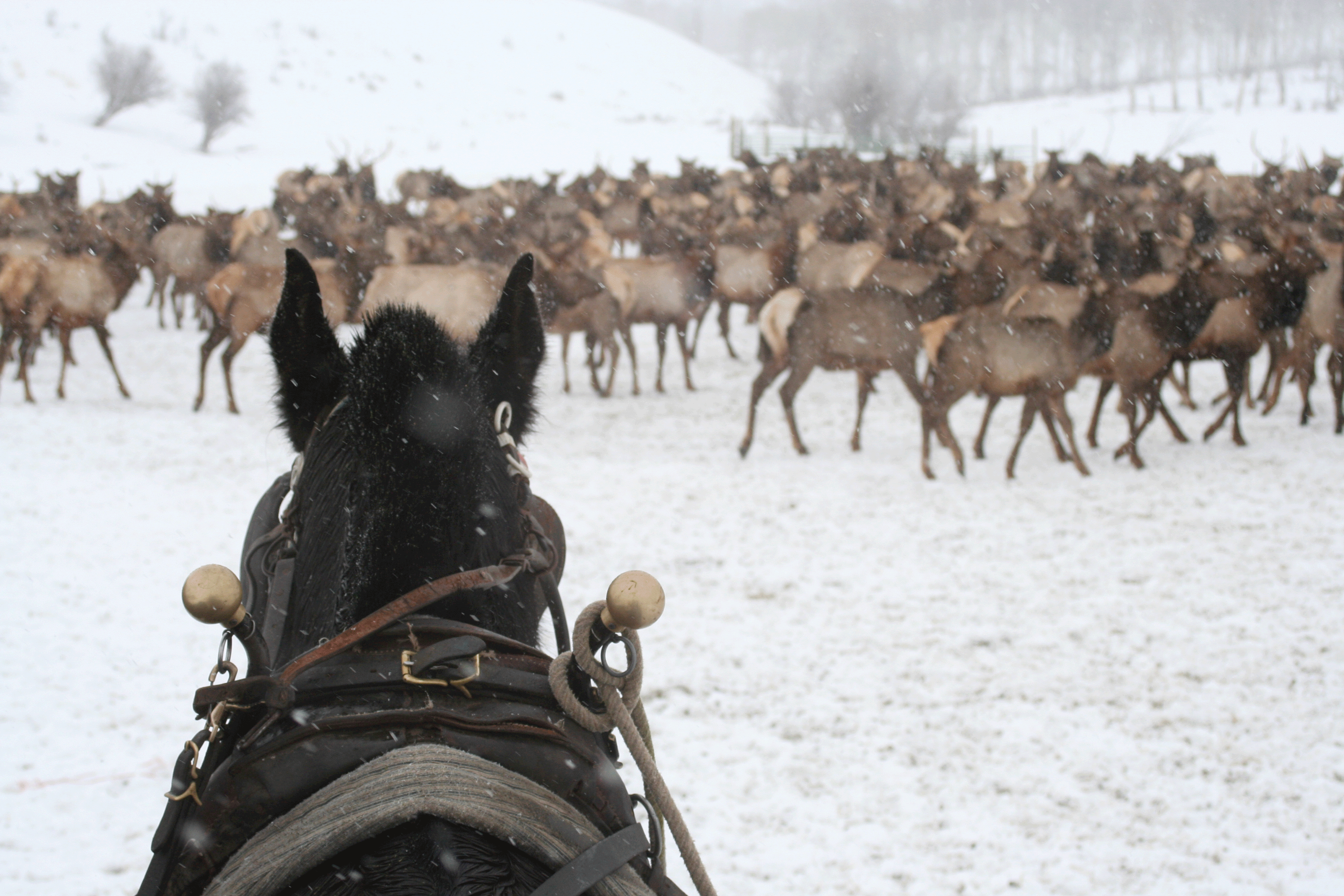
Elk (Cervus elaphus canadensis) being supplementally fed at a Wyoming Game and Fish Department feedground. (Photograph by the U.S. Geological Survey)
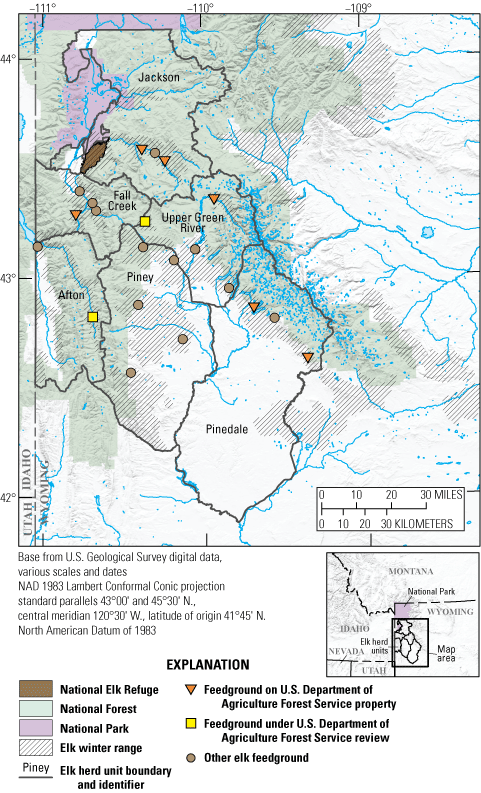
Map showing supplemental elk (Cervus elaphus canadensis) feedgrounds in western Wyoming and associated elk herd units evaluated by U.S. Geological Survey in Cook and others (2023). Cook and others (2023) evaluated the Fall Creek, Upper Green River, Afton, Piney, and Pinedale elk herd units.
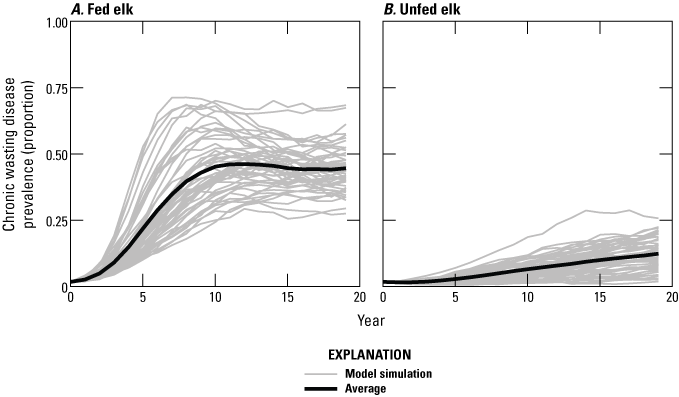
Graphs showing the 20 modeled years for A, disease prevalence in a fed elk population and, B, disease prevalence in an unfed elk population.
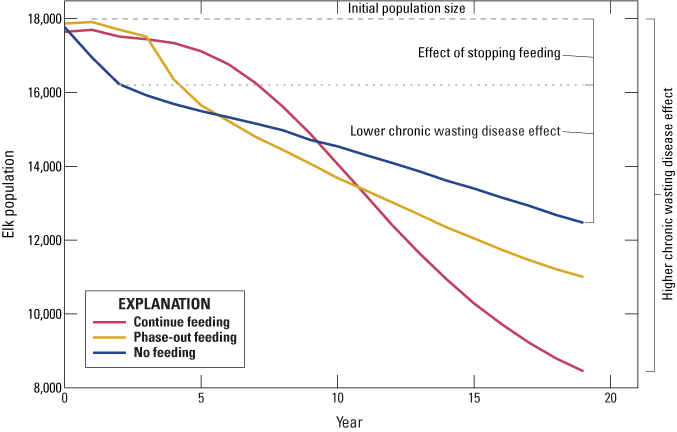
Line graph of the tradeoffs for elk (Cervus elaphus canadensis) populations through time associated with ending or phasing out supplemental feeding in western Wyoming. Elk population sizes were summed across all five of the herd units analyzed in Cook and others (2023) and were adjusted for potential undercounting of elk on native winter ranges. Modeling analyses assumed that the same management alternative was applied to all the feedgrounds.
References Cited
Cook, J.D., Cross, P.C., Tomaszewski, E.M., Cole, E.K., Campbell Grant, E.H., Wilder, J.M., and Runge, M.C., 2023, Evaluating management alternatives for Wyoming elk feedgrounds in consideration of chronic wasting disease (ver. 2.0, November 2023), U.S. Geological Survey Open-File Report 2023–1015, 50 p., accessed February 13, 2024, at https://doi.org/10.3133/ofr20231015.
Cross, P.C., Tomaszewski, E.M., and Cook, J.D., 2023, Simulating chronic wasting disease on Wyoming elk feedgrounds (version 2.0): U.S. Geological Survey software release, accessed February 13, 2024, at https://doi.org/10.5066/P9R7XWO1.
DeVivo, M.T., Edmunds, D.R., Kauffman, M.J., Schumaker, B.A., Binfet, J., Kreeger, T.J., Richards, B.J., Schätzl, H.M., and Cornish, T.E., 2017, Endemic chronic wasting disease causes mule deer population decline in Wyoming: PLoS One, v. 12, no. 10, article e0186512, 17 p., accessed February 13, 2024, at https://doi.org/10.1371/journal.pone.0186512.
Edmunds, D.R., Kauffman, M.J., Schumaker, B.A., Lindzey, F.G., Cook, W.E., Kreeger, T.J., Grogan, R.G., and Cornish, T.E., 2016, Chronic wasting disease drives population decline of white-tailed deer: PLoS One, v. 11, no. 8, article e0161127, 19 p., accessed February 13, 2024, at https://doi.org/10.1371/journal.pone.0161127.
U.S. Department of Agriculture, 2003, Brucellosis eradication—Uniform methods and rules, effective October 1, 2003: U.S. Department of Agriculture, 121 p., accessed December 2, 2024, at https://www.aphis.usda.gov/sites/default/files/umr_bovine_bruc.pdf.
U.S. Department of Agriculture Forest Service, 2023, Dell Creek & Forest Park Elk Feedgrounds—Long-term special use permits—Draft environmental impact statement: U.S. Department of Agriculture, Forest Service web page, 228 p., accessed February 13, 2024, at https://www.fs.usda.gov/project/?project=60949&exp=overview.
For More Information
Visit https://www.usgs.gov/centers/norock or contact Center Director, U.S. Geological Survey, Northern Rocky Mountain Science Center, 2327 University Way, Suite 2, Bozeman, MT 59715.
Disclaimers
Any use of trade, firm, or product names is for descriptive purposes only and does not imply endorsement by the U.S. Government.
Although this information product, for the most part, is in the public domain, it also may contain copyrighted materials as noted in the text. Permission to reproduce copyrighted items must be secured from the copyright owner.
Suggested Citation
Cross, P.C., and Wojtowicz, T.G., 2025, Potential effects of chronic wasting disease and supplemental feeding on elk populations in Wyoming: U.S. Geological Survey Fact Sheet 2024–3046, 4 p., https://doi.org/10.3133/fs20243046.
ISSN: 2327-6932 (online)
Study Area
| Publication type | Report |
|---|---|
| Publication Subtype | USGS Numbered Series |
| Title | Potential effects of chronic wasting disease and supplemental feeding on elk populations in Wyoming |
| Series title | Fact Sheet |
| Series number | 2024-3046 |
| DOI | 10.3133/fs20243046 |
| Publication Date | January 06, 2025 |
| Year Published | 2025 |
| Language | English |
| Publisher | U.S. Geological Survey |
| Publisher location | Reston VA |
| Contributing office(s) | Northern Rocky Mountain Science Center |
| Description | 4 p. |
| Country | United States |
| State | Wyoming |
| Online Only (Y/N) | Y |
| Additional Online Files (Y/N) | N |