


Assessment of Undiscovered Conventional Oil and Gas Resources in Upper Paleozoic Reservoirs of the Wind River Basin, Bighorn Basin, and Powder River Basin Provinces, 2024
Links
- Document: Report (796 KB pdf) , HTML , XML
- Data Release: USGS data release - USGS National and Global Oil and Gas Assessment Project—Paleozoic Reservoirs of the Wind River Basin, Big Horn Basin, and Powder River Basin Provinces: Assessment Unit Boundaries, Assessment Input Data, and Fact Sheet Data Tables
- NGMDB Index Page: National Geologic Map Database Index Page (html)
- Download citation as: RIS | Dublin Core
Abstract
Using a geology-based assessment methodology, the U.S. Geological Survey estimated undiscovered, technically recoverable mean conventional resources of 47 million barrels of oil and 876 billion cubic feet of gas in upper Paleozoic reservoirs of the Wind River Basin, Bighorn Basin, and Powder River Basin Provinces.
Introduction
The U.S. Geological Survey (USGS) assessed the potential for undiscovered, technically recoverable conventional oil and gas resources within upper Paleozoic reservoirs of the Wind River Basin, Bighorn Basin, and Powder River Basin Provinces (fig. 1). These basins were formed during the Late Cretaceous to Paleogene Laramide orogeny that resulted in the fragmentation of the Sevier foreland by basement-involved deformation. This process formed intermontane basins, such as the Wind River, Bighorn, and Powder River Basins (Yeck and others, 2014; Yonkee and Weil, 2015). Exploration for oil in structural traps along the margins of these basins began in earnest in the 1920s because many of the contractional structures had obvious surface expression that focused exploration efforts. By the 1960s, most structural fields had been discovered. Since that time, exploration has focused on the pursuit of oil within complex stratigraphic and structural traps in eolian sandstones in the Permian upper part of the Pennsylvanian–Permian Minnelusa Formation in the north-central part of the Powder River Basin Province. The purpose of this report is to provide an assessment of the remaining oil and gas potential in upper Paleozoic reservoirs within structural and stratigraphic traps in these three geologic provinces.
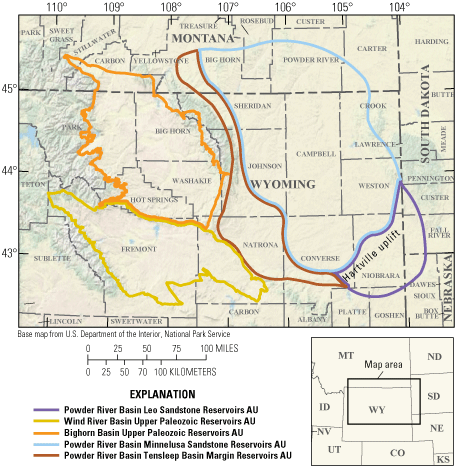
Maps showing the location of five conventional assessment units (AUs) in upper Paleozoic reservoirs of the Wind River Basin, Bighorn Basin, and Powder River Basin Provinces.
Total Petroleum Systems and Assessment Units
The USGS defined a Paleozoic–Mesozoic Composite Total Petroleum System (TPS) that encompasses oil generated and migrated from thermally mature Pennsylvanian and Cretaceous organic-rich shales. The geologic model for the Powder River Basin Leo Sandstone Reservoirs Assessment Unit (AU) is for oil generated from Pennsylvanian organic-rich shales and from Cretaceous shales (Clayton and Ryder, 1984) to have migrated into structural traps within the Hartville uplift. Reservoirs are predominantly eolian sandstones of the Pennsylvanian Leo Sandstone Member of the Minnelusa Formation (Tromp and others, 1981; Cardinal and Sherer, 1984; McBane, 1984).
The Phosphoria TPS was defined in the Wind River Basin and Bighorn Basin Provinces to encompass oil that may have been generated from thermally mature organic-rich shales of the Retort Tongue and Meade Peak Member of the Permian Phosphoria Formation in west-central Wyoming and eastern Idaho (Maughan, 1975). Phosphoria-generated oil was ultimately trapped in upper Paleozoic reservoirs in the Wind River Basin, Bighorn Basin, and Powder River Basin Provinces (Donohue and others, 2020), possibly as the result of long-distance eastward migration of oil (Sheldon, 1967; Stone, 1967; Maughan, 1975). Although several scenarios have been proposed for the regional distribution of oil generated from the Phosphoria Formation, the processes and timing of long-distance oil migration relative to ultimate trap formation are not well constrained (Burtner and Nigrini, 1994; Ellis and others, 2017; Kendall and others, 2023). The Wind River Basin Upper Paleozoic Reservoirs AU and the Bighorn Basin Upper Paleozoic Reservoirs AU were defined within the Phosphoria TPS (fig. 1). The geologic model for these two AUs is for Phosphoria-sourced oil to have ultimately migrated into eolian sandstone reservoirs in sandstones of the Pennsylvanian Amsden Formation and into the Pennsylvanian–Permian Tensleep Sandstone, and into carbonates of the Phosphoria Formation within Laramide-age structural and stratigraphic traps (Andrews and Higgins, 1984; Curry, 1984; Carr-Crabaugh and Dunn, 1996). Phosphoria-sourced gas is interpreted to have been generated at depth and trapped mainly within carbonate reservoirs of the Mississippian Madison Group, such as the hydrogen-sulfide-rich gas occurring within the dolomites of the Madison Group of the Madden Deep Field in the Wind River Basin Province (Hawkins and Baugh, 2006).
The Pennsylvanian–Permian Composite TPS was defined within the Powder River Basin Province to encompass oil and gas generated and migrated from organic-rich shales of the Phosphoria Formation (Donohue and others, 2020) and oil possibly generated from organic-rich shales of the Pennsylvanian middle part of the Minnelusa Formation (Clayton and Ryder, 1984; Desmond and others, 1984). The Powder River Basin Minnelusa Sandstone Reservoirs AU and the Powder River Basin Tensleep Basin Margin Reservoirs AU were defined within this composite TPS (fig. 1). The geologic model for the Powder River Basin Minnelusa Sandstone Reservoirs AU is for oil from the Phosphoria Formation and from thin, organic-rich shales of the middle part of the Minnelusa Formation to have migrated into Wolfcamp-age eolian sandstones within a spectrum of stratigraphic and structural traps (Fryberger, 1984; George, 1984; Trotter, 1984; Sheppy, 1986; Jorgensen and James, 1988). The potential for oil in the eolian sandstone reservoirs of the middle part of the Minnelusa Formation (Desmond and others, 1984) and for oil and gas in the carbonate reservoirs of the Madison Group are included in this AU. The geologic model for the Powder River Basin Tensleep Basin Margin Reservoirs AU is for oil to have migrated from the Powder River Basin into structural traps along the western and southern margins of the basin. Reservoirs within the basin-margin structures are eolian sandstones of the Tensleep Sandstone and possibly carbonates of the Madison Group. The assessment input data for five conventional AUs are summarized in table 1 and in Schenk (2025).
Table 1.
Key input data for five conventional assessment units in upper Paleozoic reservoirs of the Wind River Basin, Bighorn Basin, and Powder River Basin Provinces.[Gray shading indicates not applicable. AU, assessment unit; MMBO, million barrels of oil; BCFG, billion cubic feet of gas]
Undiscovered Resources Summary
The USGS quantitatively assessed undiscovered conventional oil and gas resources in upper Paleozoic reservoirs in five AUs in the Wind River Basin, Bighorn Basin, and Powder River Basin Provinces (table 2). The estimated mean undiscovered resources are 47 million barrels of oil (MMBO), with an F95–F5 range from 24 to 76 MMBO; 876 billion cubic feet of gas (BCFG), or 0.9 trillion cubic feet of gas, with an F95–F5 range from 198 to 2,186 BCFG; and 20 million barrels of natural gas liquids (MMBNGL), with an F95–F5 range from 4 to 50 MMBNGL.
Table 2.
Results for five conventional assessment units in upper Paleozoic reservoirs of the Wind River Basin, Bighorn Basin, and Powder River Basin Provinces.[Results shown are fully risked estimates. F95 represents a 95-percent chance of at least the amount tabulated; other fractiles are defined similarly. Gray shading indicates not applicable. MMBO, million barrels of oil; BCFG, billion cubic feet of gas; NGL, natural gas liquids; MMBNGL, million barrels of natural gas liquids]
For More Information
Assessment results are also available at the USGS Energy Resources Program website, https://www.usgs.gov/programs/energy-resources-program.
References Cited
Andrews, S., and Higgins, L.S., 1984, Influence of depositional facies on hydrocarbon production in the Tensleep Sandstone, Big Horn Basin, Wyoming—A working hypothesis, in [Goolsby, J., and Morton, D., eds.], The Permian and Pennsylvanian geology of Wyoming—Wyoming Geological Association 35th Annual Field Conference Guidebook, [Casper, Wyo., September 23–26, 1984]: Wyoming Geological Association, p. 183–197, accessed May 20, 2024, at https://archives-datapages-com.usgslibrary.idm.oclc.org/data/wga/data/041/041001/pdfs/183.pdf.
Burtner, R.L., and Nigrini, A., 1994, Thermochronology of the Idaho–Wyoming thrust belt during Sevier orogeny—A new, calibrated, multiprocess thermal model: AAPG Bulletin, v. 78, no. 10, p. 1586–1612, accessed May 20, 2024, at https://archives-datapages-com.usgslibrary.idm.oclc.org/data/bulletns/1994-96/images/pg/00780010/1550/1586.pdf.
Cardinal, D.F., and Sherer, M., 1984, Alum Creek field, Fall River County, South Dakota, in [Goolsby, J., and Morton, D., eds.], The Permian and Pennsylvanian geology of Wyoming—Wyoming Geological Association 35th Annual Field Conference Guidebook, [Casper, Wyo., September 23–26, 1984]: Wyoming Geological Association, p. 169–182, accessed May 20, 2024, at https://archives-datapages-com.usgslibrary.idm.oclc.org/data/wga/data/041/041001/pdfs/169.pdf.
Carr-Crabaugh, M., and Dunn, T.L., 1996, Reservoir heterogeneity as a function of accumulation and preservation dynamics, Tensleep Sandstone, Bighorn and Wind River Basins, Wyoming, in Longman, M.W., and Sonnenfeld, M.D., eds., Paleozoic systems of the Rocky Mountain region: Rocky Mountain Section, Society for Sedimentary Geology (SEPM), p. 305–320, accessed May 20, 2024, at https://archives-datapages-com.usgslibrary.idm.oclc.org/data/rocky_sepm/data/034/034001/pdfs/305.pdf.
Clayton, J.L., and Ryder, R.T., 1984, Organic geochemistry of black shales and oils in the Minnelusa Formation (Permian and Pennsylvanian), Powder River Basin, Wyoming, in [Woodward, J., Meissner, F.F., and Clayton, J.L., eds.], Hydrocarbon source rocks of the greater Rocky Mountain Region—[Rocky Mountain Association of Geologists 1984 Symposium]: Rocky Mountain Association of Geologists, p. 231–253, accessed May 20, 2024, at https://archives-datapages-com.usgslibrary.idm.oclc.org/data/rmag/SourceRocks84/clayton.pdf.
Curry, W.H., III, 1984, Paleotopography at the top of the Tensleep Formation, Bighorn Basin, Wyoming, in [Goolsby, J., and Morton, D., eds.], The Permian and Pennsylvanian geology of Wyoming—Wyoming Geological Association 35th Annual Field Conference Guidebook, [Casper, Wyo., September 23–26, 1984]: Wyoming Geological Association, p. 199–211, accessed May 20, 2024, at https://archives-datapages-com.usgslibrary.idm.oclc.org/data/wga/data/041/041001/pdfs/199.pdf.
Desmond, R.J., Steidtmann, J.R., and Cardinal, D.F., 1984, Stratigraphy and depositional environments of the Middle Member of the Minnelusa Formation, central Powder River Basin, Wyoming, in [Goolsby, J., and Morton, D., eds.], The Permian and Pennsylvanian geology of Wyoming—Wyoming Geological Association 35th Annual Field Conference Guidebook, [Casper, Wyo., September 23–26, 1984]: Wyoming Geological Association, p. 213–239, accessed May 20, 2024, at https://archives-datapages-com.usgslibrary.idm.oclc.org/data/wga/data/041/041001/pdfs/213.pdf.
Donohue, C.M., Barrie, C.D., Zumberge, J.A., Zumberge, J.E., and Curtis, J.B., 2020, Geochemistry of the petroleum systems of several U.S. Rocky Mountain basins: Houston Geological Society Bulletin, v. 63, no. 2, p. 33–37, accessed May 20, 2024, at https://archives-datapages-com.usgslibrary.idm.oclc.org/data/HGS/vol63/063002/pdfs/33.pdf.
Ellis, G.S., Said-Ahmad, W., Lillis, P.G., Shawar, L., and Amrani, A., 2017, Effects of thermal maturation and thermochemical sulfate reduction on compound-specific sulfur isotopic compositions of organosulfur compounds in Phosphoria oils from the Bighorn Basin, USA: Organic Geochemistry, v. 103, p. 63–78, accessed May 20, 2024, at https://doi.org/10.1016/j.orggeochem.2016.10.004.
Fryberger, S.G., 1984, The Permian Upper Minnelusa Formation, Wyoming—Ancient example of an offshore-prograding eolian sand sea with geomorphic, facies, and system-boundary traps for petroleum, in [Goolsby, J., and Morton, D., eds.], The Permian and Pennsylvanian geology of Wyoming—Wyoming Geological Association 35th Annual Field Conference Guidebook, [Casper, Wyo., September 23–26, 1984]: Wyoming Geological Association, p. 241–271, accessed May 20, 2024, at https://archives-datapages-com.usgslibrary.idm.oclc.org/data/wga/data/041/041001/pdfs/241.pdf.
George, G.R., 1984, Cyclic sedimentation and depositional environments of the upper Minnelusa Formation, central Campbell County, Wyoming, in [Goolsby, J., and Morton, D., eds.], The Permian and Pennsylvanian geology of Wyoming—Wyoming Geological Association 35th Annual Field Conference Guidebook, [Casper, Wyo., September 23–26, 1984]: Wyoming Geological Association, p. 75–95, accessed May 20, 2024, at https://archives-datapages-com.usgslibrary.idm.oclc.org/data/wga/data/041/041001/pdfs/75.pdf.
Hawkins, C.M., and Baugh, R.A., 2006, Madden Field—A growing giant in the Wind River Basin, Wyoming: The Mountain Geologist, v. 43, no. 3, p. 177–179, accessed May 20, 2024, at https://archives-datapages-com.usgslibrary.idm.oclc.org/data/mountain-geologist-rmag/data/043/043003/pdfs/177.pdf.
Jorgensen, S.D., and James, S.W., 1988, Integration of stratigraphic high-resolution dipmeter data into the development of the Minnelusa “B” sand reservoir in Hawk Point Field, Campbell County, Wyoming, in [Diedrich, R.P., Dyka, M.K., and Miller, W.R., eds.], Eastern Powder River Basin—Black Hills—Wyoming Geological Association 39th Annual Field Conference Guidebook, [Casper, Wyo., September 9–11, 1988]: Wyoming Geological Association, p. 105–116, accessed May 20, 2024, at https://archives-datapages-com.usgslibrary.idm.oclc.org/data/wga/data/046/046001/pdfs/105.pdf.
Kendall, B., Wang, S., Lillis, P., Xing, L., Zheng, W., and Zhu, C., 2023, Evaluation of the molybdenum isotope system as a petroleum tracer—The Phosphoria petroleum system, western U.S.A.: Chemical Geology, v. 617, article 121244, 16 p., accessed May 20, 2024, at https://doi.org/10.1016/j.chemgeo.2022.121244.
Maughan, E.K., 1975, Organic carbon in shale beds of the Permian Phosphoria Formation of eastern Idaho and adjacent states—A summary report, in [Exum, F.A., and George, G.R., eds.], Geology and mineral resources of the Big Horn Basin—Wyoming Geological Association 27th Annual Field Conference Guidebook, [Cody, Wyo., September 8–9, 1975]: Wyoming Geological Association, p. 107–115, accessed May 20, 2024, at https://archives-datapages-com.usgslibrary.idm.oclc.org/data/wga/data/031/031001/pdfs/107.pdf.
McBane, J.D., 1984, Buck Creek field, Niobrara County, Wyoming, in [Goolsby, J., and Morton, D., eds.], The Permian and Pennsylvanian geology of Wyoming—Wyoming Geological Association 35th Annual Field Conference Guidebook, [Casper, Wyo., September 23–26, 1984]: Wyoming Geological Association, p. 111–117, accessed May 20, 2024, at https://archives-datapages-com.usgslibrary.idm.oclc.org/data/wga/data/041/041001/pdfs/111.pdf.
Schenk, C.J., 2025, USGS National and Global Oil and Gas Assessment Project—Paleozoic Reservoirs of the Wind River Basin, Big Horn Basin, and Powder River Basin Provinces—Assessment unit boundaries, input data tables, and fact sheet data tables: U.S. Geological Survey data release, https://doi.org/10.5066/P95BL3S4.
Sheldon, R.P., 1967, Long-distance migration of oil in Wyoming: The Mountain Geologist, v. 4, no. 2, p. 53–65, accessed May 20, 2024, at https://archives-datapages-com.usgslibrary.idm.oclc.org/data/rmag/mg/1967/sheldon.pdf.
Sheppy, R.J., 1986, Slattery Field, Powder River Basin, Wyoming—A multidisciplinary interpretation of a complex Minnelusa (Permian) field, in [Noll, J.H., and Doyle, K.M., eds.], Rocky Mountain oil and gas fields—Wyoming Geological Association 1986 Symposium, [Casper, Wyo., September 10, 1986]: Wyoming Geological Association, p. 245–256, accessed May 20, 2024, at https://archives-datapages-com.usgslibrary.idm.oclc.org/data/wga/data/044/044001/pdfs/245.pdf.
Stone, D.S., 1967, Theory of Paleozoic oil and gas accumulation in Big Horn Basin, Wyoming: AAPG Bulletin, v. 51, no. 10, p. 2056–2114, accessed May 20, 2024, at https://archives-datapages-com.usgslibrary.idm.oclc.org/data/bulletns/1965-67/images/pg/00510010/2050/20560.pdf.
Tromp, P.L., Cardinal, D.F., and Steidtmann, J.R., 1981, Stratigraphy and depositional environments of the “Leo Sands” in the Minnelusa Formation, Wyoming, and South Dakota, in [Reid, S.G., and Miller, D.D., eds.], Energy resources of Wyoming—Wyoming Geological Association 32d Annual Field Conference Guidebook, [Jackson Hole, Wyo., September 20–22, 1981]: Wyoming Geological Association, p. 11–22, accessed May 20, 2024, at https://archives-datapages-com.usgslibrary.idm.oclc.org/data/wga/data/038/038001/pdfs/11.pdf.
Trotter, J.F., 1984, The Minnelusa revisited, 1984, in [Goolsby, J., and Morton, D., eds.], The Permian and Pennsylvanian geology of Wyoming—Wyoming Geological Association 35th Annual Field Conference Guidebook, [Casper, Wyo., September 23–26, 1984]: Wyoming Geological Association, p. 127–151, accessed May 20, 2024, at https://archives-datapages-com.usgslibrary.idm.oclc.org/data/wga/data/041/041001/pdfs/127.pdf.
Yeck, W.L., Sheehan, A.F., Anderson, M.L., Erslev, E.A., and Miller, K.C., 2014, Structure of the Bighorn Mountain region, Wyoming, from teleseismic receiver function analysis—Implications for the kinematics of Laramide shortening: Journal of Geophysical Research, Solid Earth, v. 119, no. 9, p. 7028–7042, accessed May 20, 2024, at https://doi.org/10.1002/2013JB010769.
Yonkee, W.A., and Weil, A.B., 2015, Tectonic evolution of the Sevier and Laramide belts within the North American Cordillera orogenic system: Earth-Science Reviews, v. 150, p. 531–593, accessed May 20, 2024, at https://doi.org/10.1016/j.earscirev.2015.08.001.
Disclaimers
Any use of trade, firm, or product names is for descriptive purposes only and does not imply endorsement by the U.S. Government.
Although this information product, for the most part, is in the public domain, it also may contain copyrighted materials as noted in the text. Permission to reproduce copyrighted items must be secured from the copyright owner.
Suggested Citation
Schenk, C.J., Mercier, T.J., Le, P.A., Cicero, A.D., Drake, R.M., II, Gelman, S.E., Hearon, J.S., Johnson, B.G., Lagesse, J.H., Leathers-Miller, H.M., and Timm, K.K., 2025, Assessment of undiscovered conventional oil and gas resources in upper Paleozoic reservoirs of the Wind River Basin, Bighorn Basin, and Powder River Basin Provinces, 2024: U.S. Geological Survey Fact Sheet 2024–3049, 4 p., https://doi.org/10.3133/fs20243049.
ISSN: 2327-6932 (online)
Study Area
| Publication type | Report |
|---|---|
| Publication Subtype | USGS Numbered Series |
| Title | Assessment of undiscovered conventional oil and gas resources in upper Paleozoic reservoirs of the Wind River Basin, Bighorn Basin, and Powder River Basin Provinces, 2024 |
| Series title | Fact Sheet |
| Series number | 2024-3049 |
| DOI | 10.3133/fs20243049 |
| Publication Date | March 13, 2025 |
| Year Published | 2025 |
| Language | English |
| Publisher | U.S. Geological Survey |
| Publisher location | Reston VA |
| Contributing office(s) | Central Energy Resources Science Center |
| Description | Report: 4 p.; Data Release |
| Country | United States |
| State | Montana, Nebraska, South Dakota, Wyoming |
| Online Only (Y/N) | Y |