


Assessment of Undiscovered Conventional Oil and Gas Resources of Oman, 2023
Links
- Document: Report (1.39 MB pdf) , HTML , XML
- Data Release: USGS data release - USGS National and Global Oil and Gas Assessment Project—Oman Provinces: Assessment Unit Boundaries, Assessment Input Data, and Fact Sheet Data Tables
- Download citation as: RIS | Dublin Core
Abstract
Using a geology-based assessment methodology, the U.S. Geological Survey estimated undiscovered, technically recoverable mean conventional resources of 1.2 billion barrels of oil and 6.4 trillion cubic feet of gas in Oman.
Introduction
The U.S. Geological Survey (USGS) assessed the potential for undiscovered, technically recoverable conventional oil and gas resources within three salt basins, adjacent uplifts, and the foredeep of Oman (fig. 1). The tectonic evolution of Oman began with accretion of Neoproterozoic terranes that formed the Arabian plate. Accretion resulted in regional north-trending and northwest–southeast-trending complex fault and suture systems that form the basin boundaries (Al-Husseini, 2000; Ruban and others, 2007; Droste, 2014). A period of extension from late Neoproterozoic to Early Cambrian created a series of rift basins along the eastern margin of the Arabian plate (Al-Husseini, 2000); the Ghaba, Fahud, and South Oman Salt Basins formed at this time. The intermittent connection of the rift basins to the paleo-Tethys Ocean resulted in deposition of several kilometers of evaporites, carbonates, and clastics of the Neoproterozoic to Early Cambrian Huqf Supergroup (Grosjean and others, 2009). Within the Huqf Supergroup are Neoproterozoic petroleum source rocks, reservoirs, and thick salt deposits of the Ara Group (Amthor and others, 2005; Grosjean and others, 2009; Kowalewski and others, 2009). Thermal subsidence in the Cambrian and Ordovician resulted in accommodation space for several kilometers of fluvial to shallow-marine siliciclastics of the Haima Supergroup (Al-Barwani and McClay, 2008), which form oil and gas reservoirs throughout Oman (Al-Kindi and Richard, 2014). Burial by the Haima Supergroup resulted in progressive salt deformation and the formation of structures that are traps for oil and gas. Burial also resulted in the thermal maturation of Neoproterozoic source rocks (Al-Barwani and McClay, 2008) adequate for the generation of oil and gas. The Hercynian orogeny in the Carboniferous was a time of regional contraction, uplift, and erosion that removed most Silurian and Devonian rocks from Oman along a regional unconformity (Konert and others, 2001). The Hercynian orogeny was followed by regional glaciation in the late Carboniferous and early Permian and the deposition of fluvial and deltaic siliciclastics of the lower Permian Gharif Formation. The initial opening of the neo-Tethys Ocean in the late Permian resulted in a regional transgression across much of the Arabian plate and the formation of widespread east-facing carbonate platforms of the Khuff Formation and associated evaporites and intraplatform basinal source rocks (Droste, 2014). Triassic to Lower Jurassic progradation of a western-sourced clastic wedge produced a regional seal for much of Oman (Stewart and others, 2016). From the Upper Jurassic through Upper Cretaceous, extensive carbonate platforms, intraplatform basins, and source rocks were deposited, consisting of organic-rich marls of the Jurassic Tuwaiq Mountain Formation, Hanifa Formation, Shu’aiba Formation, and Cretaceous Natih Formation (Droste, 2014). Most of the Jurassic and Cretaceous source rocks and associated carbonate platforms are restricted to the extreme northwestern part of Oman adjacent to the Rub al Khali Basin (Droste, 2014). The initial closure of the neo-Tethys Ocean in the Late Cretaceous resulted in contraction across the eastern Arabian plate, forming the Oman thrust belt, foredeep, folds, and anticlines that are major traps for oil and gas. The final closure of the neo-Tethys Ocean in the Eocene resulted in uplift and erosion along the eastern Arabian plate.
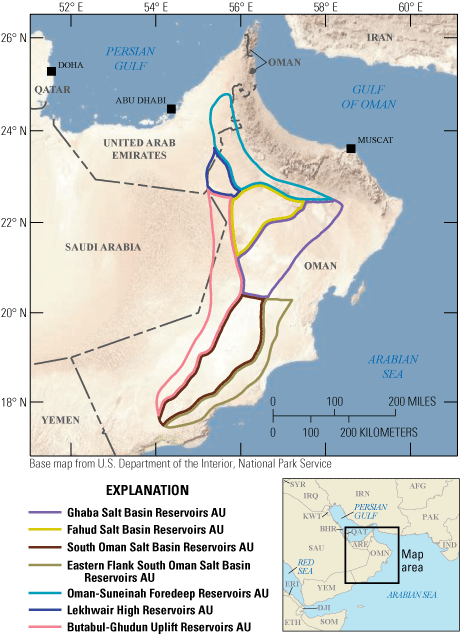
Map showing seven conventional assessment units (AUs) in Oman.
Total Petroleum System and Assessment Units
The USGS defined a Neoproterozoic–Mesozoic Composite Total Petroleum System (TPS) encompassing petroleum generated from several source rocks. Neoproterozoic source rocks underlie, overlie, and are within salt of the Ara Group. Organic-rich marls of the underlying presalt Nafun Group have total organic carbon (TOC) values as much as 5 weight percent (wt. pct.), have hydrogen index (HI) values as much as 700 milligrams (mg) of hydrocarbon per gram of TOC (mg HC/g TOC), and are as much as 50 meters (m) thick (Grosjean and others, 2009). Within the deformed salt of the Ara Group are unusual “silicilite” source (and reservoir) rocks that have TOC values as much as 7 wt. pct., have HI values as much as 900 mg HC/g TOC, and are as much as 400 m thick (Terken and others, 2001; Amthor and others, 2005). Associated with the silicilites are organic-bearing carbonate “stringers” that may also contribute as source rocks (Al-Siyabi, 2005). Within the Ara Group, overlying the salt are shales of the Dhahaban Formation, which have TOC values as much as 8 wt. pct., have HI values as much as 600 mg HC/g TOC, and are as much as 500 m thick (Terken and Frewin, 2000; Terken and others, 2001; Grosjean and others, 2009). Within the Ghaba, Fahud, and South Oman Salt Basins, Neoproterozoic source rocks have generated most of the oil and gas. Organic-rich graptolitic shales of the Silurian Qusaiba Formation are source rocks in northwestern Oman adjacent to the Rub al Khali Basin. In northwesternmost Oman, marls of the Jurassic Tuwaiq Mountain Formation, Hanifa Formation, and Shu’aiba Formation are source rocks (Boote and Mou, 2003; Grosjean and others, 2009; Droste, 2014). The Jurassic source rocks have TOC values as much as 5 wt. pct. and HI values as much as 500 mg HC/g TOC. Shales of the Cretaceous Natih Formation are source rocks in the Oman-Suneinah foredeep adjacent to the Oman thrust belt (Pollastro, 1999). Shales of the Natih Formation have TOC values as much as 15 wt. pct., have HI values as much as 800 mg HC/g TOC, and are as much as 50 m thick (Terken, 1999). Reservoirs within the salt basins are primarily the Neoproterozoic silicilites, carbonate stringers, and sandstones of the Cambrian to Ordovician Haima Supergroup.
Assessment units (AUs) defined within the composite TPS consist of the Ghaba Salt Basin Reservoirs AU, Fahud Salt Basin Reservoirs AU, South Oman Salt Basin Reservoirs AU, Eastern Flank South Oman Salt Basin Reservoirs AU, Oman-Suneinah Foredeep Reservoirs AU, Lekhwair High Reservoirs AU, and Butabul-Ghudun Uplift Reservoirs AU. Each of the AUs was assessed for undiscovered conventional oil and gas resources. The assessment input data for seven conventional AUs are summarized in table 1 and in Schenk (2025).
Table 1.
Key input data for seven conventional assessment units in Oman.[Gray shading indicates not applicable. AU, assessment unit; MMBO, million barrels of oil; BCFG, billion cubic feet of gas]
Undiscovered Resources Summary
The USGS quantitatively assessed undiscovered conventional oil and gas resources in seven AUs in Oman (table 2). The estimated mean resources are 1,248 million barrels of oil (MMBO), or 1.2 billion barrels of oil, with an F95–F5 range from 477 to 2,536 MMBO; 6,352 billion cubic feet of gas (BCFG), or 6.4 trillion cubic feet of gas, with an F95–F5 range from 1,977 to 14,897 BCFG; and 291 million barrels of natural gas liquids (MMBNGL), or 0.3 billion barrels, with an F95–F5 range from 87 to 704 MMBNGL.
Table 2.
Results for seven conventional assessment units in Oman.[Results shown are fully risked estimates. F95 represents a 95-percent chance of at least the amount tabulated; other fractiles are defined similarly. Gray shading indicates not applicable. MMBO, million barrels of oil; BCFG, billion cubic feet of gas; NGL, natural gas liquids; MMBNGL, million barrels of natural gas liquids]
For More Information
Assessment results are also available at the USGS Energy Resources Program website, https://www.usgs.gov/programs/energy-resources-program.
References Cited
Al-Barwani, B., and McClay, K., 2008, Salt tectonics in the Thumrait area, in the southern part of the South Oman Salt Basin—Implications for mini-basin evolution: GeoArabia, v. 13, no. 4, p. 77–108, accessed October 22, 2024, at https://doi.org/10.2113/geoarabia130477.
Al-Husseini, M.I., 2000, Origin of the Arabian plate structures—Amar collision and Najd rift: GeoArabia, v. 5, no. 4, p. 527–542, accessed October 22, 2024, at https://doi.org/10.2113/geoarabia0504527.
Al-Kindi, M.H., and Richard, P.D., 2014, The main structural styles of the hydrocarbon reservoirs in Oman, in Rollinson, H.R., Searle, M.P., Abbasi, I.A., Al-Lazki, A.I., and Al-Kindi, M.H., eds., Tectonic evolution of the Oman Mountains: Geological Society of London Special Publication 392, p. 409–445, accessed October 22, 2024, at https://doi.org/10.1144/SP392.20.
Al-Siyabi, H.A., 2005, Exploration history of the Ara intrasalt carbonate stringers in the South Oman Salt Basin: GeoArabia, v. 10, no. 4, p. 39–72, accessed October 22, 2024, at https://doi.org/10.2113/geoarabia100439.
Amthor, J.E., Ramseyer, K., Faulkner, T., and Lucas, P., 2005, Stratigraphy and sedimentology of a chert reservoir at the Precambrian-Cambrian boundary—The Al Shomou silicilyte, South Oman Salt Basin: GeoArabia, v. 10, no. 2, p. 89–122, accessed October 22, 2024, at https://doi.org/10.2113/geoarabia100289.
Boote, D.R.D., and Mou, D., 2003, Safah field, Oman—Retrospective of a new-concept exploration play, 1980 to 2000: GeoArabia, v. 8, no. 3, p. 367–430, accessed October 22, 2024, at https://doi.org/10.2113/geoarabia0803367.
Droste, H., 2014, Petroleum geology of the Sultanate of Oman, in Marlow, L., Kendall, C., and Yose, L., eds., Petroleum systems of the Tethyan region: AAPG Memoir 106, p. 713–755, accessed October 22, 2024, at https://doi.org/10.1306/13431870M1063039.
Grosjean, E., Love, G.D., Stalvies, C., Fike, D.A., and Summons, R.E., 2009, Origin of petroleum in the Neoproterozoic–Cambrian South Oman Salt Basin: Organic Geochemistry, v. 40, no. 1, p. 87–110, accessed October 22, 2024, at https://doi.org/10.1016/j.orggeochem.2008.09.011.
Konert, G., Afifi, A.M., Al-Hajri, S.A., and Droste, H.J., 2001, Paleozoic stratigraphy and hydrocarbon habitat of the Arabian plate: GeoArabia, v. 6, no. 3, p. 407–442, accessed October 22, 2024, at https://doi.org/10.2113/geoarabia0603407.
Kowalewski, I., Carpentier, B., Huc, A.-Y., Adam, P., Hanin, S., Albrecht, P., Wojciak, P., Frewin, N.L., and Ruwehy, N.A., 2009, An unconventional Neoproterozoic–Early Cambrian source rock interval in southern Oman—Implications for oil and gas generation: GeoArabia, v. 14, no. 4, p. 53–86, accessed October 22, 2024, at https://doi.org/10.2113/geoarabia140453.
Pollastro, R.M., 1999, Ghaba Salt Basin Province and Fahud Salt Basin Province, Oman—Geological overview and total petroleum systems: U.S. Geological Survey Open-File Report 99–50–D, 43 p., accessed October 22, 2024, at https://doi.org/10.3133/ofr9950D.
Ruban, D.A., Al-Husseini, M.I., and Iwasaki, Y., 2007, Review of Middle East Paleozoic plate tectonics: GeoArabia, v. 12, no. 3, p. 35–56, accessed October 22, 2024, at https://doi.org/10.2113/geoarabia1204157.
Schenk, C.J., 2025, USGS National and Global Oil and Gas Assessment Project—Oman Provinces—Assessment unit boundaries, assessment input data, and fact sheet data tables: U.S. Geological Survey data release, https://doi.org/10.5066/P1VRJXRI.
Stewart, S.A., Reid, C.T., Hooker, N.P., and Kharouf, O.W., 2016, Mesozoic siliciclastic reservoirs and petroleum system in the Rub’ al-Khali basin, Saudi Arabia: AAPG Bulletin, v. 100, no. 5, p. 819–841, accessed October 22, 2024, at https://doi.org/10.1306/02021615112.
Terken, J.M.J., 1999, The Natih petroleum system of north Oman: GeoArabia, v. 4, no. 2, p. 157–180, accessed October 22, 2024, at https://doi.org/10.2113/geoarabia0402157.
Terken, J.M.J., and Frewin, N.L., 2000, The Dhahaban petroleum system of Oman: AAPG Bulletin, v. 84, no. 4, p. 523–544, accessed October 22, 2024, at https://doi.org/10.1306/C9EBCE41-1735-11D7-8645000102C1865D.
Terken, J.M.J., Frewin, N.L., and Indrelid, S.L., 2001, Petroleum systems of Oman—Charge timing and risks: AAPG Bulletin, v. 85, no. 10, p. 1817–1845, accessed October 22, 2024, at https://doi.org/10.1306/8626D081-173B-11D7-8645000102C1865D.
Disclaimers
Any use of trade, firm, or product names is for descriptive purposes only and does not imply endorsement by the U.S. Government.
Although this information product, for the most part, is in the public domain, it also may contain copyrighted materials as noted in the text. Permission to reproduce copyrighted items must be secured from the copyright owner.
Suggested Citation
Schenk, C.J., Mercier, T.J., Le, P.A., Cicero, A.D., Drake, R.M., II, Gelman, S.E., Hearon, J.S., Johnson, B.G., Lagesse, J.H., Leathers-Miller, H.M., and Timm, K.K., 2025, Assessment of undiscovered conventional oil and gas resources of Oman, 2023: U.S. Geological Survey Fact Sheet 2024–3050, 4 p., https://doi.org/10.3133/fs20243050.
ISSN: 2327-6932 (online)
Study Area
| Publication type | Report |
|---|---|
| Publication Subtype | USGS Numbered Series |
| Title | Assessment of undiscovered conventional oil and gas resources of Oman, 2023 |
| Series title | Fact Sheet |
| Series number | 2024-3050 |
| DOI | 10.3133/fs20243050 |
| Publication Date | March 19, 2025 |
| Year Published | 2025 |
| Language | English |
| Publisher | U.S. Geological Survey |
| Publisher location | Reston, VA |
| Contributing office(s) | Central Energy Resources Science Center |
| Description | Report: 4 p.; Data Release |
| Country | Oman |
| Online Only (Y/N) | Y |