


Assessment of Undiscovered Oil and Gas Resources of the Los Angeles Basin Province, 2023
Links
- Document: Report (720 KB pdf) , HTML , XML
- Data Release: USGS data release - USGS National and Global Oil and Gas Assessment Project—Los Angeles Basin Province: Assessment Unit Boundaries, Assessment Input Data, and Fact Sheet Data Tables
- NGMDB Index Page: National Geologic Map Database Index Page (html)
- Download citation as: RIS | Dublin Core
Abstract
Using a geology-based assessment methodology, the U.S. Geological Survey estimated undiscovered, technically recoverable mean resources of 61 million barrels of oil and 240 billion cubic feet of gas in the Los Angeles Basin Province.
Introduction
The U.S. Geological Survey (USGS) assessed the potential for undiscovered, technically recoverable conventional and unconventional (continuous) oil and gas resources within the Los Angeles Basin Province of California (fig. 1). The tectonic evolution of the Los Angeles Basin Province is complex and related to the evolution of the continental margin from subduction to right-lateral transform motion of southern California (Wright, 1991; Nicholson and others, 1994; Ingersoll and Rumelhart, 1999; Sorlien and others, 2013). The structural configuration of the basin is due to two phases of extension in the Miocene and Pliocene that created the accommodation space for as much as 9 kilometers of sediment, in part consisting of world-class petroleum source and reservoir rocks (Biddle, 1991; Redin, 1991; Wright, 1991). Extension was followed by contraction in the late Pliocene to Pleistocene that resulted in the modification of many structures in the basin (Jung and others, 2015). This phase of deformation may have caused fracturing and loss of oil and gas from reservoirs, as shown by the numerous seeps throughout the basin (Biddle, 1991; Wright, 1991).
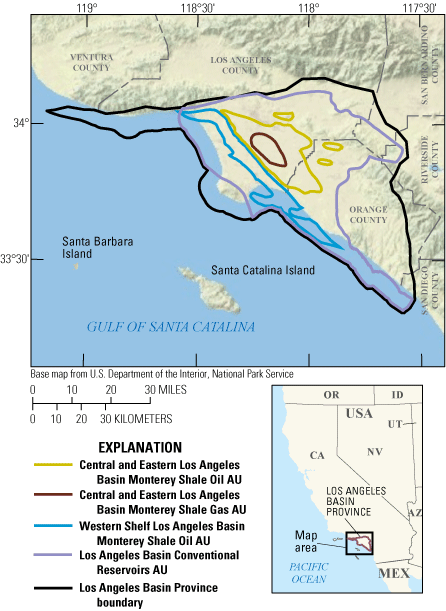
Maps showing location of four assessment units (AUs) in the Los Angeles Basin Province.
Total Petroleum System and Assessment Units
The USGS defined the Monterey Total Petroleum System (TPS) encompassing oil and gas generated from organic-rich Miocene Monterey Formation source rocks, and possibly from source rocks in the Miocene Puente and Modelo Formations. The Monterey Formation is characterized by Type II and Type IIS kerogen, total organic carbon (TOC) values as much as 18 weight percent, hydrogen index values as much as 600 milligrams of hydrocarbon per gram of TOC, thickness as much as 300 meters (Jeffrey and others, 1991; Jung and others, 2015), and a high silica content that readily fractures. The organic matter in the Monterey Formation is more sulfur rich (Type IIS) in the western side of the basin (Jeffrey and others, 1991; Tennyson and others, 2016). Onset of oil generation is modeled to have begun in the late Pliocene (Schultz and others, 2017).
The Central and Eastern Los Angeles Basin Monterey Shale Oil Assessment Unit (AU), the Central and Eastern Los Angeles Basin Monterey Shale Gas AU, and the Western Shelf Los Angeles Basin Monterey Shale Oil AU were defined to estimate the geologic uncertainty of, and potential for, shale-oil and shale-gas resources. The thermal window for oil generation from Miocene source rocks in the Central and Eastern Los Angeles Basin Monterey Shale Oil AU is generally placed at the −12,000-foot (ft) structure contour near the base of the Monterey Formation (Tennyson and others, 2016, from the map of Wright, 1991). The thermal window for gas generation estimated from one-dimensional modeling for the Central and Eastern Los Angeles Basin Monterey Shale Gas AU is generally placed at about the −21,000-ft structure contour near the base of the Monterey Formation. These depths for the beginning of oil and gas generation are uncertain and represent approximations only. The Western Shelf Los Angeles Basin Monterey Shale Oil AU was defined to encompass oil generated from Miocene shales below a depth of about 9,000 ft, due to the early generation oil from Type IIS kerogen (Peters and others, 2016; Tennyson and others, 2016) compared to Type II organic matter in the eastern part of the basin. The geologic model for the three AUs is for oil and gas to be partially retained within the shales after generation and migration. Siliceous shales of the Monterey Formation are commonly fractured, and oil and gas may have largely migrated along fractures and out of the shales and into conventional reservoirs or were lost to the surface.
The Los Angeles Basin Conventional Reservoirs AU encompasses most of the Los Angeles Basin Province (fig. 1). The AU was defined to include oil and gas generated from Monterey Formation and related organic-rich rocks to have migrated into conventional sandstone reservoirs within structural and stratigraphic traps. Reservoirs are deltaic and shallow marine sandstones, slope-channel sandstones, basin-floor sandstones, and possible sand injectites described from similar deepwater sandstone systems (Zvirtes and others, 2020). The assessment input data for four AUs are summarized in table 1 and in Schenk (2025).
Table 1.
Key input data for four assessment units in the Los Angeles Basin Province.[Gray shading indicates not applicable. The average estimated ultimate recovery (EUR) input is the minimum, median, maximum, and calculated mean. AU, assessment unit; %, percent; MMBO, million barrels of oil; BCFG, billion cubic feet of gas]
Undiscovered Resources Summary
The USGS quantitatively assessed undiscovered oil and gas resources in three continuous AUs and one conventional AU in the Los Angeles Basin Province (table 2). The estimated total mean resources are 61 million barrels of oil (MMBO), with an F95–F5 range from 10 to 201 MMBO; 240 billion cubic feet of gas (BCFG), with an F95–F5 range from 33 to 741 BCFG; and 5 million barrels of natural gas liquids (MMBNGL), with an F95–F5 range from 1 to 20 MMBNGL. Approximately 80 percent of the undiscovered oil and gas resources are estimated to be in the Los Angeles Basin Conventional Reservoirs AU.
Table 2.
Results for four assessment units in the Los Angeles Basin Province.[Results shown are fully risked estimates. F95 represents a 95-percent chance of at least the amount tabulated; other fractiles are defined similarly. Gray shading indicates not applicable. MMBO, million barrels of oil; BCFG, billion cubic feet of gas; NGL, natural gas liquids; MMBNGL, million barrels of natural gas liquids]
For More Information
Assessment results are also available at the USGS Energy Resources Program website, https://www.usgs.gov/programs/energy-resources-program.
References Cited
Biddle, K.T., 1991, The Los Angeles Basin—An overview—Chapter 1, in Biddle, K.T., ed., Active margin basins: AAPG Memoir 52, p. 5–24, accessed October 23, 2024, at https://archives.datapages.com/data/specpubs/basinar3/data/a135/a135/0001/0000/0005.htm.
Ingersoll, R.V., and Rumelhart, P.E., 1999, Three-stage evolution of the Los Angeles basin, southern California: Geology, v. 27, no. 7, p. 593–596, accessed October 23, 2024, at https://doi.org/10.1130/0091-7613(1999)027<0593:TSEOTL>2.3.CO;2.
Jeffrey, A.W.A., Alimi, H.M., and Jenden, P.D., 1991, Geochemistry of Los Angeles Basin oil and gas systems—Chapter 6, in Biddle, K.T., ed., Active margin basins: AAPG Memoir 52, p. 197–219, accessed October 23, 2024, at https://archives.datapages.com/data/specpubs/basinar3/data/a135/a135/0001/0150/0197.htm.
Jung, B., Garven, G., and Boles, J.R., 2015, The geodynamics of faults and petroleum migration in the Los Angeles Basin, California: American Journal of Science, v. 315, no. 5, p. 412–459, accessed October 23, 2024, at https://doi.org/10.2475/05.2015.02.
Nicholson, C., Sorlien, C.C., Atwater, T., Crowell, J.C., and Luyendyk, B.P., 1994, Microplate capture, rotation of the western Transverse Ranges, and initiation of the San Andreas transform as a low-angle fault system: Geology, v. 22, no. 6, p. 491–495, accessed October 23, 2024, at https://doi.org/10.1130/0091-7613(1994)022<0491:MCROTW>2.3.CO;2.
Peters, K.E., Wright, T.L., Ramos, L.S., Zumberge, J.E., and Magoon, L.B., 2016, Chemometric recognition of genetically distinct oil families in the Los Angeles basin, California: AAPG Bulletin, v. 100, no. 1, p. 115–135, accessed October 23, 2024, at https://doi.org/10.1306/08031515068.
Redin, T., 1991, Oil and gas production from submarine fans of the Los Angeles Basin—Chapter 8, in Biddle, K.T., ed., Active margin basins: AAPG Memoir 52, p. 239–259, accessed October 23, 2024, at https://archives.datapages.com/data/specpubs/basinar3/data/a135/a135/0001/0200/0239.htm.
Schenk, C.J., 2025, USGS National and Global Oil and Gas Assessment Project—Los Angeles Basin Province—Assessment unit boundaries, assessment input data, and fact sheet data tables: U.S. Geological Survey data release, https://doi.org/10.5066/P148FWYT.
Schultz, L.E., Scheirer, A.H., and Graham, S.A., 2017, Evaluating the thermal history of the Los Angeles Basin through 3D basin and petroleum system modeling—AAPG Annual Convention and Exhibition, Calgary, Alberta, Canada, June 19–22, 2016, poster presentation: AAPG Search and Discovery, article 10929, 1 p., accessed August 22, 2023, at https://www.searchanddiscovery.com/documents/2017/10929schultz/ndx_schultz.pdf.
Sorlien, C.C., Seeber, L., Broderick, K.G., Luyendyk, B.P., Fisher, M.A., Sliter, R.W., and Normark, W.R., 2013, The Palos Verdes anticlinorium along the Los Angeles, California coast—Implications for underlying thrust faulting: Geochemistry, Geophysics, Geosystems, v. 14, no. 6, p. 1866–1890, accessed October 23, 2024, at https://doi.org/10.1002/ggge.20112.
Tennyson, M.E., Charpentier, R.R., Klett, T.R., Brownfield, M.E., Pitman, J.K., Gaswirth, S.B., Hawkins, S.J., Le, P.A., Lillis, P.G., Marra, K.R., Mercier, T.J., Leathers-Miller, H.M., and Schenk, C.J., 2016, Assessment of undiscovered continuous oil and gas resources in the Monterey Formation, Los Angeles Basin Province, California, 2015: U.S. Geological Survey Fact Sheet 2016–3036, 2 p., accessed October 23, 2024, at https://doi.org/10.3133/fs20163036.
Wright, T.L., 1991, Structural geology and tectonic evolution of the Los Angeles Basin, California—Chapter 3—Part 1, in Biddle, K.T., ed., Active margin basins: AAPG Memoir 52, p. 35–134, accessed October 23, 2024, at https://archives.datapages.com/data/specpubs/basinar3/data/a135/a135/0001/0000/0035.htm.
Zvirtes, G., Philipp, R.P., Hurst, A., Palladino, G., De Ros, L.F., and Grippa, A., 2020, Petrofacies of Eocene sand injectites of the Tumey giant injection complex, California (USA): Sedimentary Geology, v. 400, article 105617, 25 p., accessed October 23, 2024, at https://doi.org/10.1016/j.sedgeo.2020.105617.
Disclaimers
Any use of trade, firm, or product names is for descriptive purposes only and does not imply endorsement by the U.S. Government.
Although this information product, for the most part, is in the public domain, it also may contain copyrighted materials as noted in the text. Permission to reproduce copyrighted items must be secured from the copyright owner.
Suggested Citation
Schenk, C.J., Tennyson, M.E., Mercier, T.J., Le, P.A., Cicero, A.D., Drake, R.M., II, Gelman, S.E., Hearon, J.S., Johnson, B.G., Lagesse, J.H., Leathers-Miller, H.M., and Timm, K.K., 2025, Assessment of undiscovered oil and gas resources of the Los Angeles Basin Province, 2023: U.S. Geological Survey Fact Sheet 2024–3051, 4 p., https://doi.org/10.3133/fs20243051.
ISSN: 2327-6932 (online)
Study Area
| Publication type | Report |
|---|---|
| Publication Subtype | USGS Numbered Series |
| Title | Assessment of undiscovered oil and gas resources of the Los Angeles Basin Province, 2023 |
| Series title | Fact Sheet |
| Series number | 2024-3051 |
| DOI | 10.3133/fs20243051 |
| Publication Date | April 09, 2025 |
| Year Published | 2025 |
| Language | English |
| Publisher | U.S. Geological Survey |
| Publisher location | Reston VA |
| Contributing office(s) | Central Energy Resources Science Center |
| Description | Report: 4 p.; Data Release |
| Country | United States |
| State | California |
| Other Geospatial | Los Angeles Basin Province |
| Online Only (Y/N) | Y |