


Critical Minerals in Ores (CMiO) Database
Links
- Document: Report (5.07 MB pdf) , HTML , XML
- Dataset: Critical Minerals in Ores - geochemistry database
- Version History: Version History (4.0 KB txt)
- NGMDB Index Pages:
- Download citation as: RIS | Dublin Core
A Global Geochemical Database to Assess Primary and Byproduct Critical Mineral Potential
Critical minerals are commodities essential to modern industrial and strategic technologies and are highly vulnerable to supply chain disruption. The Critical Minerals Mapping Initiative (CMMI) is a collaboration among the U.S. Geological Survey (USGS), the Geological Survey of Canada, and Geoscience Australia that aims to deepen global understanding of where critical minerals are located (Kelley, 2020; Emsbo and others, 2021). A key output of this initiative is the Critical Minerals in Ores (CMiO) database that is advancing our collective understanding of critical minerals distributions (fig. 1; Champion and others, 2021). For instance, publicly available data on the concentrations of many critical minerals are sparse because these commodities can only be produced in small, yet essential, quantities compared to the primary commodities like copper and zinc (for example, fig. 2). The CMiO database helps bridge this gap by offering high-quality, multielement geochemical data from a wide variety of critical mineral-bearing deposits around the world. Importantly, it uses a novel consensus deposit environment, group, and type classification scheme developed by the agencies (Hofstra and others, 2021) that allows comparisons among ore deposits from different regions. The CMiO database contains geochemical data for more than 20,000 samples from more than 100 deposit types comprising 10 deposit environments.
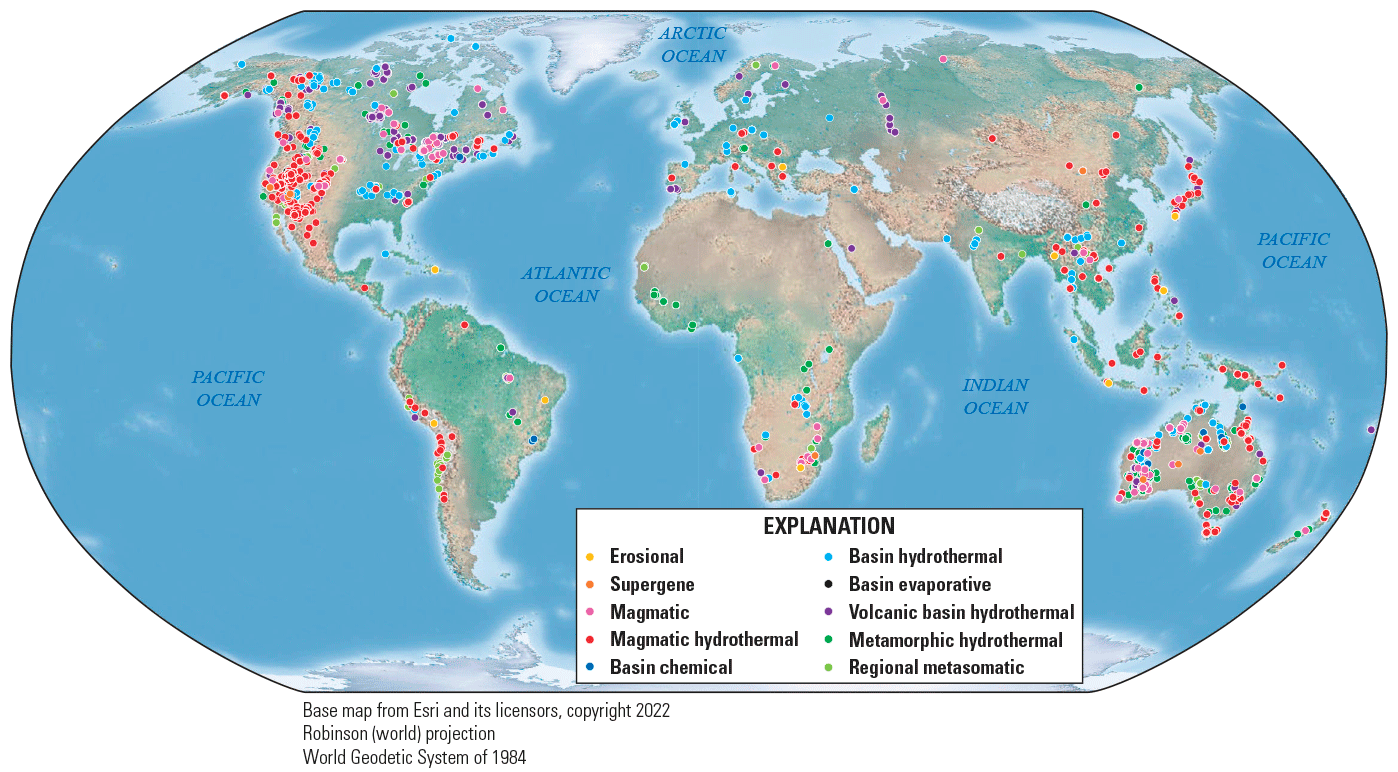
Schematic global distribution of Critical Minerals in Ores database samples, colored by deposit environment classification of Hofstra and others (2021). Future updates could fill data gaps for specific deposit environments, groups, and types. An interactive map is available by accessing this link: https://portal.ga.gov.au/persona/cmmi.
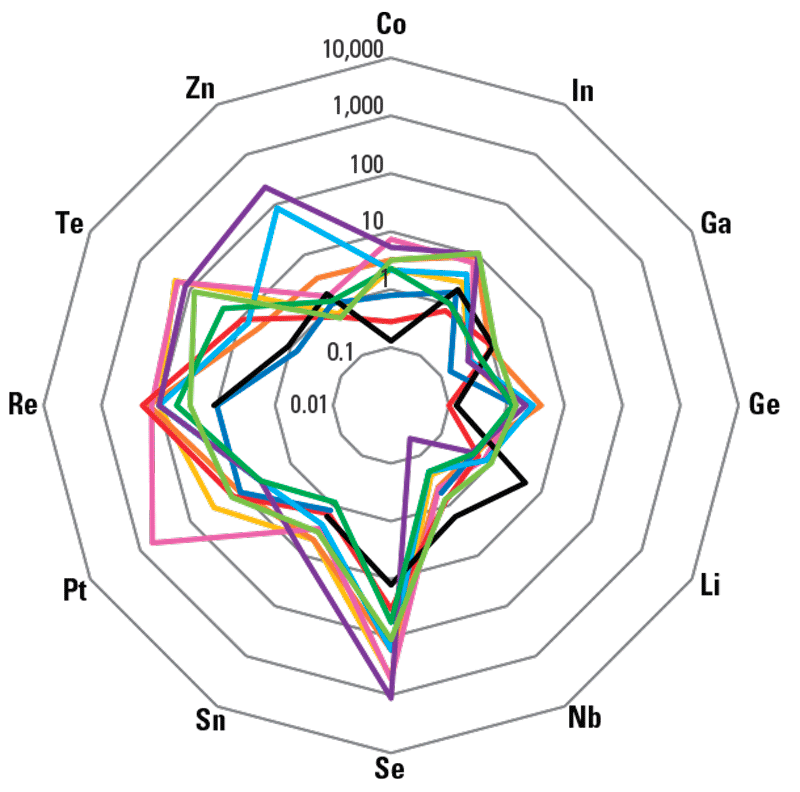
Radar plot of abundances of select critical minerals in deposit environments using the same color scheme as figure 1. The values are shown on a log scale relative to the element’s abundance in the Earth’s crust (Wedepohl, 1995).
Primary Uses of Select Critical Minerals
Cobalt (Co): Rechargeable batteries and superalloys
Gallium (Ga): Integrated circuits and optical devices like light-emitting diodes (LED)
Germanium (Ge): Fiber optics and night vision applications
Indium (In): Mostly used in liquid crystal display (LCD) screens
Lithium (Li): Mostly in batteries
Niobium (Nb): Mostly in steel alloys
Platinum (Pt) group elements (PGEs): Catalytic agents
Rare earth elements (REE): Batteries, electronics, magnets, communication, and medical technologies
Rhenium (Re): Lead-free gasoline or petrol and superalloys
Selenium (Se): Glass pigment and solar cells
Tellurium (Te): Steelmaking and solar cells
Tin (Sn): Solder, tin plating, alloys, superconducting magnets, LCD screens
Zinc (Zn): Galvanized steel, alloys, alkaline batteries
(modified from Kelley, 2020)
Quantifying Critical Mineral Abundance in Different Deposit Types
Porphyry Deposits
Porphyry copper-molybdenum-gold deposits are a subset of the porphyry deposit group in the magmatic hydrothermal deposit environment (Hofstra and others, 2021). These deposits are a major source of copper and molybdenum globally, supply nearly 90 percent of tellurium for the world, and have the potential to supply other critical minerals as byproducts, such as selenium, rhenium, and platinum group elements. The CMiO database enables abundances of these critical minerals to be compared among deposits, and can inform assessments of these vital byproduct minerals in this deposit environment (fig. 3).
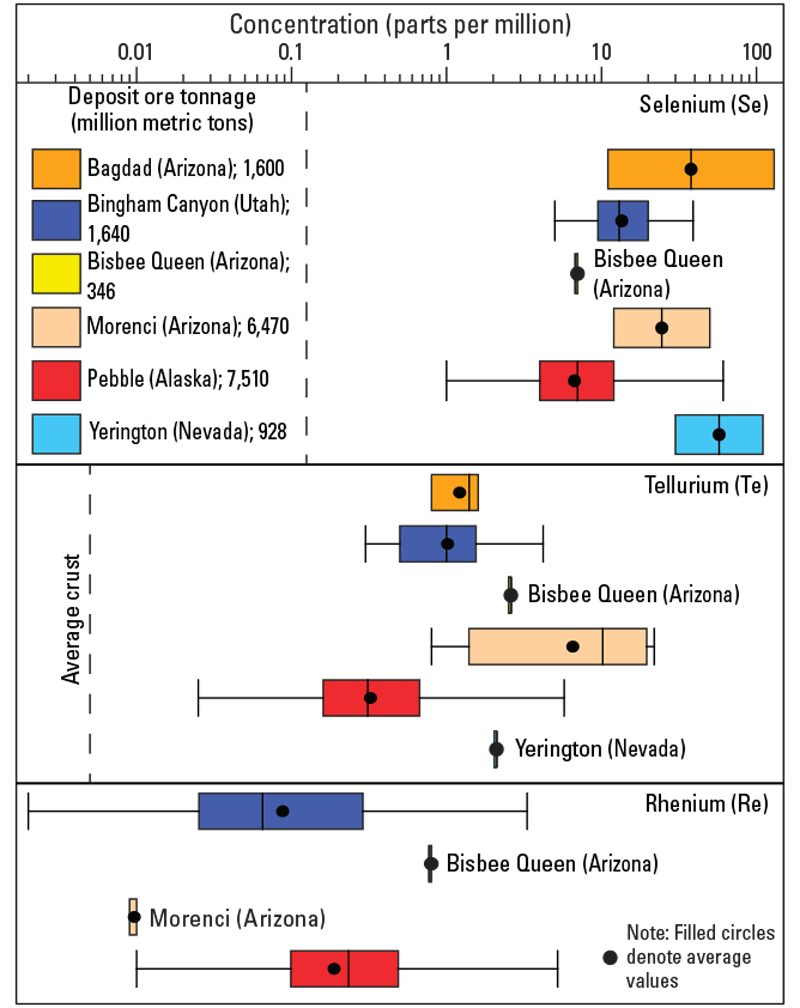
Box-and-whisker plots of selenium, tellurium, and rhenium abundance in mineralized samples from U.S. porphyry copper-molybdenum-gold deposits included in the Critical Minerals in Ores database. Boxes show the interquartile range (IQR; 25th to 75th percentile) of the data, and whiskers show the range of 1.5 times IQR. Dashed lines indicate average crustal abundance based on values from Wedepohl (1995).
Regional Metasomatic Deposits
The genetic origins and classification of iron-oxide-copper-gold (IOCG) and iron-oxide-apatite (IOA) deposits remain hotly debated and are grouped in the regional metasomatic deposit environment in the CMiO database. They are subdivided into the hematite-dominant and magnetite-dominant deposit types (Hofstra and others, 2021). Analysis of the data seems to confirm these classifications and shows different critical mineral enrichments among individual deposit types within this environment. For example, magnetite-dominant IOCG deposits are more likely to be enriched in cobalt, whereas light and heavy REE are more enriched in IOA and hematite-dominant IOCG deposits (fig. 4). The CMiO database can thus help assess the byproduct critical mineral potential for IOCG-IOA deposits in the United States and elsewhere.
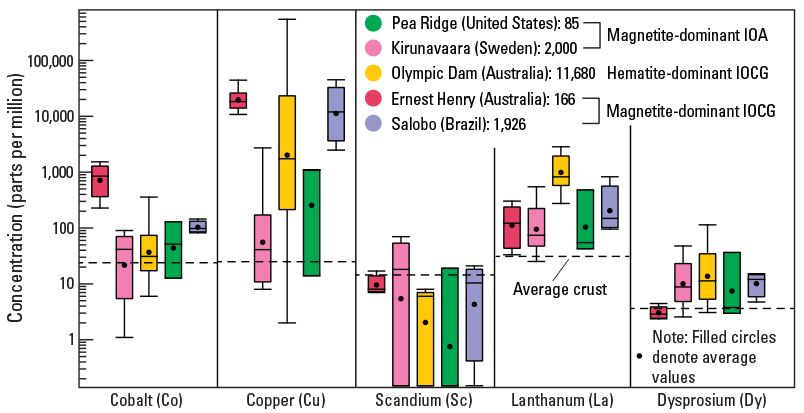
Box-and-whisker plots of cobalt, copper, scandium, lanthanum, and dysprosium abundance in mineralized samples from iron-oxide-copper-gold and iron-oxide-apatite deposits included in the Critical Minerals in Ores database. Boxes show the interquartile range (IQR); whiskers show the range of 1.5 times IQR. Deposit ore tonnage indicated in million metric tons.
Contributing Data to the CMiO Database
The CMMI is soliciting high-quality geochemical data from ore deposits from academia, government, and industry to increase spatial coverage and deposit type representation in the database. Samples should be geologically well characterized and analyzed by modern geochemical methods. The submission guide and data sheet template are available by accessing this link: https://doi.org/10.26186/149408.
References Cited
Champion, D., Raymond, O., Huston, D., VanDerWielen, S., and others, 2021, Critical Minerals in Ores—Geochemistry database: Geoscience Australia, accessed January 2025 at https://pid.geoscience.gov.au/dataset/ga/145496.
Emsbo, P., Lawley, C., and Czarnota, K., 2021, Geological surveys unite to improve critical mineral security: Eos, Transactions, American Geophysical Union, v. 102, accessed October 2024 at https://doi.org/10.1029/2021EO154252.
Hofstra, A., Lisitsin, V., Corriveau, L., Paradis, S., and others, 2021, Deposit classification scheme for the Critical Minerals Mapping Initiative Global Geochemical Database: U.S. Geological Survey Open-File Report 2021–1049, 60 p., accessed October 2024 at https://doi.org/10.3133/ofr20211049.
Kelley, K.D., 2020, International geoscience collaboration to support critical mineral discovery: U.S. Geological Survey Fact Sheet 2020–3035, 2 p., accessed July 2020 at https://doi.org/10.3133/fs20203035.
Wedepohl, K.H., 1995, The composition of the continental crust: Geochimica et Cosmochimica Acta, v. 59, no. 7, p. 1217–1232, accessed January 2017 at https://doi.org/10.1016/0016-7037(95)00038-2.
For more information, contact:
Geological Survey of Canada
Natural Resources Canada
601 Booth Street
Ottawa, Ontario K1A 0E8
Geoscience Australia
Sir Harold Raggatt Drive
Symonston ACT 2609
Mineral Resources Program
U.S. Geological Survey
913 National Center
Reston, VA 20192
Disclaimers
Geoscience Australia has tried to make the information in this product as accurate as possible. However, it does not guarantee that the information is totally accurate or complete. Therefore, you should not solely rely on this information when making a commercial decision.
The GSC/Natural Resources Canada (NRCan) is not responsible for the accuracy or completeness of the information contained in the reproduced material. NRCan shall at all times be indemnified and held harmless against any and all claims whatsoever arising out of negligence or other fault in the use of the information contained in this publication.
Any use of trade, firm, or product names is for descriptive purposes only and does not imply endorsement by the U.S. Government.
Although this information product, for the most part, is in the public domain, it also may contain copyrighted materials as noted in the text. Permission to reproduce copyrighted items must be secured from the copyright owner.
Suggested Citation
Case, G.N.D., Graham, G.E., Lawley, C.J.M., Bastrakov, E., Huston, D.L., Hofstra, A.H., Lisitsin, V., Hawkins, S.G., and Wang, B., 2025, Critical Minerals in Ores (CMiO) database (ver. 1.2, May 2025): U.S. Geological Survey Fact Sheet 2025–3002, 2 p., https://doi.org/10.3133/fs20253002.
ISSN: 2327-6932 (online)
ISSN: 2327-6916 (print)
| Publication type | Report |
|---|---|
| Publication Subtype | USGS Numbered Series |
| Title | Critical Minerals in Ores (CMiO) database |
| Series title | Fact Sheet |
| Series number | 2025-3002 |
| DOI | 10.3133/fs20253002 |
| Edition | Version 1.0: March 26, 2025; Version 1.1: April 30, 2025; Version 1.2: May 22, 2025 |
| Publication Date | March 26, 2025 |
| Year Published | 2025 |
| Language | English |
| Publisher | U.S. Geological Survey |
| Publisher location | Reston VA |
| Contributing office(s) | Alaska Science Center, Geology, Geophysics, and Geochemistry Science Center |
| Description | Report: 2 p.; Dataset |
| Online Only (Y/N) | N |