


Assessment of Undiscovered Conventional Oil and Gas Resources in the North Cuba Area, 2024
Links
- Document: Report (1.42 MB pdf) , HTML , XML
- Data Release: USGS data release - USGS National and Global Oil and Gas Assessment Project—North Cuba Area: Assessment Unit Boundaries, Assessment Input Data, and Fact Sheet Data Tables
- Download citation as: RIS | Dublin Core
Abstract
Using a geology-based assessment methodology, the U.S. Geological Survey estimated undiscovered, technically recoverable mean conventional resources of 4,098 million barrels of oil and 13,268 billion cubic feet of gas in the North Cuba area.
Introduction
The U.S. Geological Survey (USGS) assessed the potential for undiscovered, technically recoverable conventional oil and gas resources within the North Cuba area (fig. 1). The assessment is based on an analysis of a composite total petroleum system (TPS) that developed in this area through a multiphase tectonic evolution (Saura and others, 2008; Stanek and others, 2009; Escalona and Yang, 2013; Ramos and Mann, 2023). Triassic–Early Jurassic rifting between the North American plate, the Yucatan block, and the South American plate began the fragmentation of Pangaea and led to rift basins filled with synrift fluvial-alluvial and lacustrine sediments, possibly including lacustrine source rocks. Intermittent access to the ocean as rifting continued during the Middle Jurassic (Bajocian) led to the deposition of as much as 2,000 meters of salt on extended continental crust (Pindell and others, 2021). As rifting waned, organic-rich Oxfordian and Tithonian source rocks were deposited on the Bajocian salt. Seafloor spreading began in the Oxfordian as the Yucatan block rotated counterclockwise, opening the Gulf of America. Spreading formed proto-Caribbean oceanic crust between North America and South America. From the Berriasian to the Albian, thermal subsidence and open marine conditions led to the deposition of basinal organic-rich marl source rocks and extensive, stacked carbonate platforms along the passive margins. Transgression in the Late Cretaceous led to the drowning of the platforms and the deposition of organic-rich Upper Cretaceous (Cenomanian–Turonian) shale source rocks. The major tectonic event in the North Cuba area was the Late Cretaceous–Eocene progressive collision of the Greater Antilles arc with the passive margin of North America as proto-Caribbean oceanic crust subducted southwestward beneath the Caribbean plate. Northeast-directed contraction formed the North Cuba fold and thrust belt and the adjacent foreland basin. The stacked thrust sheets consist largely of synrift, postrift, and passive margin stratigraphic successions of the proto-Caribbean that include the major source rocks and reservoirs (Pszczółkowski and Myczyński, 2010). The foreland basin filled with as much as 5 kilometers of synorogenic and postorogenic clastic sediment.
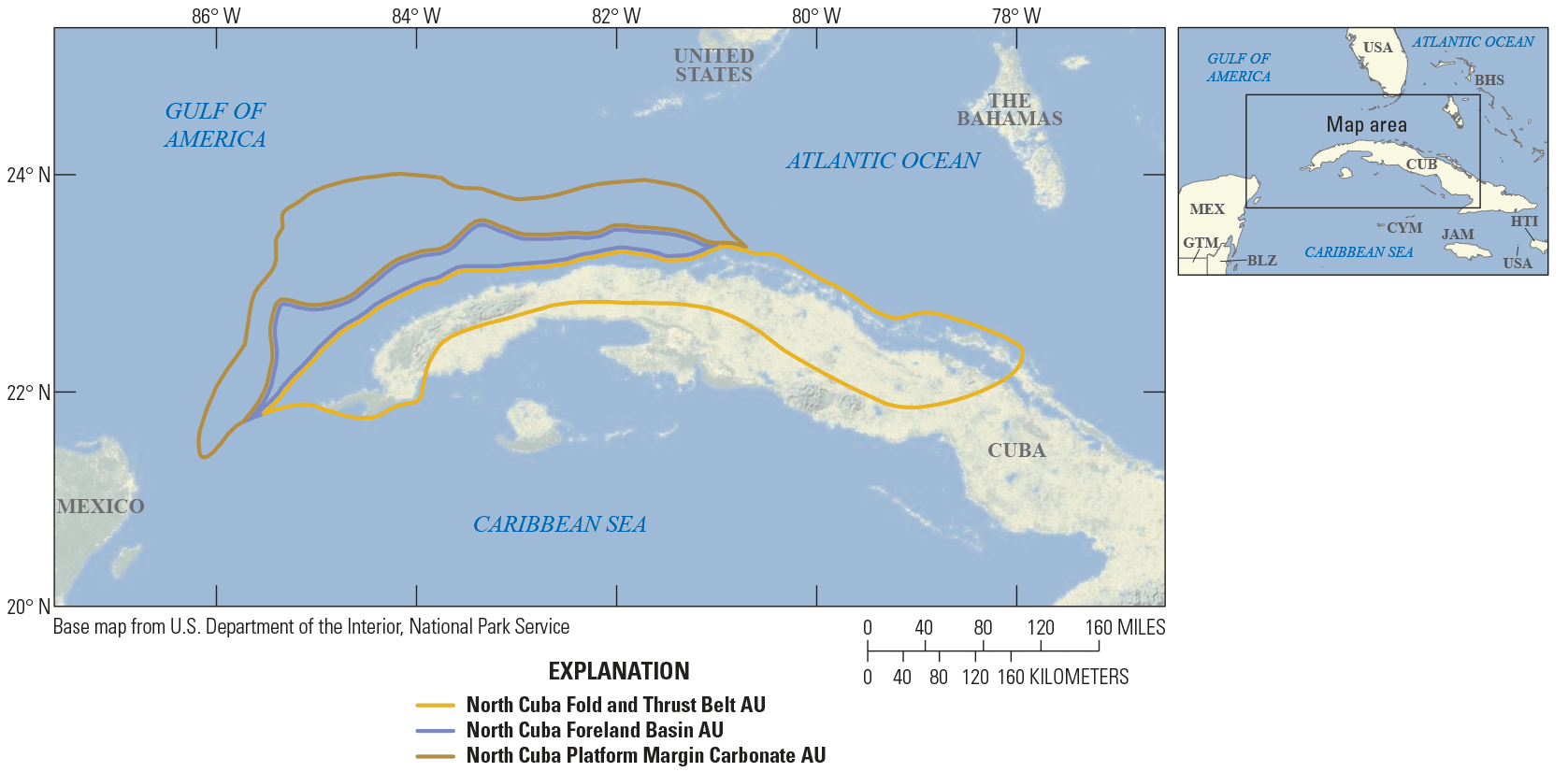
Maps showing the location of three conventional assessment units (AUs) in the North Cuba area.
Total Petroleum System and Assessment Units
The USGS defined a Mesozoic–Cenozoic Composite TPS to encompass oil and gas sourced from several organic-rich shales and marls. Petroleum source rocks in this composite TPS are Upper Jurassic (Oxfordian and Tithonian) marls, Lower Cretaceous marls, Cenomanian–Turonian shales, and possibly Paleogene shales (Jacques and Clegg, 2002; Moretti and others, 2003; Magnier and others, 2004; Zhang and others, 2023). Late Triassic–Early Jurassic synrift lacustrine shales are speculative source rocks. Organic-rich Oxfordian and Tithonian marls are interpreted to be the most substantial in terms of volumes of oil and gas generated, migrated, and potentially trapped (Jacques and Clegg, 2002; Moretti and others, 2003; Zhang and others, 2023). Thrust loading and foreland burial led to thermal maturation of speculative Jurassic and Cretaceous source rocks, whereas Paleogene source rocks in the foreland basin may not be thermally mature for oil generation.
Three conventional assessment units (AUs) were defined within the composite TPS based on the major structural elements in the North Cuba area: the North Cuba Fold and Thrust Belt AU, North Cuba Foreland Basin AU, and North Cuba Platform Margin Carbonate AU (fig. 1). The North Cuba Fold and Thrust Belt AU encompasses the onshore and offshore areas of the Late Cretaceous–Eocene fold and thrust belt. More than 30 oil fields have been discovered mostly in the onshore part of the AU, indicating that a petroleum system is or was active in the North Cuba area. Main reservoirs are fractured fine-grained carbonates within structural traps, but progressive deformation may have breached some seals. The North Cuba Foreland Basin AU outlines the foreland basin adjacent to the fold and thrust belt and has the potential for oil and gas in sandstone reservoirs within synrift–postrift structural and stratigraphic traps. The North Cuba Platform Margin Carbonate AU is defined by oil and gas that may have migrated updip into a spectrum of platform-margin reservoirs such as karst, dolomites, reefs, mounds, and debris-flow breccias mainly in stratigraphic traps, and by similar reservoirs in rift-related structural traps along the Yucatan, Florida, and Bahamas Platforms.
The geologic model for this assessment is for oil and gas generated from several source rocks by Late Cretaceous–Eocene thrust loading and foreland burial to have migrated into carbonate reservoirs along the margins of the Yucatan, Florida, and Bahamas carbonate platforms; possible synrift clastic reservoirs and orogenic and postorogenic sandstone reservoirs in the foreland basin; and fractured carbonate reservoirs within the fold and thrust belt (fig. 2). Oil fields discovered in this composite TPS are within the North Cuba Fold and Thrust Belt AU, but little exploration has occurred in the North Cuba Foreland Basin AU, and none has occurred in the North Cuba Platform Margin Carbonate AU (Ananev and others, 2014). The assessment input data for three conventional AUs are summarized in table 1 and in Schenk (2025).
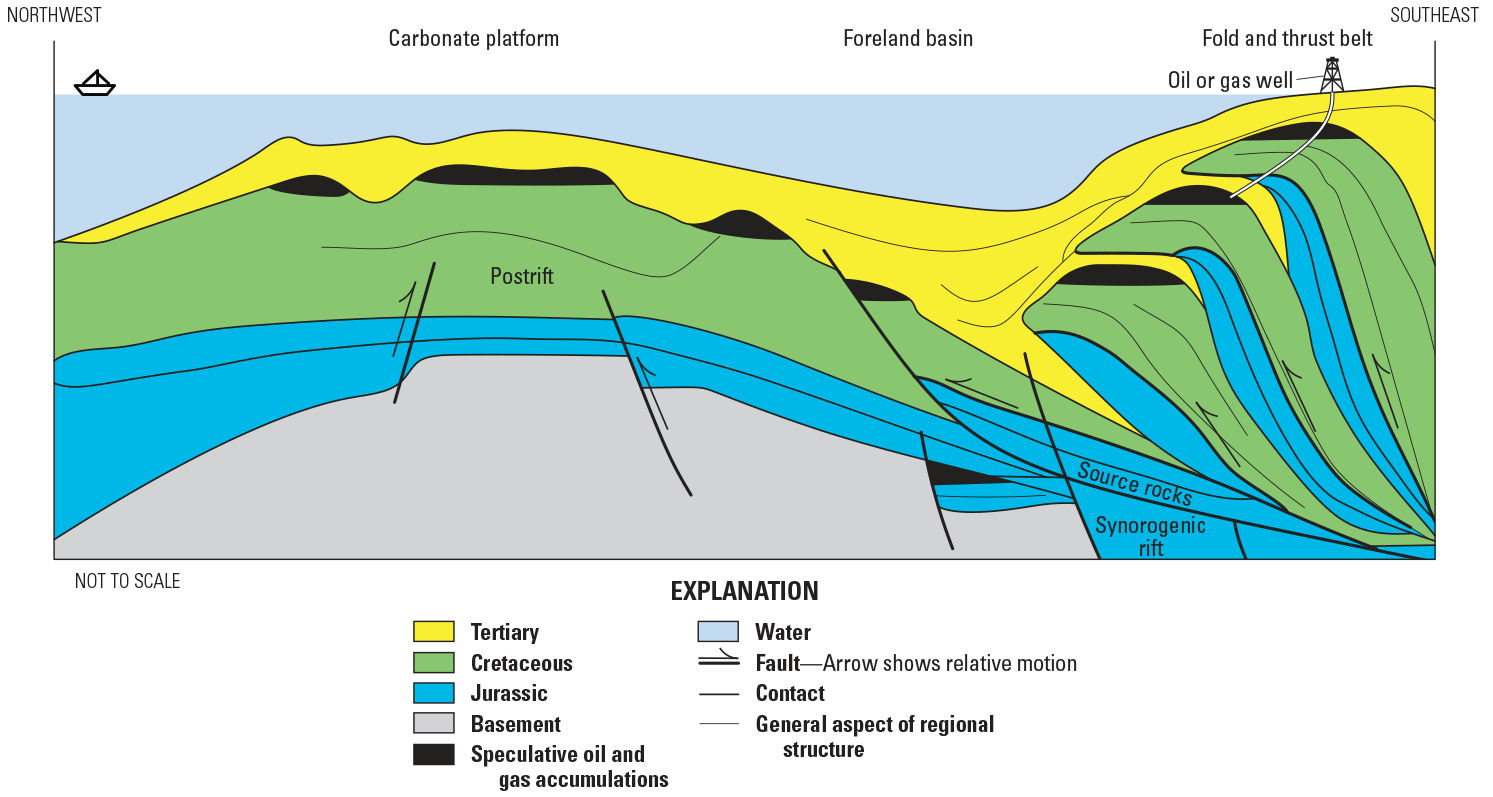
Schematic cross-section showing speculative oil and gas accumulations in the North Cuba fold and thrust belt, foreland basin, and carbonate platform reservoirs. Figure modified from Magnier and others (2004).
Table 1.
Key input data for three conventional oil and gas assessment units in the North Cuba area.[Gray shading indicates not applicable. AU, assessment unit; MMBO, million barrels of oil; BCFG, billion cubic feet of gas]
Undiscovered Resources Summary
The USGS quantitatively assessed undiscovered conventional oil and gas resources in three AUs in the North Cuba area (table 2). The estimated mean undiscovered resources are 4,098 million barrels of oil (MMBO), or 4.1 billion barrels of oil, with an F95–F5 range from 900 to 10,701 MMBO; 13,268 billion cubic feet of gas (BCFG), or 13.3 trillion cubic feet of gas, with an F95–F5 range from 2,308 to 39,404 BCFG; and 273 million barrels of natural gas liquids (MMBNGL), with an F95–F5 range from 43 to 854 MMBNGL.
Table 2.
Results for three conventional assessment units in the North Cuba area.[Gray shading indicates not applicable. Results shown are fully risked estimates. F95 represents a 95-percent chance of at least the amount tabulated; other fractiles are defined similarly. MMBO, million barrels of oil; BCFG, billion cubic feet of gas; NGL, natural gas liquids; MMBNGL, million barrels of natural gas liquids]
For More Information
Assessment results are also available at the USGS Energy Resources Program website, https://www.usgs.gov/programs/energy-resources-program.
References Cited
Ananev, V.V., Verzhbitskiy, V.E., Obukhov, A.N., Borisov, D.V., and Nortsev, G.V., 2014, Geology and petroleum potential of the Gulf of Mexico, Cuba, in SPE Russian Oil and Gas Exploration and Production Technical Conference and Exhibition, Moscow, October 14–16, 2014: Society of Petroleum Engineers, paper SPE-171212-MS, 6 p., accessed April 28, 2025, at https://doi.org/10.2118/171212-MS.
Escalona, A., and Yang, W., 2013, Subsidence controls on foreland basin development of northwestern offshore Cuba, southeastern Gulf of Mexico: AAPG Bulletin, v. 97, no. 1, p. 1–25, accessed April 28, 2025, at https://doi.org/10.1306/06111212002.
Jacques, J.M., and Clegg, H., 2002, Late Jurassic source rock distribution and quality in the Gulf of Mexico—Inferences from plate tectonic modelling: Gulf Coast Association of Geological Societies Transactions, v. 52, p. 429–440, accessed April 28, 2025, at https://archives.datapages.com/data/gcags/data/052/052001/0429.htm.
Magnier, C., Moretti, I., Lopez, J.O., Gaumet, F., Lopez, J.G., and Letouzey, J., 2004, Geochemical characterization of source rocks, crude oils and gases of northwest Cuba: Marine and Petroleum Geology, v. 21, no. 2, p. 195–214, accessed April 28, 2025, at https://doi.org/10.1016/j.marpetgeo.2003.11.009.
Moretti, I., Tenreyro, R., Linares, E., Lopez, J.G., Letouzey, J., Magnier, C., Gaumet, F., Lecomte, J.C., Lopez, J.O., and Zimine, S., 2003, Petroleum system of the Cuban northwest offshore zone, in Bartolini, C., Buffler, R.T., and Blickwede, J.F., eds., The Circum-Gulf of Mexico and the Caribbean—Hydrocarbon habitats, basin formation and plate tectonics: AAPG Memoir 79, p. 675–696, accessed April 28, 2025, at https://doi.org/10.1306/M79877C31.
Pindell, J., Villagómez, D., Molina-Garza, R., Graham, R., and Weber, B., 2021, A revised synthesis of the rift and drift history of the Gulf of Mexico and surrounding regions in the light of improved age dating of the Middle Jurassic salt, in Davison, I., Hull, J.N.F., and Pindell, J., eds., The basins, orogens and evolution of the southern Gulf of Mexico and northern Caribbean: Geological Society of London Special Publication 504, p. 29–76, accessed April 28, 2025, at https://doi.org/10.1144/SP504-2020-43.
Pszczółkowski, A., and Myczyński, R., 2010, Tithonian–Early Valanginian evolution of deposition along the proto-Caribbean margin of North America recorded in Guaniguanico successions (western Cuba): Journal of South American Earth Sciences, v. 29, no. 2, p. 225–253, accessed April 28, 2025, at https://doi.org/10.1016/j.jsames.2009.07.004.
Ramos, J.P., and Mann, P., 2023, Late Cretaceous–recent tectonostratigraphic evolution of the Yucatan back-arc basin, northern Caribbean Sea: Geochemistry, Geophysics, Geosystems, v. 24, no. 8, article e2023GC010933, 33 p., accessed April 28, 2025, at https://doi.org/10.1029/2023GC010933.
Saura, E., Vergés, J., Brown, D., Lukito, P., Soriano, S., Torrescusa, S., García, R., Sánchez, J.R., Sosa, C., and Tenreyro, R., 2008, Structural and tectonic evolution of western Cuba fold and thrust belt: Tectonics, v. 27, no. 4, article TC4002, 22 p., accessed April 28, 2025, at https://doi.org/10.1029/2007TC002237.
Schenk, C.J., 2025, USGS National and Global Oil and Gas Assessment Project—North Cuba area—Assessment unit boundaries, input data tables, and fact sheet data tables: U.S. Geological Survey data release, https://doi.org/10.5066/P14BFJJC.
Stanek, K.P., Maresch, W.V., and Pindell, J.L., 2009, The geotectonic story of the northwestern branch of the Caribbean arc—Implications from structural and geochronological data of Cuba, in James, K.H., Lorente, M.A., and Pindell, J.L., eds., The origin and evolution of the Caribbean plate: Geological Society of London Special Publication 328, p. 361–398, accessed April 28, 2025, at https://doi.org/10.1144/SP328.15.
Zhang, Y., Meng, F., Xu, J., Lui, B., Wu, X., Shi, K., and Wang, R., 2023, Oil and gas exploration potential in the exclusive economic zone of the [sic] Cuba’s sector of the Gulf of Mexico: Geological Journal, v. 58, no. 11, p. 4133–4145, accessed April 28, 2025, at https://doi.org/10.1002/gj.4687.
Disclaimers
Any use of trade, firm, or product names is for descriptive purposes only and does not imply endorsement by the U.S. Government.
Although this information product, for the most part, is in the public domain, it also may contain copyrighted materials as noted in the text. Permission to reproduce copyrighted items must be secured from the copyright owner.
Suggested Citation
Schenk, C.J., Mercier, T.J., Le, P.A., Cicero, A.D., Drake, R.M., II, Gelman, S.E., Hearon, J.S., Johnson, B.G., Lagesse, J.H., Leathers-Miller, H.M., and Timm, K.K., 2025, Assessment of undiscovered conventional oil and gas resources in the North Cuba area, 2024: U.S. Geological Survey Fact Sheet 2025–3029, 4 p., https://doi.org/10.3133/fs20253029.
ISSN: 2327-6932 (online)
Study Area
| Publication type | Report |
|---|---|
| Publication Subtype | USGS Numbered Series |
| Title | Assessment of undiscovered conventional oil and gas resources in the North Cuba area, 2024 |
| Series title | Fact Sheet |
| Series number | 2025-3029 |
| DOI | 10.3133/fs20253029 |
| Publication Date | June 25, 2025 |
| Year Published | 2025 |
| Language | English |
| Publisher | U.S. Geological Survey |
| Publisher location | Reston VA |
| Contributing office(s) | Central Energy Resources Science Center |
| Description | Report: 4 p.; Data Release |
| Country | Cuba |
| Online Only (Y/N) | Y |