


An Estimate of Undiscovered, Technically Recoverable Oil and Gas Resources Underlying Federal Lands of the Onshore United States, 2025
Links
- Document: Report (12.3 MB pdf) , HTML , XML
- Additional Report Piece: Team List (160 KB pdf)
- Data Release: USGS data release - USGS National and Global Oil and Gas Assessment Project—United States Federal Lands Oil and Gas Resource Allocations—Federal Lands Fact Sheet Data Tables
- Download citation as: RIS | Dublin Core
Abstract
Using a geology-based assessment methodology, the U.S. Geological Survey estimated undiscovered, technically recoverable mean allocated resources of 29.4 billion barrels of oil, 391.6 trillion cubic feet of gas, and 8.4 billion barrels of natural gas liquids underlying Federal lands of the onshore United States.
Introduction
The U.S. Geological Survey (USGS) assesses potential volumes of undiscovered, technically recoverable oil and gas resources in the onshore and State water provinces of the United States in an ongoing effort. The Energy Act of 2000 (Public Law 106–469, 114 Stat. 2029) and the Energy Policy Act of 2005 (Public Law 109–58, 119 Stat. 594) authorize the USGS to complete and periodically update oil and gas assessments for all onshore Federal lands and research on conventional and unconventional (continuous) oil and natural gas and other petroleum accumulations. This report, which provides an allocation of mean volumes of potential undiscovered, technically recoverable conventional- and continuous-type oil and gas resources underlying Federal lands of the onshore provinces of the United States, has been prepared as part of the USGS response to the U.S. Department of the Interior Secretary's Order 3417, “Addressing the National Energy Emergency” (U.S. Department of the Interior, 2025).
The USGS allocated potential volumes of undiscovered, technically recoverable oil and gas resources to Federal lands first in 1990 (Dolton and others, 1990) and again in 1998 (Gautier and others, 1998). However, these previous estimates of resources underlying Federal lands are not directly comparable to the results in this report. The 1990 allocation to Federal lands was based on the 1989 USGS national oil and gas assessment (Mast and others, 1989), which focused on the assessment of conventional oil and gas resources and did not include continuous-type resources (shale oil, shale gas, tight oil, tight gas, and coal-bed gas). The 1998 USGS Federal land allocation report was based on the 1995 USGS national oil and gas assessment (USGS National Oil and Gas Resource Assessment Team, 1995), which focused on conventional resources but for the first time included quantitative assessments of a subset of U.S. continuous-type oil and gas resources. This subset of continuous-type assessments was used to estimate potential continuous-type resources underlying Federal lands (Crovelli and Schmoker, 1997). However, at that time, knowledge concerning the geographic extent, production, and engineering characteristics of continuous-type oil and gas accumulations was minimal. Many continuous-type oil and gas accumulations were either not assessed or only partially assessed because of a lack of information (USGS National Oil and Gas Resource Assessment Team, 1995). This new allocation report for Federal lands is based on the quantitative assessments of all conventional- and continuous-type resources in the onshore United States completed since the 1995 assessment. Not included in this allocation are tar sands, oil shales, gas hydrates, or gas in geopressured brines because there are no technically recoverable resources generally reported for these types of oil and gas accumulations.
Since the 1995 assessment, the USGS has assessed or reassessed 579 conventional- and continuous-type assessment units with allocations of resources to Federal lands. Allocations of undiscovered oil, gas, and natural gas liquid resources were calculated for land entities in each assessment unit where surface ownership is Federal. Because of the complicated nature of mineral estate ownership, the assumption was made for this report that Federal surface ownership generally includes mineral estate ownership, as was made in the previous Federal land resource allocations (Dolton and others, 1990; Gautier and others, 1998). Federal land ownership consists of lands classified as Bureau of Land Management (BLM), BLM wilderness areas, BLM roadless areas, National Park Service (NPS), NPS wilderness areas, NPS protected withdrawals, U.S. Department of Agriculture Forest Service (FS), FS wilderness areas, FS roadless areas, FS protected withdrawals, U.S. Fish and Wildlife Service (FWS), FWS wilderness areas, FWS protected withdrawals, wilderness study areas, U.S. Department of Energy, U.S. Department of Defense, Bureau of Reclamation, and Tennessee Valley Authority.
Conventional and Continuous Oil and Gas Resources
The USGS assesses undiscovered, technically recoverable conventional- and continuous-type oil and gas resources. Although these resource categories are commonly thought of as end members, in some oil and gas accumulations, there is a transition from conventional- to continuous-type resources as reservoir permeability decreases, which is commonly observed with low-permeability (or tight) sandstones. In practice, the distinction between these two end-member resource categories is straightforward, but sometimes the distinction is not clear because of insufficient data. Therefore, in these cases, the oil or gas accumulation is defined as conventional. The volumes of undiscovered oil and gas in this report are technically recoverable resources and are not economically recoverable resources or reserves.
Quantitative Methodology
The USGS assessment process begins with a comprehensive evaluation of all geologic, petroleum system, production, and engineering data for existing and analog oil and gas accumulations. After this review, the USGS uses two quantitative methodologies—one for the assessment of conventional oil and gas resources and another for the assessment of continuous oil and gas resources; both methodologies have been reviewed by independent bodies external to the USGS. The methodology for conventional resources focuses on the development of probability distributions for sizes and numbers of undiscovered oil and gas accumulations. These two distributions, along with coproduct ratios (nonassociated gas to oil, natural gas liquids to associated gas, and liquids to gas), are entered into a Monte Carlo simulation to generate a probability distribution for volumes of undiscovered oil and gas resources (Klett and others, 2005). The methodology for continuous resources is based on well performance and an evaluation of geologic, production, and engineering data. Key inputs to the continuous-type resource methodology are probability distributions for the mapped potentially productive area, noninterfering well spacing or drainage area, predicted future well success ratio, amount of untested area of the assessment unit, and estimated ultimate oil or gas recovery of wells within the assessment unit. The probability distributions of all input data are entered into a Monte Carlo simulation to arrive at a final probability distribution for undiscovered oil or gas resources in a continuous-type assessment unit (Charpentier and Cook, 2012).
After the quantitative assessment of each assessment unit, a standard geographic information system (GIS) process is used to merge the BLM Federal land ownership map (fig. 1; BLM, 2024) with each USGS mapped assessment unit to calculate the percentage of Federal lands within each assessment unit. Mean allocated volumes of oil and gas are calculated based on this percentage. For example, the assumption is made that if Federal lands are mapped as 12 percent of the assessment unit area, then 12 percent of the undiscovered oil and gas mean resource volume of that assessment unit is assigned to Federal lands. The mean allocated volumes of oil and gas underlying Federal lands in all U.S. assessment units are summarized by State (table 1), by USGS geologic province (fig. 1; table 2), and in Mercier (2025). In addition to showing the distribution of Federal lands, figure 1 also shows the boundaries and names of USGS geologic provinces.
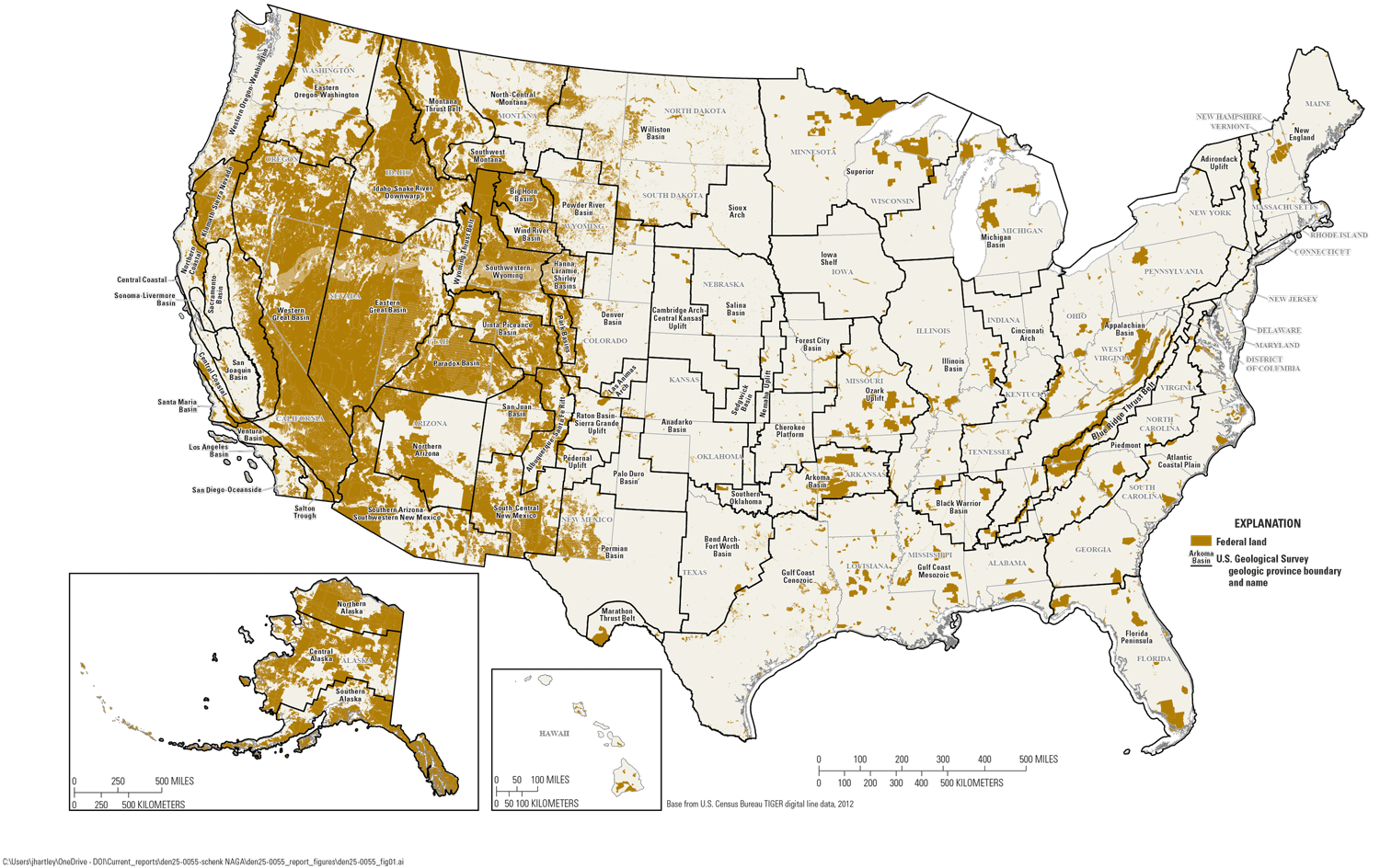
Maps showing the locations of Federal lands and U.S. Geological Survey geologic provinces.
Table 1.
Mean allocated volumes of potential undiscovered, technically recoverable oil, gas, and natural gas liquid resources underlying Federal lands by State.[MMBO, million barrels of oil; BCFG, billion cubic feet of gas; NGL, natural gas liquids; MMBNGL, million barrels of natural gas liquids]
Table 2.
Mean allocated volumes of potential undiscovered, technically recoverable oil, gas, and natural gas liquid resources underlying Federal lands by U.S. Geological Survey geologic province.[MMBO, million barrels of oil; BCFG, billion cubic feet of gas; NGL, natural gas liquids; MMBNGL, million barrels of natural gas liquids]
Summary of Allocated Mean Oil, Gas, and Natural Gas Liquid Resources
The USGS allocated mean volumes of undiscovered, technically recoverable oil, gas, and natural gas liquid (NGL) resources underlying Federal lands of the United States by State (table 1). The volumetric means of total estimated resources for Federal lands of the United States are as follows: 29,414.7 million barrels of oil (MMBO), or 29.4 billion barrels of oil; 391,553.0 billion cubic feet of gas (BCFG), or 391.6 trillion cubic feet of gas; and 8,410.4 million barrels of natural gas liquids (MMBNGL), or 8.4 billion barrels of NGL. The five States with the most undiscovered mean allocated oil resources underlying Federal lands are Alaska (14,458.1 MMBO), New Mexico (8,925.8 MMBO), Nevada (1,407.3 MMBO), Wyoming (988.3 MMBO), and Texas (915.5 MMBO). The five States with the most undiscovered mean allocated gas resources are Alaska (111,034.2 BCFG), New Mexico (85,393.7 BCFG), Colorado (60,016.0 BCFG), Wyoming (57,138.0 BCFG), and Texas (16,776.9 BCFG). The five States with the most undiscovered mean allocated NGL resources are New Mexico (3,916.5 MMBNGL), Wyoming (1,568.1 MMBNGL), Alaska (926.0 MMBNGL), Montana (600.7 MMBNGL), and Colorado (374.6 MMBNGL).
Mean volumes of oil, gas, and NGL allocated to Federal lands are also provided by geologic province (fig. 1; table 2). The five geologic provinces with the most undiscovered mean allocated oil resources underlying Federal lands are Northern Alaska (14,058.9 MMBO), Permian Basin (8,936.3 MMBO), Eastern Great Basin (1,816.8 MMBO), Gulf Coast Mesozoic (1,191.7 MMBO), and Williston Basin (548.6 MMBO). The five geologic provinces with the most undiscovered mean allocated gas resources are Northern Alaska (104,100.4 BCFG), Permian Basin (58,468.4 BCFG), Southwestern Wyoming (58,267.7 BCFG), Uinta-Piceance Basin (55,293.7 BCFG), and San Juan Basin (29,106.4 BCFG). The five geologic provinces with the most undiscovered mean allocated NGL resources are Permian Basin (3,864.7 MMBNGL), Southwestern Wyoming (1,637.0 MMBNGL), Northern Alaska (844.4 MMBNGL), Montana Thrust Belt (589.5 MMBNGL), and Gulf Coast Mesozoic (392.6 MMBNGL).
For More Information
Assessment results are also available at the USGS Energy Resources Program website, https://www.usgs.gov/programs/energy-resources-program.
National and Global Oil and Gas Assessment Project Federal Lands Resource Allocation Team
Christopher J. Schenk, Tracey J. Mercier, and the National and Global Oil and Gas Assessment Project Federal Lands Resource Allocation Team (list available at https://doi.org/10.3133/fs20253032)
References Cited
Bureau of Land Management [BLM], 2024, BLM National SMA Surface Management Agency area polygons: Bureau of Land Management Geospatial Business Platform web page, accessed May 9, 2025, at https://gbp-blm-egis.hub.arcgis.com/datasets/blm-national-sma-surface-management-agency-area-polygons/about.
Charpentier, R.R., and Cook, T.A., 2012, Improved USGS methodology for assessing continuous petroleum resources (ver. 2.0): U.S. Geological Survey Data Series 547, 23 p., accessed May 9, 2025, at https://pubs.usgs.gov/ds/547/.
Crovelli, R.A., and Schmoker, J.W., 1997, Estimates of technically recoverable petroleum resources for continuous-type (unconventional) plays in sandstones, shales, and chalks on Federal lands of the conterminous United States: U.S. Geological Survey Open-File Report 97–490, [variously paged; 207 p.], accessed May 22, 2025, at https://doi.org/10.3133/ofr97490.
Dolton, G.L., Mast, R.F., and Crovelli, R.A., 1990, Estimates of undiscovered conventional resources of oil and gas for Federal lands, and for Indian and Native lands of the continental United States: U.S. Geological Survey Open-File Report 90–705, 64 p., accessed May 9, 2025, at https://pubs.usgs.gov/of/1990/0705/report.pdf.
Gautier, D.L., Dolton, G.L., and Attanasi, E.D., 1998, 1995 national oil and gas assessment and onshore Federal lands: U.S. Geological Survey Open-File Report 95–75–N, [64 p.], accessed May 9, 2025, at https://pubs.usgs.gov/of/1995/of95-075n/Methods_assessment.htm.
Klett, T.R., Schmoker, J.W., and Charpentier, R.R., 2005, U.S. Geological Survey input-data form and operational procedure for the assessment of conventional petroleum accumulations, chap. 20 of U.S. Geological Survey Southwestern Wyoming Province Assessment Team, comps., Petroleum systems and geologic assessment of oil and gas resources in the Southwestern Wyoming Province, Wyoming, Colorado, and Utah: U.S. Geological Survey Digital Data Series DDS–69–D, 7 p., accessed May 9, 2025, at https://pubs.usgs.gov/dds/dds-069/dds-069-d/REPORTS/69_D_CH_20.pdf.
Mast, R.F., Dolton, G.L., Crovelli, R.A., Root, D.H., Attanasi, E.D., Martin, P.E., Cooke, L.W., Carpenter, G.B., Pecora, W.C., and Rose, M.B., 1989, Estimates of undiscovered conventional oil and gas resources in the United States—A part of the Nation’s energy endowment: U.S. Geological Survey, 44 p., accessed May 22, 2025, at https://doi.org/10.3133/7000090.
Mercier, T.J., 2025, USGS National and Global Oil and Gas Assessment Project—United States Federal lands oil and gas resource allocations—Federal lands fact sheet data tables: U.S. Geological Survey data release, https://doi.org/10.5066/P13XGRZC.
U.S. Department of the Interior, 2025, Addressing the national energy emergency: U.S. Department of the Interior Secretary's Order 3417, 2 p., accessed May 9, 2025, at https://www.doi.gov/document-library/secretary-order/so-3417-addressing-national-energy-emergency.
U.S. Geological Survey [USGS] National Oil and Gas Resource Assessment Team, 1995, 1995 national assessment of United States oil and gas resources: U.S. Geological Survey Circular 1118, 20 p., accessed May 9, 2025, at https://pubs.usgs.gov/publication/cir1118.
Disclaimers
Any use of trade, firm, or product names is for descriptive purposes only and does not imply endorsement by the U.S. Government.
Although this information product, for the most part, is in the public domain, it also may contain copyrighted materials as noted in the text. Permission to reproduce copyrighted items must be secured from the copyright owner.
Suggested Citation
Schenk, C.J., Mercier, T.J., and the 1995–2025 National and Global Oil and Gas Assessment Project Federal Lands Resource Allocation Team, 2025, An estimate of undiscovered, technically recoverable oil and gas resources underlying Federal lands of the onshore United States, 2025: U.S. Geological Survey Fact Sheet 2025–3032, 6 p., https://doi.org/10.3133/fs20253032.
ISSN: 2327-6932 (online)
ISSN: 2327-6916 (print)
Study Area
| Publication type | Report |
|---|---|
| Publication Subtype | USGS Numbered Series |
| Title | An estimate of undiscovered, technically recoverable oil and gas resources underlying Federal lands of the onshore United States, 2025 |
| Series title | Fact Sheet |
| Series number | 2025-3032 |
| DOI | 10.3133/fs20253032 |
| Publication Date | June 18, 2025 |
| Year Published | 2025 |
| Language | English |
| Publisher | U.S. Geological Survey |
| Publisher location | Reston VA |
| Contributing office(s) | Central Energy Resources Science Center |
| Description | Report: 5 p.; Data Release |
| Country | United States |
| Online Only (Y/N) | N |