


Assessment of Undiscovered Conventional Oil and Gas Resources in Mexico, Belize, and Guatemala, 2024
Links
- Document: Report (5.30 MB pdf) , HTML , XML
- Data Release: USGS data release - USGS National and Global Oil and Gas Assessment Project—Provinces of Mexico, Belize, and Guatemala—Assessment Unit Boundaries, Assessment Input Data, and Fact Sheet Data Tables
- Download citation as: RIS | Dublin Core
Abstract
Using a geology-based assessment methodology, the U.S. Geological Survey estimated undiscovered, technically recoverable mean conventional resources of 14.6 billion barrels of oil and 83.7 trillion cubic feet of gas in Mexico, Belize, and Guatemala.
Introduction
The U.S. Geological Survey (USGS) assessed the potential for undiscovered, technically recoverable conventional oil and gas resources in 14 assessment units (AUs) (fig. 1A, B) within 9 geologically defined provinces of Mexico, Belize, and Guatemala. The geologic provinces assessed in this report are as follows: Burgos Basin, Tampico-Misantla Basin, Veracruz Basin, Campeche-Sigsbee Salt Basin, Saline-Comalcalco Basin, Villahermosa Uplift, Macuspana Basin, Yucatan Platform, and Sierra Madre de Chiapas-Petén Fold Belt. The geologic evolution of these provinces and the oil and gas resources within them resulted from a complex tectonic history (Lara, 1993; Bartok and others, 2015; Hudec and Norton, 2019; Davison, 2021; Graham and others, 2021; Hasan and Mann, 2021; Miranda-Madrigal and Chávez-Cabello, 2021; Pindell and others, 2021; Villagómez and others, 2022) that is briefly summarized for this report. Crustal extension in the Triassic to Early Jurassic between North America, the Yucatan Platform, and South America signaled the initial fragmentation of Pangaea and led to peripheral rift basins filled with synrift fluvial-alluvial and lacustrine sediments, possibly including viable petroleum source rocks, reservoir rocks, and traps. Intermittent access to the ocean during the Middle Jurassic (Bajocian) and possibly as late as the Callovian led to the deposition of as much as 2,000 meters of salt on extended continental crust. Rifting continued to extend the continental crust between North America, the Yucatan Platform, and South America up to the Oxfordian. As rifting waned and thermal subsidence occurred, transgressive organic-rich source rocks of Oxfordian, Kimmeridgian, and Tithonian age were deposited on the thick salt. Oxfordian sandstones and carbonates deposited along the western margin of the Yucatan Block may contain potential reservoirs like the Norphlet and Smackover Formations of the offshore eastern Gulf Coast margin of the United States (Snedden and others, 2021). Seafloor spreading began in the Oxfordian between North America and the Yucatan Platform as the Yucatan Platform rotated counterclockwise, resulting in the separation of the Bajocian salt basin into a northern salt basin along the U.S. Gulf of America margin (Louann salt basin) and a southern salt basin on the western margin of the Yucatan Block (Campeche salt basin). With burial, the salt began to deform into a spectrum of structures in the Campeche salt basin, forming numerous traps for oil and gas. By Valanginian time, the Yucatan Block ceased movement, ending seafloor spreading. Open marine conditions prevailed throughout the Gulf of America, and several transgressions and regressions led to the formation of extensive, stacked carbonate platforms along the passive margins of the Burgos Basin, Tampico-Misantla Basin, and Veracruz Basin Provinces, as well as the formation of carbonate platforms throughout the passive margins of the Yucatan Block. Carbonate platforms contain many potential reservoirs, such as karsts, dolomites, reefs, mounds, debris-flow conglomerates, and breccias. Subduction of the Farallon plate along the western margin of Mexico from the Late Cretaceous to Eocene led to deformation that formed the northwest–southeast-trending Sierra Madre de Chiapas Fold Belt, with potential fractured carbonate reservoirs within structural traps. Uplift and erosion of the fold belts resulted in the eastward progradation of major offshore clastic sequences in the Burgos Basin, Tampico-Misantla Basin, and Veracruz Basin Provinces, providing numerous potential reservoirs and traps. Burial by these clastic sequences caused continuous movement and deformation of the underlying salt of the Campeche salt basin, with the potential for modifying the existing structures and possibly disrupting seal integrity. Northward dextral movement of the Greater Antilles arc system in the Paleogene caused the inversion of extensional structures along the once-passive southeastern Yucatan margin, with possible loss of oil and gas (Lara, 1993). Subduction of the Cocos-Nazca plate in the Miocene along the western Mexico margin formed the Sierra Madre de Chiapas Fold Belt and the foreland Petén Basin. Uplift in the Miocene and Pliocene resulted in eastward-prograding clastic sequences with numerous potential reservoirs and traps. In the Miocene, detachment surfaces along undercompacted and overpressured Eocene shales led to upslope extensional structures and downslope contractional structures, forming the Mexican Ridges Fold Belt offshore from the Burgos Basin, Tampico-Misantla Basin, and Veracruz Basin margins with potential for deep-water reservoirs, traps, and seals. Salt withdrawal in the southern Yucatan margin formed the Macuspana Basin and Saline-Comalcalco Basin that filled with Miocene to Pliocene clastics, providing potential reservoirs, traps, and seals.
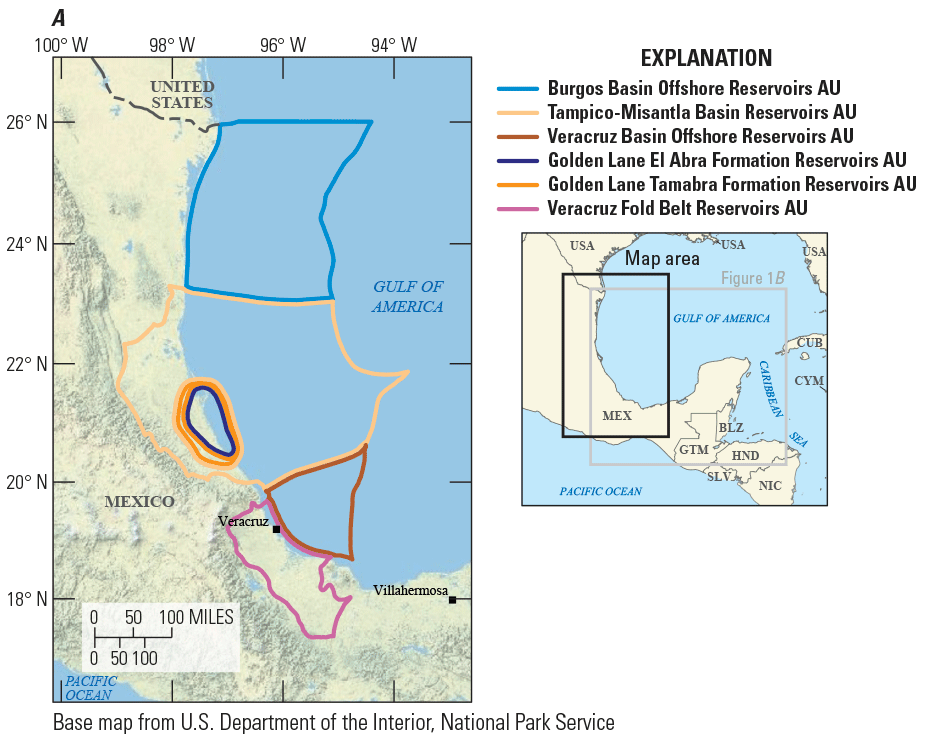
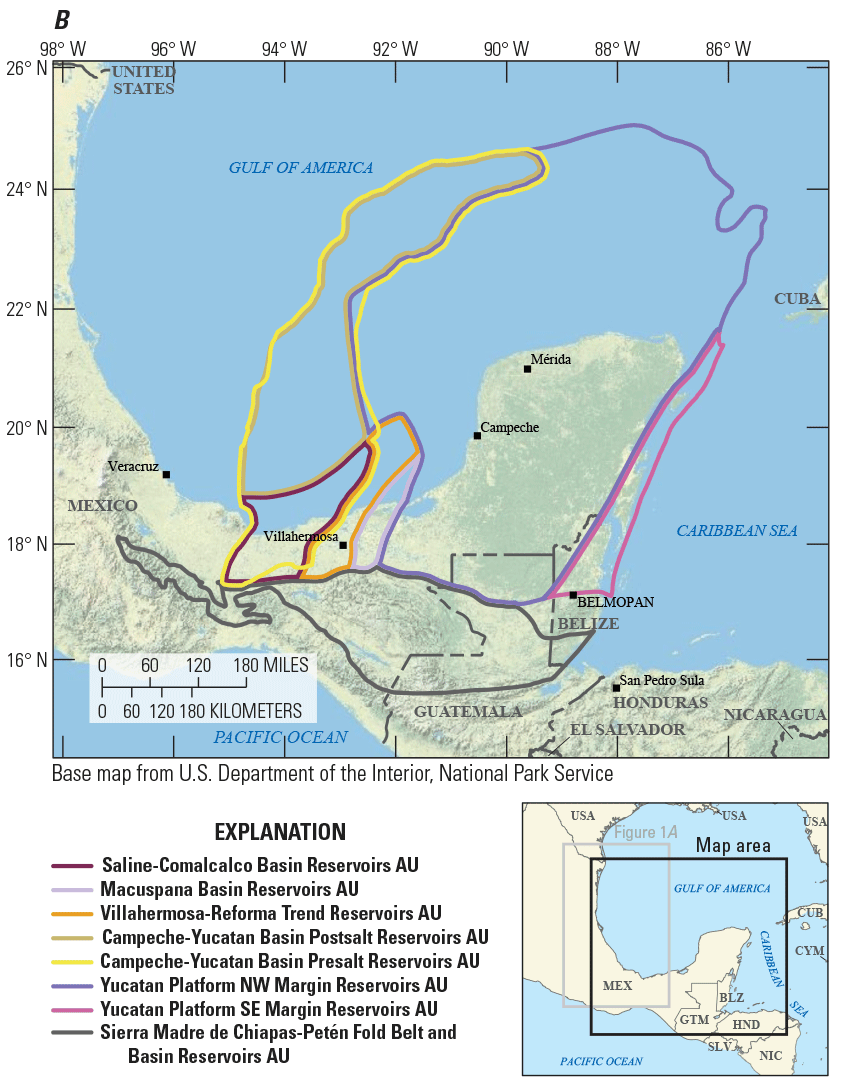
Maps showing the locations of (A) six conventional oil and gas assessment units (AUs) within Mexico and (B) eight conventional oil and gas AUs within Mexico, Belize, and Guatemala.
Total Petroleum System and Assessment Units
The USGS defined a Mesozoic–Cenozoic Composite Total Petroleum System (TPS) that encompasses oil and gas generated from several Mesozoic and Cenozoic source rocks. Organic-rich shales of the Oxfordian Smackover Formation and Tithonian Pimienta Formation are cited as having generated most oil and gas in the nine defined provinces (Jacques and Clegg, 2002; Arzate and others, 2009; Kenning and Mann, 2021; Shann, 2021). Other sources of oil and gas in this composite TPS are Triassic lacustrine shales, Kimmeridgian marine shales, Early Cretaceous (Albian) marls, Cenomanian–Turonian marine shales, and Paleogene and Neogene marine and terrestrial shales (Guzmán-Vega and others, 2001; Prost and Aranda, 2001; Lourdes Clara Valdés and others, 2009; Petersen and others, 2012; Holland and others, 2024). Not all source rocks are present or have contributed oil and gas in all provinces.
Fourteen AUs were defined within the composite TPS based on the predominant types of hydrocarbon reservoirs and traps. The Burgos Basin Offshore Reservoirs AU, Tampico-Misantla Basin Reservoirs AU, and Veracruz Basin Offshore Reservoirs AU were defined on the presence of deep-water slope and basin-floor fan sandstone reservoirs within structural traps, including the Mexican Ridges Fold Belt offshore. The Golden Lane El Abra Formation Reservoirs AU and the Golden Lane Tamabra Formation Reservoirs AU are dominated by reef and reef-margin debris-flow reservoirs, respectively. The Veracruz Fold Belt Reservoirs AU contains fractured carbonate reservoirs within stacked thrust sheets. The Saline-Comalcalco Basin Reservoirs AU and Macuspana Basin Reservoirs AU are dominated by shallow- to deep-marine sandstone reservoirs within stratigraphic traps. The Villahermosa-Reforma Trend Reservoirs AU has extensive Tamabra-like debris-flow reservoirs in salt-related structural and combination traps. The Campeche-Yucatan Basin Postsalt Reservoirs AU is defined by carbonate reservoirs within salt-related structural traps. The Campeche-Yucatan Basin Presalt Reservoirs AU contains potential Triassic fluvial-deltaic to deep-lacustrine sandstone reservoirs within stratigraphic traps. The Yucatan Platform NW Margin Reservoirs AU is defined by a spectrum of carbonate reservoirs within stratigraphic traps. The Yucatan Platform SE Margin Reservoirs AU has fluvial-deltaic to shallow-marine sandstone reservoirs within complex, inverted structural traps. The Sierra Madre de Chiapas-Petén Fold Belt and Basin Reservoirs AU is defined by sandstone reservoirs within structural traps in the fold belt and adjacent foreland basin. The assessment input data for 14 conventional AUs are summarized in table 1 and in Schenk (2025).
Table 1.
Key input data for 14 conventional oil and gas assessment units in Mexico, Belize, and Guatemala.[Gray shading indicates not applicable. AU, assessment unit; MMBO, million barrels of oil; BCFG, billion cubic feet of gas]
Undiscovered Resources Summary
The USGS quantitatively assessed undiscovered conventional oil and gas resources in 14 AUs in geologic provinces of Mexico, Belize, and Guatemala (table 2). The estimated mean undiscovered resources are 14,612 million barrels of oil (MMBO), or 14.6 billion barrels of oil, with an F95–F5 range from 3,957 to 34,303 MMBO; 83,711 billion cubic feet of gas (BCFG), or 83.7 trillion cubic feet of gas, with an F95–F5 range from 25,835 to 187,036 BCFG; and 4,849 million barrels of natural gas liquids (MMBNGL), with an F95–F5 range from 1,493 to 10,685 MMBNGL.
Table 2.
Results for 14 conventional oil and gas assessment units in Mexico, Belize, and Guatemala.[Gray shading indicates not applicable. Results shown are fully risked estimates. F95 represents a 95-percent chance of at least the amount tabulated; other fractiles are defined similarly. MMBO, million barrels of oil; BCFG, billion cubic feet of gas; NGL, natural gas liquids; MMBNGL, million barrels of natural gas liquids]
For More Information
Assessment results are also available at the USGS Energy Resources Program website, https://www.usgs.gov/programs/energy-resources-program.
References Cited
Arzate, S.O., Moguel, C.R., López, M.M., and Flores, M.F., 2009, Basin modeling of the Upper Jurassic petroleum systems (Tithonian and Oxfordian) in the Akalan-Chilam area of the Campeche Sound in the southern Gulf of Mexico, in Bartolini, C., and Román Ramos, J.R., eds., Petroleum systems in the southern Gulf of Mexico: AAPG Memoir 90, p. 285–313, accessed July 14, 2025, at https://doi.org/10.1306/13191089M903333.
Bartok, P., Mejia-Hernandez, M.C., and Ismael, M., 2015, Paleogeographic constraints on Middle- to Late-Jurassic tectonic reconstruction of the Maya block of southern Mexico and equivalent strata of northwestern South America, chap. 8 of Bartolini, C., and Mann, P., eds., Petroleum geology and potential of the Colombian Caribbean Margin: AAPG Memoir 108, p. 201–216, accessed July 14, 2025, at https://archives-datapages-com.usgslibrary.idm.oclc.org/data/specpubs/memoir108/data/pdfs/201.pdf.
Davison, I., 2021, Salt tectonics in the Sureste Basin, SE Mexico—Some implications for hydrocarbon exploration, in Davison, I., Hull, J.N.F., and Pindell, J., eds., The basins, orogens and evolution of the southern Gulf of Mexico and northern Caribbean: Geological Society of London Special Publication 504, p. 147–165, accessed July 14, 2025, at https://doi.org/10.1144/SP504-2019-227.
Graham, R., Pindell, J., Villagómez, D., Molina-Garza, R., Granath, J., and Sierra-Rojas, M., 2021, Integrated Cretaceous–Cenozoic plate tectonics and structural geology in southern Mexico, in Davison, I., Hull, J.N.F., and Pindell, J., eds., The basins, orogens and evolution of the southern Gulf of Mexico and northern Caribbean: Geological Society of London Special Publication 504, p. 285–314, accessed July 14, 2025, at https://doi.org/10.1144/SP504-2020-70.
Guzmán-Vega, M.A., Castro Ortíz, L., Román Ramos, J.R., Medrano-Morales, L., Lourdes Clara Valdés, M. de, Vázquez-Covarrubias, E., and Ziga-Rodríguez, G., 2001, Classification and origin of petroleum in the Mexican Gulf Coast Basin—An overview, chap. 5 of Bartolini, C., Buffler, R.T., and Cantú-Chapa, A., eds., The western Gulf of Mexico Basin—Tectonics, sedimentary basins, and petroleum systems: AAPG Memoir 75, p. 127–142, accessed July 14, 2025, at https://archives.datapages.com/data/specpubs/memoir75/m75ch05/m75ch05.htm.
Hasan, M.N., and Mann, P., 2021, Structural styles and evolution of the Campeche salt Basin, southern Gulf of Mexico: Marine and Petroleum Geology, v. 133, article 105313, 18 p., accessed July 14, 2025, at https://www-sciencedirect-com.usgslibrary.idm.oclc.org/science/article/pii/S0264817221004165.
Holland, B., Alsen, P., Nytoft, H.P., Rudra, A., Sanei, H., and Petersen, H.I., 2024, Quality and composition of Lower Cretaceous carbonate source rocks and seepage oils in the Belize Basin, southern Belize, Central America: International Journal of Coal Geology, v. 285, article 104478, 23 p., accessed July 14, 2025, at https://www-sciencedirect-com.usgslibrary.idm.oclc.org/science/article/pii/S0166516224000351.
Hudec, M.R., and Norton, I.O., 2019, Upper Jurassic structure and evolution of the Yucatán and Campeche subbasins, southern Gulf of Mexico: AAPG Bulletin, v. 103, no. 5, p. 1133–1151, accessed July 14, 2025, at https://doi.org/10.1306/11151817405.
Jacques, J.M., and Clegg, H., 2002, Late Jurassic source rock distribution and quality in the Gulf of Mexico—Inferences from plate tectonic modeling: Gulf Coast Association of Geological Societies Transactions, v. 52, p. 429–440, accessed July 14, 2025, at https://archives.datapages.com/data/gcags/data/052/052001/0429.htm.
Kenning, J.J., and Mann, P., 2021, Regional thermal maturity modelling of hydrocarbons along the deep-water Yucatan margin, southern Gulf of Mexico, in Davison, I., Hull, J.N.F., and Pindell, J., eds., The basins, orogens and evolution of the southern Gulf of Mexico and northern Caribbean: Geological Society of London Special Publication 504, p. 203–231, accessed July 14, 2025, at https://doi.org/10.1144/SP504-2019-252.
Lara, M.E., 1993, Divergent wrench faulting in the Belize southern lagoon—Implications for Tertiary Caribbean plate movements and Quaternary reef distribution: AAPG Bulletin, v. 77, no. 6, p. 1041–1063, accessed July 14, 2025, at https://archives-datapages-com.usgslibrary.idm.oclc.org/data/bulletns/1992-93/images/pg/00770006/1000/10410.pdf.
Lourdes Clara Valdés, M. de, Rodríguez, L.V., and García, E.C., 2009, Geochemical integration and interpretation of source rocks, oils, and natural gases in southeastern Mexico, chap. 16 of Bartolini, C., and Román Ramos, J.R., eds., Petroleum systems in the southern Gulf of Mexico: AAPG Memoir 90, p. 337–368, accessed July 14, 2025, at https://archives.datapages.com/data/specpubs/memoir90/CHAPTER16/CHAPTER16.HTM.
Miranda-Madrigal, E., and Chávez-Cabello, G., 2021, Regional geological analysis of the southern deep Gulf of Mexico and northern Yucatán Shelf, in Davison, I., Hull, J.N.F., and Pindell, J., eds., The basins, orogens and evolution of the southern Gulf of Mexico and northern Caribbean: Geological Society of London Special Publication 504, p. 183–202, accessed July 14, 2025, at https://doi.org/10.1144/SP504-2020-1.
Petersen, H.I., Holland, B., Nytoft, H.P., Cho, A., Piasecki, S., Cruz, J. de la, and Cornec, J.H., 2012, Geochemistry of crude oils, seepage oils and source rocks from Belize and Guatemala—Indications of carbonate-sourced petroleum systems: Journal of Petroleum Geology, v. 35, no. 2, p. 127–163, accessed July 14, 2025, at https://doi.org/10.1111/j.1747-5457.2012.00523.x.
Pindell, J., Villagómez, D., Molina-Garza, R., Graham, R., and Weber, B., 2021, A revised synthesis of the rift and drift history of the Gulf of Mexico and surrounding regions in the light of improved age dating of Middle Jurassic salt, in Davison, I., Hull, J.N.F., and Pindell, J., eds., The basins, orogens and evolution of the southern Gulf of Mexico and northern Caribbean: Geological Society of London Special Publication 504, p. 29–76, accessed July 14, 2025, at https://doi.org/10.1144/SP504-2020-43.
Prost, G., and Aranda, M., 2001, Tectonics and hydrocarbon systems of the Veracruz Basin, Mexico, chap. 11 of Bartolini, C., Buffler, R.T., and Cantú-Chapa, A., eds., The western Gulf of Mexico Basin—Tectonics, sedimentary basins, and petroleum systems: AAPG Memoir 75, p. 271–291, accessed July 14, 2025, at https://archives.datapages.com/data/specpubs/memoir75/m75ch11/m75ch11.htm.
Schenk, C.J., 2025, USGS National and Global Oil and Gas Assessment Project—Provinces of Mexico, Belize, and Guatemala—Assessment unit boundaries, assessment input data, and fact sheet data tables: U.S. Geological Survey data release, https://doi.org/10.5066/P1ZDDFCV.
Shann, M.V., 2021, The Sureste Basin of Mexico—Its framework, future oil exploration opportunities and key challenges ahead, in Davison, I., Hull, J.N.F., and Pindell, J., eds., The basins, orogens and evolution of the southern Gulf of Mexico and northern Caribbean: Geological Society of London Special Publication 504, p. 119–146, accessed July 14, 2025, at https://doi.org/10.1144/SP504-2019-214.
Snedden, J.W., Stockli, D.F., and Norton, I.O., 2021, Paleogeographical reconstruction and provenance of Oxfordian aeolian sandstone reservoirs in Mexico offshore areas—Comparison to the Norphlet aeolian system of the northern Gulf of Mexico, in Davison, I., Hull, J.N.F., and Pindell, J., eds., The basins, orogens and evolution of the southern Gulf of Mexico and northern Caribbean: Geological Society of London Special Publication 504, p. 233–253, accessed July 14, 2025, at https://doi.org/10.1144/SP504-2019-219.
Villagómez, D., Steffensen, C., Pindell, J., Molina-Garza, R.S., Gray, G., Graham, R., O’Sullivan, P., Stockli, D., and Spikings, R., 2022, Tectono-sedimentary evolution of southern Mexico, Implications for Cretaceous and younger source-to-sink systems in the Mexican foreland basins and the Gulf of Mexico: Earth-Science Reviews, v. 231, article 104066, 38 p., accessed July 14, 2025, at https://doi.org/10.1016/j.earscirev.2022.104066.
Disclaimers
Any use of trade, firm, or product names is for descriptive purposes only and does not imply endorsement by the U.S. Government.
Although this information product, for the most part, is in the public domain, it also may contain copyrighted materials as noted in the text. Permission to reproduce copyrighted items must be secured from the copyright owner.
Suggested Citation
Schenk, C.J., Mercier, T.J., Le, P.A., Cicero, A.D., Drake, R.M., II, Gelman, S.E., Hearon, J.S., Johnson, B.G., Lagesse, J.H., Leathers-Miller, H.M., and Timm, K.K., 2025, Assessment of undiscovered conventional oil and gas resources in Mexico, Belize, and Guatemala, 2024: U.S. Geological Survey Fact Sheet 2025–3040, 6 p., https://doi.org/10.3133/fs20253040.
ISSN: 2327-6932 (online)
Study Area
| Publication type | Report |
|---|---|
| Publication Subtype | USGS Numbered Series |
| Title | Assessment of undiscovered conventional oil and gas resources in Mexico, Belize, and Guatemala, 2024 |
| Series title | Fact Sheet |
| Series number | 2025-3040 |
| DOI | 10.3133/fs20253040 |
| Publication Date | August 20, 2025 |
| Year Published | 2025 |
| Language | English |
| Publisher | U.S. Geological Survey |
| Publisher location | Reston VA |
| Contributing office(s) | Central Energy Resources Science Center |
| Description | Report: 6 p.; Data Release |
| Country | Belize, Guatemala, Mexico |
| Online Only (Y/N) | Y |