


Assessment of Undiscovered Conventional Oil and Gas Resources of India and Sri Lanka, 2024
Links
- Document: Report (5.99 MB pdf) , HTML , XML
- Data Release: USGS data release - USGS National and Global Oil and Gas Assessment Project—India and Sri Lanka Provinces—Assessment Unit Boundaries, Assessment Input Data, and Fact Sheet Data Tables
- Download citation as: RIS | Dublin Core
Abstract
Using a geology-based assessment methodology, the U.S. Geological Survey estimated undiscovered, technically recoverable mean conventional resources of 1.0 billion barrels of oil and 53.4 trillion cubic feet of gas in India and Sri Lanka.
Introduction
The U.S. Geological Survey (USGS) assessed the potential for undiscovered, technically recoverable conventional oil and gas resources in 10 basins of India and Sri Lanka as part of the ongoing assessment of conventional resources of the world (fig. 1; table 1). The potential for undiscovered conventional resources was assessed in the Upper Assam, Mahanadi, Krishna-Godavari, Cauvery, Mannar, Kerala-Konkan, Mumbai Offshore, Cambay-Barmer, Kutch, and Laxmi Basins. The formation of these basins and the composite total petroleum system (TPS) defined for this assessment are related to the tectonic evolution of India (Rao, 2001; Bastia and others, 2010; Desa and others, 2013; Kalra and others, 2014; Nair and Pandey, 2018; Pandey and others, 2018; Srivastava and others, 2023; Unnikrishnan and others, 2023). Gondwana began to fragment along Neoproterozoic lines of crustal weakness in the Permian to Triassic, forming the Karoo rifts, which contain coal beds and lacustrine mudstones as potential petroleum source rocks (Raza Khan and others, 2000). Rifting continued in the Late Triassic and Early Jurassic due to uplift related to the thermal effect of the Reunion mantle plume. In the Late Jurassic, Greater India (India, Madagascar, Seychelles, and Sri Lanka) rifted from northeast Africa, forming—or further rifting—the Kerala-Konkan, Mumbai Offshore, Cambay-Barmer, and Kutch Basins along the western passive margin. Madagascar rifted from India in the Late Cretaceous, and at the end of the Cretaceous, the Seychelles block rifted and separated from western India, representing the final phase of rifting and forming the Laxmi Basin. Each rift phase resulted in extended continental crust, in which grabens may contain synrift source rocks overlain by Cretaceous postrift marine source rocks. In the Early Cretaceous, Antarctica rifted and separated from eastern India, forming the Mahanadi, Krishna-Godavari, Cauvery, and Mannar Basins along the eastern passive margin (fig. 1). Around the time of the Cretaceous–Paleocene boundary, the Reunion plume caused an outpouring of volcanic rocks as much as 2,000 meters thick, forming the Deccan traps, which covered a large area of southwestern India, including the Kerala-Konkan and Mumbai Offshore Basins (Srivastava and others, 2023). Subvolcanic source and reservoir rocks may occur in these basins. Uplift related to the plume occurred along the western cratonic margin, causing India to tilt eastward, which reoriented the major fluvial drainages from west to east flowing (Sahu and others, 2013). Reorientation of the fluvial systems led to the progradation of major Paleogene clastic sequences along the eastern margin of India. Minor clastic progradation occurred at this time along the western passive margin due to small sediment supply. Carbonate deposition dominated the Mumbai-Saurashtra Basin during this time. In the late Eocene, India began to collide with the southern margin of Eurasia, and contractional deformation peaked in the Oligocene, resulting in the deposition of as much as 20 kilometers of sediment in the large south-directed deltaic systems of the Indus River and Ganges River drainages (Desa and others, 2013). Collision of the West Burma terrane with Eurasia from the Oligocene to Pliocene created the Naga Thrust Belt and foreland of the Upper Assam Basin (Kent and Dasgupta, 2004).
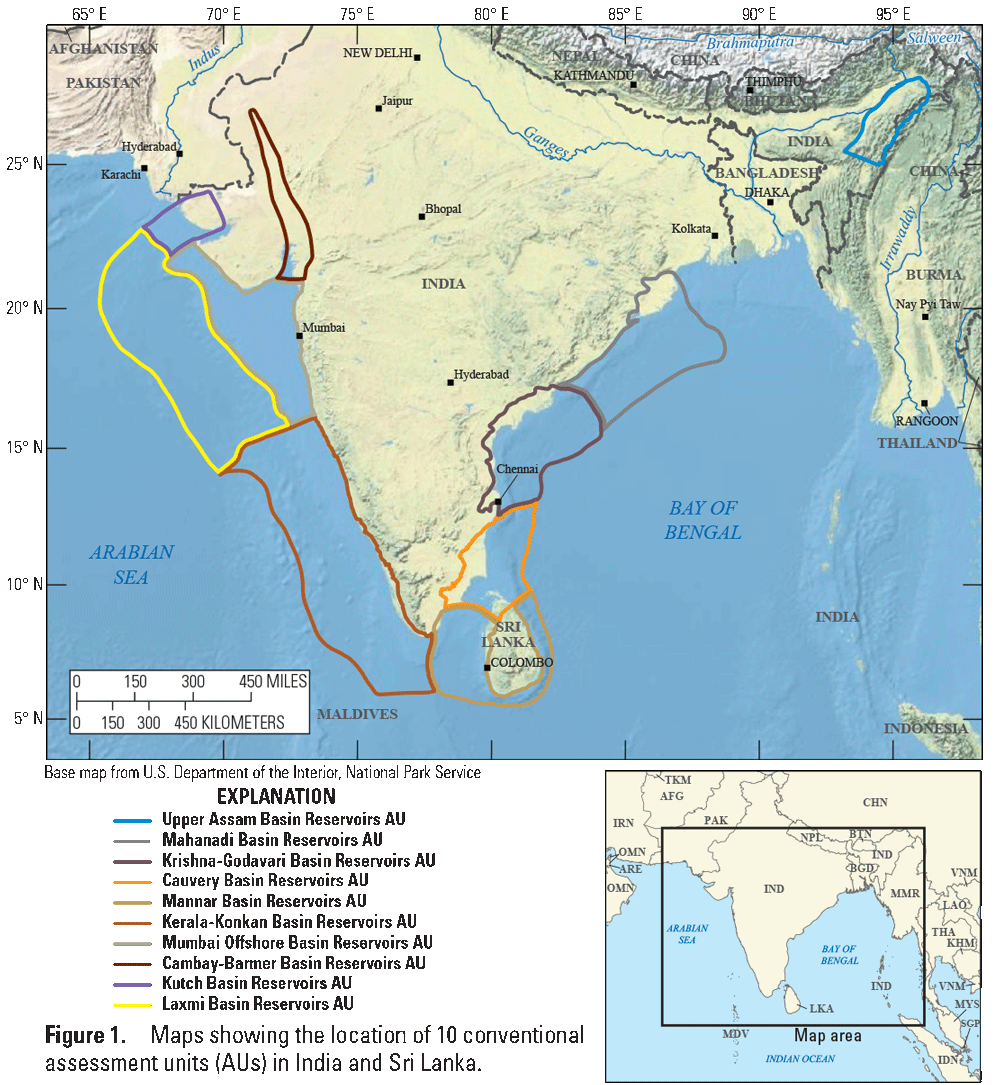
Maps showing the location of 10 conventional assessment units (AUs) in India and Sri Lanka.
Total Petroleum System and Assessment Units
The Mesozoic–Cenozoic Composite TPS was defined for this assessment to encompass oil and gas generated from source rocks ranging in age from Permian to Miocene. Geochemical data are meager or not available for most of the postulated source-rock intervals within this composite TPS (Qin and others, 2017; Kumar, 2018). Limited offshore drilling has focused source-rock sampling to shallower proximal sediments, which may be organically lean compared to deeper marine mudstones. Deep synrift mudstones and distal offshore marine mudstones as young as Miocene are greatly underrepresented in the sampling, which is significant because organic matter in condensed sections of distal marine oil-prone mudstones may be major petroleum source rocks. Sampling for source rocks in the shallow proximal offshore has been mainly from large deltaic systems dominated by gas-prone rather than oil-prone organic matter (Kumar, 2018; Mishra and others, 2023).
Postulated or known source rocks in the India and Sri Lanka basins, in order of importance based on meager data, are (1) Paleogene marine mudstones, (2) Lower Cretaceous synrift and postrift mudstones, (3) Upper Cretaceous marine mudstones, (4) Permian coals, and (5) Upper Jurassic–Lower Cretaceous synrift lacustrine mudstones (Rao, 2001; Pahari and others, 2008; Qin and others, 2017; Rammurthy and others, 2017; Kumar, 2018; Kularathna and others, 2020; Mishra and others, 2023). Additional geochemical data would greatly assist in defining viable source rocks in all the basins of India. Paleogene oil-prone mudstones are generally considered the main source rocks, along with possible gas-prone terrestrial organic matter in most basins. Lower and Upper Cretaceous marine source rocks have been suggested for several basins, but the presence of viable Cretaceous source rocks is based on meager data. Upper Jurassic mudstones are possible source rocks in the Kutch Basin and Cambay-Barmer Basin (Rammurthy and others, 2017). Permian coal beds have been interpreted as one source of gas in the Krishna-Godavari Basin (Raza Khan and others, 2000; Rao, 2001). Gas hydrates with mixed thermogenic and biogenic gases in the Krishna-Godavari Basin and Mahanadi Basin suggest that, in addition to thermal gas from deeper sources, there is a Miocene–Pliocene source rock for biogenic gas (Datta and others, 2012).
Ten assessment units (AUs) were defined within the composite TPS: the Upper Assam Basin Reservoirs AU, Mahanadi Basin Reservoirs AU, Krishna-Godavari Basin Reservoirs AU, Cauvery Basin Reservoirs AU, Mannar Basin Reservoirs AU, Kerala-Konkan Basin Reservoirs AU, Mumbai Offshore Basin Reservoirs AU, Cambay-Barmer Basin Reservoirs AU, Kutch Basin Reservoirs AU, and Laxmi Basin Reservoirs AU. The assessment input data for the 10 conventional AUs are summarized in table 1 and in Schenk (2025).
Table 1.
Key input data for 10 conventional assessment units in India and Sri Lanka.[Gray shading indicates not applicable. AU, assessment unit; MMBO, million barrels of oil; BCFG, billion cubic feet of gas]
Undiscovered Resources Summary
The USGS quantitatively assessed undiscovered conventional oil and gas resources in 10 AUs in India and Sri Lanka (table 2). The estimated mean resources are 1,010 million barrels of oil (MMBO), or 1.0 billion barrels of oil, with an F95–F5 range from 280 to 2,507 MMBO; 53,402 billion cubic feet of gas (BCFG), or 53.4 trillion cubic feet of gas, with an F95–F5 range from 19,122 to 107,365 BCFG; and 2,135 million barrels of natural gas liquids (MMBNGL), or 2.1 billion barrels, with an F95–F5 range from 760 to 4,304 MMBNGL.
Table 2.
Results for 10 conventional assessment units in India and Sri Lanka.[Gray shading indicates not applicable. Results shown are fully risked estimates. F95 represents a 95-percent chance of at least the amount tabulated; other fractiles are defined similarly. MMBO, million barrels of oil; BCFG, billion cubic feet of gas; NGL, natural gas liquids; MMBNGL, million barrels of natural gas liquids]
For More Information
Assessment results are also available at the USGS Energy Resources Program website, https://www.usgs.gov/programs/energy-resources-program.
References Cited
Bastia, R., Radhakrishna, M., Srinivas, T., Nayak, S., Nathaniel, D.M., and Biswal, T.K., 2010, Structural and tectonic interpretation of geophysical data along the eastern continental margin of India with special reference to the deep water petroliferous basins: Journal of Asian Earth Sciences, v. 39, no. 6, p. 608–619, accessed August 2, 2024, at https://doi.org/10.1016/j.jseaes.2010.04.031.
Datta, S., Mukhopadhyay, P., Das, D., and Das, P.K., 2012, Hydrocarbon occurrences in Mahanadi Basin, in 9th Biennial International Conference and Exposition on Petroleum Geophysics, Hyderabad, India, [February 16–18, 2012]: [Society of Petroleum Geophysicists, India], paper P-235, 8 p., accessed August 3, 2024, at https://spgindia.org/spg_2012/spgp235.pdf.
Desa, M.A., Ramana, M.V., Ramprasad, T., Anuradha, M., Lall, M.V., and Kumar, B.J.P., 2013, Geophysical signatures over and around the northern segment of the 85°E Ridge, Mahanadi offshore, eastern continental margin of India—Tectonic implications: Journal of Asian Earth Sciences, v. 73, p. 460–472, accessed August 3, 2024, at https://doi.org/10.1016/j.jseaes.2013.05.021.
Kalra, R., Rao, G.S., Fainstein, R., Radhakrishna, M., Bastia, R., and Chandrashekar, S., 2014, Crustal architecture and tectono-magmatic history of the western offshore of India—Implications on deepwater sub-basalt hydrocarbon exploration: Journal of Petroleum Science and Engineering, v. 122, p. 149–158, accessed August 3, 2024, at https://doi.org/10.1016/j.petrol.2014.07.002.
Kent, W.N., and Dasgupta, U., 2004, Structural evolution in response to fold and thrust belt tectonics in northern Assam—A key to hydrocarbon exploration in the Jaipur anticline area: Marine and Petroleum Geology, v. 21, no. 7, p. 785–803, accessed August 5, 2024, at https://doi.org/10.1016/j.marpetgeo.2003.12.006.
Kularathna, E.K.C.W., Pitawala, H.M.T.G.A., Senaratne, A., and Ratnayake, A.S., 2020, Play distribution and the hydrocarbon potential of the Mannar Basin, Sri Lanka: Journal of Petroleum Exploration and Production Technology, v. 10, p. 2225–2243, accessed August 3, 2024, at https://link.springer.com/article/10.1007/s13202-020-00902-8.
Kumar, N., 2018, Petroleum potential of the west coast of India: Journal of the Indian Association of Sedimentologists, v. 35, no. 2, p. 33–49, accessed August 2, 2024, at http://journal.indiansedimentologists.com/ojs/index.php/1/article/view/40.
Mishra, S., Peketi, A., Hazra, B., Silva, R. da, and Mazumdar, A., 2023, Nature and hydrocarbon potential of organic matter in offshore Mahanadi Basin, east coast of India: Journal of Earth System Science, v. 132, article 108, 9 p., accessed August 3, 2024, at https://doi.org/10.1007/s12040-023-02123-z.
Nair, N., and Pandey, D.K., 2018, Cenozoic sedimentation in the Mumbai Offshore Basin—Implications for tectonic evolution of the western continental margin of India: Journal of Asian Earth Sciences, v. 152, p. 132–144, accessed August 2, 2024, at https://doi.org/10.1016/j.jseaes.2017.11.037.
Pahari, S., Singh, H., Prasad, I.V.S.V., and Singh, R.R., 2008, Petroleum systems of Upper Assam Shelf, India, in 7th International Conference and Exposition on Petroleum Geophysics, Hyderabad, India, [January 14–16, 2008]: [Society of Petroleum Geophysicists, India], paper P-359, 8 p., accessed August 3, 2024, at https://spgindia.org/2008/359.pdf.
Pandey, D.K., Pandey, A., Clift, P.D., Nair, N., Ramesh, P., Kulhanek, D.K., and Yadav, R., 2018, Flexural subsidence analysis of the Laxmi Basin, Arabian Sea and its tectonic implications: Geological Magazine, v. 157, no. 6 (special issue), 14 p., accessed August 2, 2024, at https://doi.org/10.1017/S0016756818000833.
Qin, Y., Zhang, G., Ji, Z., Li, Z., Wu, Y., Wang, X., and Liang, X., 2017, Geological features, hydrocarbon accumulation and deep water potential of east Indian basins: Petroleum Exploration and Development, v. 44, no. 5, p. 731–744, accessed August 2, 2024, at https://doi.org/10.1016/S1876-3804(17)30084-8.
Rammurthy, G.B., Dubey, S., Pereira, L., Murugadass, R., and Chatterjee, C.L., 2017, Mesozoic petroleum system in Kutch Onland Basin—Myth or reality? A 2D PSM case study: [Jaipur, India, Society of Petroleum Geologists], 6 p., accessed August 3, 2024, at https://spgindia.org/Jaipur2017-proceedings-published/pid-374-mesozoic-petroleum-system-in-kutch.pdf.
Rao, G.N., 2001, Sedimentation, stratigraphy, and petroleum potential of Krishna-Godavari Basin, east coast of India: AAPG Bulletin, v. 85, no. 9, p. 1623–1643, accessed August 2, 2024, at https://doi.org/10.1306/8626CCDF-173B-11D7-8645000102C1865D.
Raza Khan, M.S., Sharma, A.K., Sahota, S.K., and Mathur, M., 2000, Generation and hydrocarbon entrapment within Gondwanan sediments of the Mandapeta area, Krishna-Godavari Basin, India: Organic Geochemistry, v. 31, no. 12, p. 1495–1507, accessed August 2, 2024, at https://doi.org/10.1016/S0146-6380(00)00132-7.
Sahu, H.S., Raab, M.J., Kohn, B.P., Gleadow, A.J.W., and Kumar, D., 2013, Denudation history of eastern Indian peninsula from apatite fission track analysis—Linking possible plume-related uplift and the sedimentary record: Tectonophysics, v. 608, p. 1413–1428, accessed August 3, 2024, at https://doi.org/10.1016/j.tecto.2013.06.002.
Schenk, C.J., 2025, USGS National and Global Oil and Gas Assessment Project—India and Sri Lanka Provinces—Assessment unit boundaries, assessment input data, and fact sheet data tables: U.S. Geological Survey data release, https://doi.org/10.5066/P13KMTXF.
Srivastava, H.C., Mittal, S., Kalra, T., and Parshad, R., 2023, Sub-basalt hydrocarbon prospect assessment in Peninsular India using seaward dipping reflectors: Journal of Petroleum Exploration and Production Technology, 14 p., accessed August 3, 2024, at https://doi.org/10.1007/s13202-023-01719-x.
Unnikrishnan, P., Gilbert, M.G., and Radhakrishna, M., 2023, Crustal structure along the Kerala-Konkan Basin, southwest continental margin of India, using multi-channel seismic and gravity modelling—Implications on India-Madagascar rifting and basin evolution: Journal of Asian Earth Sciences, v. 242, article 105504, 17 p., accessed August 3, 2024, at https://doi.org/10.1016/j.jseaes.2022.105504.
Disclaimers
Any use of trade, firm, or product names is for descriptive purposes only and does not imply endorsement by the U.S. Government.
Although this information product, for the most part, is in the public domain, it also may contain copyrighted materials as noted in the text. Permission to reproduce copyrighted items must be secured from the copyright owner.
Suggested Citation
Schenk, C.J., Mercier, T.J., Le, P.A., Cicero, A.D., Drake, R.M., II, Gelman, S.E., Hearon, J.S., Johnson, B.G., Lagesse, J.H., Leathers-Miller, H.M., and Timm, K.K., 2025, Assessment of undiscovered conventional oil and gas resources of India and Sri Lanka, 2024: U.S. Geological Survey Fact Sheet 2025–3043, 4 p., https://doi.org/10.3133/fs20253043.
ISSN: 2327-6932 (online)
Study Area
| Publication type | Report |
|---|---|
| Publication Subtype | USGS Numbered Series |
| Title | Assessment of undiscovered conventional oil and gas resources of India and Sri Lanka, 2024 |
| Series title | Fact Sheet |
| Series number | 2025-3043 |
| DOI | 10.3133/fs20253043 |
| Publication Date | September 10, 2025 |
| Year Published | 2025 |
| Language | English |
| Publisher | U.S. Geological Survey |
| Publisher location | Reston VA |
| Contributing office(s) | Central Energy Resources Science Center |
| Description | Report: 4 p.; Data Release |
| Country | India, Sri Lanka |
| Online Only (Y/N) | Y |