


Assessment of Undiscovered Conventional Oil and Gas Resources of Yemen, 2024
Links
- Document: Report (3.91 MB pdf) , HTML , XML
- Data Release: USGS data release - USGS National and Global Oil and Gas Assessment Project—Yemen—Assessment Unit Boundaries, Assessment Input Data, and Fact Sheet Data Tables
- Download citation as: RIS | Dublin Core
Abstract
Using a geology-based assessment methodology, the U.S. Geological Survey estimated undiscovered, technically recoverable mean conventional resources of 261 million barrels of oil and 4.5 trillion cubic feet of gas in Yemen.
Introduction
The U.S. Geological Survey (USGS) assessed the potential for undiscovered, technically recoverable conventional oil and gas resources in Yemen as part of an ongoing assessment of conventional resources in priority provinces of the world. The assessment focused on the Mesozoic Sab’atayn, Say’un-Masila, and Jiza-Qamar Basins of Yemen (fig. 1). The Mesozoic structural framework of these basins was inherited from the orientation of basement structures developed during the Neoproterozoic (Redfern and Jones, 1995; Ellis and others, 1996; Bosence, 1997). The dominant northwest–southeast trend of the regional Neoproterozoic Najd fault system was reactivated as a transtension system in the Mesozoic as the Cimmerian terranes and Greater India terrane separated from the northeastern margin of Gondwana, opening the Neo-Tethys Ocean (Ellis and others, 1996; Ahlbrandt, 2002). These events in the Late Jurassic and Early Cretaceous formed the northwest–southeast-trending transtension basins in southern Yemen and northeast Somalia because Arabia and Somalia at that time were adjacent and part of northeastern Africa. Left-lateral transtension in the Late Jurassic (Kimmeridgian) first opened the Sab’atayn Basin in the west, then the Say’un-Masila Basin, and finally the Jiza-Qamar Basin in the east, along with their Somalian counterpart rift basins (Ellis and others, 1996; Nonn and others, 2019). Intermittent connection with the marine realm in the Tithonian led to the deposition of as much as 1,500 meters (m) of evaporites of the Sab’atayn Formation in the Sab’atayn Basin, and the evaporites form important traps and seals for oil and gas. Evaporites were not deposited in the Say’un-Masila or Jiza-Qamar Basins (Csato, 2005). The Sab’atayn, Say’un-Masila, and Jiza-Qamar Basins are structurally complex, with faulted subbasins, transfer zones, and reactivated marginal fault systems. The subbasins were sites of anoxia and the deposition of major petroleum source rocks of the Upper Jurassic Madbi Formation (Hakimi and others, 2012; As-Saruri and Sorkhabi, 2014; Hakimi and others, 2014; Hakimi and Abdullah, 2015; Hatem and others, 2016; Hakimi, Alaug, and others, 2019), Lower Cretaceous Saar Formation (Hakimi, Abdullah, and others, 2019), Upper Cretaceous Harshiyat Formation (Alaug and others, 2013; As-Saruri and Sorkhabi, 2014; Hakimi and others, 2020), and Upper Cretaceous Mukalla Formation (Alaug and others, 2013). The structurally complex subbasins affected the distribution and thickness of source rocks, and the level of thermal maturation and timing of oil and gas generation. Oligocene seafloor spreading in the Gulf of Aden and the Miocene opening of the Red Sea led to the separation of the Arabian plate from Africa, and the separation of the once-continuous Yemen and Somalia rifts by about 300 kilometers across the Gulf of Aden (Redfern and Jones, 1995; Ali and Watts, 2013; Witte and others, 2016; Nonn and others, 2019). These extensional events reactivated faults in the Yemeni basins, possibly leading to loss of oil and gas (As-Saruri and Sorkhabi, 2014).
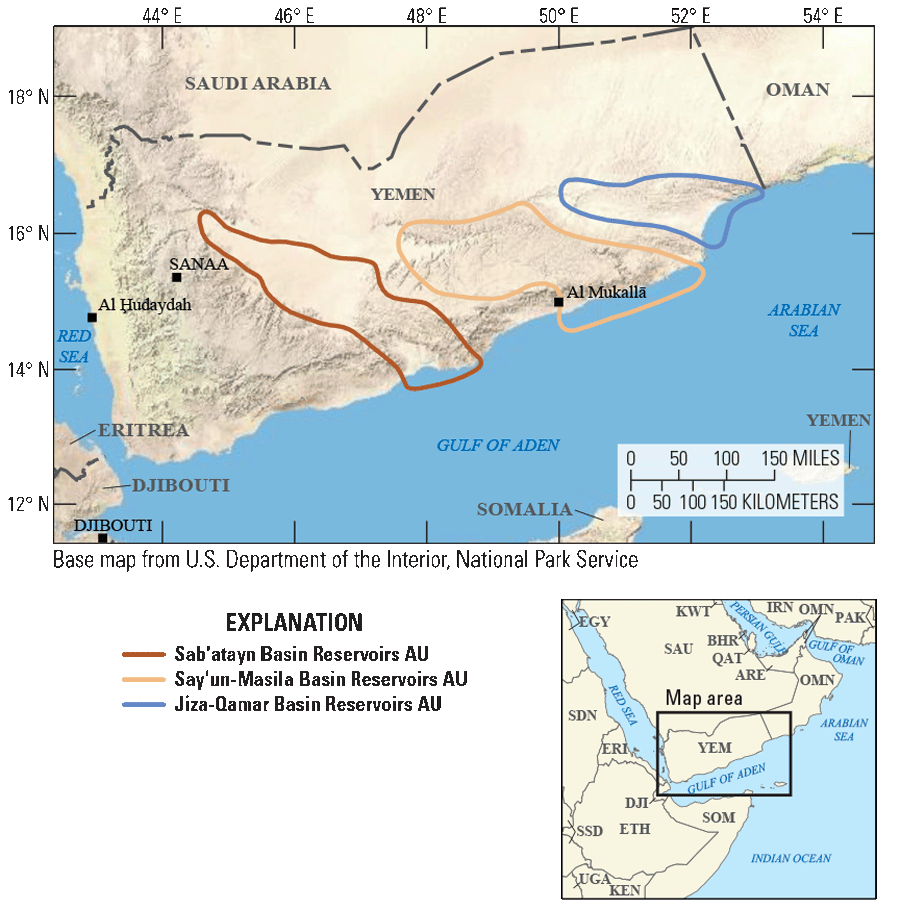
Maps showing the location of three conventional assessment units (AUs) in Yemen.
Total Petroleum System and Assessment Units
The USGS defined the Mesozoic–Cenozoic Composite Total Petroleum System (TPS)—encompassing the Sab’atayn, Say’un-Masila, and Jiza-Qamar Basins in Yemen—which consists of source rocks in the Madbi Formation, Saar Formation, and Harshiyat and Mukalla Formations. Organic-rich shales of the Madbi Formation are the major source rocks in Yemen and are present in the Sab’atayn Basin and Say’un-Masila Basin, and possibly in the Jiza-Qamar Basin (As-Saruri and Sorkhabi, 2014). Shales of the Madbi Formation contain Type II and subordinate lacustrine Type I and terrestrial Type III organic matter, have total organic carbon (TOC) content as much as 20 weight percent (wt. pct.), have hydrogen index (HI) values as much as 1,100 milligrams of hydrocarbon per gram of TOC (mg HC/g TOC), and are as much as 600 m thick (Hakimi and others, 2012; As-Saruri and Sorkhabi, 2014; Hakimi and others, 2014; Al-Areeq and Maky, 2015; Hakimi and Abdullah, 2015; Hakimi and others, 2015b; Hatem and others, 2016; Hakimi, Alaug, and others, 2019). The Upper Jurassic Meem Shale Member of the Madbi Formation contains Type II organic matter, has TOC content as much as 10 wt. pct., has HI values as much as 300 mg HC/g TOC, and is as much as 600 m thick (As-Saruri and Sorkhabi, 2014; Hakimi, Alaug, and others, 2019). The Lam Member of the Madbi Formation contains Type II organic matter, has TOC content as much as 8 wt. pct., has HI values as much as 800 mg HC/g TOC, and is as much as 900 m thick (As-Saruri and Sorkhabi, 2014). Lower Cretaceous shales of the Saar Formation are a major source rock in the Jiza-Qamar Basin, where the shales contain Type II and Type III organic matter, have TOC content as much as 10 wt. pct., and have HI values as much as 300 mg HC/g TOC (Hakimi, Abdullah, and others, 2019). Shales of the Upper Cretaceous Harshiyat Formation potentially occur in the three basins and have mixed Type II and III organic matter (with subordinate Type 1), TOC content as much as 18 wt. pct., and HI values as much as 923 mg HC/g TOC (Hakimi and others, 2020). Shales of the Upper Cretaceous Mukalla Formation in the Jiza-Qamar Basin contain mainly mixed Type III and II source rocks, have TOC content as much as 8 wt. pct., have HI values as much as 350 mg HC/g TOC, and are as much as 500 m thick (Alaug and others, 2013). Coal beds of the Upper Cretaceous Mukalla Formation in the Jiza-Qamar Basin may be an important source of gas, and some coal beds with a high liptinite content may be a source rock for oil (Alaug and others, 2013; Hakimi and others, 2015a).
Reservoir rocks in the Sab’atayn Basin are fluvial-deltaic, nearshore marine, turbidite sandstones; platform-margin carbonates; and fractured basement rocks (As-Saruri and Sorkhabi, 2014). Reservoir rocks in the Say’un-Masila Basin are Upper Jurassic fluvial-deltaic to turbidite sandstones; platform carbonates; and Lower Cretaceous Qishn sandstones, platform carbonates, and fractured basement rocks. Reservoir rocks in the Jiza-Qamar Basin are nearshore marine sandstones of the Qishn Formation (Ahlbrandt, 2002). Traps in these complex extensional systems are mainly structural, but stratigraphic traps are present in the deepwater clastic systems and platform-margin carbonate reservoirs. Seals are mainly formed by Tithonian salt in the Sab’atayn Basin, whereas seals are low-permeability carbonates of the Lower Cretaceous Qishn Formation in the Say’un-Masila and Jiza-Qamar Basins, where the carbonates overlie reservoir sandstones of the Qishn Formation (Hakimi and others, 2012).
Three conventional assessment units (AUs) were defined within the Mesozoic–Cenozoic Composite TPS: the Sab’atayn Basin Reservoirs AU, Say’un-Masila Basin Reservoirs AU, and Jiza-Qamar Basin Reservoirs AU. The assessment input data for the three conventional AUs are summarized in table 1 and Schenk (2025).
Table 1.
Key input data for three conventional assessment units in Yemen.[Gray shading indicates not applicable. AU, assessment unit; MMBO, million barrels of oil; BCFG, billion cubic feet of gas]
Undiscovered Resources Summary
The USGS quantitatively assessed undiscovered conventional oil and gas resources in three AUs in Yemen (table 2). The estimated mean resources are 261 million barrels of oil (MMBO), or 0.26 billion barrels of oil, with an F95–F5 range from 95 to 558 MMBO; 4,514 billion cubic feet of gas (BCFG), or 4.5 trillion cubic feet of gas, with an F95–F5 range from 1,034 to 11,878 BCFG; and 122 million barrels of natural gas liquids (MMBNGL), or 0.1 billion barrels, with an F95–F5 range from 29 to 323 MMBNGL.
Table 2.
Results for three conventional assessment units in Yemen.[Gray shading indicates not applicable. Results shown are fully risked estimates. F95 represents a 95-percent chance of at least the amount tabulated; other fractiles are defined similarly. MMBO, million barrels of oil; BCFG, billion cubic feet of gas; NGL, natural gas liquids; MMBNGL, million barrels of natural gas liquids]
For More Information
Assessment results are also available at the USGS Energy Resources Program website, https://www.usgs.gov/programs/energy-resources-program.
References Cited
Ahlbrandt, T.S., 2002, Madbi Amran/Qishn Total Petroleum System of the Ma’Rib-Al Jawf/Shabwah, and Masila-Jeza Basins, Yemen: U.S. Geological Survey Bulletin 2202–G, 28 p., accessed August 26, 2025, at https://doi.org/10.3133/b2202G.
Al-Areeq, N.M., and Maky, A.F., 2015, Organic geochemical characteristics of crude oils and oil-source rock correlation in the Sunah oilfield, Masila region, eastern Yemen: Marine and Petroleum Geology, v. 63, p. 17–27, accessed August 26, 2025, at https://doi.org/10.1016/j.marpetgeo.2015.01.017.
Alaug, A.S., Batten, D.J., and Ahmed, A.F., 2013, Organic geochemistry, palynofacies and petroleum potential of the Mukalla Formation (Late Cretaceous), Block 16, eastern Yemen: Marine and Petroleum Geology, v. 46, p. 67–91, accessed August 26, 2025, at https://doi.org/10.1016/j.marpetgeo.2013.05.018.
Ali, M.Y., and Watts, A.B., 2013, Subsidence history, crustal structure, and evolution of the Somaliland-Yemen conjugate margin: Journal of Geophysical Research—Solid Earth, v. 118, no. 4, p. 1638–1649, accessed August 26, 2025, at https://agupubs.onlinelibrary.wiley.com/doi/full/10.1002/jgrb.50113.
As-Saruri, M., and Sorkhabi, R., 2014, Petroleum systems and basins of Yemen, chap. 20 of Marlow, L., Kendall, C., and Yose, L., eds., Petroleum systems of the Tethyan region: AAPG Memoir 106, p. 757–780, accessed August 26, 2025, at https://doi.org/10.1306/13431871M1063617.
Bosence, D.W.J., 1997, Mesozoic rift basins of Yemen: Marine and Petroleum Geology, v. 14, no. 6, p. 611–616, accessed August 26, 2025, at https://doi.org/10.1016/S0264-8172(97)00039-1.
Csato, I., 2005, Extensional tectonics and salt structures, Marib-Shabwa Basin, Yemen: AAPG Search and Discovery, article 30030, 6 p., accessed August 26, 2025, at https://www.searchanddiscovery.com/pdfz/documents/2005/csato/images/csato.pdf.html.
Ellis, A.C., Kerr, H.M., Cornwell, C.P., and Williams, D.O., 1996, A tectono-stratigraphic framework for Yemen and its implications for hydrocarbon potential: Petroleum Geoscience, v. 2, p. 29–42, accessed August 26, 2025, at https://doi.org/10.1144/petgeo.2.1.29.
Hakimi, M.H., and Abdullah, W.H., 2015, Thermal maturity history and petroleum generation modelling for the Upper Jurassic Madbi source rocks in the Marib-Shabowah Basin, western Yemen: Marine and Petroleum Geology, v. 59, p. 202–216, accessed August 26, 2025, at https://doi.org/10.1016/j.marpetgeo.2014.08.002.
Hakimi, M.H., Abdullah, W.H., Hersi, O.S., Lashin, A.A., El Alfy, M.M., Makeen, Y.M., Kinawy, M.M., and Hatem, B.A., 2019, Organic geochemistry of the Early Cretaceous shales, Saar Formation in the East Shabwah oil fields, onshore Masila Basin of eastern Yemen: Journal of Petroleum Science and Engineering, v. 179, p. 394–409, accessed August 26, 2025, at https://doi.org/10.1016/j.petrol.2019.04.032.
Hakimi, M.H., Abdullah, W.H., Mustapha, K.A., and Adegoke, A.K., 2015a, Petroleum generation modeling of the Late Cretaceous coals from the Jiza-Qamar Basin as infer [sic] by kerogen pyrolysis and bulk kinetics: Fuel, v. 154, p. 24–34, accessed August 26, 2025, at https://doi.org/10.1016/j.fuel.2015.03.055.
Hakimi, M.H., Abdullah, W.H., Mustapha, K.A., and Makeen, Y.M., 2015b, Oil-generation characteristics of Mesozoic syn-rift Madbi source rock in the Masila Basin, Eastern Yemen—New insights from kerogen pyrolysis and bulk kinetic modelling: Marine and Petroleum Geology, v. 59, p. 336–347, accessed August 26, 2025, at https://doi.org/10.1016/j.marpetgeo.2014.09.012.
Hakimi, M.H., Abdullah, W.H., and Shalaby, M.R., 2012, Madbi–Biyadh/Qishn (!) petroleum system in the onshore Masila Basin of the eastern Yemen: Marine and Petroleum Geology, v. 35, p. 116–127, accessed August 26, 2025, at https://doi.org/10.1016/j.marpetgeo.2012.01.009.
Hakimi, M.H., Abdullah, W.H., Shalaby, M.R., and Alramisy, G.A., 2014, Geochemistry and organic petrology study of Kimmeridgian organic-rich shales in the Marib-Shabowah Basin, Yemen—Origin and implication for depositional environments and oil-generation potential: Marine and Petroleum Geology, v. 50, p. 185–201, accessed August 26, 2025, at https://doi.org/10.1016/j.marpetgeo.2013.09.012.
Hakimi, M.H., Ahmed, A., Kahal, A.Y., Hersi, O.S., Al Faifi, H.J., and Qaysi, S., 2020, Organic geochemistry and basin modeling of Late Cretaceous Harshiyat Formation in the onshore and offshore basins in Yemen—Implications for effective source rock potential and hydrocarbon generation: Marine and Petroleum Geology, v. 122, article 104701, 24 p., accessed August 26, 2025, at https://doi.org/10.1016/j.marpetgeo.2020.104701.
Hakimi, M.H., Alaug, A.S., Lashin, A.A., Mohialdeen, I.M.J., Yahya, M.M.A., and Kinawy, M.M., 2019, Geochemical and geological modeling of the Late Jurassic Meem Shale Member in the Al-Jawf sub-basin, Yemen—Implications for regional oil and gas exploration: Marine and Petroleum Geology, v. 105, p. 313–330, accessed August 26, 2025, at https://doi.org/10.1016/j.marpetgeo.2019.04.030.
Hatem, B.A., Abdullah, W.H., Hakimi, M.H., and Mustapha, K.A., 2016, Origin of organic matter and paleoenvironment conditions of the Late Jurassic organic-rich shales from Shabwah sub-basin (western Yemen)—Constraints from petrology and biological markers: Marine and Petroleum Geology, v. 72, p. 83–97, accessed August 26, 2025, at https://doi.org/10.1016/j.marpetgeo.2016.01.013.
Nonn, C., Leroy, S., Lescanne, M., and Castilla, R., 2019, Central Gulf of Aden conjugate margins (Yemen-Somalia)—Tectono-sedimentary and magmatism evolution in hybrid-type margins: Marine and Petroleum Geology, v. 105, p. 100–123, accessed August 26, 2025, at https://doi.org/10.1016/j.marpetgeo.2018.11.053.
Redfern, P., and Jones, J.A., 1995, The interior rifts of the Yemen—Analysis of basin structure and stratigraphy in a regional plate tectonic context: Basin Research, v. 7, no. 4, p. 337–356, accessed August 26, 2025, at https://doi.org/10.1111/j.1365-2117.1995.tb00121.x.
Schenk, C.J., 2025, USGS National and Global Oil and Gas Assessment Project—Yemen—Assessment unit boundaries, assessment input data, and fact sheet data tables: U.S. Geological Survey data release, https://doi.org/10.5066/P1KALRWH.
Witte, J., Trümpy, D.M., Meßner, J., and Babies, H.G., 2016, Petroleum potential of rift basins in northern Somalia—A fresh look—Society of Petroleum Engineers and American Association of Petroleum Geologists Africa Energy and Technology Conference, Nairobi, Kenya, December 5–7, 2016, extended abstract 2573746: Society of Petroleum Engineers, 6 p., accessed August 26, 2025, at https://www.searchanddiscovery.com/abstracts/html/2016/90267aetc/abstracts/2573746.html.
Disclaimers
Any use of trade, firm, or product names is for descriptive purposes only and does not imply endorsement by the U.S. Government.
Although this information product, for the most part, is in the public domain, it also may contain copyrighted materials as noted in the text. Permission to reproduce copyrighted items must be secured from the copyright owner.
Suggested Citation
Schenk, C.J., Mercier, T.J., Le, P.A., Cicero, A.D., Gelman, S.E., Hearon, J.S., Johnson, B.G., Lagesse, J.H., and Leathers-Miller, H.M., 2025, Assessment of undiscovered conventional oil and gas resources of Yemen, 2024: U.S. Geological Survey Fact Sheet 2025–3047, 4 p., https://doi.org/10.3133/fs20253047.
ISSN: 2327-6932 (online)
Study Area
| Publication type | Report |
|---|---|
| Publication Subtype | USGS Numbered Series |
| Title | Assessment of undiscovered conventional oil and gas resources of Yemen, 2024 |
| Series title | Fact Sheet |
| Series number | 2025-3047 |
| DOI | 10.3133/fs20253047 |
| Publication Date | September 24, 2025 |
| Year Published | 2025 |
| Language | English |
| Publisher | U.S. Geological Survey |
| Publisher location | Reston VA |
| Contributing office(s) | Central Energy Resources Science Center |
| Description | Report: 4 p.; Data Release |
| Country | Yemen |
| Online Only (Y/N) | Y |