


Assessment of Undiscovered Continuous Oil and Gas Resources in the Amu Darya Basin Province of Turkmenistan, Uzbekistan, and Afghanistan, 2026
Links
- Document: Report (1.73 MB pdf) , HTML , XML
- Data Release: USGS data release - USGS National and Global Oil and Gas Assessment Project—Amu Darya Basin Province Continuous Resources—Assessment Unit Boundaries, Assessment Input Data, and Fact Sheet Data Tables
- Download citation as: RIS | Dublin Core
Abstract
Using a geology-based assessment methodology, the U.S. Geological Survey estimated undiscovered, technically recoverable mean continuous resources of 519 million barrels of oil and 82.9 trillion cubic feet of gas in the Amu Darya Basin Province of Turkmenistan, Uzbekistan, and Afghanistan.
Introduction
The U.S. Geological Survey (USGS) assessed the potential for undiscovered, technically recoverable continuous (unconventional) oil and gas resources in the Amu Darya Basin Province of Turkmenistan, Uzbekistan, and Afghanistan (fig. 1). This report presents a reassessment of potential tight-gas, shale-oil, and shale-gas resources in the Amu Darya Basin Province based on data made available since the previous USGS assessment, which was completed in 2017 (Schenk and others, 2017).
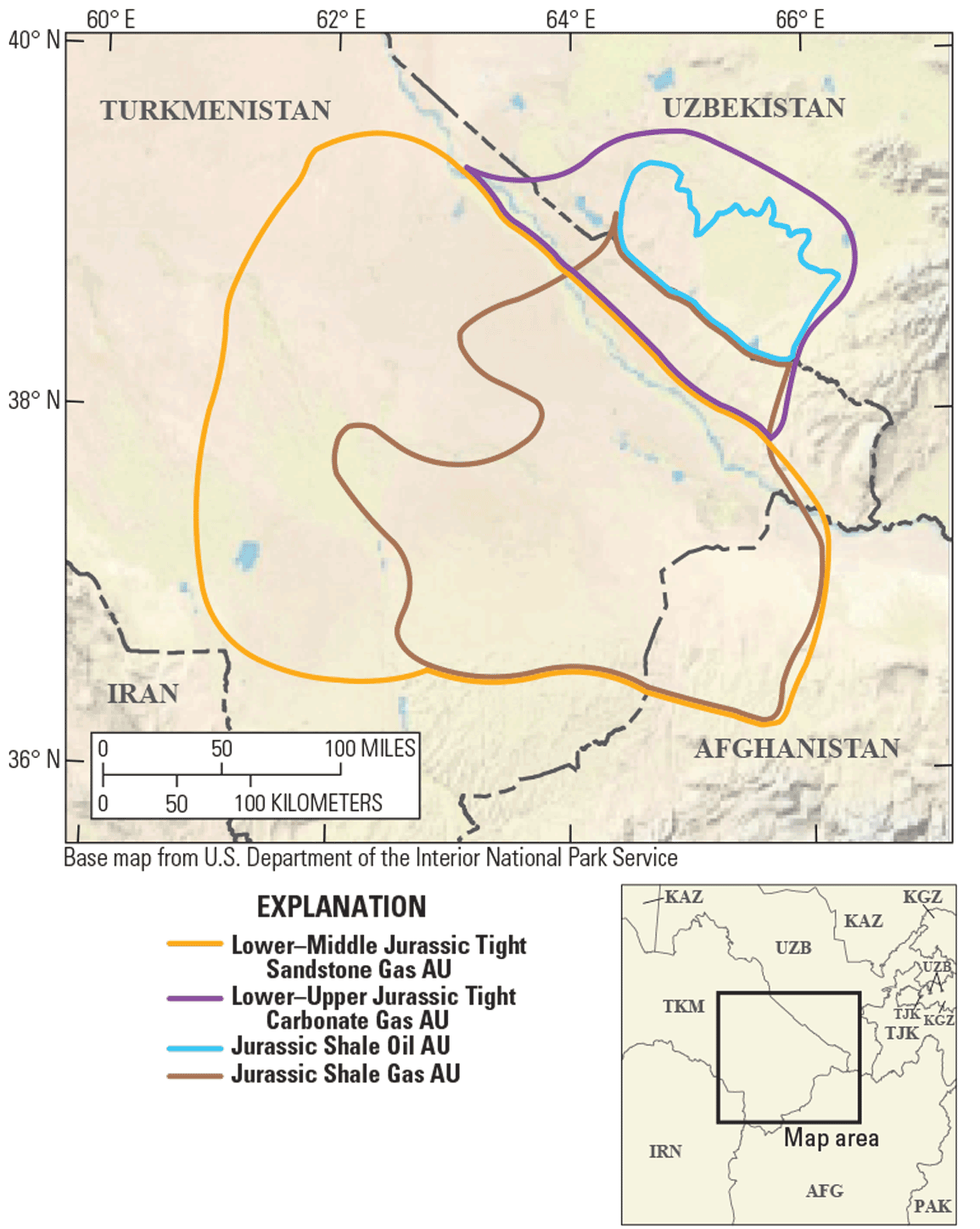
Map showing the location of four continuous oil and gas assessment units (AUs) in the Amu Darya Basin Province of Turkmenistan, Uzbekistan, and Afghanistan.
The tectonic evolution of the Amu Darya Basin Province is briefly summarized as follows to give a general background of the development of the total petroleum systems (TPSs) (Ulmishek, 2004; Brunet and others, 2017; Mordvintsev and others, 2017; Yang and others, 2017). The Amu Darya Basin Province originated as a Triassic to Jurassic extensional backarc basin encompassing a series of horsts and grabens. In the Early to Middle Jurassic, the grabens were sites of nonmarine, synrift deposits dominated by sandstones, mudstones, widespread coal beds, and carbonaceous shales. In the Late Jurassic, a decrease in the rate of rifting and subsequent thermal subsidence led to the deposition of widespread carbonate platforms and off-platform basinal organic-rich marine shales. Jurassic burial led to thermal maturation of the coal beds and carbonaceous shales to generate gas. The formation of a Neogene foreland basin associated with the Köpetdag Fold Belt along the southwestern margin of the basin led to burial and further thermal maturation of coal beds and Jurassic organic-rich shales into the thermal gas window throughout much of the Amu Darya Basin Province. Upper Jurassic shales in marginal areas were buried within the oil generation window, such as in the northern margin of the Amu Darya Basin Province in Uzbekistan (Ulmishek, 2004).
Total Petroleum Systems and Assessment Units
The USGS defined the Mesozoic Composite TPS to encompass carbonaceous shale-sourced and coal-sourced gas that migrated locally into low-permeability (tight) sandstone and carbonate reservoirs. The Lower–Middle Jurassic coal beds passed the thermal threshold for gas generation throughout most of the Amu Darya Basin Province and are the main source rocks for gas throughout the basin (Ulmishek, 2004; Yu and others, 2015; Xu and others, 2018; Chai and others, 2024). The Lower–Middle Jurassic Tight Sandstone Gas Assessment Unit (AU) and Lower–Upper Jurassic Tight Carbonate Gas AU were defined within the Mesozoic Composite TPS.
The geologic model for the assessment of the Lower–Middle Jurassic Tight Sandstone Gas AU is for gas generated from Lower–Middle Jurassic coal beds to have migrated locally and become trapped within low-permeability fluvial, coastal plain, deltaic, and nearshore marine sandstones. “Low permeability” in this assessment is defined as rock with 0.1 millidarcy (mD) or less permeability. The Lower–Middle Jurassic Tight Sandstone Gas AU may span a stratigraphic interval of 1,600 meters (m) and is as much as 7 kilometers deep. The geologic model predicts the presence of a tight sandstone gas system, primarily within the east-central part of the basin (fig. 1). Lower–Middle Jurassic coal beds may have generated oil that thermally evolved with burial to condensate (Shan and others, 2022). The geologic model for the assessment of the Lower–Upper Jurassic Tight Carbonate Gas AU is for gas generated from Lower–Middle Jurassic coal beds to have migrated locally and become trapped within low-permeability, fractured, carbonate platform margin, slope, and basinal carbonate rocks (Li and others, 2017; Wang, 2023). Natural and induced fractures may be important for gas recovery from these low-permeability rocks (Xing and others, 2022). Data compiled by Wang (2023) and Li and others (2024) show the extent of carbonate rock with less than 0.1 mD. Because no production tests or other evidence of potentially movable gas are available, geologic and production analogs from U.S. tight sandstone gas and tight carbonate gas reservoirs were used as quantitative input for the assessment (table 1). This assessment does not include potential continuous gas resources in ultradeep, high-temperature, and highly overpressured reservoirs, such as in the Bereketli-Pirgui gas field (Xing and others, 2020).
Table 1.
Key input data for four continuous oil and gas assessment units in the Amu Darya Basin Province of Turkmenistan, Uzbekistan, and Afghanistan.[Gray shading indicates not applicable. The average estimated ultimate recovery (EUR) input is the minimum, mode, maximum, and calculated mean. AU, assessment unit; %, percent; MMBO, million barrels of oil; BCFG, billion cubic feet of gas]
The USGS defined the Jurassic Shale TPS to encompass the part of the Amu Darya Basin Province where organic-rich Jurassic (Callovian to Oxfordian) shales are thermally mature for oil and gas generation (fig. 1). The Jurassic shales are as much as 250 m thick and are described as black, organic rich, and bituminous. Organic matter in the shales is oil-prone type-II and -IIS kerogen with total organic carbon values as much as 15 weight percent (Ulmishek, 2004; Xu and others, 2018; Ministry of Mining Industry and Geology of the Republic of Uzbekistan, unpub. data, 2024 [Data either are not available or have limited availability owing to proprietary restrictions. Contact the Ministry of Mining Industry and Geology of the Republic of Uzbekistan for more information.]).
Thermal gas sourced by these shales can contain as much as 8 percent hydrogen sulfide (Cheng and others, 2022). Jurassic shales achieved thermal maturation for oil generation during the Late Cretaceous, and for gas generation, during the Paleogene (Ulmishek, 2004). The Jurassic Shale Oil AU and Jurassic Shale Gas AU were defined within the Jurassic Shale TPS. The Jurassic Shale Oil AU was defined using thermal maturity data of the shales primarily in Uzbekistan, where the data indicate that the updip part of the shales is thermally mature for oil rather than gas. However, there is uncertainty about the thermal boundary between oil and gas generation in these shales.
The geologic model for the assessment of the Jurassic Shale Oil AU is for oil generated from organic-rich source rocks to have been partly retained within the matrix of the reservoir rocks after migration of oil into conventional sandstone and carbonate reservoirs. The retained oil forms a potentially recoverable resource. Similarly, the geologic model for the assessment of the Jurassic Shale Gas AU is for gas generated from organic-rich source rocks, or from oil thermally cracked to gas, to have been partly retained within the shales after migration of part of the gas into conventional reservoirs. The assessment input data for the four defined continuous AUs are summarized in table 1 and Schenk (2026).
Undiscovered Resources Summary
The USGS quantitatively assessed undiscovered, technically recoverable continuous oil and gas resources in four AUs in the Amu Darya Basin Province of Turkmenistan, Uzbekistan, and Afghanistan (table 2). The estimated mean resources are 519 million barrels of oil (MMBO), or 0.52 billion barrels of oil, with an F95 to F5 range from 128 to 1,062 MMBO; 82,934 billion cubic feet of gas (BCFG), or 82.9 trillion cubic feet of gas, with an F95 to F5 range from 18,321 to 183,175 BCFG; and 660 million barrels of natural gas liquids (MMBNGL), or 0.66 billion barrels of natural gas liquids, with an F95 to F5 range from 142 to 1,475 MMBNGL.
Table 2.
Results for four continuous oil and gas assessment units in the Amu Darya Basin Province of Turkmenistan, Uzbekistan, and Afghanistan.[Gray shading indicates not applicable. Results shown are fully risked estimates. F95 represents a 95-percent chance of at least the amount tabulated; other fractiles are defined similarly. MMBO, million barrels of oil; BCFG, billion cubic feet of gas; NGL, natural gas liquids; MMBNGL, million barrels of natural gas liquids]
For More Information
Assessment results are also available at the USGS Energy Resources Program website, https://www.usgs.gov/programs/energy-resources-program.
References Cited
Brunet, M.-F., Ershov, A.V., Korotaev, M.V., Melikhov, V.N., Barrier, E., Mordvintsev, D.O., and Sidorova, I.P., 2017, Late Paleozoic and Mesozoic evolution of the Amu Darya Basin (Turkmenistan, Uzbekistan), in Brunet, M.-F., McCann, T., and Sobel, E.R., eds., Geological evolution of central Asian basins and the western Tien Shan Range: Geological Society of London Special Publication 427, p. 89–144, accessed June 2, 2026, at https://doi.org/10.1144/SP427.18.
Chai, H., Wang, H., Guo, C., Zhang, L., Chen, P., Xing, Y., Cheng, M., and Zhang, T., 2024, Geological characteristics and developmental achievements of the large presalt carbonate gas fields in the Amu Darya Basin: Unconventional Resources, v. 4, article 100089, 13 p., accessed June 2, 2026, at https://doi.org/10.1016/j.uncres.2024.100089.
Cheng, Y., Feng, Z., Guo, C., Chen, P., Tan, C., Shi, H., and Luo, X., 2022, Links of hydrogen sulfide content with fluid components and physical properties of carbonate gas reservoirs—A case study of the right bank of Amu Darya, Turkmenistan: Frontiers in Earth Science, v. 10, article 910666, 12 p., accessed June 2, 2026, at https://doi.org/10.3389/feart.2022.910666.
Li, Y., Cheng, X., Fan, L., Sun, L., Wu, J., and Wei, J., 2024, Evaluation of fractured carbonate reservoir and prediction of favorable areas in the eastern area of Amu Darya right bank: Frontiers in Earth Science, v. 12, article 1495245, 15 p., accessed June 2, 2026, at https://doi.org/10.3389/feart.2024.1495245.
Li, F., Jing, X., Zou, C., Zhang, H., and Xiang, F., 2017, Facies analysis of the Callovian–Oxfordian carbonates in the northeastern Amu Darya Basin, southeastern Turkmenistan: Marine and Petroleum Geology, v. 88, p. 359–380, accessed June 2, 2026, at https://doi.org/10.1016/j.marpetgeo.2017.08.038.
Mordvintsev, D., Barrier, E., Brunet, M.-F., Blanpied, C., and Sidorova, I., 2017, Structure and evolution of the Bukhara-Khiva region during the Mesozoic—The northern margin of the Amu-Darya Basin (southern Uzbekistan), in Brunet, M.-F., McCann, T., and Sobel, E.R., eds., Geological evolution of central Asian basins and the western Tien Shan Range: Geological Society of London Special Publication 427, p. 145–174, accessed June 2, 2026, at https://doi.org/10.1144/SP427.16.
Schenk, C.J., 2026, USGS National and Global Oil and Gas Assessment Project—Amu Darya Basin Province continuous resources—Assessment unit boundaries, assessment input data, and fact sheet data tables: U.S. Geological Survey data release, https://doi.org/10.5066/P13SXVBJ.
Schenk, C.J., Tennyson, M.E., Mercier, T.J., Hawkins, S.J., Gaswirth, S.B., Marra, K.R., Klett, T.R., Le, P.A., Brownfield, M.E., and Woodall, C.A., 2017, Assessment of undiscovered continuous gas resources in the Amu Darya Basin Province of Turkmenistan, Uzbekistan, Iran, and Afghanistan, 2017: U.S. Geological Survey Fact Sheet 2017–3058, 2 p., accessed June 2, 2026, at https://doi.org/10.3133/fs20173058.
Shan, Y., Chai, H., Wang, H., Zhang, L., Su, P., Kong, X., Bai, Z., Cheng, M., and Zhang, H., 2022, Origin and characteristics of the crude oils and condensates in the Callovian-Oxfordian carbonate reservoirs of the Amu Darya right bank block, Turkmenistan: Lithosphere, v. 2022, article 5446117, 28 p., accessed June 2, 2026, at https://doi.org/10.2113/2022/5446117.
Ulmishek, G.F., 2004, Petroleum geology and resources of the Amu-Darya Basin, Turkmenistan, Uzbekistan, Afghanistan, and Iran: U.S. Geological Survey Bulletin 2201–H, 32 p., accessed June 2, 2026, at https://doi.org/10.3133/b2201H.
Wang, Q., 2023, Types and distribution characteristics of Callovian-Oxfordian reservoir on the right bank of Amu Darya River in Turkmenistan: Geofluids, v. 2023, article 6754915, 13 p., accessed June 2, 2026, at https://doi.org/10.1155/2023/6754915.
Xing, Y., Guo, C., Cheng, M., Yang, H., Shi, H., and Chen, P., 2020, Flow unit classification and characterization of Callovian-Oxfordian carbonate reservoir—Bereketli-Pirgui gas field, the right bank of Amu Darya, in Lin, J., ed., Proceedings of the International Field Exploration and Development Conference 2019, Xi'an, China, October 16–18, 2019: Singapore, Springer, p. 2328–2337, accessed June 2, 2026, at https://doi.org/10.1007/978-981-15-2485-1_211.
Xing, Y., Wang, H., Zhang, L., Chen, P., Yu, W., Guo, C., and Shi, H., 2022, Fracture properties and their impacts on performance in carbonate reservoir, central block B on the right bank of Amu Darya: Lithosphere, v. 2022, article 5335113, 15 p., accessed June 2, 2026, at https://doi.org/10.2113/2022/5335113.
Xu, W., Wen, H., Zheng, R., Li, F., Huo, F., Hou, M., and Zhou, G., 2018, The carbonate platform model and reservoirs’ origins of the Callovian-Oxfordian Stage in the Amu Darya Basin, Turkmenistan: Crystals, v. 8, no. 2, 22 p., accessed June 2, 2026, at https://doi.org/10.3390/cryst8020084.
Yang, Y.-T., Guo, Z.-X., and Luo, Y.-J., 2017, Middle-Late Jurassic tectonostratigraphic evolution of central Asia, implications for the collision of the Karakoram-Lhasa block with Asia: Earth-Science Reviews, v. 166, p. 83–110, accessed June 2, 2026, at https://doi.org/10.1016/j.earscirev.2017.01.005.
Yu, Y., Yin, J., Zheng, J., Li, F., Tao, C., Xu, X., and Wu, H., 2015, Division and resources evaluation of hydrocarbon plays in the Amu Darya Basin, central Asia: Petroleum Exploration and Development, v. 42, no. 6, p. 819–826, accessed June 2, 2026, at https://doi.org/10.1016/S1876-3804(15)30078-1.
Disclaimers
Any use of trade, firm, or product names is for descriptive purposes only and does not imply endorsement by the U.S. Government.
Although this information product, for the most part, is in the public domain, it also may contain copyrighted materials as noted in the text. Permission to reproduce copyrighted items must be secured from the copyright owner.
Suggested Citation
Schenk, C.J., Mercier, T.J., Le, P.A., Cicero, A.D., Gelman, S.E., Hearon, J.S., Johnson, B.G., Lagesse, J.H., and Leathers-Miller, H.M., 2026, Assessment of undiscovered continuous oil and gas resources in the Amu Darya Basin Province of Turkmenistan, Uzbekistan, and Afghanistan, 2026: U.S. Geological Survey Fact Sheet 2026–3013, 4 p., https://doi.org/10.3133/fs20263013.
ISSN: 2327-6932 (online)
Study Area
| Publication type | Report |
|---|---|
| Publication Subtype | USGS Numbered Series |
| Title | Assessment of undiscovered continuous oil and gas resources in the Amu Darya Basin Province of Turkmenistan, Uzbekistan, and Afghanistan, 2026 |
| Series title | Fact Sheet |
| Series number | 2026-3013 |
| DOI | 10.3133/fs20263013 |
| Publication Date | June 10, 2026 |
| Year Published | 2026 |
| Language | English |
| Publisher | U.S. Geological Survey |
| Publisher location | Reston VA |
| Contributing office(s) | Central Energy Resources Science Center |
| Description | Report: 4 p.; Data Release |
| Country | Afghanistan, Turkmenistan, Uzbekistan |
| Other Geospatial | Amu Darya Basin Province |
| Online Only (Y/N) | Y |