


Assessment of Undiscovered Conventional Oil and Gas Resources in the Greater Carpathian Area, 2024
Links
- Document: Report (2.60 MB pdf) , HTML , XML
- Data Release: USGS data release - USGS National and Global Oil and Gas Assessment Project—Greater Carpathian Area—Assessment Unit Boundaries, Assessment Input Data, and Fact Sheet Data Tables
- Download citation as: RIS | Dublin Core
Abstract
Using a geology-based assessment methodology, the U.S. Geological Survey estimated undiscovered, technically recoverable mean conventional resources of 208 million barrels of oil and 4.1 trillion cubic feet of gas in the greater Carpathian area.
Introduction
The U.S. Geological Survey (USGS) assessed the potential for undiscovered, technically recoverable conventional oil and gas resources within the greater Carpathian area (fig. 1). The greater Carpathian area for this assessment consists of assessment units (AUs) within the northern Carpathian Basin, southern Carpathian Basin, Moesian Platform, Varna Trough, Transylvanian Basin, Great Hungarian Plain of the Pannonian Basin, Danube Basin, and Vienna Basin (fig. 1).
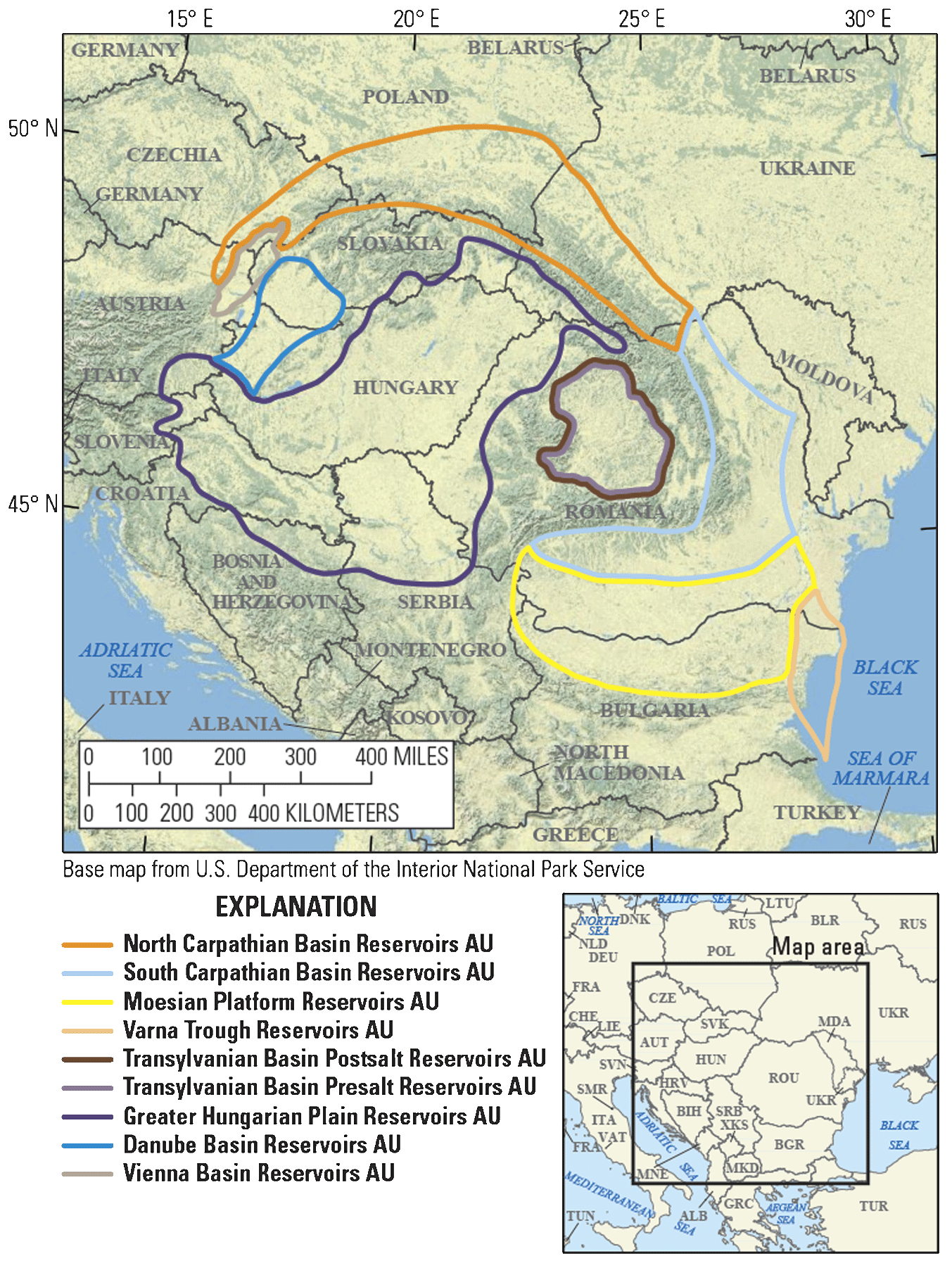
Map showing the location of nine conventional assessment units (AUs) in the greater Carpathian area.
The greater Carpathian area has a long record of oil and gas exploration dating back more than 100 years (Kotarba and others, 2019). Many of the producing areas are at a mature level of exploration for conventional oil and gas resources.
The greater Carpathian area is a complex mosaic of tectonic elements that record the tectonic evolution of one of the most complex regions in the world. Decades of focused research have shed considerable light on the evolution of the greater Carpathian area, which records multiple phases of deformation in the Tethyan realm between the eastern European continent and the northern margin of Gondwana since the Jurassic. The following is a brief summary from the literature of the key points in the tectonic evolution of the greater Carpathian area (Morley, 1996; Corver and others, 2009; Krézsek and others, 2010; Matenco and Radivojević, 2012; Horvàth and others, 2015; Krézsek and others, 2023; Schleder and others, 2023; Tari and others, 2023; Zielińska and others, 2023). From the Jurassic through the Paleogene, several terranes rifted from the Gondwanan and European margins and translated to the north and east, resulting in subduction that closed the paleo-Tethys Ocean. The diachronous movement of these various terranes opened several strands of the neo-Tethys Ocean. The terranes were made up of various continental and marine assemblages (Csontos and Vörös, 2004). The Alcapa and Tisza-Dacia terranes rifted from the southern margin of the European craton, moved northeast, and eventually entered the Carpathian embayment, where they began to collide with the eastern European margin. The Adria terrane collided with the southern margin of these terranes, leading to differential movement of the Alcapa and Tisza-Dacia terranes and the diachronous west-to-east formation of the Alpine and Carpathian fold and thrust belts. In the late Miocene, rollback of the south-facing subducting slab led to backarc extension of the terranes, forming the Miocene Pannonian Basin, an area largely coincident with the Greater Hungarian Plain Reservoirs AU (fig. 1). Thermal subsidence of the Pannonian Basin resulted in the deposition of several kilometers of sediment from the Pliocene to Holocene. In the late Pliocene, northeast movement of the Adria terrane caused contraction and inversion of many Miocene extensional structures (Morley, 1996).
Total Petroleum System and Assessment Units
The USGS defined the Mesozoic–Cenozoic Composite Total Petroleum System (TPS) to encompass oil and gas potentially sourced from several organic-rich marine shales and marls in the greater Carpathian assessment area. Nine AUs were defined within the Mesozoic–Cenozoic Composite TPS: (1) North Carpathian Basin Reservoirs AU, (2) South Carpathian Basin Reservoirs AU, (3) Moesian Platform Reservoirs AU, (4) Varna Trough Reservoirs AU, (5) Transylvanian Basin Postsalt Reservoirs AU, (6) Transylvanian Basin Presalt Reservoirs AU, (7) Greater Hungarian Plain Reservoirs AU, (8) Danube Basin Reservoirs AU, and (9) Vienna Basin Reservoirs AU.
The major source rocks in the North Carpathian Basin Reservoirs AU, South Carpathian Basin Reservoirs AU, Moesian Platform Reservoirs AU, and Varna Trough Reservoirs AU are Oligocene to Miocene organic-rich dysodile shales and the Oligocene to Miocene Menilite Shale (Kotarba and others, 2019; Körmös and others, 2021; Wójcik-Tabol and others, 2022; Krézsek and others, 2023; Rybár and Kotulová, 2023). Other potential source rocks are the shales of the Berriasian to Albian Spas Formation and Upper Jurassic marine marls. Source rocks in the Greater Hungarian Plain Reservoirs AU and Danube Basin Reservoirs AU are the Oligocene Tard Clay Formation (Badics and Vető, 2012; Körmös and others, 2021) and Miocene shales equivalent to the Oligocene to Miocene Dysodile Shale and Menilite Shale. The Triassic Kössen Formation is a viable source rock but may be limited in extent within the greater Carpathian area. The source rocks for biogenic gas in the Transylvanian Basin Postsalt Reservoirs AU and Transylvanian Basin Presalt Reservoirs AU are Miocene to Pliocene shales (Krézsek and others, 2010; Baciu and others, 2018). The major source rock in the Vienna Basin is the Jurassic Mikulov Formation (Rupprecht and others, 2017). The assessment input data for the nine AUs are summarized in table 1 and Schenk (2026).
Table 1.
Key input data for nine conventional oil and gas assessment units in the greater Carpathian area.[Gray shading indicates not applicable. AU, assessment unit; MMBO, million barrels of oil; BCFG, billion cubic feet of gas]
Undiscovered Resources Summary
The USGS quantitatively assessed undiscovered conventional oil and gas resources in nine AUs in the greater Carpathian area (table 2). The estimated mean resources are 208 million barrels of oil (MMBO), or 0.2 billion barrels of oil, with an F95 to F5 range from 90 to 412 MMBO; 4,123 billion cubic feet of gas (BCFG), or 4.1 trillion cubic feet of gas, with an F95 to F5 range from 1,846 to 7,766 BCFG; and 89 million barrels of natural gas liquids (MMBNGL), with an F95 to F5 range from 41 to 162 MMBNGL. The potential volumes of undiscovered conventional oil and gas reflect the mature level of exploration in the greater Carpathian area.
Table 2.
Results for nine conventional oil and gas assessment units in the greater Carpathian area.[Gray shading indicates not applicable. Results shown are fully risked estimates. F95 represents a 95-percent chance of at least the amount tabulated; other fractiles are defined similarly. MMBO, million barrels of oil; BCFG, billion cubic feet of gas; NGL, natural gas liquids; MMBNGL, million barrels of natural gas liquids]
For More Information
Assessment results are also available at the USGS Energy Resources Program website, https://www.usgs.gov/programs/energy-resources-program.
References Cited
Baciu, C., Ionescu, A., and Etiope, G., 2018, Hydrocarbon seeps in Romania—Gas origin and release to the atmosphere: Marine and Petroleum Geology, v. 89, pt. 1, p. 130–143, accessed July 21, 2025, at https://doi.org/10.1016/j.marpetgeo.2017.06.015.
Badics, B., and Vető, I., 2012, Source rocks and petroleum systems in the Hungarian part of the Pannonian Basin—The potential for shale gas and shale oil plays: Marine and Petroleum Geology, v. 31, no. 1, p. 53–69, accessed July 21, 2025, at https://doi.org/10.1016/j.marpetgeo.2011.08.015.
Corver, M.P., Doust, H., Van Wees, J.-D., Bada, G., and Cloetingh, S., 2009, Classification of rifted sedimentary basins of the Pannonian Basin system according to the structural genesis, evolutionary history and hydrocarbon maturation zones: Marine and Petroleum Geology, v. 26, no. 8, p. 1452–1464, accessed July 21, 2025, at https://doi.org/10.1016/j.marpetgeo.2008.12.001.
Csontos, L., and Vörös, A., 2004, Mesozoic plate tectonic reconstruction of the Carpathian region: Palaeogeography, Palaeoclimatology, Palaeoecology, v. 210, no. 1, 56 p., accessed July 21, 2025, at https://doi.org/10.1016/j.palaeo.2004.02.033.
Horvàth, F., Musitz, B., Balázs, A., Végh, A., Uhrin, A., Nádor, A., Koroknai, B., Pap, N., Tóth, T., and Wórum, G., 2015, Evolution of the Pannonian Basin and its geothermal resources: Geothermics, v. 53, p. 328–352, accessed July 21, 2025, at https://doi.org/10.1016/j.geothermics.2014.07.009.
Körmös, S., Sachsenhofer, R.F., Bechtel, A., Radovics, B.G., Milota, K., and Schubert, F., 2021, Source rock potential, crude oil characteristics and oil-to-source rock correlation in a central Paratethys sub-basin, the Hungarian Paleogene Basin (Pannonian Basin): Marine and Petroleum Geology, v. 127, article 104955, 21 p., accessed July 21, 2025, at https://doi.org/10.1016/j.marpetgeo.2021.104955.
Kotarba, M.J., Wiȩcław, D., Bilkiewicz, E., Radkovets, N.Y., Koltun, Y.V., Kmiecik, N., Romanowski, T., and Kowalski, A., 2019, Origin and migration of oil and natural gas in the western part of the Ukrainian Outer Carpathians—Geochemical and geological approach: Marine and Petroleum Geology, v. 103, p. 596–619, accessed July 21, 2025, at https://doi.org/10.1016/j.marpetgeo.2019.02.018.
Krézsek, C., Filipescu, S., Silye, L., Maţenco, L., and Doust, H., 2010, Miocene facies associations and sedimentary evolution of the southern Transylvanian Basin (Romania)—Implications for hydrocarbon exploration: Marine and Petroleum Geology, v. 27, no. 1, p. 191–214, accessed July 21, 2025, at https://doi.org/10.1016/j.marpetgeo.2009.07.009.
Krézsek, C., Schléder, Z., Olardu-Florea, R., Tamas, A., Oteleanu, A., Stoicescu, A., Ungureanu, C., Dudus, R., and Tari, G., 2023, Structure and petroleum systems of the eastern Carpathians, Romania: Marine and Petroleum Geology, v. 151, article 106179, 16 p., accessed July 21, 2025, at https://doi.org/10.1016/j.marpetgeo.2023.106179.
Matenco, L., and Radivojević, D., 2012, On the formation and evolution of the Pannonian Basin—Constraints derived from the structure of the junction area between the Carpathians and Dinarides: Tectonics, v. 31, no. 6, article TC6007, 31 p., accessed July 21, 2025, at https://doi.org/10.1029/2012TC003206.
Morley, C.K., 1996, Models for relative motion of crustal blocks within the Carpathian region, based on restorations of the outer Carpathian thrust sheets: Tectonics, v. 15, no. 4, p. 885–904, accessed July 21, 2025, at https://doi.org/10.1029/95TC03681.
Rupprecht, B.J., Sachsenhofer, R.F., Gawlick, H.-J., Kallanxhi, M.-E., and Kucher, F., 2017, Jurassic source rocks in the Vienna Basin (Austria)—Assessment of conventional and unconventional petroleum potential: Marine and Petroleum Geology, v. 86, p. 1327–1356, accessed July 21, 2025, at https://doi.org/10.1016/j.marpetgeo.2017.07.026.
Rybár, S., and Kotulová, J., 2023, Petroleum play types and source rocks in the Pannonian Basin, insight from the Slovak part of the Danube Basin: Marine and Petroleum Geology, v. 149, article 106092, 19 p., accessed July 21, 2025, at https://doi.org/10.1016/j.marpetgeo.2022.106092.
Schenk, C.J., 2026, USGS National and Global Oil and Gas Assessment Project—Greater Carpathian area—Assessment unit boundaries, assessment input data, and fact sheet data tables: U.S. Geological Survey data release, https://doi.org/10.5066/P1NQM3OG.
Schleder, Z., Lăpădat, I.A., Trandafir, G., Fernández, O., Tămaș, D.M., Tămaș, A., Filipescu, S., Krézsek, C., Rădoiaș, M.A., and Vasiliu, M., 2023, Structural inheritance and style within the Getic Depression, south Carpathians, Romania: Marine and Petroleum Geology, v. 148, article 106068, 30 p., accessed July 21, 2025, at https://doi.org/10.1016/j.marpetgeo.2022.106068.
Tari, G., Bada, G., Boote, D.R.D., Krézsek, C., Koroknai, B., Kovács, G., Lemberkovics, V., Sachsenhofer, R.F., and Tóth, T., 2023, The Pannonian Super Basin—A brief overview: AAPG Bulletin, v. 107, no. 8, p. 1391–1417, accessed July 21, 2025, at https://doi.org/10.1306/02172322098.
Wójcik-Tabol, P., Wendorff-Belon, M., Kosakowski, P., Zakrzewski, A., and Marynowski, L., 2022, Paleoenvironment, organic matter maturity, and the hydrocarbon potential of Menilite shales (Silesian unit, Polish Outer Carpathians)—Organic and inorganic geochemical proxies: Marine and Petroleum Geology, v. 142, article 105767, 22 p., accessed July 21, 2025, at https://doi.org/10.1016/j.marpetgeo.2022.105767.
Zielińska, M., Jirman, P., Gedl, P., and Botor, D., 2023, Burial and thermal history of the eastern transform boundary of the central western Carpathians based on 1D basin modeling: Marine and Petroleum Geology, v. 147, article 106021, 19 p., accessed July 21, 2025, at https://doi.org/10.1016/j.marpetgeo.2022.106021.
Disclaimers
Any use of trade, firm, or product names is for descriptive purposes only and does not imply endorsement by the U.S. Government.
Although this information product, for the most part, is in the public domain, it also may contain copyrighted materials as noted in the text. Permission to reproduce copyrighted items must be secured from the copyright owner.
Suggested Citation
Schenk, C.J., Mercier, T.J., Le, P.A., Cicero, A.D., Gelman, S.E., Hearon, J.S., Johnson, B.G., Lagesse, J.H., and Leathers-Miller, H.M., 2026, Assessment of undiscovered conventional oil and gas resources in the Greater Carpathian area, 2024: U.S. Geological Survey Fact Sheet 2026–3060, 4 p., https://doi.org/10.3133/fs20263060.
ISSN: 2327-6932 (online)
Study Area
| Publication type | Report |
|---|---|
| Publication Subtype | USGS Numbered Series |
| Title | Assessment of undiscovered conventional oil and gas resources in the Greater Carpathian area, 2024 |
| Series title | Fact Sheet |
| Series number | 2026-3060 |
| DOI | 10.3133/fs20263060 |
| Publication Date | January 28, 2026 |
| Year Published | 2026 |
| Language | English |
| Publisher | U.S. Geological Survey |
| Publisher location | Reston VA |
| Contributing office(s) | Central Energy Resources Science Center |
| Description | Report: 4 p.; Data Release |
| Country | Austria, Bosnia and Herzegovina, Bulgaria, Croatia, Czechia, Hungary, Poland, Romania, Serbia, Slovakia, Slovenia, Ukraine |
| Online Only (Y/N) | Y |