


Metallurgical Coal—Deposits, Production, Resources, Market Dynamics, and Supply Chain Risks
Links
- Document: Report (6.82 MB pdf) , HTML , XML
- NGMDB Index Page: National Geologic Map Database Index Page (html)
- Download citation as: RIS | Dublin Core
The U.S. Geological Survey (USGS) analyzed the available information and data on metallurgical coal (met coal) related to its occurrence, characteristics, and availability in the United States. The analysis consists of a generalized overview of met coal deposits in the conterminous United States, the chemical and physical specifications required for a coal to be considered met coal, a short description of the met coal supply chain, international met coal production and exports, and domestic met coal production. A tabulation and explanation of domestic met coal reserves and available resources is provided. Information on the 2023 United States reliance on met coal imports is also included.
Introduction
Coal is a brown to black, readily combustible rock that is classified by rank1 . Coal is mainly used for electrical power generation and steelmaking. Coal used for electrical power generation is referred to as “thermal coal,” and coal used in conventional steelmaking is referred to as “metallurgical coal” (hereafter called met coal) or “coking coal.” Met coal is consumed in a coke oven to produce coke—a hard, porous, carbon-rich material that is a key ingredient, along with iron ore and limestone, in steelmaking (Kentucky Geological Survey [KGS], 2023).
Terms defined in the glossary are in bold print where first used in this fact sheet.
Coal must meet certain rigorous chemical and physical specifications to be considered met coal. Met coal is almost always bituminous in rank and is low in ash, sulfur, phosphorus, and alkaline content. Met coal must also meet specifications for plasticity, swelling, and vitrinite reflectance.
Much of the Nation’s metallurgical coal resources are located throughout the Appalachian Basin, with large deposits in Pennsylvania, West Virginia, Virginia, Kentucky, and Alabama. Widespread deposits of bituminous coal in the Illinois Basin and the central Great Plains are generally high in sulfur content and do not meet the specifications for met coal. Colorado, New Mexico, and Utah have bituminous coal deposits that meet the specifications for met coal, but they are either mined out or, compared to deposits in the Appalachian Basin, relatively isolated because of their distance from coke plants (for domestic use) or port facilities (for export). Consequently, Colorado was the only Western State to produce met coal in 2023 (U.S. Energy Information Administration [EIA], 2024a). Figure 1 shows a map of the conterminous United States and the distribution of coal by rank and area. Deposits of low-volatile matter bituminous coal (low-vol coal), usually preferred for met coal, are along the eastern margin of the Appalachian Basin. Volatile matter values generally increase from east to west across the Appalachian Basin.
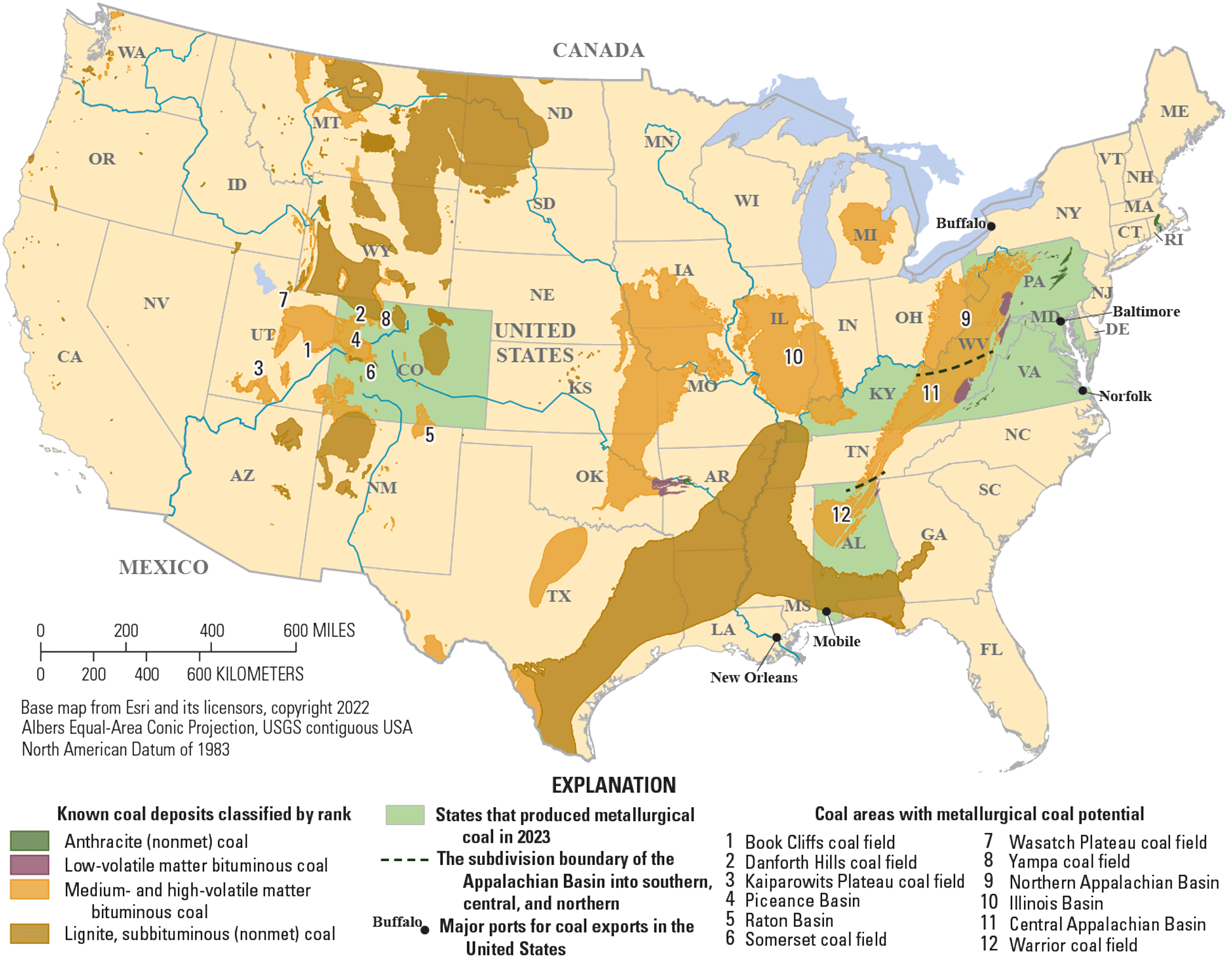
Map showing the distribution of coals by rank in the conterminous United States. Figure modified from East (2013). The subdivisions of the Appalachian Basin are from Ruppert (2001).
Coal Resources and Coal Reserves
Discussing “coal resources” and “coal reserves” is often confusing because the terms are mistakenly applied when attempting to quantify coal deposits. “Coal resources” are defined by Wood and others (1983) as naturally occurring “deposits of coal in the Earth’s crust, in such forms and amounts that economic extraction is currently or potentially feasible” (p. 19). Before the extraction of any coal, coal resources that are less than 6,000 feet deep and, for anthracite and bituminous coal beds, greater than 14 inches thick are classified as “original coal resources.” “Available coal resources” (a classification subset of original coal resources) is defined as the coal that remains after coal resources with land use, environmental, or societal restrictions are subtracted from the original coal resources. Available coal resources also do not include coal that is not extractable because of technical or mining limitations caused by weathering, excessive cover depths, high-stripping ratios, coal bed thickness (too thick or thin), and geological anomalies (Luppens and others, 2009). “Coal reserves” (a classification subset of available coal resources) is defined as coal that can be sold at market value for a profit after deducting extraction and processing costs (Luppens and others, 2009). The quantity of coal reserves constantly fluctuates based on several factors, such as coal mining costs, sales prices, availability, demand, and technological innovations.
Physical and Chemical Parameters of Metallurgical Coal
For coal to be classified as “met coal,” certain chemical and physical specifications need to be met. Common specifications for met coal include constraints on the following chemical parameters: ash, sulfur, volatile matter, fixed carbon, phosphorus, and alkaline content. The specifications for the physical properties of met coal include plasticity, swelling, and vitrinite reflectance (thermal maturity). Specialized testing methods for met coal, such as the Gieseler Plastometer for plasticity and the Arnu Dilatometer and Free Swelling Index for swelling, have been developed. The analyses’ targets or ranges for each of the common met coal specifications are summarized in table 1.
Table 1.
The targets and ranges of common chemical and physical analyses for met coal specifications.[Ash and sulfur are on an as-received basis, and volatile matter and fixed carbon are on a dry, mineral-matter-free basis.<, less than; high-vol coal, high-volatile matter bituminous coal; >, greater than; medium-vol coal, medium-volatile matter bituminous coal; ≤, less than or equal to; low-vol coal, low-volatile matter bituminous coal; ≥, greater than or equal to; DDPM, dial divisions per minute; SGS, SGS Mineral Services; +percent, coal dilation or expansion from original volume; −percent, coal dilation or shrinkage from original volume; CSN, crucible swelling number; MMR, mean maximum reflectance of vitrinite (in oil)]
Data from Wood and others (1983).
Data from ASTM (1981, as cited in Wood and others [1983]).
Data from IspatGuru (2018).
Data from SGS (2013b).
Data from Whitehaven Coal Limited (2023).
Individual coal beds rarely meet all the required specifications for met coal. Usually, met coal feedstocks for coking ovens are a blend of several coal beds, with each coal contributing chemical or physical characteristics that increase the strength of the produced coke, reduce impurities, and contribute to cost controls. Blending reduces costs because more expensive premium met coals are combined with less expensive met coals to produce usable met coal without reducing coke quality (Whitehaven Coal Limited, 2023).
Supply Chain for Metallurgical Coal
Figure 2 shows a generalized flow chart for the five steps in the met coal supply chain. The first step in the supply chain is resource exploration and development. Coal resources are acquired through leasing or purchasing, then met coal reserves are delineated through detailed exploration drilling, chemical and physical analyses, and geologic mapping. The second step, after a viable met coal reserve is delineated, is mining to extract these reserves. Met coal can be mined by surface methods (contour, mountaintop removal, auger, or highwall mining) or by underground methods (room and pillar or longwall mining; KGS, 2023). The type of mining used is dependent on numerous parameters, including the cover depth from the surface to the coal, coal thickness, stripping ratio, structural geology (localized folding and faulting), and lateral extent of the reserve area.
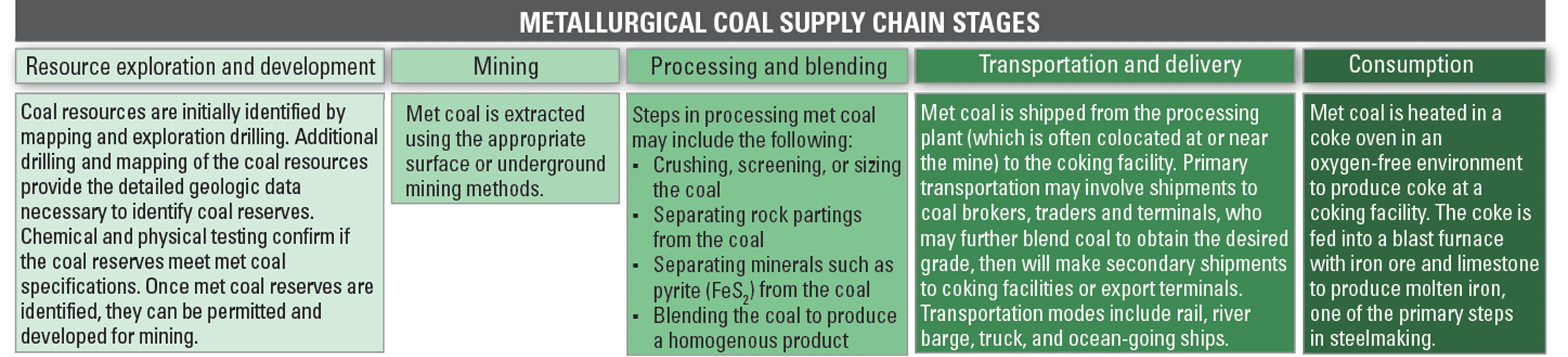
Flow diagram showing the metallurgical coal supply chain stages.
After the met coal is mined, the (discretionary) third step is processing and blending. Met coal may be sent to a coal processing plant for preparation (cleaning) to enhance its chemical and physical parameters to meet the specifications for met coal before shipping. Depending upon its intended use, the met coal preparation process may include some or all the following steps: (a) crushing, screening, and sizing the coal to a specific particle size; (b) removing rock partings to increase the heating (calorific) value of the coal; and (c) separating unwanted minerals (for example, pyrite) from the coal.
Once the specified met coal product has been mined and, if needed, processed, the fourth step is transportation and delivery. Domestically produced and consumed met coal may be shipped by rail, barge, or truck from the mine or coal processing plant directly to coke ovens. Met coal may also be shipped to a coal broker, trader, or terminal, where further processing or blending of the met coal with other coals may be done to prepare a specific product before exporting. Domestically produced met coal sold to international export markets may also be transported by several modes, most commonly by ocean-going ships. For example, met coal may be loaded onto a train at a mine or coal processing plant and transported to a port facility for international shipping.
At the port facility (refer to fig. 1), the met coal is transloaded from train to ship. Once the ship reaches the destination port, the coal may be unloaded directly at coke ovens, or it may need to be transloaded again to a train or trucks for transportation inland to coke ovens. Whether the met coal is mined for domestic use or international export, the fifth step in the met coal supply chain is consumption at a coking facility.
International Metallurgical Coal Production and Exports
Seven countries produce more than 96 percent of the world’s met coal (table 2), according to 2023 production data (the most recent full-year data available in 2025; EIA, 2024e). China is by far the world’s largest producer of met coal, producing more than half of the world’s total in 2023, and the other six countries (in descending order of production) are Australia, Russia, India, the United States, Mongolia, and Canada (EIA, 2024e). Australia, the United States, Mongolia, Russia, and Canada export more than 95 percent of the world’s met coal (table 3). The world’s leading exporter of met coal is Australia, accounting for more than 48 percent of the world’s met coal exports (EIA, 2024c).
Table 2.
Countries producing the most metallurgical coal, based on 2023 data.[Data from the U.S. Energy Information Administration (EIA; 2024e). Totals may not equal the sum of components because of rounding of individual values. There is a discrepancy between U.S. met coal production reported by the EIA in their 2023 international coal and coke production data (EIA, 2024e) and their “Annual Coal Report 2023” (EIA, 2024a). mst, million short tons]
Table 3.
Countries exporting the most metallurgical coal, based on 2023 data.[Data from the U.S. Energy Information Administration (EIA; 2024c). Totals may not equal the sum of components because of rounding of individual values. mst, million short tons]
China, despite leading the world in met coal production, consumes almost all its met coal domestically. Out of the almost 600 million short tons (mst) of met coal that China produced in 2023 (table 2), it only exported 0.404 mst (404,000 short tons [st]; EIA, 2024c). Similarly, India produced more than 71 mst of met coal in 2023 but only exported about 0.026 mst (26,000 st).
Domestic Metallurgical Coal Production
The United States, as shown in table 2, produced approximately 66 mst of met coal in 2023. Seven States contributed all the U.S. met coal production in 2023 (table 4), with West Virginia leading with 30.3 mst produced; the other six States (in descending order of production) are Alabama, Virginia, Pennsylvania, Kentucky, Maryland, and Colorado (EIA, 2024a). Except for Colorado, all the States listed are in the Appalachian Basin. The production of met coal in the United States peaked at 90.0 mst in 2011 and steadily decreased to 55.5 mst in 2020 (EIA, 2024e). Met coal production increased by approximately 10 mst between 2020 and 2023. In 2020, the total sales price of domestic met coal (the weighted average of open [spot] market and export prices) was $110.64 per st (EIA, 2024a). By 2023, the total sales price increased to $212.30 per st, which corresponds to the increase in met coal production between 2020 and 2023 (EIA, 2024a).
Table 4.
United States metallurgical coal production data by State, based on 2023 data.[Data from the U.S. Energy Information Administration (EIA; 2024a, table 8). Totals may not equal the sum of components because of rounding of individual values. There is a discrepancy between U.S. met coal production reported by the EIA in their 2023 international coal and coke production data (EIA, 2024e) and their “Annual Coal Report 2023” (EIA, 2024a). mst, million short tons]
Domestic Metallurgical Coal Reserves and Resources
The United States contains an abundance of coal reserves and resources. The EIA (2024a, table 14) lists the remaining coal reserves at producing mines as of the end of 2023. Table 5 is a compilation of the coal reserves from the EIA for the six States producing met coal in the Appalachian Basin. Those six States have coal reserves totaling 3,151 mst. There is no practical way to calculate how much of those remaining reserves may meet the specifications for met coal, so it is difficult to say how much of the 3,151 mst of coal reserves may be met coal.
Table 5.
United States coal reserves by State, based on 2023 data.[Data from the U.S. Energy Information Administration (EIA; 2024a, table 14). Domestic 2023 met coal consumption from EIA (2024b). Totals may not equal the sum of components because of rounding of individual values. mst, million short tons]
Beyond coal reserves, vast quantities of coal resources are spread throughout the conterminous United States. Some of these coal resources are in areas that have met coal reserves. Whereas recent USGS assessment studies have concentrated on assessing areas with abundant thermal coal resources (Scott and others, 2019; Luppens and others, 2015), an earlier generation of assessments (the “National Coal Resource Assessment” [NCRA] 1999–2001; Ruppert and others, 2002) covered six major coal-bearing regions in the conterminous United States.
These six known areas may have available coal resources that meet the specifications for met coal. The NCRA study for (1) the northern Appalachian Basin identified 46,500 mst of remaining (as of 2001) available coal resources in Pennsylvania, West Virginia, and Ohio for two major coal beds (the Pittsburgh and Upper Freeport coal beds) that have historically produced met coal (Ruppert, 2001). This same study (Ruppert, 2001) identified 13,800 mst of remaining available coal resources in (2) the central Appalachian Basin for selected coal beds (the Pond Creek and Pocahontas #3 coal beds) that may meet specifications for met coal in West Virginia, Virginia, and eastern Kentucky.
Several areas in the Colorado Plateau may also contain met coal resources. (3) The southern part of the Piceance Basin area in western Colorado contains approximately 34,000 mst of available coal resources, and some of those resources meet the specifications for met coal (Hettinger and others, 2000b). (4) The Kaiparowits Plateau in Utah also contains large quantities of available coal resources (28,000 mst) that meet the specifications for met coal, but many of those coal resources underlie the Grand Staircase-Escalante National Monument and cannot be extracted (Hettinger and others, 2000a). (5) The Somerset coal field in west-central Colorado contains high-volatile matter A and B bituminous coal (high-vol A coal and high-vol B coal) that meets specifications for met coal (Kirschbaum and Biewick, 2000).
One other basin in the Rocky Mountains that has historically produced met coal is (6) the Raton Basin, straddling the Colorado and New Mexico border (Flores and Bader, 1999). Pillmore (1991) reports that coal beds in the Raton Basin are high-vol A and high-vol B coal, with low-sulfur (less than 1.0 percent) and low- (less than 8.0 percent, on an as-received basis) to medium-ash (8–15 percent, on an as-received basis) contents. These coal beds meet specifications for met coal. Assessments by Amuedo and Bryson (1977) and Pillmore (1991) estimate that approximately 5,500 mst of available coal resources remain in the Raton Basin. These six areas contain approximately 130,900 mst of available coal resources (table 6). There is no practical way to calculate how many of these available resources may meet specifications for met coal.
Table 6.
United States available coal resources by coal basin or area.[Domestic 2023 met coal consumption data is from the U.S. Energy Information Administration (EIA; 2024b). The reported available coal resources for the northern and central Appalachian Basin are from Ruppert (2001), southern Piceance Basin are from Hettinger and others (2000b), Kaiparowits Plateau are from Hettinger and others (2000a), Somerset coal field are from Kirschbaum and Biewick (2000), Raton Basin are from Amuedo and Bryson (1977) and Pillmore (1991). mst, million short tons; Pa., Pennsylvania; W. Va., West Virginia; Va., Virginia; Ky., Kentucky; Colo., Colorado; N. Mex., New Mexico]
There are other coal field or basins in the United States that produce or have produced coal but are not included in the tabulation of met coal resources or reserves in table 6 for various reasons. The Warrior coal field in Alabama contains active mining operations producing met coal. The USGS reported that 11,905 mst of coal resources remained in the Warrior coal field in the mid-1960s (Culbertson, 1964). However, since then, there have been no other studies by the USGS for that coal field using the coal resource classification system standardized in Wood and others (1983) and incorporating any recent (post-1964) drill hole and production data. Because of the age of the assessment study, resource classification system and methodology used, and subsequent production since the study was completed, the reported coal resources for the Warrior coal field were not included in table 6. Despite the exclusion of the Warrior coal field resources from table 6, it should be noted that this coal field is currently (as of 2025) a major producer of met coal in the United States.
Several other areas in the Colorado Plateau contain coal beds of bituminous rank. The Wasatch Plateau in Utah has high-vol B coal and high-vol C coal, but the coal beds do not meet the specifications for met coal (Dubiel and others, 2000). The Book Cliffs coal field in central Utah produced high-vol A and high-vol B coal into the mid-1990s, but there is no current (as of 2025) reported met coal production from this coal field (Trippi and others, 2021). The Danforth Hills coal field in northwestern Colorado contains high-vol C coal with low-sulfur values, but no met coal was produced (Brownfield and others, 2000). The Yampa coal field in northwestern Colorado, just to the east of the Danforth Hills coal field, also contains high-vol C coal with low-sulfur values, but, as with the Danforth Hills coal field, no met coal was produced (Johnson and others, 2000).
Coal from the Illinois Basin (Illinois, Indiana, and western Kentucky), although high-vol A coal to high-vol C coal, does not meet the chemical and physical specifications for met coal. However, Illinois Basin coal can be blended with Appalachian met coals to produce a suitable met coal product (Trippi and others, 2021).
Metallurgical Coal Import Reliance
Data on met coal imports for the United States are published by the EIA (2024d). As shown in table 3, in 2023, the United States was a net exporter of met coal to the world, exporting more than 51 mst. In contrast, the United States only imported 0.712 mst (712,000 st) in 2023 (EIA, 2024d), entirely from Canada (Ryan and others, 2025).
Summary
Met coal is a type of bituminous rank coal that is consumed to produce coke, a key ingredient in steelmaking. Met coal must meet rigorous chemical and physical specifications. Coal mines in the United States produced 66 mst of met coal in 2023. Domestic consumption of met coal was 15.85 mst in 2023. The United States is a net exporter of met coal and was second in the world in met coal exports, trailing only Australia. The production of met coal in the United States is concentrated in the Appalachian Basin, which contains six of the seven States that produce met coal. West Virginia is the leading met-coal producing State, accounting for almost 50 percent of the nation’s production.
As of 2023, the United States exports more than three times as much met coal than it consumes domestically. The United States imported less than 1 mst of met coal in 2023. The United States has abundant coal reserves and resources. The six states currently producing met coal in the Appalachian Basin have 3,151 mst of reported coal reserves. In addition, available coal resources of at least 130,900 mst are identified in the Colorado Plateau and other areas of the Western United States. Predicting the amount of met coal within these coal reserves and available coal resources is difficult. The estimate of available coal resources does not include possible additional met coal resources in the Warrior coal field, an area that has not been assessed by the USGS since the 1960s.
References Cited
Amuedo, C.L., and Bryson, R.S., 1977, Trinidad-Raton basins—A model coal resource evaluation program, in Murray, D.K., ed., Geology of Rocky Mountain coal—Proceedings of the 1976 Symposium, Golden, Colo., April 26–27, 1976, Colorado Geological Survey Resource Series 1: Denver, Colo., Colorado Geological Survey, p. 45–60, accessed September 16, 2024, at https://doi.org/10.58783/cgs.rs01.fnbg7289.
Brownfield, M.E., Roberts, L.N.R., Johnson, E.A., and Mercier, T.J., 2000, Assessment of the distribution and resources of coal in the Fairfield Group of the Williams Fork Formation, Danforth Hills Coal Field, northwest Colorado, chap. M of Kirschbaum, M.A., Roberts, L.N.R., and Biewick, L.H.R., eds., Geologic assessment of coal in the Colorado Plateau—Arizona, Colorado, New Mexico, and Utah: U.S. Geological Survey Professional Paper 1625–B, 60 p., accessed September 16, 2025, at https://pubs.usgs.gov/pp/p1625b/Reports/Chapters/Chapter_M.pdf.
Culbertson, W.C., 1964, Geology and coal resources of the coal-bearing rocks of Alabama—Contributions to economic geology: U.S. Geological Survey Bulletin 1182–B, 79 p., accessed September 18, 2025, at https://pubs.usgs.gov/bul/1182b/report.pdf.
Dubiel, R.F., Kirschbaum, M.A., Roberts, L.N.R., Mercier, T.J., and Heinrich, A., 2000, Geology and coal resources of the Blackhawk Formation in the Southern Wasatch Plateau, Central Utah, chap. S of Kirschbaum, M.A., Roberts, L.N.R., and Biewick, L.H.R., eds., Geologic assessment of coal in the Colorado Plateau—Arizona, Colorado, New Mexico, and Utah: U.S. Geological Survey Professional Paper 1625–B, 61 p., accessed September 16, 2025, at https://pubs.usgs.gov/pp/p1625b/Reports/Chapters/Chapter_S.pdf.
East, J.A., 2013, Coal fields of the conterminous United States—National Coal Resource Assessment updated version: U.S. Geological Survey Open-File Report 2012–1205, 1 sheet, scale 1:5,000,000, accessed September 3, 2024, at https://pubs.usgs.gov/of/2012/1205/.
Flores, R.M., and Bader, L.R., 1999, A summary of Tertiary coal resources of the Raton Basin, Colorado and New Mexico, chap. SR of Fort Union Coal Assessment Team and USGS Energy Resources Team, comps., 1999 Resource assessment of selected Tertiary coal beds and zones in the northern Rocky Mountains and Great Plains region: U.S. Geological Survey Professional Paper 1625–A, 38 p., accessed September 15, 2025, at https://doi.org/10.3133/pp1625A.
Hettinger, R.D., Roberts, L.N.R., Biewick, L.R.H., and Kirschbaum, M.A., 2000a, Geologic overview and resource assessment of coal in the Kaiparowits Plateau, southern Utah, chap. T of Kirschbaum, M.A., Roberts, L.N.R., and Biewick, L.H.R., eds., Geologic assessment of coal in the Colorado Plateau—Arizona, Colorado, New Mexico, and Utah: U.S. Geological Survey Professional Paper 1625–B, 73 p., accessed September 16, 2025, at https://pubs.usgs.gov/pp/p1625b/Reports/Chapters/Chapter_T.pdf.
Hettinger, R.D., Roberts, L.N.R., and Gognat, T.A., 2000b, Investigations of the distribution and resources of coal in the southern part of the Piceance Basin, Colorado, chap. O of Kirschbaum, M.A., Roberts, L.N.R., and Biewick, L.H.R., eds., Geologic assessment of coal in the Colorado Plateau—Arizona, Colorado, New Mexico, and Utah: U.S. Geological Survey Professional Paper 1625–B, 106 p., accessed September 16, 2025, at https://pubs.usgs.gov/pp/p1625b/Reports/Chapters/Chapter_O.pdf.
IspatGuru, 2018, Metallurgical coal: IspatGuru web page, accessed September 11, 2025, at https://www.ispatguru.com/metallurgical-coal/.
Johnson, E.A., Roberts, L.N.R., Brownfield, M.E., and Mercier, T.J., [2000], Geology and resource assessment of the middle and upper coal groups in the Yampa Coal Field, northwest Colorado, chap. P of Kirschbaum, M.A., Roberts, L.N.R., and Biewick, L.H.R., eds., Geologic assessment of coal in the Colorado Plateau—Arizona, Colorado, New Mexico, and Utah: U.S. Geological Survey Professional Paper 1625–B, 65 p., accessed September 16, 2025, at https://pubs.usgs.gov/pp/p1625b/Reports/Chapters/Chapter_P.pdf.
Kentucky Geological Survey [KGS], [2023], Coal to make coke and steel: Kentucky Geological Survey web page, accessed September 3, 2025, at https://www.uky.edu/KGS/coal/coal-for-cokesteel.php.
Kirschbaum, M.A., and Biewick, L.R.H., [2000], A summary of the coal deposits in the Colorado Plateau—Arizona, Colorado, New Mexico, and Utah, chap. B of Kirschbaum, M.A., Roberts, L.N.R., and Biewick, L.H.R., eds., Geologic assessment of coal in the Colorado Plateau—Arizona, Colorado, New Mexico, and Utah: U.S. Geological Survey Professional Paper 1625–B, 99 p., accessed September 16, 2025, at https://pubs.usgs.gov/pp/p1625b/Reports/Chapters/Chapter_B.pdf.
Luppens, J.A., Rohrbacher, T.J., Osmonson, L.M., and Carter, M.D., 2009, Coal resource availability, recoverability, and economic evaluations in the United States—A summary, chap. D of Pierce, B.S., and Dennon, K.O., eds., The national coal resource assessment overview: U.S. Geological Survey Professional Paper 1625–F, 17 p., accessed September 16, 2025, at https://pubs.usgs.gov/pp/1625f/downloads/ChapterD.pdf.
Luppens, J.A., Scott, D.C., Haacke, J., Osmonson, L.E., and Pierce, P.E., 2015, Coal geology and assessment of coal resources and reserves in the Powder River Basin, Wyoming and Montana: U.S. Geological Survey Professional Paper 1809, 218 p. [Also available at https://doi.org/10.3133/pp1809.]
Pillmore, C.L., 1991, Geology and coal resources of the Raton coalfield, chap. D of Molnia, C.L., Jobin, D.A., O’Connor, J.T., and Kottlowski, F.E., eds., Coalfields of New Mexico—Geology and resources: U.S. Geological Survey Bulletin 1972, p. 49–68, accessed September 16, 2025, at https://doi.org/10.3133/b1972.
Ruppert, L.F., 2001, Executive summary—Coal resource assessment of selected coal beds and zones in the northern and central Appalachian Basin coal regions, chap. A of Northern and Central Appalachian Basin Coal Regions Assessment Team, comps., 2000 resource assessment of selected coal beds and zones in the northern and central Appalachian Basin coal regions: U.S. Geological Survey Professional Paper 1625–C, 1 CD–ROM. [Also available at https://pubs.usgs.gov/pp/p1625c/CHAPTER_A/CHAPTER_A.pdf.]
Ruppert, L.F., Kirschbaum, M.A., Warwick, P.D., Flores, R.M., Affolter, R.H., and Hatch, J.R., 2002, The U.S. Geological Survey’s national coal resource assessment—The results: International Journal of Coal Geology, v. 50, nos. 1–4, p. 247–274, accessed September 17, 2024, at https://doi.org/10.1016/S0166-5162(02)00120-9.
Ryan, L., Buffie, N.E., Kaboli, E., and Sutherland, M.D., 2025, Metallurgical coal—Frequently asked questions: Congressional Research Service Report R48635, 17 p., accessed September 3, 2025, at https://congress.gov/crs-product/R48635.
Scott, D.C., Shaffer, B.N., Haacke, J.E., Pierce, P.E., and Kinney, S.A., 2019, Coal geology and assessment of resources and reserves in the Little Snake River coal field and Red Desert assessment area, Greater Green River Basin, Wyoming: U.S. Geological Survey Professional Paper 1836, 169 p. [Also available at https://doi.org/10.3133/pp1836.]
SGS Mineral Services [SGS], 2013a, Coal physical testing: SGS Mineral Services Brochure T3 SGS 527, 3 p., accessed September 18, 2025, at https://www.sgs.com/-/media/sgscorp/documents/corporate/brochures/sgs-min-wa-239-coal-physical-testing-en-11.cdn.en.pdf.
SGS Mineral Services [SGS], 2013b, Metallurgical coal and coke testing: SGS Mineral Services Brochure T3 SGS 526, 3 p., accessed September 2, 2025, at https://www.sgs.com/-/media/sgscorp/documents/corporate/brochures/sgs-min-wa058-lab-testing-metallurgical-coal-and-coke-en-11.cdn.en.pdf.
Trippi, M.H., Ruppert, L.F., Eble, C.F., and Hower, J.C., 2021, Coking coal of the United States—Modern and historical coking coal mining locations and chemical, rheological, petrographic, and other data from modern samples: U.S. Geological Survey Open-File Report 2020–1113, 112 p., accessed September 30, 2025, at https://doi.org/10.3133/ofr20201113.
U.S. Energy Information Administration [EIA], 2024a, Annual coal report 2023: U.S. Energy Information Administration, 85 p., accessed September 9, 2025, at https://www.eia.gov/coal/annual/archive/0584_2023.pdf.
U.S. Energy Information Administration [EIA], 2024b, International coal and coke [consumption]: U.S. Energy Information Administration web page, accessed September 15, 2025, at https://www.eia.gov/international/data/world/coal-and-coke/coal-and-coke-consumption.
U.S. Energy Information Administration [EIA], 2024c, International coal and coke [exports]: U.S. Energy Information Administration web page, accessed September 10, 2025, at https://www.eia.gov/international/data/world/coal-and-coke/coal-and-coke-exports.
U.S. Energy Information Administration [EIA], 2024d, International coal and coke [imports]: U.S. Energy Information Administration web page, accessed September 10, 2025, at https://www.eia.gov/international/data/world/coal-and-coke/coal-and-coke-imports.
U.S. Energy Information Administration [EIA], 2024e, International coal and coke [production]: U.S. Energy Information Administration web page, accessed September 10, 2025, at https://www.eia.gov/international/data/world/coal-and-coke/coal-and-coke-production.
Whitehaven Coal Limited, 2023, Coal quality workshop—Thermal coal and coking coal: Whitehaven Coal Limited, 57-slide presentation, accessed September 11, 2025, at https://whitehavencoal.com.au/wp-content/uploads/2023/06/WHC-Coal-Quality-Presentation-for-analysts.pptx.pdf.
Wood, G.H., Jr., Kehn, T.M., Carter, M.D., and Culbertson, W.C., 1983, Coal resource classification system of the U.S. Geological Survey: U.S. Geological Survey Circular 891, 65 p., accessed September 2, 2025, at https://doi.org/10.3133/cir891.
Glossary
- Arnu Dilatometer
A test “used to determine the swelling properties of coal when heated under standard conditions” (SGS, 2013b, p. 1). The coal is heated in a retort tube, which causes it to either expand or shrink. This expansion or shrinkage is measured by a graduated piston at the top of the retort tube.
- bituminous coal
“A rank class of coals as defined by the American Society for Testing and Materials (ASTM [as cited in Wood and others, 1983]) [as coal] high in carbonaceous matter, having less than 86 percent fixed carbon, and more than 14 percent volatile matter on a dry, mineral-matter-free basis and a more than 10,500 Btu [British thermal units per pound] on a moist, mineral-matter-free basis. This class may be either agglomerating or nonagglomerating and is divisible into the high-volatile C, B, A; medium; and low-volatile bituminous coal groups on the basis of increasing heat content and fixed carbon and decreasing volatile matter” (Wood and others, 1983, p. 5).
- fixed carbon
“The solid residue, other than ash, obtained by destructive distillation of a coal” (ASTM, 1981, p. 183, as cited in Wood and others [1983, p. 9]). Fixed carbon is one of the common parameters measured as part of the standard proximate analysis of coal.
- Free Swelling Index
A test “used to measure a coal’s swelling properties…[that is] useful in determining the plastic properties of coal and as an indication of the coal’s suitability for use as a met coal” (SGS, 2013a, p. 2).
- Gieseler Plastometer
A plasticity test where coal is steadily heated and softened. The plastic range of the coal “is the difference between the initial softening and resolidification temperatures” (SGS, 2013b, p. 1). The plasticity values are expressed in dial divisions per minute of the stirrer rotation (SGS, 2013b).
- high-volatile matter A bituminous coal (high-vol A coal)
A classification of bituminous coal that contains less than 69 percent fixed carbon (on a dry, mineral-matter-free basis), greater than 31 percent volatile matter (on a dry, mineral-matter-free basis), and a heating value equal or greater than 14,000 Btu per pound (on a moist, mineral-matter-free basis; ASTM, 1981, as cited in Wood and others [1983]). High-vol A coal is commonly agglomerating (when heated, it will almost always clump together with the capability of supporting weight or shows swelling and (or) cell structure; Wood and others, 1983).
- high-volatile matter B bituminous coal (high-vol B coal)
A classification of bituminous coal that contains less than 69 percent fixed carbon (on a dry, mineral-matter-free basis), greater than 31 percent volatile matter (on a dry, mineral-matter-free basis), and a heating value equal or greater than 13,000 and less than 14,000 Btu per pound (on a moist, mineral-matter-free basis; ASTM, 1981, as cited in Wood and others [1983]). High-vol B coal is commonly agglomerating (when heated, it will almost always clump together with the capability of supporting weight or shows swelling and (or) cell structure; Wood and others, 1983).
- high-volatile matter C bituminous coal (high-vol C coal)
A classification of bituminous coal that contains less than 69 percent fixed carbon (on a dry, mineral-matter-free basis), greater than 31 percent volatile matter (on a dry, mineral-matter-free basis), a heating value equal or greater than 10,500 and less than 13,000 Btu per pound (on a moist, mineral-matter-free basis; ASTM, 1981, as cited in Wood and others [1983]). High-vol C coal is agglomerating (when heated, it will usually clump together with the capability of supporting weight or shows swelling and (or) cell structure; Wood and others, 1983).
- low-volatile matter bituminous coal (low-vol coal)
A classification of bituminous coal that contains more than 78 and less than 86 percent fixed carbon (on a dry, mineral-matter-free basis), more than 14 and less than 22 percent volatile matter (on a dry, mineral-matter-free basis), and a heating value greater than 14,000 Btu per pound (on a moist, mineral-matter-free basis; ASTM, 1981, as cited in Wood and others [1983]). Low-vol coal is commonly agglomerating (when heated, it will almost always clump together with the capability of supporting weight or shows swelling and (or) cell structure; Wood and others, 1983).
- rank
“The classification of coals according to their degree of metamorphism, progressive alteration, or coalification (maturation) in the natural series from lignite to anthracite” (Wood and others, 1983, p. 17).
- vitrinite reflectance
The definitive measure of coal rank, which uses light reflected from the vitrinite component of coal, because vitrinite reflectance increases with coal rank (Whitehaven Coal Limited, 2023).
- volatile matter
The gases (exclusive of water vapor) in coal given off during combustion. Volatile matter is one of the most common parameters measured as part of the standard proximate analysis of coal.
For More Information
This fact sheet is also available at the USGS Energy Resources Program website, https://www.usgs.gov/energy-and-minerals/energy-resources-program/.
Disclaimers
Any use of trade, firm, or product names is for descriptive purposes only and does not imply endorsement by the U.S. Government.
Although this information product, for the most part, is in the public domain, it also may contain copyrighted materials as noted in the text. Permission to reproduce copyrighted items must be secured from the copyright owner.
Suggested Citation
Shaffer, B.N., Alonso, E., Johnston, M.N., and Kinney, S.A., 2026, Metallurgical coal—Deposits, production, resources, market dynamics, and supply chain risks: U.S. Geological Survey Fact Sheet 2026-3061, 6 p., https://doi.org/10.3133/fs20263061.
ISSN: 2327-6932 (online)
ISSN: 2327-6916 (print)
Study Area
| Publication type | Report |
|---|---|
| Publication Subtype | USGS Numbered Series |
| Title | Metallurgical coal—Deposits, production, resources, market dynamics, and supply chain risks |
| Series title | Fact Sheet |
| Series number | 2026-3061 |
| DOI | 10.3133/fs20263061 |
| Publication Date | April 23, 2026 |
| Year Published | 2026 |
| Language | English |
| Publisher | U.S. Geological Survey |
| Publisher location | Reston VA |
| Contributing office(s) | Central Energy Resources Science Center |
| Description | 6 p. |
| Country | United States |
| Other Geospatial | conterminous United States |
| Online Only (Y/N) | N |