


Assessment of Undiscovered Conventional Oil and Gas Resources in the Santos Basin, Campos Basin, and Espírito Santo Basin Provinces of Brazil, 2024
Links
- Document: Report (2.27 MB pdf) , HTML , XML
- Data Release: USGS data release - USGS National and Global Oil and Gas Assessment Project—Santos Basin, Campos Basin, and Espírito Santo Basin Provinces of Brazil—Assessment Unit Boundaries, Assessment Input Data, and Fact Sheet Data Tables
- NGMDB Index Page: National Geologic Map Database Index Page (html)
- Download citation as: RIS | Dublin Core
Abstract
Using a geology-based assessment methodology, the U.S. Geological Survey estimated undiscovered, technically recoverable mean conventional resources of 10.4 billion barrels of oil and 53.3 trillion cubic feet of gas in the Santos Basin, Campos Basin, and Espírito Santo Basin provinces of Brazil.
Introduction
The U.S. Geological Survey (USGS) assessed the potential for undiscovered, technically recoverable conventional oil and gas resources in the Santos Basin, Campos Basin, and Espírito Santo Basin provinces of Brazil (fig. 1A, B). These three offshore geologic provinces along the eastern margin of South America share a similar tectonic evolution, which is briefly summarized as follows for this report (Davison, 2007; Contreras and others, 2010; Beglinger, Doust, and Cloetingh, 2012; Beglinger, Wees, and others, 2012; Alves and others, 2017; Amarante and others, 2020). In the Late Jurassic, Gondwana began to fragment because of mantle hotspot activity, and by the Early Cretaceous, rifts formed as South America began to separate from Africa. From the Berriasian to Barremian, synrift lacustrine-fluvial to deep-lacustrine sandstones and organic-rich lacustrine mudstones accumulated in the rifts. As extension and rifting waned in the early Aptian, postrift thermal subsidence formed a sag basin in which a spectrum of lacustrine carbonate reservoir rocks, mudstones, and minor sandstones were deposited. Topographic relief on the Florianopolis Fracture Zone formed a volcanic sill immediately south of the Santos Basin that was periodically crossed by marine waters. Evaporation in the silled basin led to as much as 2,000 meters (m) of salt and anhydrite from the late Aptian Ariri Formation. Shortly after deposition, differential loading produced by postsalt deposition caused the salt to deform, forming diapirs, rollers, turtles, and other salt structures that affected the distribution, trapping, and sealing of postsalt carbonate and clastic reservoirs. Seafloor spreading and the continued opening of the South Atlantic Ocean in the early Albian led to the inundation of the evaporite basin by normal marine waters and the formation of extensive carbonate platforms. Transgression in the Late Cretaceous led to drowning of the carbonate platforms, deposition of Cenomanian to Turonian organic-rich source rocks, and progradation of clastic sequences shed from the Serra do Mar. Several phases of uplift from the Late Cretaceous to the Miocene, possibly related to mantle hotspot activity, led to the progradation of several clastic sequences. These sequences comprise fluvial, deltaic, shelf, and slope to deep-marine sandstones and mudstones and are important postsalt reservoirs in the three provinces. The Paleogene emplacement of volcanic rocks of the Abrolhos Bank in the eastern Espírito Santo Basin may have covered presalt and postsalt source rocks, reservoir rocks, and traps (Estrella and others, 1984).
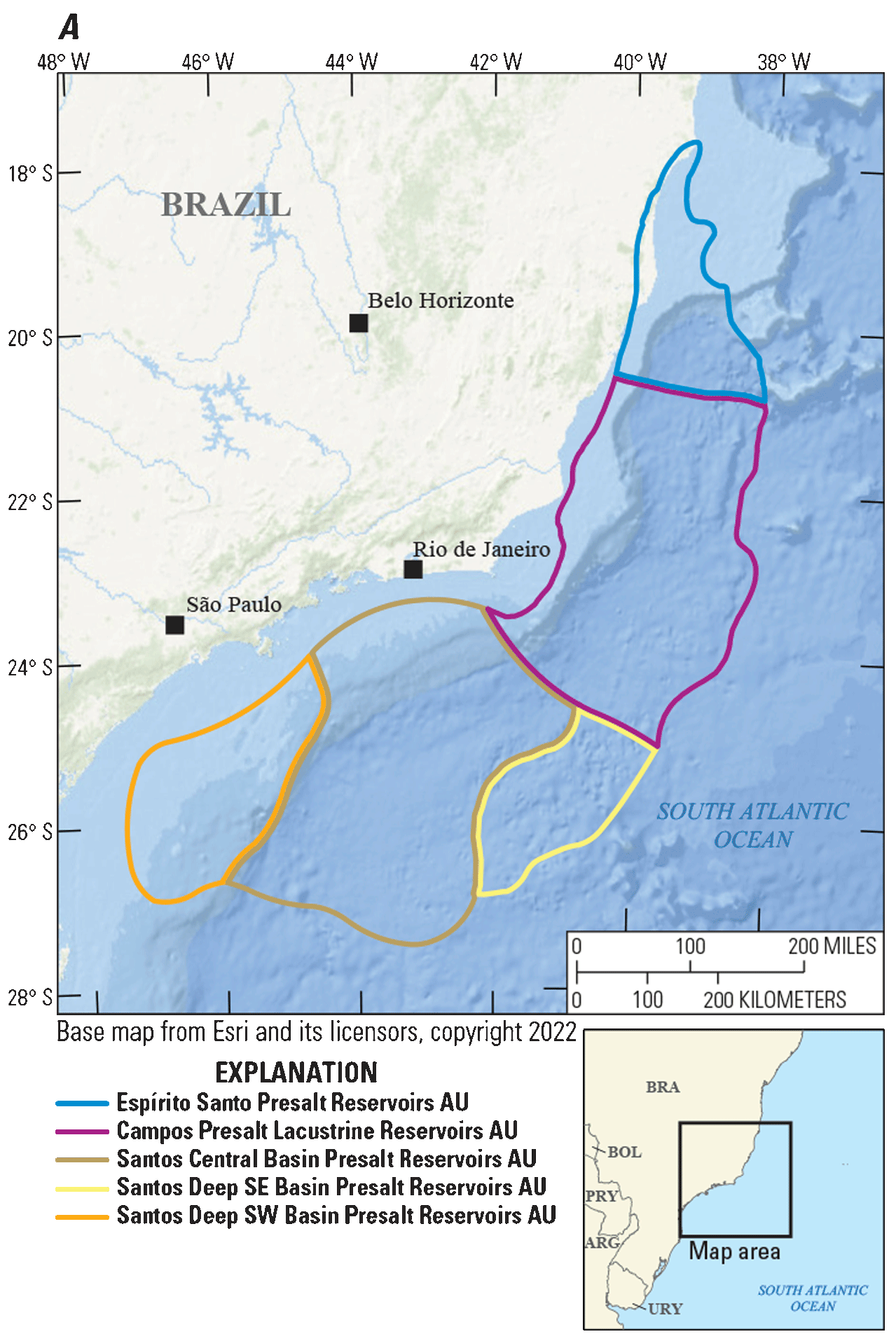
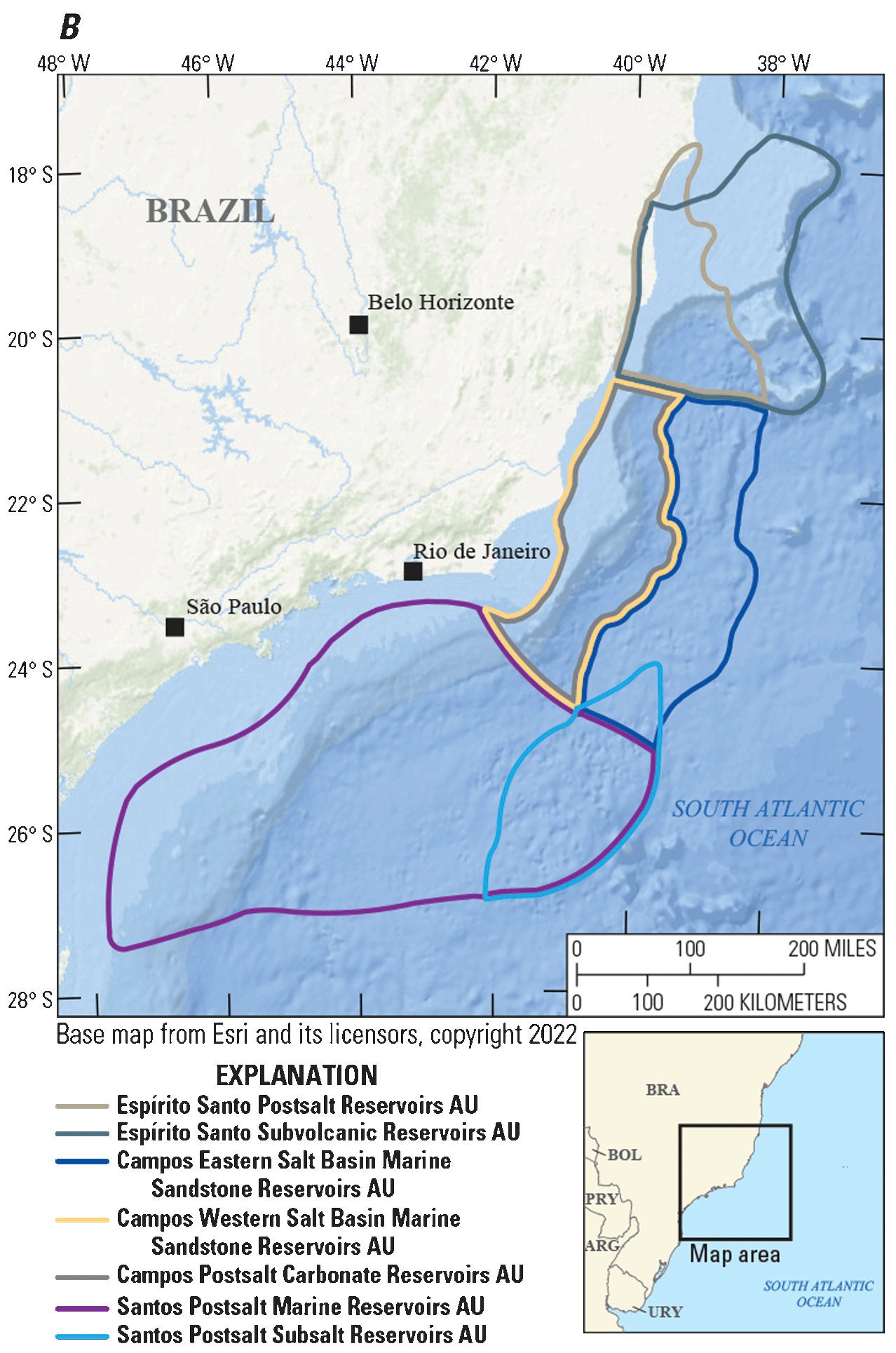
Maps showing the location of (A) five conventional assessment units (AUs) in the presalt section and (B) seven conventional AUs in the postsalt section of the Santos Basin, Campos Basin, and Espírito Santo Basin provinces of Brazil.
Total Petroleum System and Assessment Units
The Mesozoic Composite Total Petroleum System (TPS) was defined for this assessment to encompass oil and gas generated from organic-rich Aptian presalt lacustrine source rocks and postsalt Albian to Turonian marine mudstones. Presalt lower Aptian lacustrine mudstones are generally interpreted as the major source rocks in the three provinces and consist of Type I organic matter, have total organic carbon (TOC) values as much as 10 weight percent (wt. pct.), have hydrogen indices (HI) as much as 900 milligrams of hydrocarbon per gram of TOC (mg HC/g TOC), and are as much as 300 m thick (Guardado and others, 2000; Buckley and others, 2015; Sabato Ceraldi and Green, 2017; Farias and others, 2019; Oliveira and others, 2019; Mello and others, 2021; Freitas and others, 2022; Fragoso and others, 2023; Terra and others, 2023; Carvalho Antunes and others, 2024). Burial-history modeling has indicated that presalt source rocks in the Santos and Campos Basins are in the thermal generative windows for oil and gas (Cole, 2021).
Albian to Turonian mudstones have been cited as possible postsalt source rocks related to deep-marine marls deposited in basins adjacent to carbonate platforms, and possibly to deposition of shales during Late Cretaceous oceanic anoxic events (Venancio and others, 2022). These potential source rocks contain Type II marine organic matter, have TOC values as much as 8 wt. pct., have HI values as much as 700 mg HC/g TOC, and are as much as 90 m thick (Contreras and others, 2010; Beglinger, Wees, and others, 2012; Delgado and others, 2018; Venancio and others, 2022).
The geologic model for the assessment of the three provinces is for oil and gas generated from presalt Aptian lacustrine mudstones to have migrated into presalt lacustrine reservoirs, mainly in structural traps, and then to have migrated, where salt was not present, into postsalt carbonate platform margin reservoirs and fluvial to deep-marine sandstone reservoirs. Oil and gas generated from Albian to Turonian shales migrated into postsalt sandstone and carbonate reservoirs.
Twelve assessment units (AUs) were defined within the Mesozoic Composite TPS in the three provinces (fig. 1A, B). The assessment input data for the AUs are summarized in table 1 and Schenk (2026).
Table 1.
Key input data for 12 conventional assessment units in the Santos Basin, Campos Basin, and Espírito Santo Basin provinces of Brazil.[Gray shading indicates not applicable. AU, assessment unit; MMBO, million barrels of oil; BCFG, billion cubic feet of gas]
Undiscovered Resources Summary
The USGS quantitatively assessed undiscovered, technically recoverable conventional oil and gas resources in 12 AUs in the Santos Basin, Campos Basin, and Espírito Santo Basin provinces of Brazil (table 2). The estimated mean resources are 10,381 million barrels of oil (MMBO), or 10.4 billion barrels of oil, with an F95 to F5 range from 2,814 to 24,965 MMBO; 53,289 billion cubic feet of gas (BCFG), or 53.3 trillion cubic feet of gas, with an F95 to F5 range from 12,137 to 133,055 BCFG; and 1,926 million barrels of natural gas liquids (MMBNGL), or 1.9 billion barrels of natural gas liquids, with an F95 to F5 range from 454 to 4,780 MMBNGL.
Table 2.
Results for 12 conventional assessment units in the Santos Basin, Campos Basin, and Espírito Santo Basin provinces of Brazil.[Gray shading indicates not applicable. Results shown are fully risked estimates. F95 represents a 95-percent chance of at least the amount tabulated; other fractiles are defined similarly. MMBO, million barrels of oil; BCFG, billion cubic feet of gas; NGL, natural gas liquids; MMBNGL, million barrels of natural gas liquids]
For More Information
Assessment results are also available at the USGS Energy Resources Program website, https://www.usgs.gov/programs/energy-resources-program.
References Cited
Alves, T.M., Fetter, M., Lima, C., Cartwright, J.A., Cosgrove, J., Gangá, A., Queiroz, C.L., and Strugale, M., 2017, An incomplete correlation between pre-salt topography, top reservoir erosion, and salt deformation in deep-water Santos Basin (SE Brazil): Marine and Petroleum Geology, v. 79, p. 300–320, accessed January 28, 2026, at https://doi.org/10.1016/j.marpetgeo.2016.10.015.
Amarante, F.B. do, Kuchle, J., Iacopini, D., Santos Scherer, C.M. dos, Santos Alvarenga, R. dos, Ene, P.L., and Schilling, A.B., 2020, Seismic tectono-stratigraphic analysis of the Aptian pre-salt marginal system of Espírito Santo Basin, Brazil: Journal of South American Earth Sciences, v. 98, article 102474, 16 p., accessed January 28, 2026, at https://doi.org/10.1016/j.jsames.2019.102474.
Beglinger, S.E., Doust, H., and Cloetingh, S., 2012, Relating petroleum system and play development to basin evolution—Brazilian South Atlantic margin: Petroleum Geoscience, v. 18, p. 315–336, accessed January 28, 2026, at https://doi.org/10.1144/1354-079311-022.
Beglinger, S.E., Wees, J.-D. van, Cloetingh, S., and Doust, H., 2012, Tectonic subsidence history and source-rock maturation in the Campos Basin, Brazil: Petroleum Geoscience, v. 18, p. 153–172, accessed January 28, 2026, at https://doi.org/10.1144/1354-079310-049.
Buckley, J.P., Bosence, D., and Elders, C., 2015, Tectonic setting and stratigraphic architecture of an Early Cretaceous lacustrine carbonate platform, Sugar Loaf High, Santos Basin, Brazil, in Bosence, D., Gibbons, K.A., Le Heron, D.P., Morgan, W.A., Pritchard, T., and Vining, B.A., eds., Microbial carbonates in space and time—Implications for global exploration and production: Geological Society of London Special Publication 418, p. 175–191, accessed January 28, 2026, at https://doi.org/10.1144/SP418.13.
Carvalho Antunes, R. de, Guerrero, J.C., and Jahnert, R.J., 2024, Coquina depositional model, Buzios field, Brazil: Marine and Petroleum Geology, v. 160, article 106607, 19 p., accessed January 28, 2026, at https://doi.org/10.1016/j.marpetgeo.2023.106607.
Cole, G., 2021, 3D Trinity thermal-burial history modeling results for the pre-salt petroleum system of the Campos-Santos Basins, Brazil: Global Petroleum Systems, 22 p., accessed January 28, 2026, at https://doi.org/10.13140/RG.2.2.32195.94247.
Contreras, J., Zühlke, R., Bowman, S., and Bechstädt, T., 2010, Seismic stratigraphy and subsidence analysis of the southern Brazilian margin (Campos, Santos, and Pelotas basins): Marine and Petroleum Geology, v. 27, no. 9, p. 1952–1980, accessed January 28, 2026, at https://doi.org/10.1016/j.marpetgeo.2010.06.007.
Davison, I., 2007, Geology and tectonics of the South Atlantic Brazilian salt basins, in Ries, A.C., Butler, R.W.H., and Graham, R.H., eds., Deformation of the continental crust—The legacy of Mike Coward: Geological Society of London Special Publication 272, p. 345–359, accessed January 28, 2026, at https://doi.org/10.1144/GSL.SP.2007.272.01.18.
Delgado, L., Batezelli, A., and Luna, J., 2018, Petroleum geochemical characterization of Albian–Oligocene sequences in the Campos Basin—“Case study: Eastern Marlim oilfield, offshore, Brazil”: Journal of South American Earth Sciences, v. 88, p. 715–735, accessed January 28, 2026, at https://doi.org/10.1016/j.jsames.2018.10.009.
Estrella, G., Mello, M.R., Gaglianone, P.C., Azevedo, R.L.M., Tsubone, K., Rossetti, E., Concha, J., and Brüning, I.M.R.A., 1984, The Espírito Santo Basin (Brazil) source rock characterization and petroleum habitat, in Demaison, G., and Murris, R.J., eds., Petroleum geochemistry and basin evaluation: AAPG Memoir 35, p. 253–271, accessed January 28, 2026, at https://doi.org/10.1306/M35439C15.
Farias, F., Szatmari, P., Bahniuk, A., and França, A.B., 2019, Evaporitic carbonates in the pre-salt of Santos Basin—Genesis and tectonic implications: Marine and Petroleum Geology, v. 105, p. 251–272, accessed January 28, 2026, at https://doi.org/10.1016/j.marpetgeo.2019.04.020.
Fragoso, D.G.C., Melo, A.H. de, Arienti Gonçalves, L., Brandão Bunevich, R., Aratanha Maia Araujo, J. de, Costa, T.C. da, Pedrosa, C.A., and Santos Scherer, C.M. dos, 2023, High-resolution sequence stratigraphy applied to reservoir characterization of the Brazilian Cretaceous pre-salt section, Campos Basin—Guidelines for geological modeling and reservoir management: Marine and Petroleum Geology, v. 151, article 106203, 25 p., accessed January 28, 2026, at https://doi.org/10.1016/j.marpetgeo.2023.106203.
Freitas, V.A. de, Santos Vital, J.C. dos, Rodriques, B.R., and Rodrigues, R., 2022, Source rock potential, main depocenters, and CO2 occurrence in the pre-salt section of Santos Basin, southeast Brazil: Journal of South American Earth Sciences, v. 115, article 103760, 23 p., accessed January 28, 2026, at https://doi.org/10.1016/j.jsames.2022.103760.
Guardado, L.R., Spadini, A.R., Brandão, J.S.L., and Mello, M.R., 2000, Petroleum system of the Campos Basin, Brazil, chap. 22 of Mello, M.R., and Katz, B.J., eds., Petroleum systems of south Atlantic margins: AAPG Memoir 73, p. 317–324, accessed January 28, 2026, at https://archives-datapages-com.usgslibrary.idm.oclc.org/data/specpubs/memoir73/m73ch22/images/m73ch22.pdf.
Mello, M.R., Peres, W., Rostirolla, S.P., Pedrosa, O.A., Jr., Piquet, A., Becker, S., and Yilmaz, P.O., 2021, The Santos Basin pre-salt super giant petroleum system—An incredible journey from failure to success, chap. 1 of Mello, M.R., Yilmaz, P.O., and Katz, B.J., eds., The supergiant Lower Cretaceous pre-salt petroleum systems of the Santos Basin, Brazil: AAPG Memoir 124, p. 1–34, accessed January 28, 2026, at https://doi.org/10.1306/13722313MSB.1.1853.
Oliveira, V.C.B. de, Assis Silva, C.M. de, Borghi, L.F., and Souza Carvalho, I. de, 2019, Lacustrine coquinas and hybrid deposits from rift phase—Pre-salt, Lower Cretaceous, Campos Basin, Brazil: Journal of South American Earth Sciences, v. 95, article 102254, 31 p., accessed January 28, 2026, at https://doi.org/10.1016/j.jsames.2019.102254.
Sabato Ceraldi, T., and Green, D., 2017, Evolution of the South Atlantic lacustrine deposits in response to Early Cretaceous rifting, subsidence, and lake hydrology, in Sabato Ceraldi, T., Hodgkinson, R.A., and Backe, G., eds., Petroleum geoscience of the west African margin: Geological Society of London Special Publication 438, p. 77–98, accessed January 28, 2026, at https://doi.org/10.1144/SP438.10.
Schenk, C.J., 2026, USGS National and Global Oil and Gas Assessment Project—Santos Basin, Campos Basin, and Espírito Santo Basin provinces of Brazil—Assessment unit boundaries, assessment input data, and fact sheet data tables: U.S. Geological Survey data release, https://doi.org/10.5066/P13LEA4F.
Terra, S.A., Silva, D.R.L. da, Ribeiro, A., and Borghi, L., 2023, The lower Barra Velha formation (Aptian) in the Atapu field, Santos Basin—Geological model for a pre-salt succession: Journal of South American Earth Sciences, v. 131, article 104589, accessed January 28, 2026, at https://doi.org/10.1016/j.jsames.2023.104589.
Venancio, I.M., Santos, T.P., Bione, F.R.A., Belem, A.L., Bernardes, M.C., Díaz, R.A., Moreira, M., Carreira, V., Spigolon, A., Souza, I.V., and Albuquerque, A.L.S., 2022, Preservation factors during Cretaceous oceanic anoxic events in the Espírito Santo Basin, southeast Brazil: Geosciences, v. 12, no. 10, 12 p., accessed January 28, 2026, at https://doi.org/10.3390/geosciences12100351.
Disclaimers
Any use of trade, firm, or product names is for descriptive purposes only and does not imply endorsement by the U.S. Government.
Although this information product, for the most part, is in the public domain, it also may contain copyrighted materials as noted in the text. Permission to reproduce copyrighted items must be secured from the copyright owner.
Suggested Citation
Schenk, C.J., Gelman, S.E., Hearon, J.S., Mercier, T.J., Le, P.A., Cicero, A.D., Johnson, B.G., Lagesse, J.H., and Leathers-Miller, H.M., 2026, Assessment of undiscovered conventional oil and gas resources in the Santos Basin, Campos Basin, and Espírito Santo Basin provinces of Brazil, 2024: U.S. Geological Survey Fact Sheet 2026–3062, 6 p., https://doi.org/10.3133/fs20263062.
ISSN: 2327-6932 (online)
Study Area
| Publication type | Report |
|---|---|
| Publication Subtype | USGS Numbered Series |
| Title | Assessment of undiscovered conventional oil and gas resources in the Santos Basin, Campos Basin, and Espírito Santo Basin provinces of Brazil, 2024 |
| Series title | Fact Sheet |
| Series number | 2026-3062 |
| DOI | 10.3133/fs20263062 |
| Publication Date | February 11, 2026 |
| Year Published | 2026 |
| Language | English |
| Publisher | U.S. Geological Survey |
| Publisher location | Reston VA |
| Contributing office(s) | Central Energy Resources Science Center |
| Description | Report: 6 p.; Data Release |
| Country | Brazil |
| Other Geospatial | Campos Basin, Espírito Santo Basin, Santos Basin |
| Online Only (Y/N) | Y |