


Assessment of Undiscovered Conventional Oil and Gas Resources of the Larsen Basin, Antarctica, 2025
Links
- Document: Report (2.83 MB pdf) , HTML , XML
- Data Release: USGS data release - USGS National and Global Oil and Gas Assessment Project—Larsen Basin, Antarctica—Assessment Unit Boundaries, Assessment Input Data, and Fact Sheet Data Tables
- NGMDB Index Page: National Geologic Map Database Index Page (html)
- Download citation as: RIS | Dublin Core
Abstract
Using a geology-based assessment methodology, the U.S. Geological Survey estimated undiscovered, technically recoverable mean conventional resources of 269 million barrels of oil and 14.3 trillion cubic feet of gas in the Larsen Basin, Antarctica.
Introduction
The U.S. Geological Survey (USGS) assessed potential volumes of undiscovered, technically recoverable conventional oil and gas resources in the Larsen Basin, Antarctica (fig. 1). The Larsen Basin is generally defined as the depositional area along the eastern margin of the northern part of the Antarctic Peninsula and is bounded to the north by Joinville Island, to the south by the Hollick-Kenyon Peninsula, to the east by the 3,000-meter Weddell Sea depth contour, and to the west by the faulted eastern margin of the Antarctic Peninsula (Macdonald and others, 1988; Valle and others, 1992; Sloan and others, 1995).
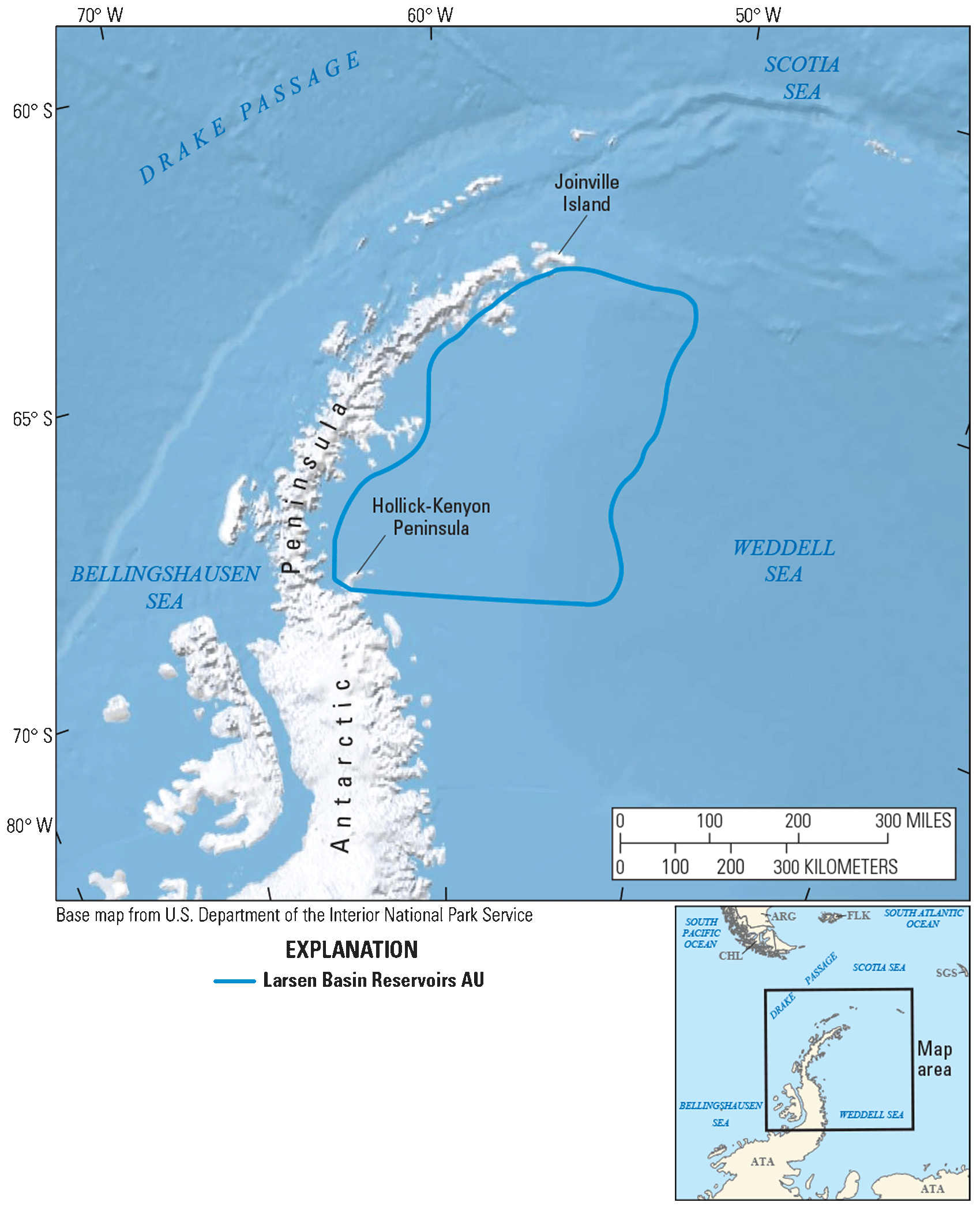
Map showing the location of one conventional assessment unit (AU) in the Larsen Basin, Antarctica.
The Larsen Basin developed during the complex fragmentation of southern Gondwana beginning in the early Mesozoic (Storey and Nell, 1988; Whitham and Doyle, 1989; Sloan and others, 1995; Storey and others, 1996; Hathway, 2000; Valle and Miller, 2001; Poblete and others, 2016; Jordan and others, 2020; Reguero and Goin, 2021). In the Late Triassic to Early Jurassic, thermal doming associated with a mantle plume resulted in regional west-to-east-trending rift basins that were largely filled with nonmarine synrift sediments. Middle Jurassic plume-sourced volcanic rocks were deposited in the rifts, similar to the volcanic rocks of the Tobífera Series in the then-adjacent Magallanes Basin in Patagonia (Farquharson, 1982; Jordan and others, 2020; Valle and others, 2024). Oblique southeast-directed subduction of proto-Pacific oceanic crust beneath western Antarctica set up a regional strike-slip fault system that resulted in the separation of eastern and western Antarctica, and in the differential movement of the mosaic of terranes that formed western Antarctica (Storey and Nell, 1988). As the terranes of western Antarctica separated, the evolving magmatic arc running the length of the Antarctic Peninsula placed the Larsen Basin in a backarc passive margin location. Late Triassic to Early Jurassic extension in the Larsen Basin may have been augmented by subduction rollback and the opening of the Weddell Sea in the Early Cretaceous (König and Jokat, 2006). Postrift thermal subsidence along the passive margin during the Late Jurassic to Early Cretaceous resulted in a regional transgression and deposition of nearshore marine sandstones of the Cape Framnes beds of the Gustav Group (Valle and Miller, 2001). The sandstones were succeeded by deep-water organic-rich mudstones of the Nordenskjöld Formation, similar to the transgressive sandstones of the Springhill Formation and organic-rich mudstones of the Rio Mayer Formation of the Magallanes Basin. From the Barremian to the Coniacian, conglomerates and sandstones derived from the Antarctic Peninsula magmatic arc bypassed the narrow-faulted shelf margin and were deposited in deep-water slope-channel, slope-apron, and basin-floor fan systems, forming potential reservoir rocks. The conglomerates and sandstones were encased in sealing mudstones and were in proximity to Nordenskjöld Formation source rocks. Arc uplift, possibly related to a change in the rate of proto-Pacific subduction, led to shallowing of the Larsen Basin from the Coniacian to the Eocene and to the progradation of multiple sequences of deltaic and nearshore marine sandstones of the Marambio Group and Seymour Island Group. Ridge subduction in the Eocene largely stopped subduction along much of the western margin of the Antarctic Peninsula, and erosion occurred throughout the region during the Neogene.
Total Petroleum System and Assessment Unit
The USGS defined the Mesozoic Composite Total Petroleum System in the Larsen Basin on the basis of published geochemical data. The most viable petroleum source rocks, according to outcrop data, are organic-bearing mudstones of the Kimmeridgian to Berriasian Nordenskjöld Formation (also known as the Ameghino Formation; Scasso and others, 1991), which crop out at several sites along the faulted western margin of the Larsen Basin (Macdonald and others, 1988; Whitham and Doyle, 1989; Scasso and others, 1991; Villar and others, 1993; Pirrie and Crame, 1995). Potential petroleum source rocks are radiolarian-bearing, siliceous, laminated, organic-bearing mudstones, interspersed with thin (less than 15 centimeters thick), light-colored, normally graded tuffaceous sandstone beds. The Nordenskjöld Formation mudstones contain Type II marine organic matter and minor Type III terrestrial organic matter, have total organic carbon (TOC) values as much as 3.5 weight percent, and have hydrogen index (HI) values as much as 300 milligrams of hydrocarbon per gram of TOC. The TOC and HI values may reflect a low level of thermal maturation of these rocks, which may have reduced the TOC and HI from original values. The gross thickness of Nordenskjöld Formation mudstones is unknown but is cited as a minimum of 550 meters (Macdonald and others, 1988) because the lower and upper contacts are not exposed. The proximal part of the Nordenskjöld Formation was subsequently deformed along the active faulted basin margin, resulting in eastward transport of slide blocks, clasts, and breccias of the sediments of the Nordenskjöld Formation, which were redeposited into Lower Cretaceous sediments (Ineson, 1989).
The USGS defined the Larsen Basin Reservoirs Assessment Unit (AU), which encompasses the entire Larsen Basin. The assumption in this study is that the Nordenskjöld Formation source rocks are present throughout the Larsen Basin, as assumed by Macdonald and others (1988). There are no exploration wells within the AU, so the geologic model for the assessment depends upon data from exposures along the eastern faulted margin of the Antarctic Peninsula (Macdonald and others, 1988). The geologic model for this assessment is for oil and gas generated from distal organic-rich Nordenskjöld Formation source rocks to have migrated into Lower Cretaceous deep-marine slope-channel, slope-apron, and basin-floor conglomerates and sandstones, and possibly into Upper Cretaceous deltaic to nearshore marine and shelf sandstone reservoirs. Trapping of oil in the deep-marine reservoirs is mainly stratigraphic because the conglomerates and sandstones are encased and sealed by mudstones. Reservoir quality may be degraded by the presence of labile volcanic rock fragments. Structural trapping is possible because of drapes over extensional structures and inversion structures that developed in the Late Cretaceous (Macdonald and others, 1988; Macdonald and Butterworth, 1990).
A one-dimensional burial-history model of a pseudowell was constructed for this study to gain insight into the thermal evolution of the Nordenskjöld Formation source rocks using the stratigraphy, lithologies, thickness, and age data from Macdonald and others (1988). The model results indicate that the Nordenskjöld Formation mudstones reached the level for thermal oil generation in the Early Cretaceous and thermogenic gas generation in the Late Cretaceous, but there is uncertainty in these results. As emphasized by Macdonald and others (1988), the geologic input data for a burial-history model in the Larsen Basin are uncertain, and in this study, model results reflect only a general indication of the level and extent of thermal maturity. Given that reasonable geologic input was used in the model, the results indicate that there are more potential gas resources than oil resources. Geologic risk was applied to the charge element of the total petroleum system, indicating that there is a 10-percent chance for the source rocks to be inadequate to produce an oil or gas accumulation of minimum size (5 million barrels of oil; 30 billion cubic feet) in the Larsen Basin. The assessment input data for the Larsen Basin Reservoirs AU are summarized in table 1 and Schenk (2026).
Undiscovered Resources Summary
The USGS quantitatively assessed undiscovered conventional oil, gas, and natural gas liquid resources in the Larsen Basin, Antarctica (table 2). The estimated mean resources are 269 million barrels of oil (MMBO), or 0.27 billion barrels of oil, with an F95 to F5 range from 0 to 591 MMBO; 14,257 billion cubic feet of gas (BCFG), or 14.3 trillion cubic feet of gas, with an F95 to F5 range from 0 to 37,804 BCFG; and 439 million barrels of natural gas liquids (MMBNGL), with an F95 to F5 range from 0 to 1,160 MMBNGL.
Table 2.
Results for one conventional assessment unit in the Larsen Basin, Antarctica.[Gray shading indicates not applicable. Results shown are fully risked estimates. F95 represents a 95-percent chance of at least the amount tabulated; other fractiles are defined similarly. MMBO, million barrels of oil; BCFG, billion cubic feet of gas; NGL, natural gas liquids; MMBNGL, million barrels of natural gas liquids]
For More Information
Assessment results are also available at the USGS Energy Resources Program website, https://www.usgs.gov/programs/energy-resources-program.
References Cited
Farquharson, G.W., 1982, Late Mesozoic sedimentation in the northern Antarctic Peninsula and its relationship to the southern Andes: Journal of the Geological Society [of London], v. 139, no. 6, p. 721–727, accessed August 6, 2025, at https://doi.org/10.1144/gsjgs.139.6.0721.
Hathway, B., 2000, Continental rift to back-arc basin—Jurassic–Cretaceous stratigraphical and structural evolution of the Larsen Basin, Antarctic Peninsula: Journal of the Geological Society [of London], v. 157, no. 2, p. 417–432, accessed August 6, 2025, at https://doi.org/10.1144/jgs.157.2.417.
Ineson, J.R., 1989, Coarse-grained submarine fan and slope apron deposits in a Cretaceous back-arc basin, Antarctica: Sedimentology, v. 36, no. 5, p. 793–819, accessed August 6, 2025, at https://doi.org/10.1111/j.1365-3091.1989.tb01747.x.
Jordan, T.A., Riley, T.R., and Siddoway, C.S., 2020, The geological history and evolution of West Antarctica: Nature Reviews Earth and Environment: v. 1, p. 117–133, accessed August 6, 2025, at https://doi.org/10.1038/s43017-019-0013-6.
König, M., and Jokat, W., 2006, The Mesozoic breakup of the Weddell Sea: Journal of Geophysical Research, Solid Earth, v. 111, no. B12, 28 p., accessed August 6, 2025, at https://doi.org/10.1029/2005JB004035.
Macdonald, D.I.M., Barker, P.F., Garrett, S.W., Ineson, J.R., Pirrie, D., Storey, B.C., Whitham, A.G., Kinghorn, R.R.F., and Marshall, J.E.A., 1988, A preliminary assessment of the hydrocarbon potential of the Larsen Basin, Antarctica: Marine and Petroleum Geology, v. 5, no. 1, p. 34–53, accessed August 6, 2025, at https://doi.org/10.1016/0264-8172(88)90038-4.
Macdonald, D.I.M., and Butterworth, P.J., 1990, The stratigraphy, setting and hydrocarbon potential of the Mesozoic sedimentary basins of the Antarctic Peninsula, chap. 8 of St. John, B., ed., Antarctica as an exploration frontier—Hydrocarbon potential, geology, and hazards: AAPG Studies in Geology, v. 31, p. 100–125, accessed August 6, 2025, at https://doi.org/10.1306/St31524C8.
Pirrie, D., and Crame, J.A., 1995, Late Jurassic paleogeography and anaerobic-dysaerobic sedimentation in the northern Antarctic Peninsula region: Journal of the Geological Society [of London], v. 152, no. 3, p. 469–480, accessed August 6, 2025, at https://doi.org/10.1144/gsjgs.152.3.0469.
Poblete, F., Roperch, P., Arriagada, C., Ruffet, G., Arellano, C.R. de, Hervé, F., and Poujol, M., 2016, Late Cretaceous–early Eocene counterclockwise rotation of the Fueguian Andes and evolution of the Patagonia-Antarctic Peninsula System: Tectonophysics, v. 668–669, p. 15–34, accessed August 6, 2025, at https://doi.org/10.1016/j.tecto.2015.11.025.
Reguero, M.A., and Goin, F.J., 2021, Paleogeography and biogeography of the Gondwanan final breakup and its terrestrial vertebrates—New insights from southern South America and the “double Noah’s ark” Antarctic Peninsula: Journal of South American Earth Sciences, v. 108, article 103358, 23 p., accessed August 6, 2025, at https://doi.org/10.1016/j.jsames.2021.103358.
Scasso, R.A., Grunenberg, T., and Bausch, W.M., 1991, Mineralogical and geochemical characterization of the Ameghino Formation mudstones (Upper Jurassic, Antarctic Peninsula) and its stratigraphical, diagenetical and paleoenvironmental meaning: Polarforschung, v. 59, no. 3, p. 179–198, accessed August 6, 2025, at https://core.ac.uk/download/pdf/11771237.pdf.
Schenk, C.J., 2026, USGS National and Global Oil and Gas Assessment Project—Larsen Basin, Antarctica—Assessment unit boundaries, assessment input data, and fact sheet data tables: U.S. Geological Survey data release, https://doi.org/10.5066/P14LT9DY.
Sloan, B.J., Lawver, L.A., and Anderson, J.B., 1995, Seismic stratigraphy of the Larsen Basin, Eastern Antarctic Peninsula: American Geophysical Union, Antarctic Research Series, Geology and Seismic Stratigraphy of the Antarctic Margin, v. 68, p. 59–74, accessed August 6, 2025, at https://doi.org/10.1029/AR068p0059.
Storey, B.C., and Nell, P.A.R., 1988, Role of strike-slip faulting in the tectonic evolution of the Antarctic Peninsula: Journal of the Geological Society [of London], v. 145, no. 2, p. 333–337, accessed August 6, 2025, at https://doi.org/10.1144/gsjgs.145.2.0333.
Storey, B.C., Vaughan, A.P.M., and Millar, I.L., 1996, Geodynamic evolution of the Antarctic Peninsula during Mesozoic times and its bearing on Weddell Sea history, in Storey, B.C., King, E.C., and Livermore, R.A., eds., Weddell Sea tectonics and Gondwana break-up: Geological Society of London Special Publication 108, p. 87–103, accessed August 6, 2025, at https://doi.org/10.1144/GSL.SP.1996.108.01.07.
Valle, R.A. del, Elliot, D.H., and Macdonald, D.I.M., 1992, Sedimentary basins on the east flank of the Antarctic Peninsula—Proposed nomenclature: Antarctic Science, v. 4, no. 4, p. 477–478, accessed August 6, 2025, at https://doi.org/10.1017/S0954102092000695.
Valle, R.A. del, and Miller, H., 2001, Transpressional deformation along the margin of Larsen Basin—New data from Pedersen Nunatak, Antarctic Peninsula: Antarctic Science, v. 13, no. 2, p. 158–166, accessed August 6, 2025, at https://doi.org/10.1017/S0954102001000244.
Valle, M.N., Paredes, J.M., Foix, N., and Pérez Frasette, M.J., 2024, Sedimentology and stratigraphic evolution of the early Cretaceous regressive cycle at the northern edge of the Austral-Magallanes Basin, Santa Cruz, Argentina: Journal of South American Earth Sciences, v. 135, article 104812, 27 p., accessed August 6, 2025, at https://doi.org/10.1016/j.jsames.2024.104812.
Villar, H.J., Scasso, R., Triguis, J.A., and Mello, M.R., 1993, Geochemical evaluation of mudstones of the Ameghino Formation (Upper Jurassic-Larsen Basin–Antarctic Peninsula) considered as potential hydrocarbon source rocks, in Mello, M.R., and Trindade, L.A.F., eds., Third Latin American Congress on Organic Geochemistry, Manaus, Brazil, November 22–25, 1992, Extended abstracts: Latin American Association of Organic Geochemistry, p. 154–157.
Whitham, A.G., and Doyle, P., 1989, Stratigraphy of the Upper Jurassic–Lower Cretaceous Nordenskjöld Formation of eastern Graham Land, Antarctica: Journal of South American Earth Sciences, v. 2, no. 4, p. 371–384, accessed August 6, 2025, at https://doi.org/10.1016/0895-9811(89)90015-1.
Disclaimers
Any use of trade, firm, or product names is for descriptive purposes only and does not imply endorsement by the U.S. Government.
Although this information product, for the most part, is in the public domain, it also may contain copyrighted materials as noted in the text. Permission to reproduce copyrighted items must be secured from the copyright owner.
Suggested Citation
Schenk, C.J., Mercier, T.J., Pitman, J.K., Le, P.A., Cicero, A.D., Johnson, B.G., Lagesse, J.H., and Leathers-Miller, H.M., 2026, Assessment of undiscovered conventional oil and gas resources of the Larsen Basin, Antarctica, 2025: U.S. Geological Survey Fact Sheet 2026–3063, 4 p., https://doi.org/10.3133/fs20263063.
ISSN: 2327-6932 (online)
Study Area
| Publication type | Report |
|---|---|
| Publication Subtype | USGS Numbered Series |
| Title | Assessment of undiscovered conventional oil and gas resources of the Larsen Basin, Antarctica, 2025 |
| Series title | Fact Sheet |
| Series number | 2026-3063 |
| DOI | 10.3133/fs20263063 |
| Publication Date | February 25, 2026 |
| Year Published | 2026 |
| Language | English |
| Publisher | U.S. Geological Survey |
| Publisher location | Reston VA |
| Contributing office(s) | Central Energy Resources Science Center |
| Description | Report: 4 p.; Data Release |
| Other Geospatial | Antarctica, Larsen Basin |
| Online Only (Y/N) | Y |