


Critical Minerals in Zinc Ore—An Update on Earth Mapping Resources Initiative Research in the Boulder Batholith Region, Montana
Links
- Document: Report (8.15 MB pdf) , HTML , XML
- Version History: Version History (8.0 KB txt)
- NGMDB Index Page: National Geologic Map Database Index Page (html)
- Download citation as: RIS | Dublin Core
Plain Language Summary
U.S. Geological Survey research, in collaboration with Montana Technical University and Montana Bureau of Geology and Mines, is providing key critical mineral information that may have potential for critical mineral production of several mining districts in the Boulder Batholith region, to better understand the abundance and distribution of natural resources within this region. Continued research can be used to show the potential for previously undiscovered critical mineral resources in southwestern Montana and in other parts of the United States.
Introduction
Critical minerals are nonfuel minerals or mineral materials essential to the U.S. economy and (or) national security. Critical minerals supply chains are vulnerable to disruption, such as a change in trade relations, abrupt rise in demand, natural disaster, or other risks (Lederer and others, 2025). The U.S. Geological Survey (USGS) delivers scientific data and geologic mapping expertise to understand the distribution of U.S. critical minerals and informs decisions about national mineral production. In 2022, the Earth Mapping Resources Initiative (Earth MRI) of the USGS Mineral Resources Program and the National Cooperative Geologic Mapping Program began a study in southwestern Montana (fig. 1) to understand potential mineral resources. This region hosts the Boulder batholith, a region of granitic rock that hosts mineralization and historical mining operations throughout the region, as well as the potential for undiscovered mineral deposits. In particular, the Butte Mining District in southwestern Montana is a historically important site of copper production and was instrumental to the electrification of the Nation and is still actively producing mineral resources (Gammons and others, 2006). USGS research, in collaboration with Montana Technical University and Montana Bureau of Geology and Mines, is providing key information about potential critical minerals in several mining districts in the Boulder batholith region, to better understand the abundance and distribution of its natural resources. This fact sheet provides progress of recent USGS critical mineral zinc ore studies in southwestern Montana, illustrating how continued research can be used to show the potential for previously undiscovered critical mineral resources in southwestern Montana and in other parts of the United States.
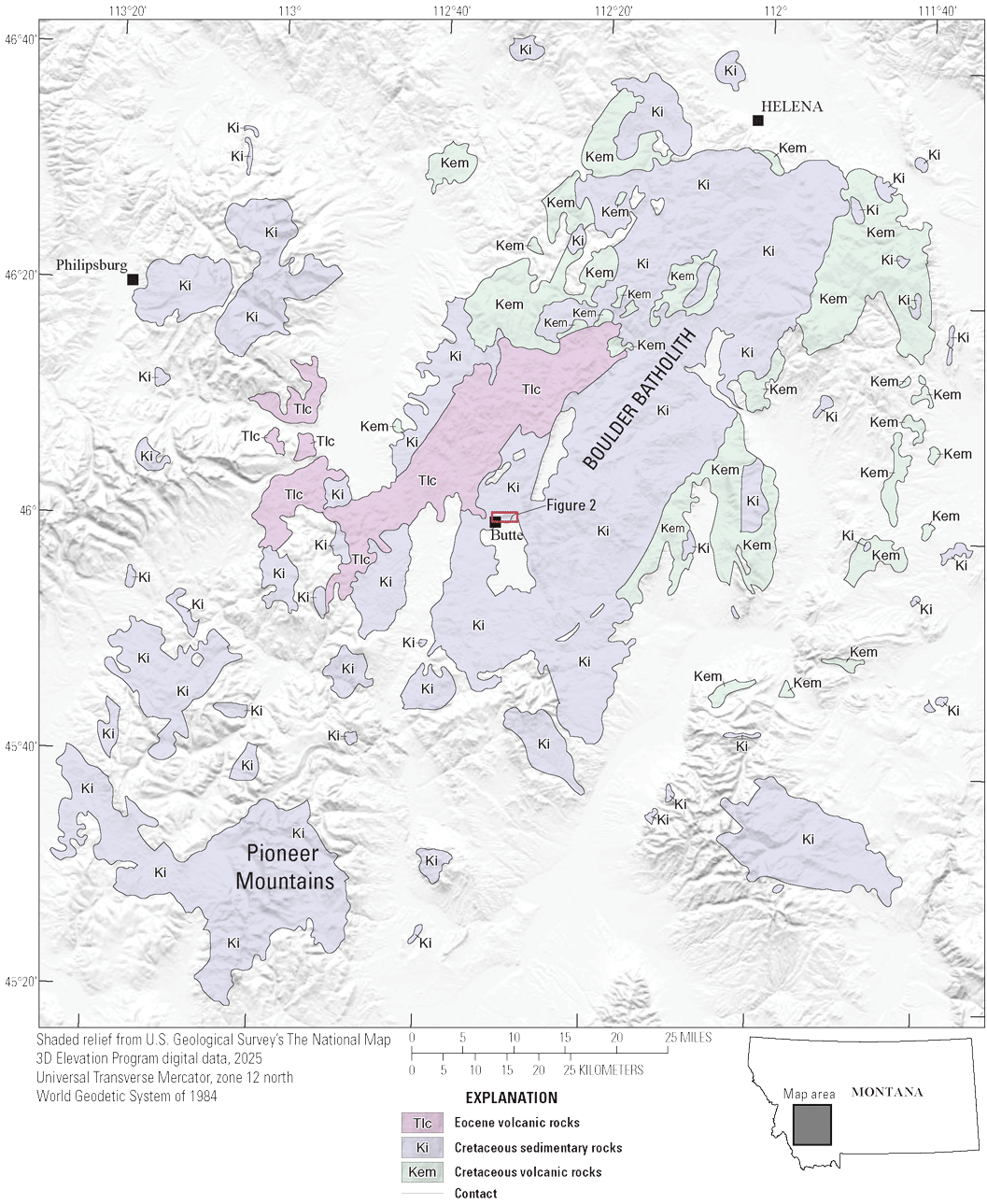
Simplified geologic map of southwestern Montana, showing the extent of the Cretaceous Boulder batholith, which is the host rock for a suite of ore deposits in the region. The Porphyry Copper Systems of the Boulder batholith project, an effort of the Mineral Resources Program and the National Cooperative Geologic Mapping Program of the U.S. Geological Survey, is currently (at the time this report was published) working on a suite of research efforts within the region to better understand the potential critical mineral resources in the area and using it to develop more sophisticated models for the formation of mineral deposits. The inset box shows the location of figure 2, which is the mineralized region of Butte Mining District that has produced copper (Cu), gold (Au), manganese (Mn), molybdenum (Mo), lead (Pb), silver (Ag), zinc (Zn), cadmium (Cd), bismuth (Bi), arsenic (As), selenium (Se), tellurium (Te) and sulfuric acid (H2SO4). The Philipsburg and Butte Mining Districts are located in the general vicinity of their namesake cities.
Mineral Deposits of the Butte Mining District, Southwestern Montana
The Butte Mining District, in southwestern Montana, has been mined for multiple types of ore for more than 135 years (Gammons and others, 2006). Initial mining focused first on placer gold and then on silver from lode veins in the western region of the Butte Mining District. In the late 1800s, copper was mined from lode veins; the large historic production of copper led to the Butte Mining District being commonly referred to as the “Richest Hill on Earth” (fig. 2). The district has also produced manganese, molybdenum, lead, zinc, cadmium, bismuth, arsenic, selenium, tellurium, and sulfuric acid (Anaconda Company Geological Department, 1971). More recent mining operations have focused on open pit operations, largely producing copper, molybdenum, gold, and silver. In addition to ore hosted in large lode veins, the Butte Mining District also hosts complicated vein networks extending across the district (fig. 2). These vein networks have been mined for a broad suite of minerals used to produce metal commodities, including argentite, bornite, chalcocite, chalcopyrite, enargite, galena, molybdenite, rhodochrosite, sphalerite, and tennantite.
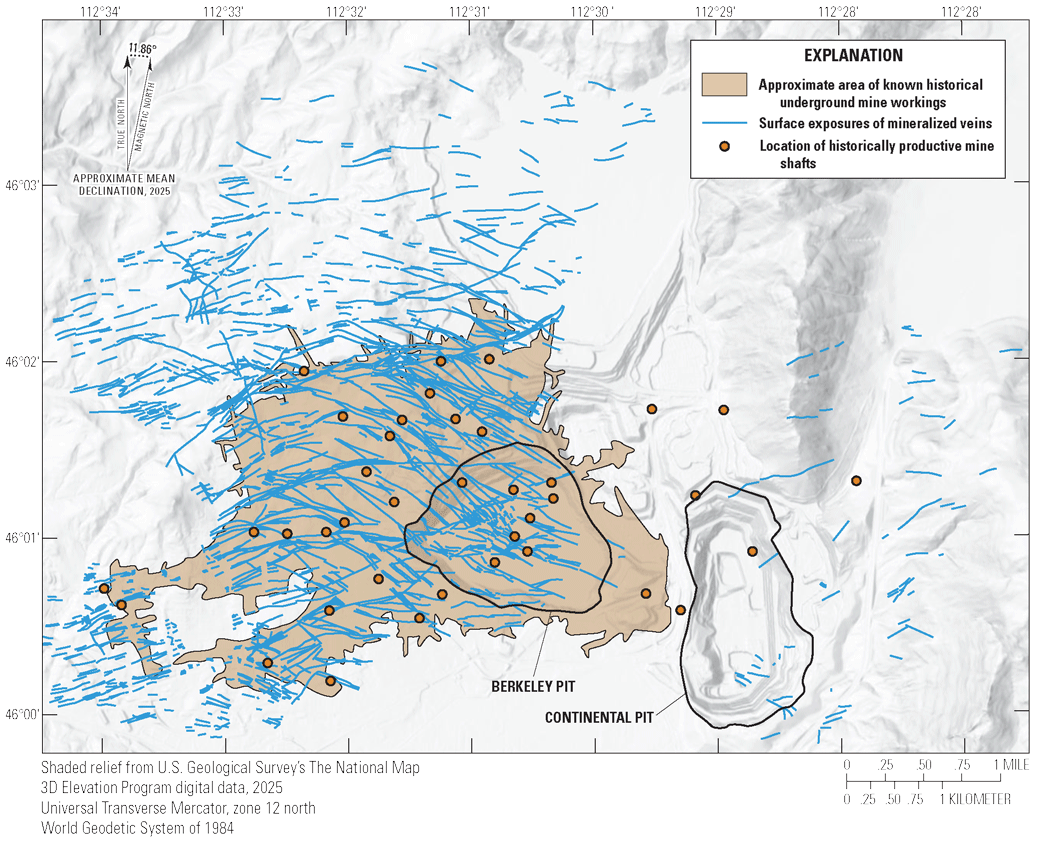
Generalized map of the Butte Mining District, southwestern Montana, highlighting the location of historical and active mining operations relative to the known locations of mineralized veins within the mining district. Mineralized veins are also present to the west of this map region and at depth. These veins are a major source of metals in the Butte Mining District, and many of the veins east, west, and north of the Berkeley pit were historically mined for lead, silver, and zinc. Map data from Houston and Dilles (2013).
The Butte Mining District has had mining operations since 1889, continues to support commercial mining, and likely has significant untapped mineral resources (Long and others, 2000). Mining in the area currently (at the time this report was published) recovers copper, molybdenum, and silver, with more than 4.9 billion tons of copper-molybdenum ore potential in the district (Houston and others, 2013). Beyond this potential from minerals underground, the area contains abundant mine waste left from previous production, present as tailings, overburden or waste rock. These mine waste materials may contain critical minerals that were not economically desirable or technologically feasible to extract at the time of mining but now hold potential for reprocessing and refinement. A better understanding of what metals can be found in the Butte Mining District and their mapped setting is crucial to evaluating the potential for critical minerals in the area from deposits or mine wastes, to inform any potential planning for potential future mineral production.
Zinc Ore and Critical Minerals
In addition to copper, the Butte Mining District produced zinc throughout most of the mining history from ore containing sphalerite (ZnS; fig. 3). Zinc is a critical mineral used in the production of galvanized metal to slow metal corrosion and has applications in the pharmaceutical and agricultural industries. Along with zinc and sulfur, sphalerite can also contain trace amounts of critical minerals, such as arsenic, gallium, germanium, indium, tellurium, tin, and tungsten, and when mined at scale, can produce enough of these elements to make a significant contribution to national demand. The United States relies on imported mineral supplies to serve as commodities in many diverse sectors of the economy. Understanding the critical mineral composition of sphalerite ore across the Butte Mining District is an essential step towards evaluating the potential of this resource and planning a resilient U.S. economy.
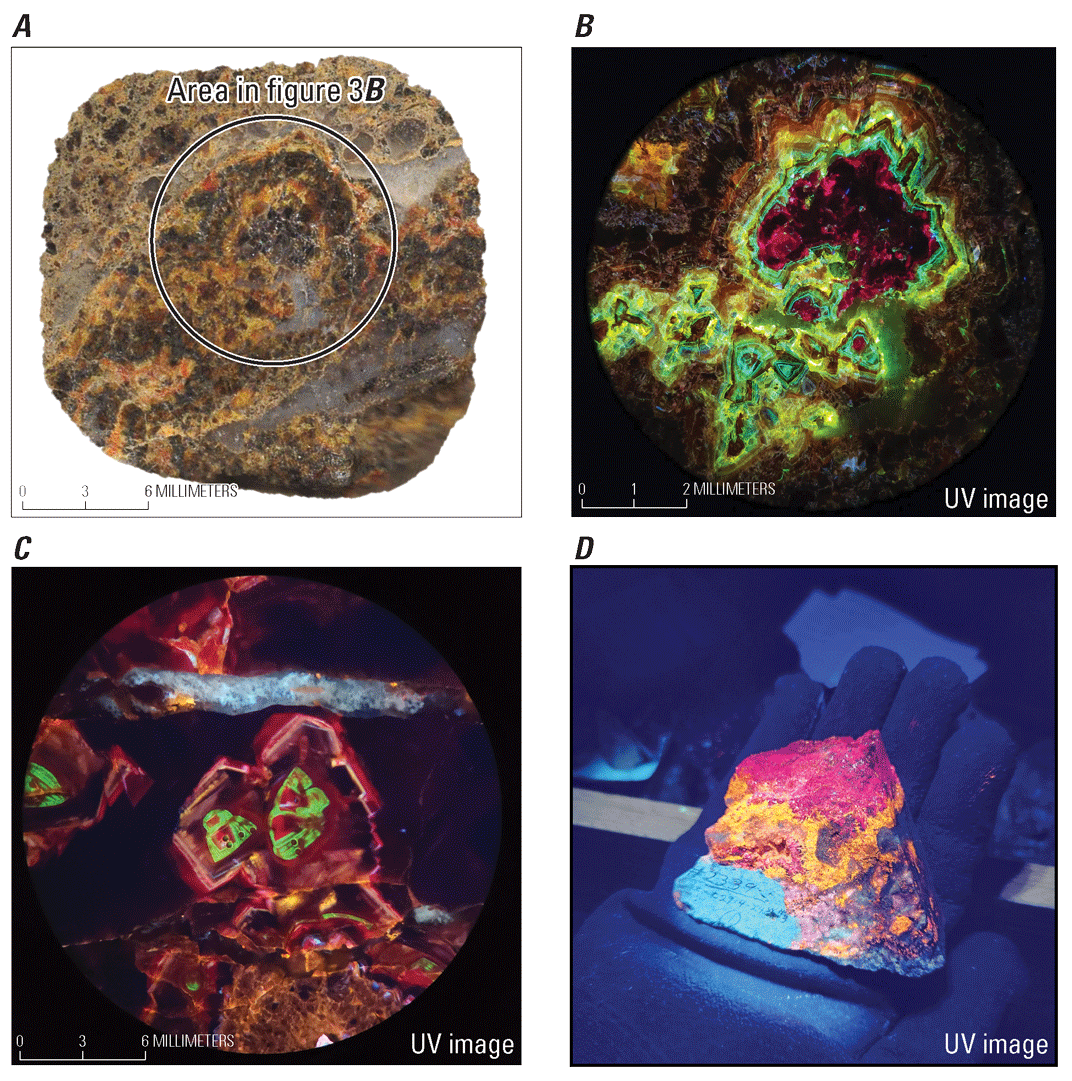
Images of sphalerite from the Butte Mining District showing the characteristics of zinc ore in both traditional lighting and ultraviolet (UV) lighting. Fluorescence of sphalerite in 365 nanometers of UV light is correlated with low iron and elevated contents of trace and critical elements, including gallium, indium and tungsten (Beaucamp and others, 2024; Eastman and others, 2025). Individual images are of A, polished mount of sphalerite from the Orphan Girl Mine, 1,500 feet level; B, UV imagery of the sample in panel A; C, UV-fluorescent sphalerite, Badger Mine, 200 feet level; D, hand sample of fluorescent sphalerite from the Leonard Mine, 2,900 feet level (gloved hand for scale).
Potential Critical Minerals in Sphalerite
-
• Arsenic has not been produced in the United States since 1985. Arsenic is a key ingredient of herbicides and insecticides, and it is important for agriculture (USGS, 2025).
-
• Gallium has not been recovered in the United States since 1987 but is an important semiconductor used in laser diodes, light-emitting diodes (LEDs), photodetectors, and solar cells (USGS, 2025).
-
• Some germanium is produced in the United States, but most is imported; it is used in fiber optics, solar cells, and satellite equipment (USGS, 2025).
-
• Production of indium has not been consistent in the United States, with none recovered in 2024; however, it is needed for production of liquid crystal displays (LCDs) (USGS, 2025).
-
• Tellurium is used in solar panels, thermoelectric devices, and metal alloys; however, there is limited U.S. production of this metal (USGS, 2025).
-
• The United States has not mined tin since 1993, but it is a key component in corrosion-resistant coatings and alloys (USGS, 2025).
-
• No tungsten has been produced in the United States since 2015, and it is an important component in wear-resistant equipment for construction, metalworking, mining, and oil- and gas-drilling industries (USGS, 2025).
Estimating the Critical Minerals in Butte, Montana, Zinc Ore
Recent research estimated the concentrations of critical minerals potentially present in sphalerite in a neighboring mining district in Philipsburg, Montana, (for example, Beaucamp and others, 2024; fig. 1 of this report) which is similar to sphalerite ore from the Butte Mining District. The same type and age of polymetallic veins are present in both the Butte and Philipsburg Mining Districts. Detailed mineralogical studies of both districts have led previous researchers to suggest they formed in similar ways and have comparable compositions (for example, Beaucamp and others, 2024; Eastman and others, 2025). Potential future USGS geochemical, geophysical, geochronological, and mapping studies are planned in collaboration with both State and industry partners to further understand the distribution and abundance of critical mineral resources in the district. A major focus of potential future work is to develop better understanding of how these systems form so models for the Butte Mining District can be applied to similar mineral systems in other parts of the United States. Estimates from 2000 suggest unmined ore at the Butte Mining District contains 2.44 million tons of zinc (Long and others, 2000). If average concentrations of critical elements in sphalerite crystals from the Philipsburg Mining District reported by Beaucamp and others (2024) represent those of ore from the Butte Mining District, the Butte Mining District unmined ore may contain approximately 650 tons of arsenic, 820 tons of gallium, 160 tons of germanium, 250 tons of indium, 3 tons of tellurium, 40 tons of tin, and 190 tons of tungsten. This level of byproduct production could meet the U.S. annual consumption for approximately 65 years for arsenic, 40 years for gallium, and more than 900 years of indium based on domestic annual consumption published in 2025 (U.S. Geological Survey, 2025). Given that many of these commodities are not currently (at the time this report was published) produced in the United States, refining byproduct metals from Butte sphalerite ore may be a way to strengthen U.S. supply chains.
Furthermore, because the Butte, Montana, region has a long history of mining, (for example, Gammons and others, 2006), it may be uniquely positioned to provide critical mineral resources in the United States. This area’s economic history allows for a wealth of technically experienced labor force and hosts both the Montana Bureau of Mines and Geology and the Montana Technological University, which could allow for rapid workforce development.
There are several important caveats to these estimates. First, potential metal commodities may not be effectively extracted from sphalerite for production; metallurgical studies are needed to determine how effectively they could be recovered. Next, the composition of sphalerites varies throughout the district due to mineralizing processes. As a result, critical minerals may not be evenly distributed throughout the district and specific critical minerals may be localized to specific regions of the vein networks. Finally, it is possible that the compositions of Butte sphalerites are different than those from neighboring districts (for example, Philipsburg, Montana). Despite these caveats, initial estimates are encouraging, and preliminary geochemical analyses indicate critical minerals are concentrated in sphalerite from the Butte Mining District (for example, Eastman and others, 2025). Potential future USGS work is planned in collaboration with both State and industry partners to further understand the distribution and abundance of critical mineral resources in the district. A major focus of this potential work is understanding how these systems formed so that models for the Butte Mining District can be applied to similar mineral systems in other parts of the United States.
In addition to defining the critical mineral potential of the underground resources, potential future work is also planned to better understand the potential for critical mineral resources in mine waste features in the Butte Mining District. The Butte Mining District produced 2.2 million tons of zinc since the 1860s, leaving potential critical mineral byproduct material in the mine waste (for example, Gammons and others, 2006). Understanding this potential is an ongoing research focus for Earth MRI. A potential future research direction would be to develop remote sensing methods to estimate the critical mineral potential of mine waste. The team has been working throughout the region using field-based radiometric scanners, which measure the potassium, thorium, and uranium composition, to map geologic features (Anderson and others, 2025). These three elements create a characteristic signature of either rocks, mine waste, or soil at the surface of the Earth. By combining this data with recently collected Earth MRI airborne radiometric mapping, it may be possible to assess the potential for critical minerals in mine wastes in the analyzed area.
Conclusions
Despite more than 135 years of mining and geological research in the Butte Mining District in southwestern Montana, there is still significant potential for the production of new critical minerals, particularly through targeting new minerals and using novel techniques. By investigating the formation and composition of critical mineral bearing ores, there is potential for the recognition of new critical mineral resources in this region of active and expanding mining operations. Ongoing research collaborations between the USGS, Montana Technological University, and Montana Bureau of Mines and Geology, alongside industry partners such as Montana Resources and Silver Bow Mining, Inc., are aimed at further understanding the potential distribution of critical minerals in sphalerite and in other ore minerals of the Butte Mining District. Finally, this work has the potential to not only contribute to the understanding of resources at the Butte Mining District but also in the surrounding mining districts and in similar U.S. mineral systems.
For More Information
For more information on the U.S. Geological Survey Porphyry Copper Systems of the Boulder batholith, Montana project and Northern Rocky Mountains Transect project, please visit https://www.usgs.gov/centers/gggsc/science/porphyry-copper-systems-boulder-batholith-montana and https://www.usgs.gov/programs/national-cooperative-geologic-mapping-program.
References Cited
Anderson, E.D., Scarberry, K.C., Eastman, K.A., Funk, J.A., Magnin, B.P., Clevenger, J., Dilles, J.H., Zimmerman, J.L., Attia, S., and Cosca, M.A., 2025, Airborne radiometric data map alteration of porphyry copper systems in the Elkhorn district, MT: Proceedings of the 18th SGA Biennial Meeting, v. 3, p. 1200−1203, accessed September 18, 2025, at https://www.e-sga.org/publications/conference-proceedings.
Beaucamp, C.M.E., Gammons, C.H., Thompson, J.M., and Lowers, H.A., 2024, Fluorescent sphalerite rich in tungsten, copper, gallium, silver, and other elements from Cordilleran-style, polymetallic veins of Philipsburg, Montana: Ore Geology Reviews, v. 173, 14 p., accessed May 13, 2025, at https://doi.org/10.1016/j.oregeorev.2024.106267.
Eastman, K.A., Gammons, C.H., Beaucamp, C., Thompson, J.M., and Lowers, H.A., 2025, Trace and critical elements in UV-fluorescent and non-fluorescent sphalerite from the Butte porphyry-lode deposit, Montana, USA: Proceedings of the 18th SGA Biennial Meeting, v. 2, p. 415–418, accessed September 18, 2025, at https://www.e-sga.org/publications/conference-proceedings.
Disclaimers
Any use of trade, firm, or product names is for descriptive purposes only and does not imply endorsement by the U.S. Government.
Although this information product, for the most part, is in the public domain, it also may contain copyrighted materials as noted in the text. Permission to reproduce copyrighted items must be secured from the copyright owner.
Suggested Citation
Gaynor, S.P., Anderson, E.D., Eastman, K.A., Lund, K., Gammons, C., Lowers, H., and Thompson, J., 2026, Critical minerals in zinc ore—An update on Earth Mapping Resources Initiative Research in the Boulder Batholith region (ver. 1.2, April 2026), Montana: U.S. Geological Survey Fact Sheet 2026–3064, 6 p., https://doi.org/10.3133/fs20263064.
ISSN: 2327-6932 (online)
Study Area
| Publication type | Report |
|---|---|
| Publication Subtype | USGS Numbered Series |
| Title | Critical minerals in zinc ore—An update on Earth Mapping Resources Initiative Research in the Boulder Batholith region, Montana |
| Series title | Fact Sheet |
| Series number | 2026-3064 |
| DOI | 10.3133/fs20263064 |
| Edition | Version 1.0: March 4, 2026; Version 1.1: March 5, 2026; Version 1.2: April 16, 2026 |
| Publication Date | March 04, 2026 |
| Year Published | 2026 |
| Language | English |
| Publisher | U.S. Geological Survey |
| Publisher location | Reston VA |
| Contributing office(s) | Geology, Geophysics, and Geochemistry Science Center |
| Description | 6 p. |
| Country | United States |
| State | Montana |
| Other Geospatial | Boulder Batholith region |
| Online Only (Y/N) | Y |