


Assessment of Undiscovered Conventional Oil and Gas Resources of South America and the Caribbean, 2025
Links
- Document: Report (9.61 MB pdf) , HTML , XML
- Data Release: USGS data release - USGS National and Global Oil and Gas Assessment Project—South America and Caribbean provinces—Assessment Unit Boundaries, Assessment Input Data, and Fact Sheet Data Tables
- Download citation as: RIS | Dublin Core
Abstract
Using a geology-based assessment methodology, the U.S. Geological Survey estimated undiscovered, technically recoverable mean conventional resources of 37.6 billion barrels of oil and 281.6 trillion cubic feet of gas in 31 geologic provinces of South America and the Caribbean.
Introduction
The U.S. Geological Survey (USGS) assessed the potential for undiscovered, technically recoverable conventional oil and gas resources within geologic provinces of South America and the Caribbean (fig. 1). Thirty-one priority geologic provinces were assessed in this study, representing a reassessment of South America and the Caribbean published in 2012 (Schenk and others, 2012). This report provides the assessment results by geologic province; province numbers and names are listed in table 1 and figure 1. The data and assessment results are also provided by total petroleum system (TPS) and assessment unit in the companion data release (Schenk, 2026).
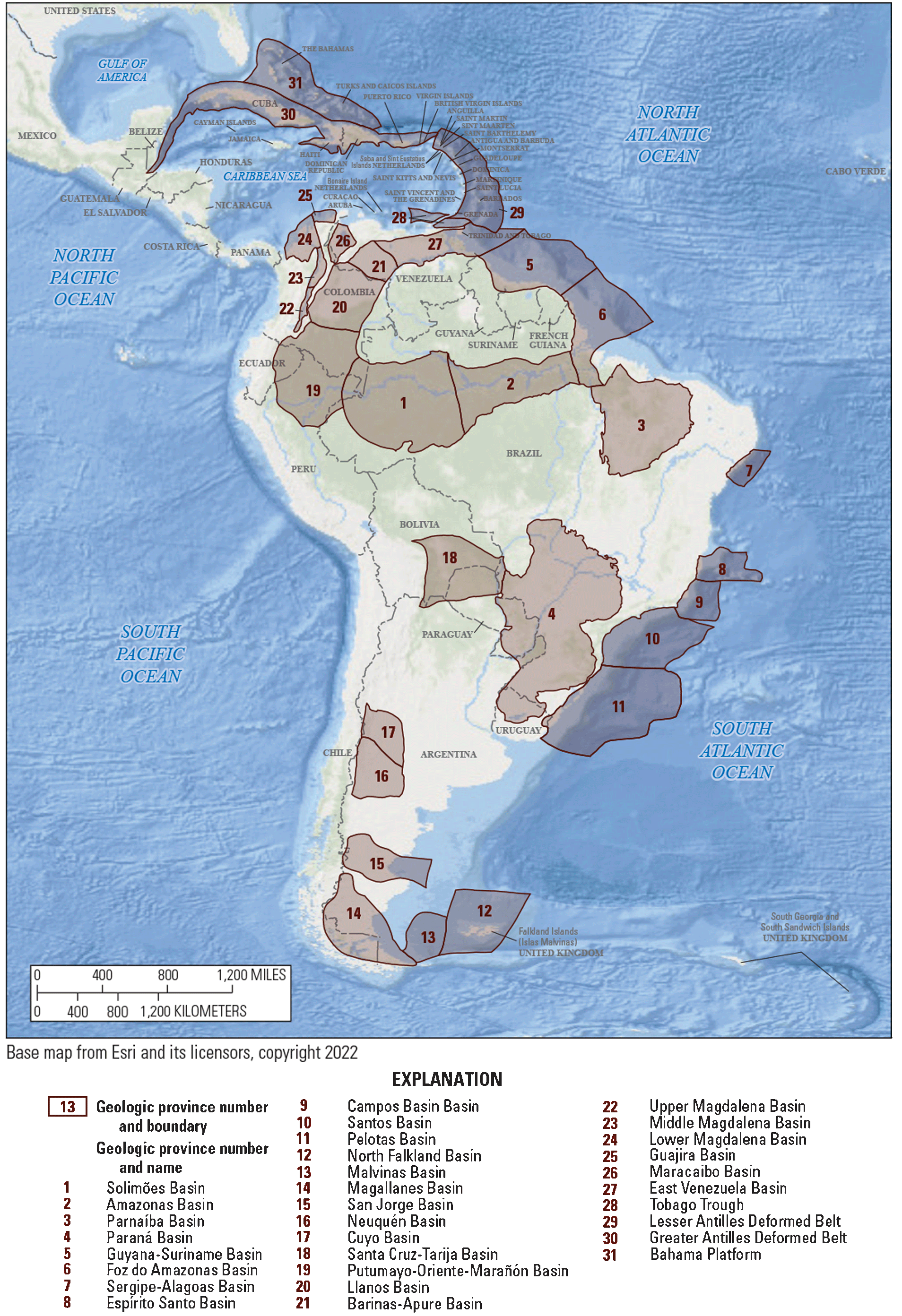
Map showing the locations of 31 geologic provinces in South America and the Caribbean.
Table 1.
Results for conventional oil and gas resources in 31 geologic provinces of South America and the Caribbean.[Results shown are fully risked estimates. F95 represents a 95-percent chance of at least the amount tabulated; other fractiles are defined similarly. MMBO, million barrels of oil; BCFG, billion cubic feet of gas; NGL, natural gas liquids; MMBNGL, million barrels of natural gas liquids]
Geologic Provinces and Total Petroleum Systems
The geologic provinces assessed in this study of South America and the Caribbean represent a spectrum of basin types and TPSs (Urien and others, 1995; Pindell and Kennan, 2009). For this report, the geologic provinces are grouped to illustrate the commonality of source rocks and timing of oil and gas generation by general tectonic setting.
The intracratonic rift-sag Solimões Basin, Amazonas Basin, Parnaíba Basin, and Paraná Basin Provinces contain Paleozoic TPSs defined mainly by Devonian marine organic-rich source rocks (Souza and others, 2021; Mussa and others, 2024). The Paraná Basin Province also contains oil shale source rocks (Martins and others, 2022). Thermal maturation of source rocks and the generation of oil and gas in these geologic provinces are related to the thermal effects of Permian, Triassic, and Early Cretaceous diabase sills and dikes rather than to thermal maturation as a function of burial. This atypical thermal maturation process resulted in spatial heterogeneity of thermal maturation, oil and gas generation, and distribution of oil and gas throughout these four geologic provinces.
The Guyana-Suriname Basin, Foz do Amazonas Basin, Sergipe-Alagoas Basin, Espírito Santo Basin, Campos Basin, Santos Basin, and Pelotas Basin Provinces are rifted, passive-margin basins that formed and evolved as South America separated from Africa in the latest Jurassic and Early Cretaceous, initially opening the South Atlantic Ocean, followed by opening of the central Atlantic Ocean. In these geologic provinces, TPSs are defined mainly by Lower Cretaceous synrift (presalt in the Espírito Santo Basin, Campos Basin, and Santos Basin Provinces) organic-rich lacustrine shales and postrift Cenomanian to Turonian passive-margin marine source rocks (Beglinger and others, 2012; Cedeño, Ohm, and others, 2021; Mello and others, 2021). Thermal maturation of synrift shales necessary to generate oil and gas resulted mainly from Cretaceous burial, and postrift shales were thermally matured by Oligocene to Pliocene burial.
The North Falkland Basin and Malvinas Basin Provinces within the southernmost part of South America reflect regional extension related to the Mesozoic fragmentation of southern Gondwana (Richards and others, 1996; Galeazzi, 1998; Jones and others, 2019). Late Jurassic to Early Cretaceous synrift lacustrine source rocks were thermally matured to generate oil and gas from the Late Cretaceous to Paleogene.
The TPSs of the Magallanes Basin, San Jorge Basin, Neuquén Basin, Cuyo Basin, Santa Cruz-Tarija Basin, Putumayo-Oriente-Marañón Basin, Llanos Basin, and Barinas-Apure Basin Provinces along the western part of South America in general reflect the effects of Andean compressive deformation associated with long-lived subduction of Pacific plates such as the Nazca Plate under cratonic South America. Progressive deformation formed the east-verging Andean fold and thrust belt and the adjacent foreland basins. In these geologic provinces, TPSs range in age from Late Paleozoic to Mesozoic (Fitzgerald and others, 1990; Moretti and others, 1996; Mora and others, 2019; Veiga and others, 2020; Mei and others, 2021). Thermal maturation of major Mesozoic source rocks for oil and gas generation is related to burial of source rocks in the thrust belts and adjacent foreland basins, and maturation ranges from Late Cretaceous to Neogene (Veiga and others, 2020; Spacapan and others, 2023).
The Upper Magdalena Basin, Middle Magdalena Basin, Lower Magdalena Basin, Guajira Basin, Maracaibo Basin, East Venezuela Basin, Tobago Trough, and Lesser Antilles Deformed Belt Provinces along the northern margin of South America reflect the complex eastward movement of the Caribbean Plate between North and South America (Pindell and Kennan, 2009). Oblique eastward collision of the Caribbean Plate with northern South America caused transpression and transtension beginning in the Eocene, and deformation continues at present to the east in offshore Trinidad. The major source rock in these geologic provinces is the Upper Cretaceous La Luna Formation and its stratigraphic equivalents, which were deposited as passive-margin organic-rich shales throughout northern South America (Gallango and Pamaud, 1995; Summa and others, 2003; Sarmiento and Rangel, 2004; Escalona and Mann, 2006; Osorno and Rangel, 2015; Ramirez and others, 2015; Carvajal-Arenas and others, 2020). Thermal maturation of shales in the La Luna began in the Eocene in the west and is younger to the east, and shales in Trinidad achieved thermal maturation by burial in the Pliocene to Pleistocene (Erlich and Barrett, 1992).
The Barbados Accretionary Complex of the Lesser Antilles Deformed Belt Province contains Upper Cretaceous La Luna-equivalent organic-rich source rocks (Hill and Schenk, 2005). The Upper Cretaceous source rocks are incorporated within the accretionary complex as the Atlantic Plate continues to subduct beneath the Caribbean Plate (Cedeño, Ahmed, and others, 2021). Thermal maturation most likely began in the Eocene and continues at present. The North Cuba Basin of the Greater Antilles Deformed Belt Province contains Upper Jurassic Oxfordian and Tithonian organic-rich source rocks that reflect proximity to the Gulf of America. The Upper Jurassic source rocks reached thermal maturity for oil generation by burial and foreland basin formation in the Late Cretaceous to Paleogene (Sá and others, 2024). The Bahama Platform Province, like the North Cuba Basin of the Greater Antilles Deformed Belt Province, is interpreted to contain Oxfordian and possibly Tithonian source rocks. Thermal maturation of oil and gas in the Bahama Platform Province is interpreted to have been in the Late Cretaceous to Paleogene (Schenk and others, 2025). The assessment results for the 31 geologic provinces are summarized in table 1 and Schenk (2026).
Undiscovered Resources Summary
The USGS quantitatively assessed undiscovered conventional oil and gas resources in 31 geologic provinces of South America and the Caribbean (table 1). The estimated mean resources are 37,584 million barrels of oil (MMBO), or 37.6 billion barrels of oil, with an F95 to F5 range from 10,160 to 88,819 MMBO; 281,610 billion cubic feet of gas (BCFG), or 281.6 trillion cubic feet of gas, with an F95 to F5 range from 77,604 to 656,338 BCFG; and 7,014 million barrels of natural gas liquids (MMBNGL), or 7.0 billion barrels of natural gas liquids, with an F95 to F5 range from 1,857 to 16,795 MMBNGL.
For More Information
Assessment results are also available at the USGS Energy Resources Program website, https://www.usgs.gov/programs/energy-resources-program.
References Cited
Beglinger, S.E., Doust, H., and Cloetingh, S., 2012, Relating petroleum system and play development to basin evolution—Brazilian South Atlantic margin: Petroleum Geoscience, v. 18, p. 315–336, accessed February 19, 2026, at https://doi.org/10.1144/1354-079311-022.
Carvajal-Arenas, L.C., Torrado, L., Mann, P., and English, J., 2020, Basin modeling of Late Cretaceous/Mio-Pliocene (.) petroleum system of the deep-water eastern Colombian Basin and South Caribbean Deformed Belt: Marine and Petroleum Geology, v. 121, article 104511, 27 p., accessed February 19, 2026, at https://doi.org/10.1016/j.marpetgeo.2020.104511.
Cedeño, A., Ahmed, M., Escalona, A., and Abrahamson, P., 2021, Tectono-stratigraphic evolution of the western Barbados accretionary prism and the eastern Tobago Basin—Implications for petroleum systems, chap. 20 of Bartolini, C., ed., South America–Caribbean–Central Atlantic plate boundary—Tectonic evolution, basin architecture, and petroleum systems: AAPG Memoir 123, p. 649–676, accessed February 19, 2026, at https://doi.org/10.1306/13692261M1233854.
Cedeño, A., Ohm, S., Escalona, A., Narain, E., and Jager, J. de, 2021, Source rocks in the Guyana Basin—Insights from geochemical investigation of 15 heavy oils from onshore Suriname, chap. 24 of Bartolini, C., ed., South America–Caribbean–Central Atlantic plate boundary—Tectonic evolution, basin architecture, and petroleum systems: AAPG Memoir 123, p. 749–776, accessed February 19, 2026, at https://doi.org/10.1306/13692312M1233854.
Erlich, R.N., and Barrett, S.F., 1992, Petroleum geology of the Eastern Venezuela Foreland Basin, in Macqueen, R.W., and Leckie, D.A., eds., Foreland basins and fold belts: AAPG Memoir 55, p. 341–362, accessed February 19, 2026, at https://doi.org/10.1306/M55563C13.
Escalona, A., and Mann, P., 2006, An overview of the petroleum system of Maracaibo Basin: AAPG Bulletin, v. 90, no. 4, p. 657–678, accessed February 20, 2026, at https://doi.org/10.1306/10140505038.
Fitzgerald, M.G., Mitchum, R.M., Jr., Uliana, M.A., and Biddle, K.T., 1990, Evolution of the San Jorge Basin, Argentina: AAPG Bulletin, v. 74, no. 6, p. 879–920, accessed February 20, 2026, at https://doi.org/10.1306/0C9B23C1-1710-11D7-8645000102C1865D.
Galeazzi, J.S., 1998, Structural and stratigraphic evolution of the western Malvinas Basin, Argentina: AAPG Bulletin, v. 82, no. 4, p. 596–636, accessed February 20, 2026, at https://doi.org/10.1306/1D9BC5C5-172D-11D7-8645000102C1865D.
Gallango, O., and Pamaud, F., 1995, Two-dimensional computer modeling of oil generation and migration in a transect of the Eastern Venezuela Basin, in Tankard, A.J., Suárez Soruco, R., and Welsink, H.J., eds., Petroleum basins of South America: AAPG Memoir 62, p. 727–740, accessed February 19, 2026, at https://doi.org/10.1306/M62593C39.
Hill, R.J., and Schenk, C.J., 2005, Petroleum geochemistry of oil and gas from Barbados—Implications for distribution of Cretaceous source rocks and regional petroleum prospectivity: Marine and Petroleum Geology, v. 22, no. 8, p. 917–943, accessed February 19, 2026, at https://doi.org/10.1016/j.marpetgeo.2005.05.003.
Jones, D.J.R., McCarthy, D.J., and Dodd, T.J.H., 2019, Tectonostratigraphy and the petroleum systems in the northern sector of the North Falkland Basin, South Atlantic: Marine and Petroleum Geology, v. 103, p. 150–162, accessed February 19, 2026, at https://doi.org/10.1016/j.marpetgeo.2019.02.020.
Martins, C.M.S., Cerqueira, J.R., Celino, J.J., Severiano Ribeiro, H.J.P., Garcia, K.S., Oliveira, O.M.C. de, and Souza Queiroz, A.F.de, 2022, Burial history and thermal maturity of the atypical petroleum system of the Paraná Basin (Irati and Ponta Grossa Formations), Brazil: Journal of South American Earth Sciences, v. 120, article 104087, 16 p., accessed February 19, 2026, at https://doi.org/10.1016/j.jsames.2022.104087.
Mei, M., Burnham, A.K., Schoellkopf, N., Wendebourg, J., and Gelin, F., 2021, Modeling petroleum generation, retention, and expulsion from the Vaca Muerta Formation, Neuquén Basin, Argentina—Part 1. Integrating compositional kinetics and basin modeling: Marine and Petroleum Geology, v. 123, article 104743, 14 p., accessed February 19, 2026, at https://doi.org/10.1016/j.marpetgeo.2020.104743.
Mello, M.R., Peres, W., Rostirolla, S.P., Pedrosa, O.A., Jr., Piquet, A., Becker, S., and Yilmaz, P.O., 2021, The Santos Basin pre-salt super giant petroleum system—An incredible journey from failure to success, chap. 1 of Mello, M.R., Yilmaz, P.O., and Katz, B.J., eds., The supergiant Lower Cretaceous pre-salt petroleum systems of the Santos Basin, Brazil: AAPG Memoir 124, p. 1–33, accessed February 19, 2026, at https://doi.org/10.1306/13722313MSB.1.1853.
Mora, A., García-Bautista, D.F., Reyes-Harker, A., Parra, M., Blanco, V., Sánchez, N., Parra, F. de la, Caballero, V., Rodriguez, G., Ruiz, C., Naranjo, J., Tesón, E., Niño, F., Quintero, I., Moreno, N., Cardozo, E., Gamba, N., Horton, B.K., and Arias-Martinez, J.P., 2019, Tectonic evolution of petroleum systems within the onshore Llanos Basin—Insights on the presence of Orinoco heavy oil analogs in Colombia and a comparison with other heavy oil provinces worldwide: AAPG Bulletin, v. 103, no. 5, p. 1179–1224, accessed February 19, 2026, at https://doi.org/10.1306/1003181611417236.
Moretti, I., Baby, P., Mendez, E., and Zubieta, D., 1996, Hydrocarbon generation in relation to thrusting in the sub Andean zone from 18 to 22 degrees S, Bolivia: Petroleum Geoscience, v. 2, no. 1, p. 17–28, accessed February 19, 2026, at https://doi.org/10.1144/petgeo.2.1.17.
Mussa, A., Kalkreuth, W., Mizusaki, A.M.P., and Silva, T.F. da, 2024, Geochemistry and petrography of shales from Brazilian Paleozoic basins—An example of the Parnaíba Basin, Devonian Pimenteiras Formation—A review: Marine and Petroleum Geology, v. 160, article 106640, 16 p., accessed February 19, 2026, at https://doi.org/10.1016/j.marpetgeo.2023.106640.
Osorno, J., and Rangel, A., 2015, Geochemical assessment and petroleum systems in the Sinú-San Jacinto Basin, northwestern Colombia: Marine and Petroleum Geology, v. 65, p. 217–231, accessed February 19, 2026, at https://doi.org/10.1016/j.marpetgeo.2015.03.022.
Pindell, J.L., and Kennan, L., 2009, Tectonic evolution of the Gulf of Mexico, Caribbean and northern South America in the mantle reference frame—An update, in James, K.H., Lorente, M.A., and Pindell, J.L., eds., The origin and evolution of the Caribbean plate: Geological Society of London Special Publication 328, p. 1–55, accessed February 19, 2026, at https://doi.org/10.1144/SP328.1.
Ramirez, V., Vargas, L.S., Rubio, C., Nino, H., and Mantilla, O., 2015, Petroleum systems of the Guajira Basin, northern Colombia, chap. 15 of Bartolini, C., and Mann, P., eds., Petroleum geology and potential of the Colombian Caribbean margin: AAPG Memoir 108, p. 399–430, accessed February 20, 2026, at https://doi.org/10.1306/13531944M1083647.
Richards, P.C., Gatliff, R.W., Quinn, M.F., Fannin, N.G.T., and Williamson, J.P., 1996, The geological evolution of the Falkland Islands continental shelf, in Storey, B.C., King, E.C., and Livermore, R.A., eds., Weddell Sea tectonics and Gondwana break-up: Geological Society of London Special Publication 108, p. 105–128, accessed February 19, 2026, at https://doi.org/10.1144/GSL.SP.1996.108.01.08.
Sá, A.O.de, Leroy, S., d’Acremont, E., Lafuerza, S., Granja-Bruña, J.-L., Moreno, B., Cabiativa Pico, V., and Letouzey, J., 2024, The protracted evolution of a plate boundary—Eastern Cuba block and Old Bahamas Channel: Geochemistry, Geophysics, Geosystems, v. 25, no. 5, article e2023GC011230, 28 p., accessed February 19, 2026, at https://doi.org/10.1029/2023GC011230.
Sarmiento, L.F., and Rangel, A., 2004, Petroleum systems of the upper Magdalena Valley, Colombia: Marine and Petroleum Geology, v. 21, no. 3, p. 373–391, accessed February 19, 2026, at https://doi.org/10.1016/j.marpetgeo.2003.11.019.
Schenk, C.J., 2026, USGS National and Global Oil and Gas Assessment Project—South America and Caribbean provinces—Assessment unit boundaries, assessment input data, and fact sheet data tables: U.S. Geological Survey data release, https://doi.org/10.5066/P1MI2FYG.
Schenk, C.J., Brownfield, M.E., Charpentier, R.R., Cook, T.A., Klett, T.R., Kirschbaum, M.A., Pitman, J.K., Pollastro, R.M., and Tennyson, M.E., 2012, Assessment of undiscovered conventional oil and gas resources of South America and the Caribbean, 2012: U.S. Geological Survey Fact Sheet 2012–3046, 3 p., accessed February 19, 2026, at https://doi.org/10.3133/fs20123046.
Schenk, C.J., Mercier, T.J., Le, P.A., Cicero, A.D., Drake, R.M., II, Gelman, S.E., Hearon, J.S., Johnson, B.G., Lagesse, J.H., Leathers-Miller, H.M., and Timm, K.K., 2025, Assessment of undiscovered conventional oil and gas resources in the North Cuba area, 2024: U.S. Geological Survey Fact Sheet 2025–3029, 4 p., accessed February 19, 2026, at https://doi.org/10.3133/fs20253029.
Souza, I.M.S., Cerqueira, J.R., Garcia, K.S., Severiano Ribeiro, H.J.P., Oliveira, O.M.C. de, Souza Queiroz, A.F.de, and Teixeira, L.S.G., 2021, Geochemical characterization and origin of kerogens from source-rock of Devonian in the Amazonas Basin, Brazil: Journal of South American Earth Sciences, v. 111, article 103437, 13 p., accessed February 19, 2026, at https://doi.org/10.1016/j.jsames.2021.103437.
Spacapan, J., Brisson, I., Comerio, M., Giampaoli, P., Pineda, J.A., and Benedetto, M. di, 2023, Petroleum system modeling in complex tectonic setting; a study case of the Huallaga-Marañon retroforeland basin system, Peru: Marine and Petroleum Geology, v. 154, article 106326, 24 p., accessed February 19, 2026, at https://doi.org/10.1016/j.marpetgeo.2023.106326.
Summa, L.L., Goodman, E.D., Richardson, M., Norton, I.O., and Green, A.R., 2003, Hydrocarbon systems of northeastern Venezuela—Plate through molecular scale-analysis of the genesis and evolution of the Eastern Venezuela Basin: Marine and Petroleum Geology, v. 20, nos. 3–4, p. 323–349, accessed February 19, 2026, at https://doi.org/10.1016/S0264-8172(03)00040-0.
Urien, C.M., Zambrano, J.J., and Yrigoven, M.R., 1995, Petroleum basins of southern South America—An overview, in Tankard, A.J., Suárez Soruco, R., and Welsink, H.J., eds., Petroleum basins of South America: AAPG Memoir 62, p. 63–77, accessed February 19, 2026, at https://doi.org/10.1306/M62593C3.
Veiga, R.D., Vergani, G.D., Brissón, I.E., Macellari, C.E., and Leanza, H.A., 2020, The Neuquén Super Basin: AAPG Bulletin, v. 104, no. 12, p. 2521–2555, accessed February 19, 2026, at https://doi.org/10.1306/09092020023.
Disclaimers
Any use of trade, firm, or product names is for descriptive purposes only and does not imply endorsement by the U.S. Government.
Although this information product, for the most part, is in the public domain, it also may contain copyrighted materials as noted in the text. Permission to reproduce copyrighted items must be secured from the copyright owner.
Suggested Citation
Schenk, C.J., Mercier, T.J., Le, P.A., Cicero, A.D., Gelman, S.E., Hearon, J.S., Johnson, B.G., Lagesse, J.H., and Leathers-Miller, H.M., 2026, Assessment of undiscovered conventional oil and gas resources of South America and the Caribbean, 2025: U.S. Geological Survey Fact Sheet 2026–3066, 4 p., https://doi.org/10.3133/fs20263066.
ISSN: 2327-6932 (online)
Study Area
| Publication type | Report |
|---|---|
| Publication Subtype | USGS Numbered Series |
| Title | Assessment of undiscovered conventional oil and gas resources of South America and the Caribbean, 2025 |
| Series title | Fact Sheet |
| Series number | 2026-3066 |
| DOI | 10.3133/fs20263066 |
| Publication Date | March 11, 2026 |
| Year Published | 2026 |
| Language | English |
| Publisher | U.S. Geological Survey |
| Publisher location | Reston, VA |
| Contributing office(s) | Central Energy Resources Science Center |
| Description | Report: 4 p.; Data Release |
| Other Geospatial | Caribbean, South America |
| Online Only (Y/N) | Y |