


System Characterization Report on Resourcesat-2A Linear Imaging Self Scanning-4 Sensor
Links
- Document: Report (2.5 MB pdf) , HTML , XML
- Larger Work: This publication is Chapter U of System characterization of Earth observation sensors
- Download citation as: RIS | Dublin Core
Executive Summary
This report documents the system characterization of the Indian Space Research Organisation Resourcesat-2A Linear Imaging Self Scanning-4 (LISS–4) sensor. It is part of a series of system characterization reports produced by the U.S. Geological Survey Earth Resources Observation and Science Cal/Val Center of Excellence. These reports describe the methodology and procedures used for characterization, present technical and operational information about the specific sensing system being evaluated, and provide a summary of test measurements, data retention practices, data analysis results, and conclusions.
Resourcesat-2A was launched in 2016 on the Polar Satellite Launch Vehicle-C36; it is identical to Resourcesat-2, and together, they decrease imaging revisit time from 5 days to 2–3 days, providing data continuity and improved temporal resolution. Resouresat-2 and 2A carry the Advanced Wide Field Sensor, Linear Imaging Self Scanning-3, and LISS–4 medium-resolution imaging sensors, continuing the legacy of the Indian Space Research Organisation’s Indian Remote Sensing-1C/1D/P3 satellite programs. More information about the Indian Space Research Organisation’s satellites and sensors is available through the Joint Agency Commercial Imagery Evaluation Earth Observing Satellites Online Compendium at https://calval.cr.usgs.gov/apps/compendium/ (Clauson and others, 2024) and from the manufacturer at https://www.isro.gov.in/.
The Earth Resources Observation and Science Cal/Val Center of Excellence system characterization team assessed the geometric, radiometric, and spatial performances of the Resourcesat-2A LISS–4 sensor. Geometric performance is divided into the interior geometric performance of band-to-band registration and the exterior geometric performance of geolocation accuracy. The interior geometric performance had mean offsets in the range of −0.118 to 0.024 pixel in easting and −0.053 to 0.022 pixel in northing with root mean square error values from 0.067 to 0.230 pixel in easting and from 0.087 to 0.2 pixel in northing. The exterior geometric performance had offsets in the range of 2.55 to 7.85 meters (m) in easting and −6.15 to 11.15 m in northing with root mean square error values in the range of 2.6 to 8.2 m in easting and 6.35 to 11.8 m in northing compared to the U.S. Department of Agriculture National Agriculture Imagery Program and WorldView-3 orthoimages. The measured radiometric performance had offsets from 0.003 to 0.024 and slopes from 0.736 to 0.952, and spatial performance was in the range of 1.633 to 1.903 pixels for the full width at half maximum with a modulation transfer function at a Nyquist frequency in the range of 0.0529 to 0.0952.
Reference Cited
Clauson, J, Cantrell, S., Vrabel, J., Oeding, J., Ranjitkar, B., Rusten, T., Ramaseri, S., and Casey, K., 2024, Earth Observing Sensing Satellites Online Compendium: U.S. Geological Survey digital data, accessed February 28, 2025, at https://calval.cr.usgs.gov/apps/compendium.
Introduction
This report documents the system characterization of the Indian Space Research Organisation Resourcesat-2A Linear Imaging Self Scanning-4 (LISS–4) sensor. It is part of a series of system characterization reports produced by the U.S. Geological Survey (USGS) Earth Resources Observation and Science Cal/Val Center of Excellence (ECCOE). These reports describe the methodology and procedures used for characterization, present technical and operational information about the specific sensing system being evaluated, and provide a summary of test measurements, data retention practices, data analysis results, and conclusions.
Resourcesat-2A was launched in 2016 on the Polar Satellite Launch Vehicle-C36; it is identical to Resourcesat-2, and together, they decrease imaging revisit time from 5 days to 2–3 days, providing data continuity and improved temporal resolution. Resouresat-2 and 2A carry the Advanced Wide Field Sensor, Linear Imaging Self Scanning-3, and LISS–4 medium-resolution imaging sensors, continuing the legacy of the Indian Space Research Organisation’s Indian Remote Sensing-1C/1D/P3 satellite programs. More information about the Indian Space Research Organisation’s satellites and sensors is available through the Joint Agency Commercial Imagery Evaluation Earth Observing Satellites Online Compendium at https://calval.cr.usgs.gov/apps/compendium/ (Clauson and others, 2024) and from the manufacturer at https://www.isro.gov.in/.
The Resourcesat-2A LISS–4 sensor is a wide-angle medium-resolution camera launched in 2016 that consists of three bands: green, red, and near infrared. The camera has a swath width of 74 kilometers in panchromatic, which enables LISS–4 to provide a 5-day repeat (using sensor tilt) capability. The primary objectives for data acquired by LISS–4 include vegetation and crop monitoring, forest mapping, land cover/land use mapping, change detection, and regional resource assessment.
The data analysis results provided in this report have been derived from Joint Agency Commercial Imagery Evaluation (JACIE) processes and procedures. JACIE was formed to leverage resources from several Federal agencies for the characterization of remote sensing data and to share those results across the remote sensing community. More information about JACIE is available at https://www.usgs.gov/calval/jacie.
Purpose and Scope
The purpose of this report is to describe the specific sensor or sensing system, test its performance in three categories, complete related data analyses to quantify these performances, and report the results in a standardized document. In this chapter, the LISS–4 sensor is described. The performance assessment of the system is limited to geometric, radiometric, and spatial analyses. The scope of the geometric assessment is limited to testing the interior alignments of spectral bands against each other and testing the exterior alignment in reference to the U.S. Department of Agriculture National Agriculture Imagery Program (NAIP) and WorldView-3 orthoimages.
The system characterization process used by the ECCOE team follows the USGS Fundamental Science Practices, which include maintaining data, information, and documentation needed to reproduce and validate the scientific analysis documented in this report. Additional information and guidance about Fundamental Science Practices are available at https://www.usgs.gov/office-of-science-quality-and-integrity/fundamental-science-practices. For additional information related to the report, please contact ECCOE at eccoe@usgs.gov.
System Description
This section describes the satellite and operational details for Resourcesat-2A and provides information about the LISS–4 sensor.
Satellite and Operational Details
The satellite and operational details of Resourcesat-2A and information about the LISS–4 sensor are listed in table 1.
Table 1.
Satellite and operational details for Resourcesat-2A Linear Imaging Self Scanning-4 sensor.[kg, kilogram; NIR, near infrared; W, watt; AH, amp hour; Ni-Cd, nickel-cadmium; Mbps, megabit per second; ~, about; km, kilometer; °, degree; min, minute; ±, plus or minus; lat., latitude; NA, not applicable; m, meter]
| Product information | Resourcesat-2A Linear Imaging Self Scanning-4 data |
|---|---|
| Product name | Level 1T |
| Satellite name | Resourcesat-2A |
| Sensor name | Linear Imaging Self Scanning-4 |
| Lift-off mass | 1,235 kg |
| Instrument mass | 106 kg |
| Sensor type | Multispectral, visible, and infrared (green, red, NIR) |
| Scanning technique | Pushbroom; 12,000 pixel/line array |
| Power | Solar array generating 1,250 W at end of life; two 24 AH Ni-Cd batteries |
| Data rate | 52.5 Mbps |
| Mission type | Global land-monitoring mission |
| Launch date | December 7, 2016 |
| Number of satellites | 1 |
| Expected lifetime | ~5 years |
| Operator | Indian Space Research Organisation |
| Operating orbit | Circular polar Sun synchronous |
| Orbital altitude range | 817 km |
| Sensor angle altitude | 98.7° inclination |
| Altitude and orbit control | Three-axis body stabilized using reaction wheels, magnetic torquers, and hydrazine thrusters |
| Orbit period | 101.35 min |
| Imaging time | 10:30 descending node |
| Geographic coverage | Land imaging ±81.3° lat. |
| Temporal resolution | 24 days/5 days with tilting capability |
| Temporal coverage | 2016 to present (2025) |
| Imaging angles | NA |
| Ground sample distance(s) | 5.8 m resampled to 5 m |
| Data licensing | NA |
| Data pricing | NA |
| Product abstract | Resourcesat-2A (https://www.isro.gov.in/) |
| Product locator | NA |
Sensor Information
The spectral characteristics and the relative spectral response of the LISS–4 sensor are listed in table 2 and shown in figure 1, respectively.
Table 2.
Imaging sensor details for Resourcesat-2A Linear Imaging Self Scanning-4 sensor.[The Resourcesat-2A Linear Imaging Self Scanning-4 (LISS–4) sensor has a swath width of 70 kilometers; μm, micrometer; m, meter; NIR, near infrared]
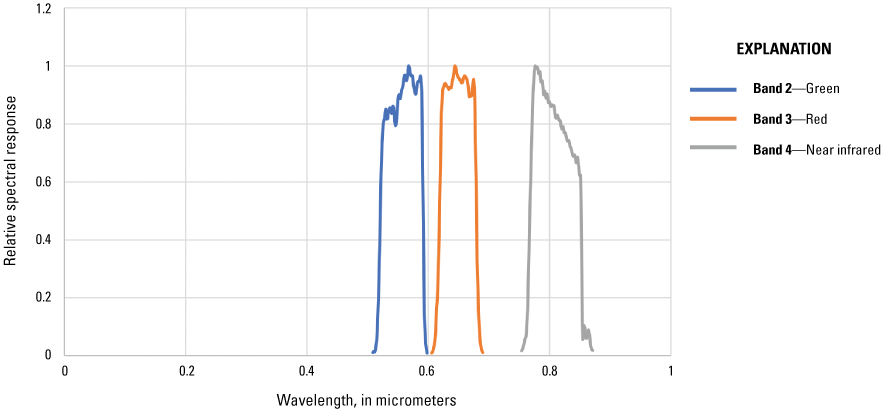
Graph showing Resourcesat-2A Linear Imaging Self Scanning-4 sensor relative spectral response.
Procedures
ECCOE has established standard processes to identify Earth observing systems of interest and to assess the geometric, radiometric, and spatial qualities of data products from these systems.
The assessment steps are as follows:
-
• system identification and investigation to learn the general specifications of the satellite and its sensor(s);
-
• data receipt and initial inspection to understand the characteristics and any overt flaws in the data product so that it may be further analyzed;
-
• geometry characterization, including interior geometric orientation measuring the relative alignment of spectral bands and exterior geometric orientation measuring how well the georeferenced pixels within the image are aligned to a known reference;
-
• radiometry characterization, including assessing how well the data product correlates with a known reference and, when possible, assessing the signal-to-noise ratio; and
-
• spatial characterization, assessing the two-dimensional fidelity of the image pixels to their projected ground sample distance (GSD).
Measurements
The observed USGS measurements are listed in table 3. The error and root mean square error (RMSE) values for interior (band-to-band) and exterior (image-to-image) geometric performance are listed in meters (pixels). These values are derived from tables 4, 5, 6, and 7 and are summarized here. The values for interior and exterior geometry and for radiometry are the averages of three datasets used for the analysis. Details about the methodologies used are outlined in the “Analysis” section.
Table 3.
U.S. Geological Survey measurement results.[m, meter; RMSE, root mean square error; NIR, near infrared; LISS–4, Linear Imaging Self Scanning-4; L8 OLI, Landsat 8 Operational Land Imager; FWHM, full width at half maximum; MTF, modulation transfer function]
Table 4.
Band-to-band registration error (in pixels resampled to a 5-meter ground sample distance).[Band 2 is green, band 3 is red, and band 4 is near infrared; ID, identifier; RMSE, root mean square error]
Table 5.
Geometric error of the Resourcesat-2A Linear Imaging Self Scanning-4 sensor relative to the U.S. Department of Agriculture National Agriculture Imagery Program and WorldView-3 images.[ID, identifier; RMSE, root mean square error; USDA NAIP, U.S. Department of Agriculture National Agriculture Imagery Program]
Table 6.
Top of Atmosphere reflectance comparison of the Resourcesat-2A Linear Imaging Self Scanning-4 sensor against the Landsat 8 Operational Land Imager sensor.[ID, identifier; B, band; %, percent; R2, coefficient of determination]
Table 7.
Radiometric analyses by estimating spectral band adjustment factors between Landsat 9 and Linear Imaging Self Scanning-4 sensors using the Resourcesat-2A Linear Imaging Self Scanning-4 sensor over the Railroad Valley Playa, Nevada, Radiometric Calibration Network site.[ID, identifier; ROI, region of interest; SBAF, spectral band adjustment factor; NIR, near infrared; LISS–4, Linear Imaging Self Scanning-4; RadCalNet, Radiometric Calibration Network; OLI, Operational Land Imager]
Analysis
This section describes the geometric, radiometric, and spatial performance of LISS–4.
Geometric Performance
The geometric performance for LISS–4 is characterized in terms of the interior (band-to-band alignment) and exterior (geometric location accuracy) geometric analysis results.
Interior (Band to Band)
The band-to-band alignment analysis was completed using the Earth Resources Observation and Science System Characterization software on three separate images. Band combinations were registered against each other to determine the mean error and RMSE values as listed in table 4 with results represented in pixels resampled to a 5-meter (m) GSD from the original 5.8-m GSD. Example error scatterplots and histograms for scene identifier 239330761_R2A_L4FX__29-JUL-2023_251_043_GEOREF are shown in figures 2–3.
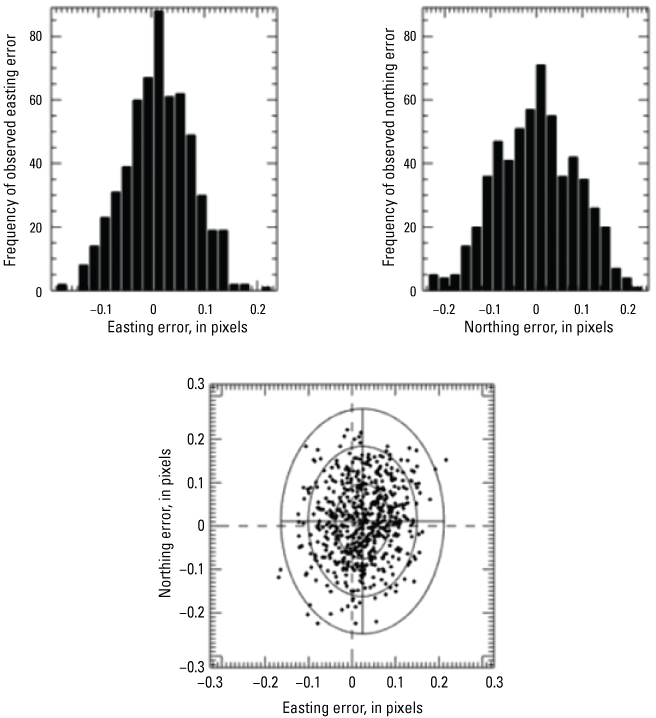
Band 2 (green) to band 3 (red) geometric error histogram (upper) and error distribution (lower) (scene identifier 239330761_R2A_L4FX__29-JUL-2023_251_043_GEOREF).
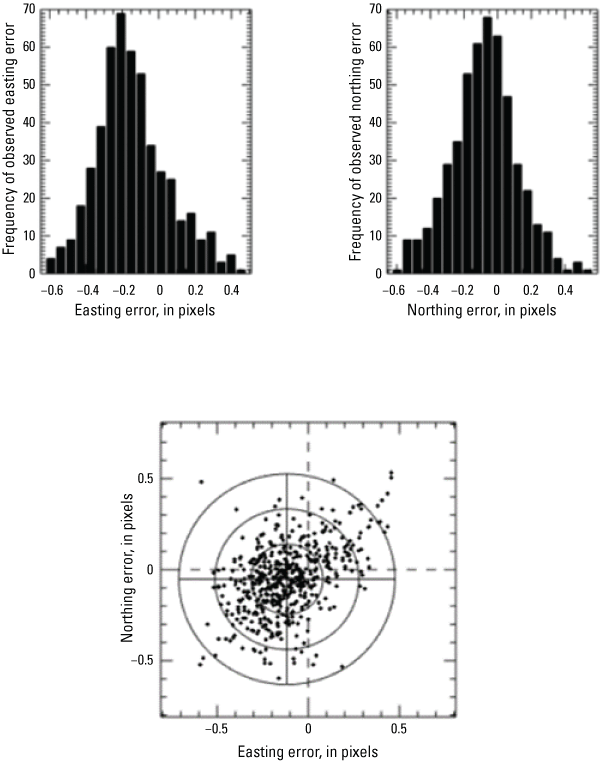
Band 2 (green) to band 4 (near infrared) geometric error histogram (upper) and error distribution (lower) (scene identifier 239330761_R2A_L4FX__29-JUL-2023_251_043_GEOREF).
Exterior (Geometric Location Accuracy)
For the exterior geometric analysis, band 3 (red) of the LISS–4 data for two datasets was compared against the corresponding band from high resolution U.S. Department of Agriculture NAIP orthographic imagery. For a third dataset over Baotou, Inner Mongolia, China, the single LISS–4 image (scene identifier 239330461_R2A_L4FX__26-AUG-2023_123_041_GEOREF) was compared with 18 spatially coincident orthorectified WorldView-3 images. In all cases, conjugate points in the reference and search images were identified automatically and refined using similarity measures such as normalized cross-correlation metrics. The mean error and RMSE results for the three datasets are listed in table 5 with results represented in pixels and meters at a 5-m GSD because the NAIP and WorldView-3 images were resampled to match the 5-m product GSD of LISS–4. The displacement in features between the LISS–4 and NAIP datasets is shown in figure 4. Histograms showing the error distribution are provided in figure 5 for scene identifier 239330761_R2A_L4FX__29-JUL-2023_251_043_GEOREF.
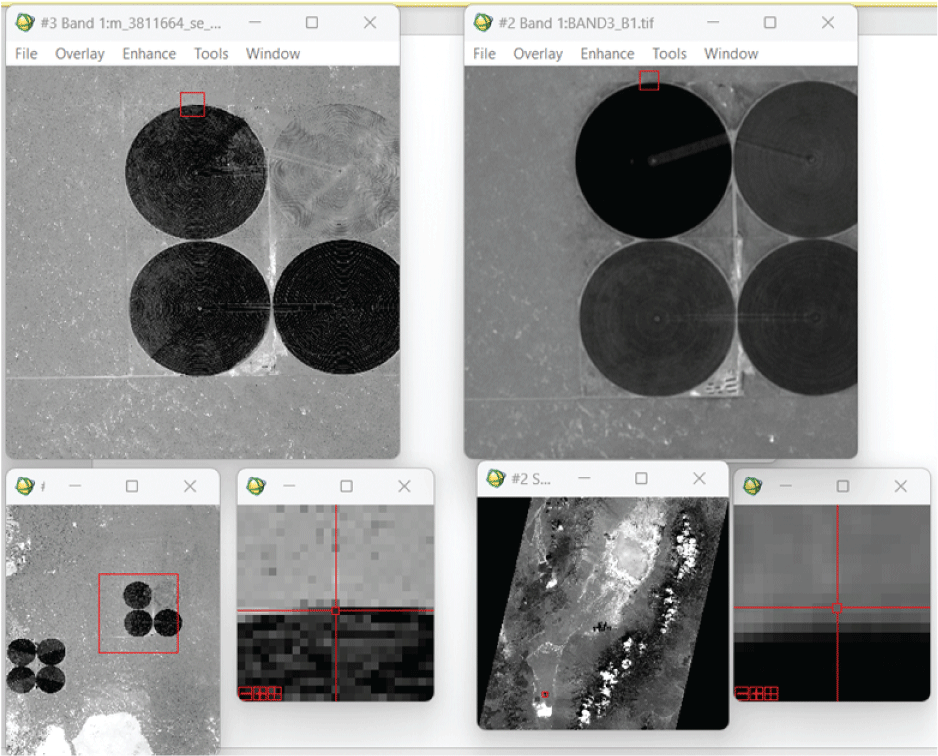
Images showing geometric comparison for U.S. Department of Agriculture National Agricultural Imagery Program imagery (left) and Resourcesat-2A Linear Imaging Self Scanning-4 (right) (scene identifier 239330751_R2A_L4FX__15-SEP-2023_251_043_GEOREF).
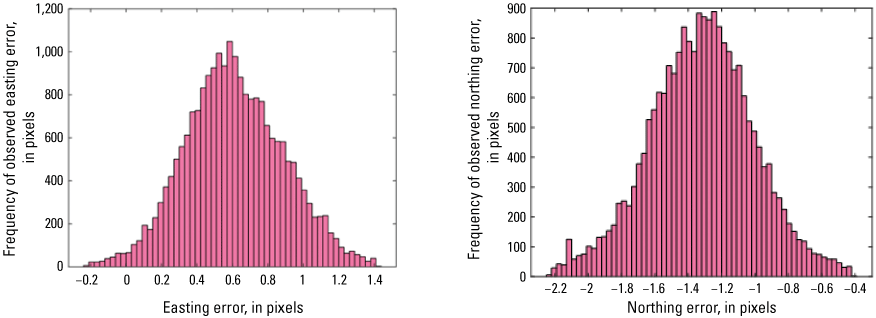
Geometric error histograms (scene identifier 239330751_R2A_L4FX__15-SEP-2023_251_043_GEOREF).
Radiometric Performance
For radiometric performance, cloud-free regions of interest were analyzed within three LISS–4 and Landsat 8 Operational Land Imager (OLI) scene pairs. Raw digital number-to-radiance conversion coefficients were obtained from the Indian Space Research Organisation. The scatterplots in figure 6 show the values for the reference sensor on the x-axis and the values for the comparison sensor on the y-axis. Thus, the linear regression represents Top of Atmosphere (TOA) reflectance relative to that of the reference sensor. Ideally, the slope should be near unity, and the offset should be near zero. For instance, if the slope is greater than unity, then the comparison sensor is overestimating the TOA reflectance compared to the reference sensor.
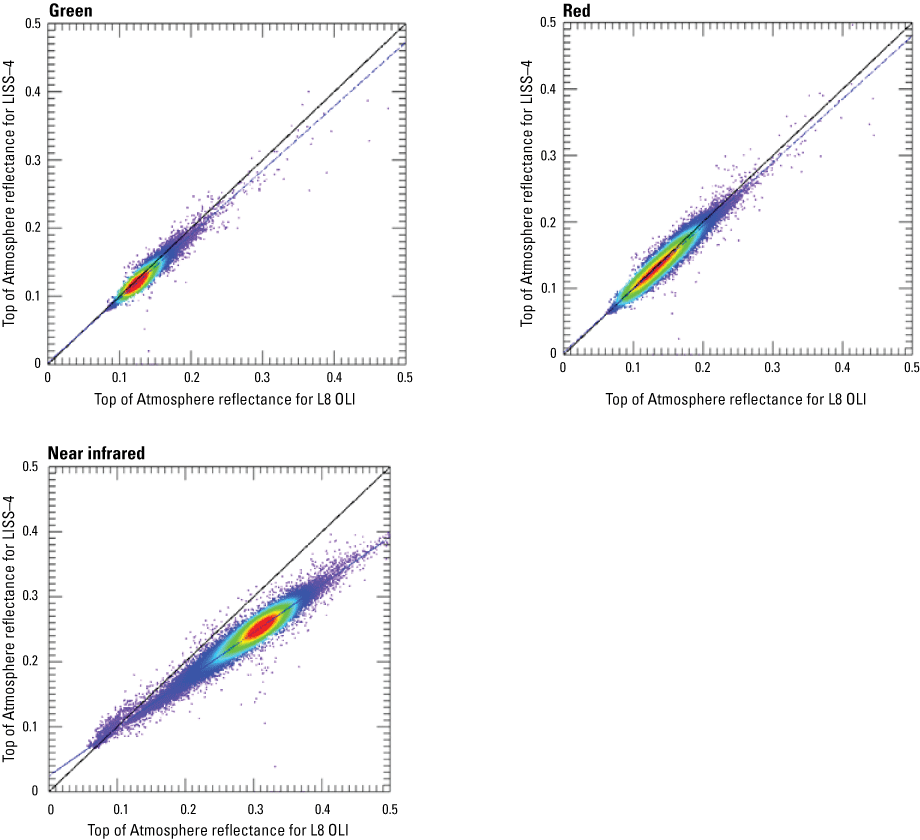
Graphs showing Top of Atmosphere reflectance comparison for Landsat 8 Operational Land Imager (L8 OLI) and Resourcesat-2A Linear Imaging Self Scanning-4 (LISS–4) sensors.
TOA reflectance comparison results are listed in table 6. A band-by-band graphical comparison between LISS–4 scene identifier 239329731_R2A_L4FX__27-MAY-2023_100_061_GEOREF and Landsat 8 OLI scene identifier LC08_L1TP_144048_20230527_20230603_02_T1 is shown in figure 6.
The LISS–4 radiometric quality was also assessed by comparing it with Radiometric Calibration Network (RadCalNet) coincident measurements. RadCalNet provides automated TOA reflectance measurements that are used to calibrate and validate optical satellite sensors. LISS–4 was compared to measurements from the RadCalNet instrumentation and a coincident Landsat 9 OLI image over the Railroad Valley Playa, Nevada, site. The LISS–4 and Landsat 9 OLI footprints over the Railroad Valley Playa site are shown in figure 7, and the red box indicates the 700-m x 700-m region of interest used to extract LISS–4 and Landsat 9 OLI TOA reflectance values.
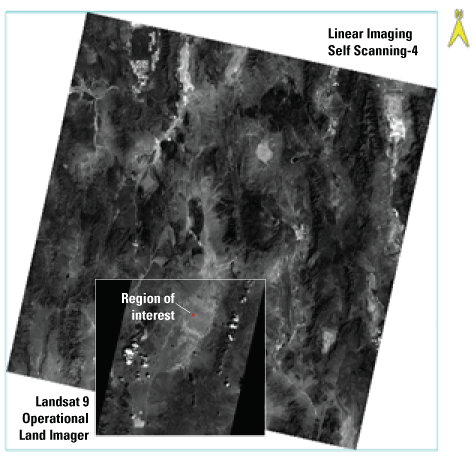
Images showing Resourcesat-2A Linear Imaging Self Scanning-4 and Landsat 9 Operational Land Imager footprint over Railroad Valley Playa, Nevada. Landsat 9 Operational Land Imager has a larger footprint, and Linear Imaging Self Scanning-4 has a smaller footprint. The red box represents the region of interest.
The TOA reflectance comparisons among LISS–4, RadCalNet, and Landsat 9 on two dates, July 29, 2023, and September 15, 2023, are shown in figure 8A and B, respectively. For the radiometric comparison, RadCalNet hyperspectral TOA reflectance is used to simulate LISS–4 TOA reflectance using the LISS–4 relative spectral response. In figure 8A and B, blue symbols represent the TOA reflectance ratio between LISS–4 and RadCalNet, and the green symbols represent the TOA reflectance ratio between LISS–4 and Landsat 9 OLI observations. The July 29, 2023, comparison in figure 8A shows that LISS–4 agrees with RadCalNet within about 7 percent and with Landsat 9 OLI within about 10 percent. The September 15, 2023, comparison in figure 8B shows that LISS–4 agrees with RadCalNet within 5 percent across all the bands, whereas it agrees with Landsat 9 OLI within 5 percent for the green and red bands and within 11 percent for the near-infrared band.
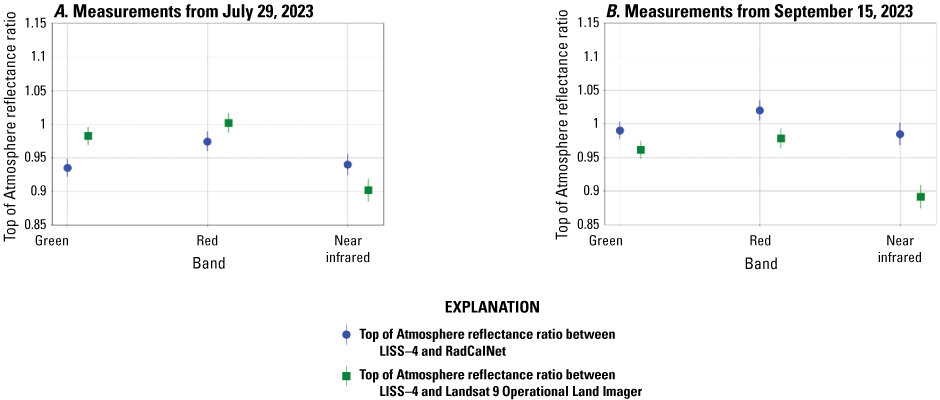
Graphs showing Linear Imaging Self Scanning-4 (LISS–4) comparison with Radiometric Calibration Network (RadCalNet) and Landsat 9 on (A) July 29, 2023, and (B) September 15, 2023.
The results of the analyses are summarized in table 7. The spectral band adjustment factor should be interpreted such that a factor of 1 indicates a perfect alignment of spectral bands and calibration between Landsat and LISS–4. The bands compared are green, red, and near infrared.
Spatial Performance
For this analysis, edge spread and line spread functions were calculated for the spatial test site over Shadnagar, India (https://calval.cr.usgs.gov/apps/shadnagar), for the LISS–4 scene identifier 239329731_R2A_L4FX__27-MAY-2023_100_061_GEOREF. The Indian Space Research Organisation also provided data over the Baotou test site (https://calval.cr.usgs.gov/apps/baotou); however, the Baotou results are not included in this report because they were not as consistent as the larger Shadnagar test pattern. The resulting relative edge response, full width at half maximum, and modulation transfer function at Nyquist frequency analysis output values are listed in table 8. An illustration of the spatial analysis completed on the red band (band 3) of the image over the Shadnagar test site is provided in figure 9.
Table 8.
Spatial performance of the Resourcesat-2A Linear Imaging Self Scanning-4 sensor.[RER, relative edge response; FWHM, full width at half maximum; MTF, modulation transfer function; NIR, near infrared]
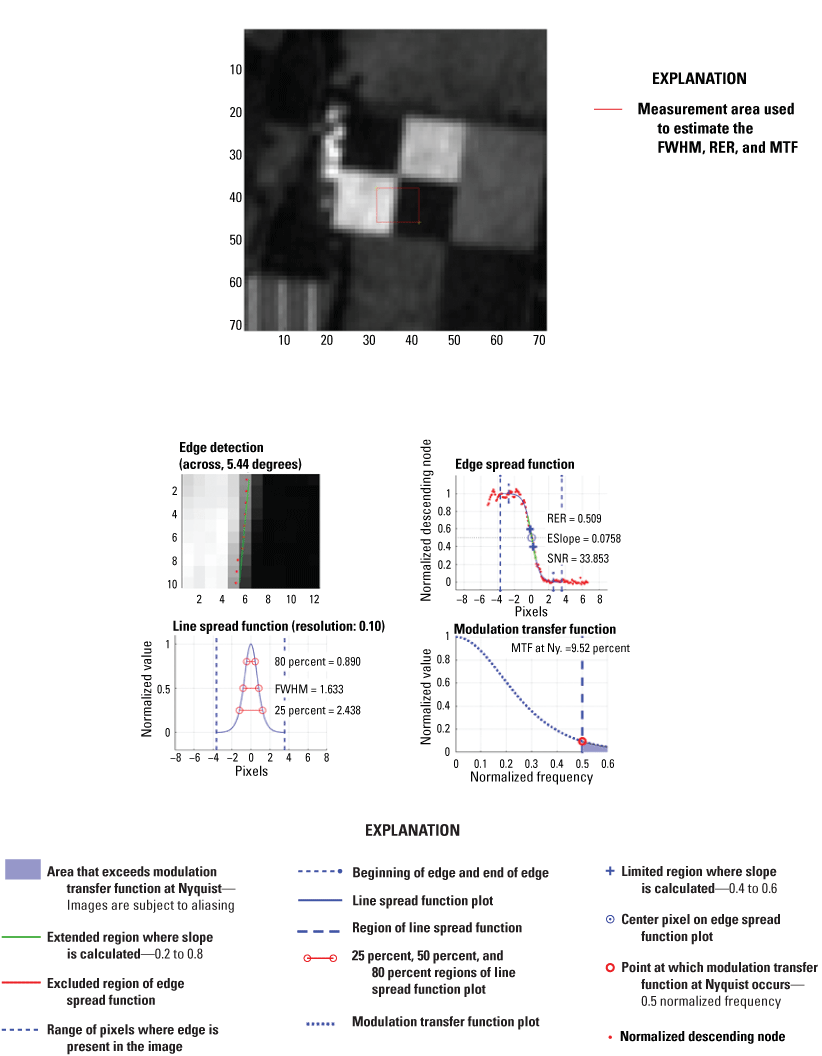
Image and graphs showing Linear Imaging Self Scanning-4 spatial data assessment over the Shadnagar, India, test site. [RER, relative edge response; ESlope, edge slope; SNR, signal to noise ratio; FWHM, full width at half maximum; MTF, modulation transfer function; Ny., Nyquist]
Summary and Conclusions
This report summarizes the sensor performance of the Resourcesat-2A Linear Imaging Self Scanning-4 (LISS–4) sensor system based on the U.S. Geological Survey Earth Resources Observation and Science Cal/Val Center of Excellence (ECCOE) system characterization process.
In summary, ECCOE has determined that this sensor provides an interior geometric performance with band-to-band mean offsets in the range of −0.118 to 0.024 pixel in easting and −0.053 to 0.022 pixel in northing with root mean square error values from 0.067 to 0.230 pixel in easting and 0.087 to 0.2 pixel in northing. ECCOE measured exterior geometric error offsets in the range of 2.55 to 7.85 meters (m) in easting and −6.15 to 11.15 m in northing with root mean square error values in the range of 2.6 to 8.2 m in easting and 6.35 to 11.8 m in northing compared to the U.S. Department of Agriculture National Agriculture Imagery Program and WorldView-3 orthoimages. The measured radiometric performance had offsets from 0.003 to 0.024 and slopes from 0.736 to 0.952. Spatial performance was in the range of 1.633 to 1.903 pixels for full width at half maximum with a modulation transfer function at a Nyquist frequency in the range of 0.0529 to 0.0952.
In conclusion, the team has completed an ECCOE standardized system characterization of the LISS–4 sensing system. Although the team followed characterization procedures that are standardized across the many sensors and sensing systems under evaluation, these procedures are customized to fit the individual sensor as was done with LISS–4. The team acquired the data, defined proper testing methodologies, carried out comparative tests against specific references, recorded measurements, completed data analyses, and quantified sensor performance accordingly. The team also archived all data and measurements and documented the evaluation methods, which ensures that all data and measurements remain accessible so that the performance results can be reproduced if necessary.
The ECCOE project and associated Joint Agency Commercial Imagery Evaluation partners are always interested in reviewing sensor and remote sensing application assessments and would like to review and discuss information on similar data and product assessments and reviews. If you would like to discuss system characterization with either the U.S. Geological Survey ECCOE or Joint Agency Commercial Imagery Evaluation teams, please email us at eccoe@usgs.gov.
Selected References
Bouvet, M., Thome, K., Berthelot, B., Bialek, A., Czapla-Myers, J., Fox, N.P., Goryl, P., Henry, P., Ma, L., Marcq, S., Meygret, A., Wenny, B.N., and Woolliams, E.R., 2019, RadCalNet—A Radiometric Calibration Network for Earth observing imagers operating in the visible to shortwave infrared spectral range: Remote Sensing (Basel), v. 11, no. 20, 24 p., accessed February 28, 2025, at https://doi.org/10.3390/rs11202401.
Clauson, J, Cantrell, S., Vrabel, J., Oeding, J., Ranjitkar, B., Rusten, T., Ramaseri, S., and Casey, K., 2024, Earth Observing Sensing Satellites Online Compendium: U.S. Geological Survey digital data, accessed February 28, 2025, at https://calval.cr.usgs.gov/apps/compendium.
Indian Space Research Organisation, 2023, Resourcesat-2A: Indian Space Research Organisation web page, accessed August 30, 2024, at https://www.isro.gov.in/RESOURCESAT_2A.html.
Ramaseri Chandra, S.N., Christopherson, J.B., Casey, K.A., Lawson, J., and Sampath, A., 2022a, 2022 Joint Agency Commercial Imagery Evaluation—Remote sensing satellite compendium: U.S. Geological Survey Circular 1500, 279 p. [Also available at https://doi.org/10.3133/cir1500.] [Supersedes USGS Circular 1468.]
U.S. Geological Survey, 2021a, EROS CalVal Center of Excellence (ECCOE): U.S. Geological Survey web page, accessed June 2021 at https://www.usgs.gov/core-science-systems/eros/calval.
U.S. Geological Survey, 2021b, EROS CalVal Center of Excellence (ECCOE)—JACIE: U.S. Geological Survey web page, accessed June 2021 at https://www.usgs.gov/calval/jacie?qt-science_support_page_related_con=3#qt-science_support_page_related_con.
U.S. Geological Survey, 2021c, Landsat missions—Glossary and acronyms: U.S. Geological Survey web page, accessed June 2021 at https://www.usgs.gov/core-science-systems/nli/landsat/glossary-and-acronyms.
Abbreviations
ECCOE
EROS Cal/Val Center of Excellence
GSD
ground sample distance
JACIE
Joint Agency Commercial Imagery Evaluation
LISS–4
Linear Imaging Self Scanning-4
NAIP
National Agriculture Imagery Program
OLI
Operational Land Imager
RadCalNet
Radiometric Calibration Network
RMSE
root mean square error
TOA
Top of Atmosphere
USGS
U.S. Geological Survey
For more information about this publication, contact:
Director, USGS Earth Resources Observation and Science Center
47914 252nd Street
Sioux Falls, SD 57198
605–594–6151
For additional information, visit: https://www.usgs.gov/centers/eros
Publishing support provided by the
Rolla Publishing Service Center
Disclaimers
Any use of trade, firm, or product names is for descriptive purposes only and does not imply endorsement by the U.S. Government.
Although this information product, for the most part, is in the public domain, it also may contain copyrighted materials as noted in the text. Permission to reproduce copyrighted items must be secured from the copyright owner.
Suggested Citation
Shrestha, M., Sampath, A., Kim, M., Park, S., and Clauson, J., 2025, System characterization report on Resourcesat-2A Linear Imaging Self Scanning-4 sensor, chap. U of Ramaseri Chandra, S.N., comp., System characterization of Earth observation sensors: U.S. Geological Survey Open-File Report 2021–1030, 16 p., https://doi.org/10.3133/ofr20211030U.
ISSN: 2331-1258 (online)
| Publication type | Report |
|---|---|
| Publication Subtype | USGS Numbered Series |
| Title | System characterization report on Resourcesat-2A Linear Imaging Self Scanning-4 sensor |
| Series title | Open-File Report |
| Series number | 2021-1030 |
| Chapter | U |
| DOI | 10.3133/ofr20211030U |
| Publication Date | March 27, 2025 |
| Year Published | 2025 |
| Language | English |
| Publisher | U.S. Geological Survey |
| Publisher location | Reston, VA |
| Contributing office(s) | Earth Resources Observation and Science (EROS) Center |
| Description | iv, 16 p. |
| Online Only (Y/N) | Y |
| Additional Online Files (Y/N) | N |