


Quality of Groundwater Used for Domestic Supply in the Eastern Sacramento Valley and Adjacent Foothills, California
Links
- Document: Report (10 MB pdf) , HTML , XML
- NGMDB Index Page: National Geologic Map Database Index Page (html)
- Download citation as: RIS | Dublin Core
Abstract
More than 2 million Californians rely on groundwater from privately owned domestic wells for drinking-water supply. This report summarizes a water-quality survey of domestic and small-system drinking-water supply wells in the eastern Sacramento Valley and adjacent foothills where more than 25,000 residents are estimated to use privately owned domestic wells. Study results show that inorganic and organic constituents in groundwater were present above regulatory (maximum contaminant level, MCL) benchmarks for public drinking-water quality in 8 and 3 percent, respectively, of the aquifer area used for domestic drinking-water supply (herein, “domestic groundwater resources”; fig. 1). The only inorganic constituent detected above regulatory benchmarks was arsenic. The only organic constituent exceeding regulatory benchmarks was the fumigant 1,2,3-trichloropropane (1,2,3-TCP). Three additional organic constituents—the disinfection by-product chloroform, the gasoline oxygenate methyl tert-butyl ether (MTBE), and the solvent tetrachloroethene (PCE)—were detected at low concentrations below one-tenth of regulatory benchmarks in 34, 10, and 10 percent of domestic groundwater resources, respectively. Total dissolved solids (TDS), iron, and manganese exceeded non-regulatory aesthetic guidelines for drinking water in 5, 10, and 26 percent of domestic groundwater resources, respectively. Per- and polyfluoroalkyl substances (PFASs) were detected in 29 percent of domestic groundwater resources, with 5 percent exceeding the recently enacted (April 2024) U.S. Environmental Protection Agency MCLs. Total coliform and enterococci bacteria were detected in 13 and 8 percent of domestic groundwater resources, respectively.
Redox sensitive constituents in this study included arsenic, manganese, nitrate, and iron. In the lower elevation portions of the eastern Sacramento Valley study area, reducing conditions in groundwater aquifers promote elevated arsenic, iron, and manganese, and conversely lower concentrations of nitrate. The presence of the volatile organic compound (VOC) 1,2,3-TCP was related to its past history in select agricultural land uses (on orchards or vineyards) in the Sacramento Valley; however, unlike in the San Joaquin Valley where orchards and vineyards are more common, its detection frequency was low (only detected in one well in this study). Chloroform was frequently detected in this study at low levels. Chloroform is a disinfection byproduct commonly found in domestic wells treated by shock chlorination. The solvent PCE is among the most frequently detected VOCs in groundwater, which is primarily related to its long history of use and its persistence in groundwater in oxic conditions. The gasoline oxygenate MTBE was a contaminant introduced to groundwater through atmospheric exchange when it was used as a fuel additive to decrease smog inducing emissions from vehicles. Its occurrence in groundwater at low levels is expected and makes it a potentially useful tracer of relatively recent recharge water being withdrawn from wells. The PFASs are anthropogenic chemicals with hundreds of uses, and they have been incorporated into many different products, processes, and applications worldwide. Like MTBE, the occurrence of PFASs in groundwater may be in part due to atmospheric exchange, but there are several other pathways that contribute PFASs to the environment.
Introduction
Approximately 40 percent of the residential population of California depends in some part on groundwater for drinking-water supply (Carle, 2016). To protect this vital resource, the California State Water Resources Control Board (SWRCB) created the Groundwater Ambient Monitoring and Assessment (GAMA) program in 2000. The purpose of GAMA is to comprehensively assess groundwater quality throughout California and enhance public access to groundwater-quality information and analysis. The U.S. Geological Survey (USGS), in cooperation with the SWRCB, implements the Priority Basin Project (PBP) of the GAMA program, which provides assessments of the groundwater resources used for drinking-water supply on a basin scale.
The first phase of the GAMA-PBP (2004–12) focused on groundwater wells used for public drinking-water supply (Belitz and others, 2015). Presently (2024), the GAMA-PBP is assessing the status of groundwater resources used for domestic drinking-water supply (U.S. Geological Survey, 2024). Unlike public-supply wells that are routinely monitored for water quality by law, private domestic wells are not systematically monitored for water quality, and much less is known about the quality of domestic drinking-water resources on a regional scale. Domestic wells in the Central Valley tend to be drilled to shallower depths than public-supply wells and can provide important information on groundwater quality in shallower parts of aquifer systems that respond more rapidly to changes at the land surface compared to deeper production wells (Burow and others, 2008; Voss and others, 2019).
Between July and November 2021, the GAMA-PBP sampled domestic wells in two study areas in the eastern Sacramento Valley and adjacent foothills of the Sierra Nevada (fig. 1; Lor and Dupuy, 2022). The eastern Sacramento Valley study area includes the Butte, Los Molinos, North Yuba, South Yuba, Sutter, Vina, and Wyandotte Creek subbasins of the Sacramento Valley groundwater basin (California Department of Water Resources, 2021). The area adjacent to the eastern Sacramento Valley study area in Butte and Yuba Counties were defined as the foothills study area. Two study areas (collectively referred to as the study unit) were defined because the aquifer system in the eastern Sacramento Valley study area consists of alluvial and fluvial sediments, whereas the aquifer system in the foothills study area consists of fractured hard rock. Johnson and Belitz (2019) estimated that more than 25,000 residents in these two areas use domestic wells for household drinking-water supplies. The eastern Sacramento Valley and Foothill study areas were each divided into cells of approximately 150 square kilometers (km2) such that the eastern Sacramento Valley has 25 cells, and the foothills have 15 cells. Only the parts of the study areas located within 3 kilometers of a domestic well that is included in the California Department of Water Resources online library of well-completion reports were included in the gridded area. The GAMA-PBP sampled a total of 38 (24 in the eastern Sacramento Valley and 14 in the foothills) domestic or small-system wells for water quality distributed across 38 of the cells in the study unit (fig. 1; Jurgens and others, 2018;Lor and Dupuy, 2022).
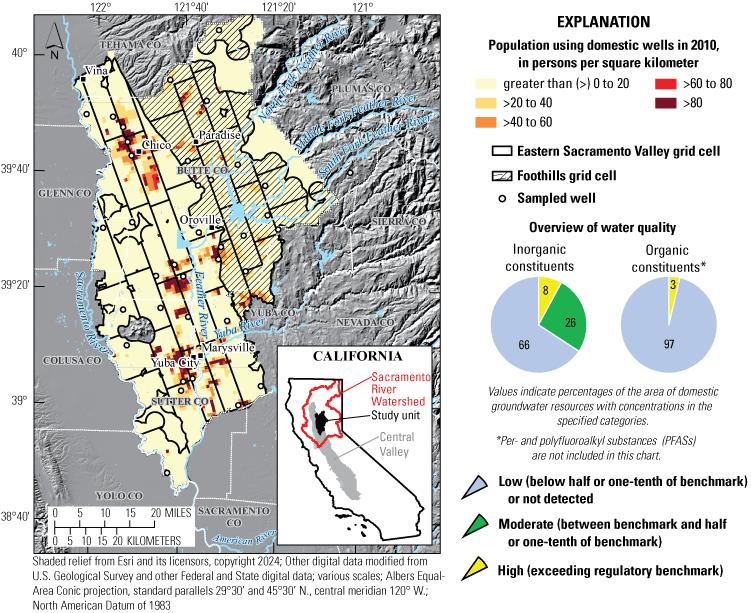
Eastern Sacramento Valley and adjacent foothills study units showing the population using domestic wells, sampling grid cells for the eastern Sacramento Valley and foothills study areas, and locations of wells sampled to characterize the quality of groundwater resources used for domestic drinking-water supply (Johnson and Belitz, 2019; Lor and Dupuy, 2022). Overview of water-quality inset shows proportions of domestic groundwater resources in the study unit that have low, moderate, or high concentrations of inorganic and organic constituents with regulatory maximum contaminant level benchmarks.
Hydrogeologic Setting
The study unit covers about 6,000 km2 and is in the lower half of the Sacramento River watershed (California Department of Water Resources, 2021). It includes a portion of the east side of the Sacramento River Basin and adjacent foothills to the east (fig. 1), which represent a mix of highly productive agricultural areas with some relatively large population centers (Chico, Marysville and Yuba City, and Oroville) as well as vast areas of predominantly natural and forested lands east of the Sacramento Valley. The eastern Sacramento Valley study area is characterized by the low slope of alluvial fan deposits extending east from the Quaternary alluvial contact with the Sierra Nevada, whereas the foothills study area is part of the west flank of the Sierra Nevada extending about halfway to the crest of the Sierra Nevada with its eastern extent being defined by the location of domestic wells within the boundary of Butte and Yuba Counties (Clark, 1960; Olmsted and Davis, 1961; Page, 1986; Lor and Dupuy, 2022).
Average annual precipitation is about 410 and 710 millimeters (mm) in the eastern Sacramento Valley and Foothill study areas, respectively (PRISM Climate Group, 2024), following a distinct seasonal pattern with cool, wet winters and hot, dry summers. Land uses in the eastern Sacramento Valley study area are primarily agricultural and urban, transitioning to predominantly natural grassland and forested areas in the foothills study area to the east (Jin and others, 2013). Primary crop types in the eastern Sacramento Valley study area are rice and deciduous fruits and nuts (Faunt, 2009). Despite being relatively rich with surface water compared to the San Joaquin Valley to the south, groundwater is commonly used to supplement surface-water diversions for irrigation during the summer dry season and during extended regional droughts (Faunt, 2009).
The freshwater portion of the aquifer system in the eastern Sacramento Valley study area is composed of overlapping Tertiary to Quaternary alluvial fan sediments that were deposited by tributaries of the Sacramento River draining the Sierra Nevada (Olmsted and Davis, 1961; Page, 1986; Faunt, 2009). The aquifer system is unconfined to semi-confined with no regionally continuous clay layers, although near the center of the Sacramento Valley Basin, there are higher proportions of clay rich soils that support wetlands and large tracts of rice agriculture (Dawson, 2001; Faunt, 2009). Wells sampled in the eastern Sacramento Valley study area ranged in depth from 24 to 201 meters (m) with a median depth of 44 m (Lor and Dupuy, 2022). The aquifer system of the foothills study area is composed of a complex and diverse mix of fractured and faulted ultramafic, plutonic, volcanic, and sedimentary rocks that have been metamorphosed (Day and others, 1985; Fram and Belitz, 2014). Wells sampled in the foothills study area ranged in depth from 22 to 222 m with a median depth of 61 m (Lor and Dupuy, 2022).
The primary source of groundwater recharge in both study areas is natural infiltration of precipitation that falls on the landscape in the winter months. This precipitation is later drained across the landscape via streams. In their upper reaches, these streams are an additional source of recharge. The Sacramento River and its tributaries are primary discharge points for groundwater in the study area. Additional discharge sources include extraction of groundwater by wells for irrigation or municipal use.
Methods for Evaluating Groundwater Quality
The GAMA-PBP uses established benchmarks for public drinking water to contextualize groundwater quality from domestic wells, which is not regulated in California. This report focuses on water-quality constituents with regulatory maximum contaminant level (MCL) benchmarks. Constituents with aesthetic-based, secondary maximum contaminant level (SMCL) benchmarks that affect groundwater color, taste, or odor are discussed, but not included in the overview of water-quality charts (fig. 1). Other constituents of interest with non-regulatory, health-based benchmarks (such as California State response levels or Federal health advisory levels) are discussed on a more limited basis and also are not included in the overview of water-quality charts (fig. 1). References for the water-quality benchmarks used and other constituent results that are not presented in this report are compiled by Lor and Dupuy (2022).
Concentrations of a given water-quality constituent exceeding its respective benchmark were considered high. Concentrations between the benchmark and one-half the benchmark (for inorganic constituents) or one-tenth the benchmark (for organic and per- and polyfluoroalkyl substances [PFASs] constituents) were considered moderate. Concentrations beneath the moderate threshold were considered low. The moderate classification indicates elevated concentrations below the benchmark and can help identify constituents of emerging concern in aquifer systems. The one-tenth threshold was set for organic constituents (such as pesticides and volatile organic compounds [VOCs]) and PFASs because they typically are not naturally present in groundwater systems, and a lower threshold effectively highlights portions of the aquifer area vulnerable to anthropogenic contamination as opposed to inorganic constituents that are often present naturally at low levels in aquifer systems from water-rock interactions (Fram and Belitz, 2014). Total coliform and Escherichia coli (E. coli) have MCLs in California under the Revised Total Coliform Rule; however, they are not included in the overview of water-quality summary (California State Water Resources Control Board, 2024a).
The gridded sampling design used in GAMA-PBP studies allows results to be put in terms of proportion of aquifer area, with water quality in a defined range (for example, exceeding the MCL or high). Wells selected from individual grid cells represent a random sampling within a defined unit of the total aquifer area used for domestic drinking-water supply (herein, referred to as “domestic groundwater resources”; Belitz and others, 2010, 2015).
From July to October 2021, groundwater from 38 domestic or small-system wells selected for study was sampled and analyzed for a comprehensive suite of water-quality constituents and geochemical indicators, as described by Lor and Dupuy (2022). Groundwater samples were taken as close to the wellhead as possible and reflect the quality of ambient aquifer water before exposure to household plumbing or treatment systems. The median and interquartile range of sampled well depths were 61 and 37–73 m, respectively (Lor and Dupuy, 2022).
Overview of Water-Quality Results
This report focuses on water-quality constituents with regulatory benchmarks detected at moderate or high concentrations in the study area. Results are presented separately for inorganic and organic constituents. Inorganic constituents include trace elements and nutrients, which are often naturally present at low levels in groundwater due to chemical interactions with aquifer materials. Organic constituents include VOCs and pesticides, which tend to originate from human activities at the land surface, such as agriculture or industry. Inorganic and organic constituents were present at high concentrations exceeding an MCL benchmark in 8 and 4 percent of domestic groundwater resources, respectively (fig. 1). Inorganic and organic constituents were present at moderate concentrations below MCL benchmarks in 26 and 0 percent of domestic groundwater resources, respectively (fig. 1).
Inorganic Constituents
The only inorganic constituent with a health-based benchmark detected at high concentrations was arsenic, which was detected at concentrations exceeding its MCL (10 micrograms per liter [µg/L]) in 8 percent of domestic groundwater resources (fig. 2). Arsenic also was detected at moderate concentrations in 18 percent of domestic groundwater resources (fig. 2). Wells with high concentrations of arsenic were in the eastern Sacramento Valley study area and were near the center of the Sacramento Valley basin (fig. 3A).

Proportion of domestic groundwater resources that have selected inorganic constituents detected at low (or not detected), moderate, or high concentrations (Lor and Dupuy, 2022).
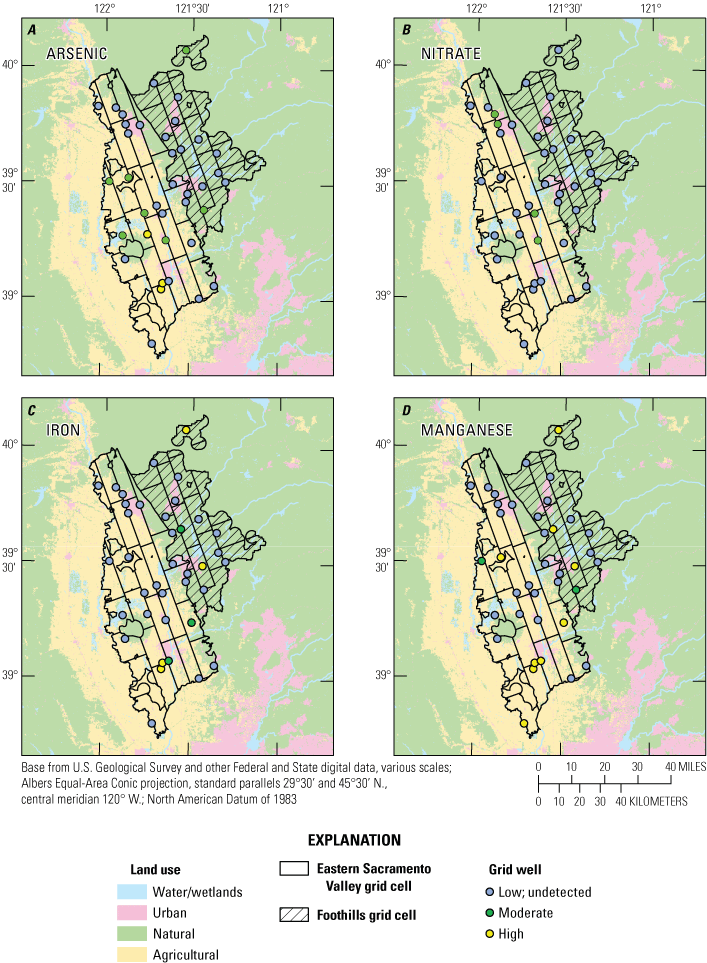
Study-area boundaries, land use, grid cells, and grid wells that have low, moderate, and high concentrations of A, arsenic; B, nitrate; C, iron; and D, manganese (Falcone, 2015; Lor and Dupuy, 2022).
Additional inorganic constituents that have regulatory and non-regulatory benchmarks were detected at moderate concentrations with less prevalence. The trace element uranium and the nutrient nitrate were detected at moderate concentrations below their MCLs in 3 and 10 percent of domestic groundwater resources of the study unit, respectively (fig. 2). Hexavalent chromium, a carcinogenic trace element, does not presently (2024) have an MCL in California; therefore, it is regulated under the total chromium MCL of 50 µg/L. There were no detections of hexavalent chromium that exceeded 50 µg/L. The USGS health-based screening level for hexavalent chromium is 20 µg/L (Norman and others, 2018; fig. 2). One well had a moderate relative concentration when compared to the USGS health-based screening level because it had a concentration of 12 µg/L.
Constituents with non-regulatory benchmarks or SMCLs are not included in the water-quality overview charts on figure 1 and are considered separately to highlight aesthetic properties of groundwater, such as taste, color, or odor. Manganese is a trace metal that can affect the taste and color of groundwater but also can precipitate in pipes causing clogging of household plumbing systems. Manganese was present above its SMCL of 50 µg/L in 26 percent of domestic groundwater resources in the study unit (fig. 2). Manganese also has a SWRCB defined notification level of 500 µg/L (California State Water Resources Control Board, 2022) and was present at concentrations greater than the notification level in 10 percent of domestic groundwater resources. Total dissolved solids (TDS) are a measure of groundwater salinity and have both recommended and upper SMCLs of 500 and 1,000 milligrams per liter (mg/L), respectively, which were used as moderate and high thresholds for this study. Total dissolved solids were measured at moderate and high levels in 8 and 5 percent of domestic groundwater resources in the study unit, respectively (fig. 2). Chloride and sulfate are major ionic components of TDS with SMCL thresholds, but only chloride exceeded the recommended SMCLs in 3 percent of domestic groundwater resources in the study unit.
Organic Constituents
The only organic constituent exceeding regulatory benchmarks was the fumigant 1,2,3-trichloropropane (1,2,3-TCP), which was detected at a concentration above its California SWRCB defined MCL of 0.005 µg/L in 1 well (3 percent of domestic groundwater resources in the study unit; California State Water Resources Control Board, 2023; fig. 4). Fumigants are VOC pesticides that historically have been applied to agricultural crops, such as vineyards or orchards, for nematode control in the Central Valley.
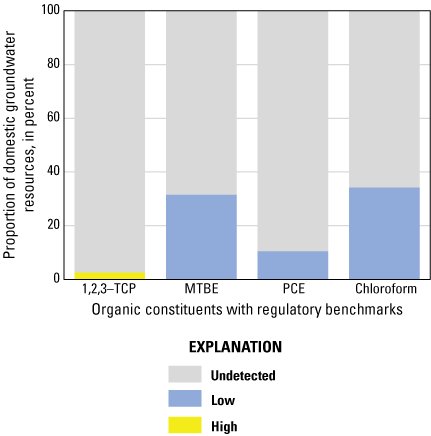
Proportion of domestic groundwater resources that have selected organic constituents undetected or detected at low or high concentrations. Abbreviations: 1,2,3-TCP, 1,2,3-trichloropropane; MTBE, methyl tert-butyl ether; PCE, tetrachloroethene (Lor and Dupuy, 2022).
Additional VOCs with regulatory benchmarks detected frequently (greater than or equal to 10 percent) in the study area included a gasoline byproduct, a solvent, and a disinfection byproduct. The gasoline byproduct methyl tert-butyl ether (MTBE) was detected at low concentrations in 32 percent of the domestic groundwater resources; the solvent tetrachloroethene (PCE) was detected at low concentrations in 10 percent of domestic groundwater resources; and chloroform, a disinfection byproduct, was detected at low concentrations in 34 percent of domestic groundwater resources (Lor and Dupuy, 2022).
Microbial Indicators
Microbial indicator constituents can be used to evaluate the potential for bacterial contamination of groundwater from wastewater sources. In this study, groundwater samples were tested for the presence or absence of total coliform bacteria, E. coli, and enterococci. Total coliform bacteria and enterococci were detected in 13 and 8 percent of domestic groundwater resources, respectively. E. coli bacteria were not detected. Total coliform bacteria were detected in both study areas, whereas enterococci was only detected in the foothills study area. Coliform bacteria are common and naturally present in soil and surface water and are generally harmless to humans. E. coli and enterococci are more specific indicators of fecal contamination because they are found in human and animal wastes (California State Water Resources Control Board, 2019). Because microbial MCL violations under the Revised Total Coliform Rule are based on repeat sampling, and survey results described in this study are from a single sampling event, they are insufficient to indicate MCL exceedances for these constituents (California State Water Resources Control Board, 2019).
Per- and Polyfluoroalkyl Substances
Per- and polyfluoroalkyl substances are a family of human-made chemicals that are commonly used as surfactants in a variety of industrial processes and are persistent in the environment (Kent, 2021). In April 2024, the U.S. Environmental Protection Agency (EPA) announced the final National Primary Drinking Water Regulation establishing MCLs for five individual PFAS compounds: perfluorooctanoate (PFOA), perfluorooctanesulfonate (PFOS), perfluorohexanesulfonate (PFHxS), perfluorononanoic acid (PFNA), and hexafluoropropylene oxide dimer acid (HFPO-DA; U.S. Environmental Protection Agency, 2024). The MCLs for PFOA and PFOS are 4 nanograms per liter (ng/L), and for PFHxS, PFNA, and HFPO-DA, the MCL is 10 ng/L. The PFAS compounds PFHxS, PFNA, HFPO-DA, and perfluorobutanesulfonate (PFBS) also are regulated as a PFAS mixture (U.S. Environmental Protection Agency, 2024). Before the establishment of the EPA MCLs, the State of California issued health-based advisory notification and response levels for the following PFASs: PFBS, PFHxS, PFOA, and PFOS (California State Water Resources Control Board, 2024b). The EPA MCLs supersede the California notification and response levels for PFOA, PFOS, and PFHxS. The California notification and response levels for PFBS are 500 and 5,000 ng/L, respectively.
In this study, 8 out of 28 measured PFAS were detected. At least one PFAS was detected in 26 percent of domestic groundwater resources (fig. 5). Two of the PFAS compounds with EPA MCLs, PFOA and PFOS, were detected above the MCL in 5 and 3 percent of domestic groundwater resources, respectively (fig. 5). The overall detection frequency of PFOA, PFOS, PFHxS, and PFBS, the PFASs with EPA MCLs or SWRCB notification or response levels, were 16, 16, 18, and 11 percent, respectively (fig. 5). The PFASs detected that do not have EPA MCLs or SWRCB notification or response levels were perfluoropentanoate (PFPeA), perfluorohexanoate (PFHxA), perfluoroheptanoate (PFHpA), and perfluorobutanoate (PFBA), which had detection frequencies of 16, 16, 8, and 3 percent, respectively (fig. 5).
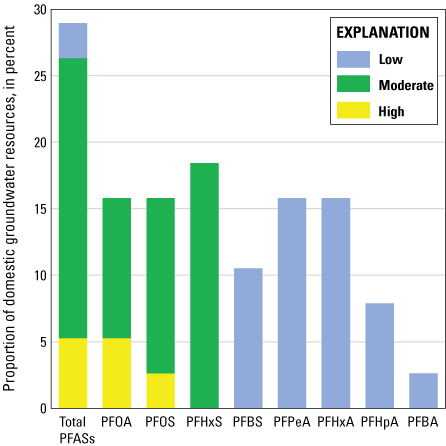
Proportion of domestic groundwater resources with detected per- and polyfluoroalkyl substances (PFASs). Abbreviations: PFOA, perfluorooctanoate; PFOS, perfluorooctanesulfonate; PFHxS, perfluorohexanesulfonate; PFBS, perfluorobutanesulfonate; PFPeA, perfluoropentanoate; PFHxA, perfluorohexanoate; PFHpA, perfluoroheptanoate; PFBA, perfluorobutanoate (Lor and Dupuy, 2022).
Factors that Affect Groundwater Quality
Groundwater quality is related to a mix of variables, including the chemistry of the recharge water entering the aquifer, the geochemical interactions of groundwater with aquifer sediments, and anthropogenic factors like land use. The following sections discuss how geochemical conditions and anthropogenic activities may affect select constituents within the aquifer system.
Redox-Sensitive Constituents
Concentrations of some constituents in groundwater can be affected by the oxidation-reduction (redox) state of the aquifer from which the samples were drawn. Redox sensitive constituents sampled in this study that were detected at high concentrations were arsenic, iron, and manganese. Nitrate concentrations also are redox sensitive and were detected at moderate concentrations in some wells. The amount of dissolved oxygen (DO) in groundwater is an important indicator of redox condition. Before entering the aquifer, DO in water is typically in equilibrium with the atmosphere. However, it can be depleted once it enters the aquifer by reactions with organic carbon or inorganic reductants (McMahon and Chapelle, 2008). Generally, the redox state of groundwater is categorized as oxic (DO concentration greater than 0.5 mg/L) or anoxic (DO less than or equal to 0.5 mg/L). There are additional geochemical indicators of redox state in groundwater beyond DO concentration, and the relative concentrations of redox sensitive constituents like nitrate, manganese, iron, and sulfate can be used to determine if the redox state is mixed, meaning both oxic and anoxic conditions are present (McMahon and Chapelle, 2008; Jurgens and others, 2009).
Wells sampled in the study unit were categorized as oxic, anoxic, or mixed using the methodology described by Jurgens and others (2009) (one sample identified as suboxic was placed in the anoxic category). Most of the samples in the study unit were categorized as oxic (66 percent of wells) with the remainder classified as anoxic or mixed. Most of the anoxic wells were in the eastern Sacramento Valley study area (fig. 6). Generally, groundwater from wells in fine-grained alluvial sediments, especially those at the far end of groundwater flow paths, have a higher likelihood of being anoxic because of the geochemical evolution of groundwater as it moves through the system (McMahon and Chapelle, 2008).

Redox category (Jurgens and others, 2009) of sampled wells (Lor and Dupuy, 2022).
About 26 percent of the wells in the study unit had anoxic groundwater. Groundwater with anoxic conditions allows for the mobilization of arsenic, iron, and manganese from dissolution of or desorption from minerals or mineral coatings containing these trace elements (Smedley and Kinniburgh, 2002). All but one of the wells with a high or moderate relative concentration of arsenic was in the eastern Sacramento Valley study area, and the three wells with high concentrations were classified as anoxic and were located near the center of the Sacramento Valley (fig. 3A). Previous studies of groundwater quality in the Sacramento Valley have shown that reducing conditions in these deposits are a major influencing factor on the groundwater chemistry, affecting concentrations of arsenic, DO, nitrate, iron, and manganese (Hull, 1984; Dawson, 2001; Bennett and others, 2011; Bennett, 2022). Nitrate is stable in oxic groundwater; however, in anoxic groundwater, nitrate is reduced, meaning it is consumed by redox processes that ultimately lower its concentrations (Burow and others, 2010). The four sites with moderate concentrations of nitrate were in wells classified as oxic and located closer to the east edge of the eastern Sacramento Valley study area where sediments are generally coarser than those located closer to the center of the Sacramento Valley (Hull, 1984; fig. 3B). The absence of moderate or high concentrations of nitrate in anoxic areas could either indicate that it was not in the groundwater to begin with or indicate that nitrate is being consumed by redox processes (Landon and others, 2011). All the wells with high concentrations of iron or manganese in the eastern Sacramento Valley study area also were in wells classified as anoxic or mixed, and with one exception, were located near the center of the Sacramento Valley in areas of generally fine-grained sediments (figs. 3C, 3D).
Anthropogenic Constituents
Detections of VOCs and PFASs are commonly related to factors associated with human activities on the landscape, such as degree of urbanization or agricultural practices. Additionally, there is a tendency for some of these constituents to become incorporated into water vapor, allowing them to be distributed into areas outside established urban or agricultural zones where they may have originated, through precipitation and runoff that eventually recharges the domestic groundwater resource. The following section discusses select VOCs and PFASs detected in the eastern Sacramento Valley and Foothill study areas within the context of factors that could affect their presence in the domestic groundwater resource.
The disinfection by-product chloroform (a trihalomethane) was the most frequently detected VOC (34 percent) in the study unit. This finding matches recent and past nationwide studies of VOC occurrence in which chloroform was the most frequently detected VOC in groundwater (Moran and others, 2002; Bexfield and others, 2022). Previous studies have examined chloroform and other trihalomethanes in drinking water because of their widespread presence in the hydrologic system and deleterious effects on human health at high concentrations (Ivahnenko and Barbash, 2004; Ivahnenko and Zogorski, 2006). Sources of chloroform to the groundwater system are numerous, which leads to its detection in urban and suburban areas as well as beneath agricultural, forested, and other undeveloped areas (Ivahnenko and Barbash, 2004). Detections of chloroform in the study unit were nearly equally divided between both study areas, with detections in the eastern Sacramento Valley generally occurring in the north or east-central side of the study area. In the foothills study area, detections of chloroform were uniformly distributed among the sampled wells (fig. 7A). Chloroform was detected in each of the three general land-use settings (urban, natural, and agricultural), but most occurred in or near areas identified as urban (fig. 7A). Treated drinking water has been cited as a potentially high source of chloroform either through landscape irrigation or leaking distribution pipes (Ivahnenko and Barbash, 2004). Another source of chloroform in groundwater could be related to shock chlorination of domestic wells. Shock chlorination is a treatment often prescribed to owners of domestic wells that need microbial contamination abatement and involves pouring chlorine directly into the well, allowing time for it to disinfect the well casing, then purging the well to remove the chlorine (Centers for Disease Control and Prevention and U.S. Department of Housing and Urban Development, 2006). This practice can result in residual chloroform forming in the aquifer and may be a source of chloroform in areas where there are no known urban sources of chlorinated water available to recharge the aquifer.

Study area boundaries, land use, grid cells, and sampled wells that have no detections or low, moderate, or high relative concentrations of A, chloroform; B, tetrachloroethene (PCE); C, methyl-tert butyl ether (MTBE); and D, per- and polyfluoroalkyl substances (PFASs; Falcone, 2015; Lor and Dupuy, 2022).
The occurrence of the solvent PCE in aquifers has been linked to urban settings. Tetrachloroethene was detected in 10 percent of the wells sampled at low relative concentrations. Tetrachloroethene is among the most frequently detected VOCs in groundwater in California and the Nation (DeSimone and others, 2015; Belitz and others, 2015; Bexfield and others, 2022). It was detected in both the eastern Sacramento Valley and foothills study areas in primarily urban areas (fig. 7B). Tetrachloroethene is a chlorinated solvent with a long history of use and many know applications in commercial and industrial settings (DeSimone and others, 2015). Its relatively frequent detection in groundwater is assumed to be related to its widespread use, which increases the potential for its disposal, potential spills, and leaks (Bexfield and others, 2022).
In this study unit, the only VOC detected at a high relative concentration was 1,2,3-TCP, an additive to soil fumigant mixtures. It was only detected in one well that was located near an orchard. Although not frequently detected in the Sacramento Valley, 1,2,3-TCP is detected statewide and has been linked to legacy agricultural land-use practices (Burow and others, 2019). In this study unit, its introduction to the aquifer is likely the result of past applications of fumigant mixtures containing 1,2,3-TCP beneath orchards and vineyards near the well after precipitation and irrigation transported it into the domestic aquifer system.
The gasoline oxygenate MTBE and PFASs were frequently detected in the study unit (32 and 29 percent, respectively). In the eastern Sacramento Valley study area, MTBE and PFASs were detected in or near the urbanized areas at the north and south end of the study area, and detections in the central part of the eastern Sacramento Valley were near the Feather River (figs. 7C, 7D). In the foothills study area, MTBE detections were evenly distributed throughout the study area (fig. 7C) with two of the three detections occurring near urban areas and one detection observed in natural land use (fig. 7C). The spatial distribution of MTBE and PFASs detections indicate a connection between the constituents that could be related to sources or mode of transport that allow these constituents to enter the domestic groundwater resource.
Methyl tert-butyl ether was a fuel additive used to raise octane levels to reduce harmful emissions, thereby improving air quality. As part of the Clean Air Act, implemented in 1990, oxygenated fuel use was mandated in areas out of compliance for ozone or carbon monoxide air quality standards. However, its use was banned in California after MTBE was discovered to be a groundwater contaminant; many studies have since detailed sources and occurrences of MTBE in groundwater throughout the Nation (Pankow and others, 1997; Baehr and others, 1999; Ayotte and others, 2005; Zogorski and others, 2006). California established an MCL for MTBE in 2000 (13 µg/L) and banned its use in 2004 (California State Water Resources Control Board, 2017). The maximum concentration of MTBE detected in the study unit was 0.79 µg/L (Lor and Dupuy, 2022).
Per- and polyfluoroalkyl substances, collectively, are a large group of chemicals (more than 12,000) used worldwide in hundreds of products that have been used and produced for decades in the United States (Kent, 2021; California State Water Resources Control Board, 2024b). Environmental sources are numerous because there is a very broad range of applications for this group of chemicals, which ranges from consumer goods, industrial applications, and emergency fire response (California State Water Resources Control Board, 2024b). Increased attention on PFASs in the environment is a result of an increasing awareness of their widespread occurrence and persistence in groundwater, surface water, soil, and precipitation that results from their unique chemical properties that make them highly resistant to processes that might otherwise break them down (California State Water Resources Control Board, 2024b). They are often referred to as “forever chemicals.” Adding to the increased attention are recently enacted regulations on specific PFAS constituents (California State Water Resources Control Board, 2024b; U.S. Environmental Protection Agency, 2024). Comprehensive monitoring efforts will be important to understand if mitigation efforts can effectively reduce these chemicals in the environment (Kent, 2021; California State Water Resources Control Board, 2024b; Dong and others, 2024).
In this study unit, detections of MTBE and PFASs generally occurred in areas of urban land use. Results of Spearman’s rank correlation testing, with a significance level of 0.05, showed both were significantly positively correlated with percentage of urban land use in 2002 (p<0.05), and total PFASs were significantly positively correlated with population density in 2000 within a 500-m buffer surrounding the sampled wells (Falcone, 2015, 2016). This finding is expected because their use, production, and emission into the environment primarily occurred or continues to occur there; however, they also were detected in areas of agricultural and natural land use (figs. 7C, 7D). Using geospatial data compiled by Tokranov and others (2024), which included distances to known sources of PFASs determined by the EPA, additional significant correlations were observed for total PFASs concentrations in wells in this study unit. Distances to fire stations, fire training sites, and machine metal manufacturing facilities had significant inverse correlations with total PFASs concentrations (p<0.05, Spearman’s rank correlation). It is unknown if these sources account for all the PFASs detections observed in the study unit, and additional analysis addressing specific sources is beyond the scope of this report. However, MTBE and PFASs are relatively frequently detected in this study unit and are seen in wells outside of urban areas (fig. 7D).
The atmosphere is a mechanism for the distribution of these constituents into areas outside of the urban environment. Atmospheric deposition of MTBE to groundwater has been demonstrated in numerous studies (Squillace and others, 1996, 1997; Baehr and others, 1999; Belitz and others, 2004; Fram and Belitz, 2014). In their study of groundwater quality throughout the Sierra Nevada for the GAMA-PBP, Fram and Belitz (2014) observed that concentrations of MTBE detected in public-supply wells were consistent with MTBE concentrations in precipitation that was a result of the partitioning of MTBE into water vapor from the atmosphere. Likewise, studies have shown that PFASs can be distributed far from their initial sources of production by way of the atmosphere, and they have been measured in precipitation (Scott and others, 2006; Kim and Kannan, 2007; Kwok and others, 2010; Gewurtz and others, 2019; Pike and others, 2021; Cousins and others, 2022; Pfotenhauer and others, 2022). Studies of PFAS concentrations in rainfall (primarily in the eastern United States) show PFAS concentrations ranging from less than 1 ng/L to more than 60 ng/L; however, concentrations vary by site, constituent, and proximity to local sources (Gewurtz and others, 2019; Pike and others, 2021; Pfotenhauer and others, 2022). Atmospheric contributions of PFASs to the environment are occurring globally, either through dry, or more likely, wet deposition (Thackray and others, 2020; Cousins and others, 2022). In this study, the concentration of PFAS compounds in groundwater ranged from not detected to 16.2 ng/L, with most compounds having maximum concentrations less than 10 ng/L (Lor and Dupuy, 2022).
Interestingly, higher concentrations of MTBE and PFASs were observed in wells in the foothills compared to wells in the eastern Sacramento Valley (Lor and Dupuy, 2022; figs. 8, 9). Wells that have detectable concentrations of MTBE are receiving recharge water affected by MTBE presence in the atmosphere between the early 1990s and the early 2000s. The same is true for PFASs because they have been manufactured for use in commonly available consumer products or industrial processes since the 1950s (Interstate Technology Regulatory Council, 2020) and, therefore, are an indication of modern groundwater. It is suspected that the differences could be related to differing aquifer dynamics between the study areas because they are very different aquifer types (alluvial versus fractured hard rock). The distribution of groundwater ages in wells completed in an alluvial aquifer system might yield lower relative concentrations of a constituent in modern groundwater if that alluvial aquifer well also is tapping into an older groundwater source. Conversely, a well completed in a fractured hard rock setting might only be receiving modern groundwater containing tracers of recent anthropogenic activity, which is not diluted with older groundwater that lacks the same tracer. Although a detailed analysis of the groundwater age of samples collected in this study using the complete set of tracers collected at all wells (tritium, sulfur hexafluoride, and carbon-14) was not done for this report, tritium concentrations were used to classify the samples into three different groundwater-age categories: modern, mixed, or premodern (Lindsey and others, 2019). Of the 12 wells with detections of MTBE, 9 were classified as modern, 2 mixed, and 1 premodern. Similarly, of the 11 wells with PFASs, 9 were classified as modern, 1 mixed, and 1 premodern.
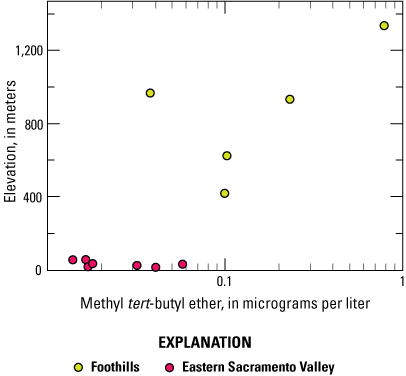
Concentrations of methyl-tert butyl ether (MTBE) in micrograms per liter detected in sampled wells versus elevation in meters (Lor and Dupuy, 2022).

Plot showing sum of per- and polyfluoroalkyl substance (PFAS) concentrations in nanograms per liter detected in sampled wells versus elevation in meters (Lor and Dupuy, 2022).
Acknowledgments
We thank the site owners and water purveyors for granting access and allowing the U.S. Geological Survey to collect samples from their wells. Most of the funding for this work was provided by the California State Water Resources Control Board Groundwater Ambient Monitoring and Assessment Program. Additional funding was provided through U.S. Geological Survey Cooperative Matching Funds. This report is a product of the California State Water Resources Control Board Groundwater Ambient Monitoring and Assessment Program Priority Basin Project.
References Cited
Ayotte, J.D., Argue, D.M., and McGarry, F.J., 2005, Methyl tert-butyl ether occurrence and related factors in public and private wells in southeast New Hampshire: Environmental Science & Technology, v. 39, no. 1, p. 9–16, accessed June 25, 2024, at https://doi.org/10.1021/es049549e.
Baehr, A.L., Stackelberg, P.E., and Baker, R.J., 1999, Evaluation of the atmosphere as a source of volatile organic compounds in shallow groundwater: Water Resources Research, v. 35, no. 1, p. 127–136, accessed June 25, 2024, at https://doi.org/10.1029/1998WR900030.
Belitz, K., Fram, M.S., and Johnson, T.D., 2015, Metrics for assessing the quality of groundwater used for public supply, CA, USA—Equivalent-population and area: Environmental Science & Technology, v. 49, no. 14, p. 8330–8338. [Available at https://doi.org/10.1021/acs.est.5b00265.]
Belitz, K., Hamlin, S.N., Burton, C.A., Kent, R., Fay, R.G., and Johnson, T.D., 2004, Water quality in the Santa Ana Basin, California, 1999–2001: U.S. Geological Survey Circular 1238, 37 p., accessed June 25, 2024, at https://doi.org/10.3133/cir1238.
Belitz, K., Jurgens, B., Landon, M.K., Fram, M.S., and Johnson, T.D., 2010, Estimation of aquifer scale proportion using equal area grids—Assessment of regional scale groundwater quality: Water Resources Research, v. 46, no. 11, 14 p. [Also available at https://doi.org/10.1029/2010WR009321.]
Bennett, G.L., V, 2022, Status and understanding of groundwater quality in the Sacramento Metropolitan Domestic-Supply Aquifer study unit, 2017—California GAMA Priority Basin Project: U.S. Geological Survey Scientific Investigations Report 2022–5021, 52 p., accessed June 25, 2024, at https://doi.org/10.3133/sir20225021.
Bennett, G.L., V, Fram, M.S., and Belitz, K., 2011, Status of groundwater quality in the Southern, Middle, and Northern Sacramento Valley study units, 2005–08—California GAMA Priority Basin Project: U.S. Geological Survey Scientific Investigations Report 2011–5002, 120 p., accessed June 25, 2024, at https://doi.org/10.3133/sir20115002.
Bexfield, L.M., Belitz, K., Fram, M.S., and Lindsey, B.D., 2022, Volatile organic compounds in groundwater used for public supply across the United States—Occurrence, explanatory factors, and human-health context: Science of the Total Environment, v. 827, 12 p. [Also available at https://doi.org/10.1016/j.scitotenv.2022.154313.]
Burow, K.R., Floyd, W.D., and Landon, M.K., 2019, Factors affecting 1,2,3-trichloropropane contamination in groundwater in California: Science of the Total Environment, v. 672, p. 324–334. [Also available at https://doi.org/10.1016/j.scitotenv.2019.03.420.]
Burow, K.R., Nolan, B.T., Rupert, M.G., and Dubrovsky, N.M., 2010, Nitrate in groundwater of the United States, 1991–2003: Environmental Science & Technology, v. 44, no. 13, p. 4988–4997, accessed August 19, 2024, at https://doi.org/10.1021/es100546y.
Burow, K.R., Shelton, J.L., and Dubrovsky, N.M., 2008, Regional nitrate and pesticide trends in ground water in the eastern San Joaquin Valley, California: Journal of Environmental Quality, v. 37, no. S5, p. S249–S263. [Also available at https://doi.org/10.2134/jeq2007.0061.]
California Department of Water Resources, 2021, California’s groundwater update 2020: California Department of Water Resources Bulletin 118, 485 p., accessed June 25, 2024, at https://data.cnra.ca.gov/dataset/calgw_update2020/resource/d2b45d3c-52c0-45ba-b92a-fb3c90c1d4be.
California State Water Resources Control Board, 2017, Groundwater fact sheet—Methyl tertiary-butyl ether (MTBE): California State Water Resources Control Board, Groundwater Ambient Monitoring and Assessment Program (GAMA), 6 p., accessed June 25, 2024, at https://www.waterboards.ca.gov/gama/docs/coc_mtbe.pdf.
California State Water Resources Control Board, 2019, Groundwater fact sheet—Bacteria indicators: California State Water Resources Control Board, Groundwater Ambient Monitoring and Assessment Program (GAMA), 5 p., accessed June 25, 2024, at https://www.waterboards.ca.gov/gama/docs/coc_bacteria_indicators.pdf.
California State Water Resources Control Board, 2022, Drinking water notification levels—Manganese in drinking water: California State Water Resources Control Board web page, accessed June 25, 2024, at https://www.waterboards.ca.gov/drinking_water/certlic/drinkingwater/Manganese.html.
California State Water Resources Control Board, 2023, 1,2,3-Trichloropropane (1,2,3-TCP): California State Water Resources Control Board web page, accessed May 23, 2024, at https://www.waterboards.ca.gov/drinking_water/certlic/drinkingwater/123TCP.html.
California State Water Resources Control Board, 2024a, Revised Total Coliform Rule: California State Water Resources Control Board web page, accessed August 19, 2024, at https://www.waterboards.ca.gov/drinking_water/certlic/drinkingwater/rtcr.html.
California State Water Resources Control Board, 2024b, PFAS—Per- and polyfluoroalkyl substances: California State Water Resources Control Board web page, accessed April 15, 2024, at https://www.waterboards.ca.gov/drinking_water/certlic/drinkingwater/pfas.html.
Carle, D., 2016, Introduction to water in California (2d ed.): Oakland, Calif., University of California Press, 348 p., accessed June 25, 2024, at https://www.jstor.org/stable/10.1525/j.ctv1xxwxp.
Centers for Disease Control and Prevention and U.S. Department of Housing and Urban Development, 2006, Rural water supplies and water-quality issues, chap. 8 of Healthy housing reference manual: Atlanta, Ga., U.S. Department of Health and Human Services, 231 p., accessed June 25, 2024, at https://stacks.cdc.gov/view/cdc/21748.
Clark, L.D., 1960, Foothills fault system, western Sierra Nevada, California: Geological Society of America Bulletin, v. 71, no. 4, p. 8-1 to 8-12, accessed June 25, 2024, at https://doi.org/10.1130/0016-7606(1960)71[483:FFSWSN]2.0.CO;2.
Cousins, I.T., Johansson, J.H., Salter, M.E., Sha, B., and Scheringer, M., 2022, Outside the safe operating space of a new planetary boundary for per- and polyfluoroalkyl substances (PFAS): Environmental Science & Technology, v. 56, no. 16, p. 11172–11179, accessed June 25, 2024, at https://doi.org/10.1021/acs.est.2c02765.
Dawson, B.J.M., 2001, Ground-water quality in the southeastern Sacramento Valley aquifer, California, 1996: U.S. Geological Survey Water-Resources Investigations Report 2001–4125, 24 p., accessed June 25, 2024, at https://doi.org/10.3133/wri014125.
Day, H.W., Moores, E.M., and Tuminas, A.C., 1985, Structure and tectonics of the northern Sierra Nevada: Geological Society of America Bulletin, v. 96, no. 4, p. 436–450, accessed June 25, 2024, at https://doi.org/10.1130/0016-7606(1985)96<436:SATOTN>2.0.CO;2.
DeSimone, L.A., McMahon, P.B., and Rosen, M.R., 2015, The quality of our Nation’s waters—Water quality in Principal Aquifers of the United States, 1991–2010: U.S. Geological Survey Circular 1360, 150 p., 4 app. plus data archive, accessed June 25, 2024, at https://doi.org/10.3133/cir1360.
Dong, J., Tsai, G., and Olivares, C.I., 2024, Prediction of 35 target per- and polyfluoroalkyl substances (PFASs) in California groundwater using multilabel semisupervised machine learning: American Chemical Society Environmental Science & Technology—Water (ACS ES&T Water), v. 4, no. 3, p. 969–981, accessed June 25, 2024, at https://doi.org/10.1021/acsestwater.3c00134.
Falcone, J.A., 2015, U.S. conterminous wall-to-wall anthropogenic land use trends (NWALT), 1974–2012: U.S. Geological Survey Data Series 948, 33 p. plus appendixes 3–6 as separate files, accessed June 25, 2024, at https://doi.org/10.3133/ds948.
Falcone, J.A., 2016, U.S. block-level population density rasters for 1990, 2000, and 2010: U.S. Geological Survey data release, accessed February 29, 2024, at https://doi.org/10.5066/F74J0C6M.
Faunt, C.C., ed., 2009, Groundwater availability of the Central Valley aquifer, California: U.S. Geological Survey Professional Paper 1766, 227 p., accessed June 25, 2024, at https://doi.org/10.3133/pp1766.
Fram, M.S., and Belitz, K., 2014, Status and understanding of groundwater quality in the Sierra Nevada Regional study unit, 2008—California GAMA Priority Basin Project: U.S. Geological Survey Scientific Investigations Report 2014–5174, 118 p., accessed June 25, 2024, at https://doi.org/10.3133/sir20145174.
Gewurtz, S.B., Bradley, L.E., Backus, S., Dove, A., McGoldrick, D., Hung, H., and Dryfhout-Clark, H., 2019, Perfluoroalkyl acids in great lakes precipitation and surface water (2006–2018) indicate response to phase-outs, regulatory action, and variability in fate and transport processes: Environmental Science & Technology, v. 53, no. 15, p. 8543–8552, accessed June 25, 2024, at https://doi.org/10.1021/acs.est.9b01337.
Hull, L.C., 1984, Geochemistry of ground water in the Sacramento Valley, California: U.S. Geological Survey Professional Paper 1401–B, 36 p., 2 pls., accessed June 25, 2024, at https://doi.org/10.3133/pp1401B.
Interstate Technology Regulatory Council, 2020, History and use of per- and polyfluoroalkyl substances (PFAS) found in the environment: Interstate Technology Regulatory Council fact sheet, accessed June 25, 2024, at https://pfas-1.itrcweb.org/wp-content/uploads/2020/10/history_and_use_508_2020Aug_Final.pdf.
Ivahnenko, T., and Barbash, J.E., 2004, Chloroform in the hydrologic system—Sources, transport, fate, occurrence, and effects on human health and aquatic organisms: U.S. Geological Survey Scientific Investigations Report 2004–5137, 34 p., accessed June 25, 2024, at https://doi.org/10.3133/sir20045137.
Ivahnenko, T., and Zogorski, J.S., 2006, Sources and occurrence of chloroform and other trihalomethanes in drinking-water supply wells in the United States, 1986–2001: U.S. Geological Survey Scientific Investigations Report 2006–5015, 13 p., accessed June 25, 2024, at https://doi.org/10.3133/sir20065015.
Jin, S., Yang, L., Danielson, P., Homer, C., Fry, J., and Xian, G., 2013, A comprehensive change detection method for updating the National Land Cover Database to circa 2011: Remote Sensing of Environment, v. 132, p. 159–175, accessed June 25, 2024, at https://doi.org/10.1016/j.rse.2013.01.012.
Johnson, T.D., and Belitz, K., 2019, Domestic well locations and populations served in the contiguous U.S.—Datasets for decadal years 2000 and 2010: U.S. Geological Survey data release, accessed June 25, 2024, at https://doi.org/10.5066/P9FSLU3B.
Jurgens, B.C., Jasper, M., Nguyen, D.H., and Bennett, G.L., 2018, USGS California Groundwater Ambient Monitoring and Assessment Program Priority Basin Project (GAMA-PBP) groundwater-quality results—Assessment and trends: U.S. Geological Survey database, accessed June 25, 2024, at https://doi.org/10.5066/P91WJ2G1.
Jurgens, B.C., McMahon, P.B., Chapelle, F.H., and Eberts, S.M., 2009, An Excel workbook for identifying redox processes in ground water: U.S. Geological Survey Open-File Report 2009–1004, 8 p., accessed June 25, 2024, at https://doi.org/10.3133/ofr20091004.
Kent, R.H., 2021, Sampling for per- and polyfluoroalkyl substances (PFAS) by the Groundwater Ambient Monitoring and Assessment Priority Basin Project: U.S. Geological Survey Fact Sheet 2021–3028, 4 p., accessed June 25, 2024, at https://doi.org/10.3133/fs20213028.
Kim, S.-K., and Kannan, K., 2007, Perfluorinated acids in air, rain, snow, surface runoff, and lakes—Relative importance of pathways to contamination of urban lakes: Environmental Science & Technology, v. 41, no. 24, p. 8328–8334, accessed June 25, 2024, at https://doi.org/10.1021/es072107t.
Kwok, K.Y., Taniyasu, S., Yeung, L.W.Y., Murphy, M.B., Lam, P.K.S., Horii, Y., Kannan, K., Petrick, G., Sinha, R.K., and Yamashita, N., 2010, Flux of perfluorinated chemicals through wet deposition in Japan, the United States, and several other countries: Environmental Science & Technology, v. 44, no. 18, p. 7043–7049, accessed June 25, 2024, at https://doi.org/10.1021/es101170c.
Landon, M.K., Green, C.T., Belitz, K., Singleton, M.J., and Esser, B.K., 2011, Relations of hydrogeologic factors, groundwater reduction-oxidation conditions, and temporal and spatial distributions of nitrate, Central-Eastside San Joaquin Valley, California, USA: Hydrogeology Journal, v. 19, p. 1203–1224, accessed June 25, 2024, at https://doi.org/10.1007/s10040-011-0750-1.
Lindsey, B.D., Jurgens, B.C., and Belitz, K., 2019, Tritium as an indicator of modern, mixed, and premodern groundwater age: U.S. Geological Survey Scientific Investigations Report 2019–5090, 18 p., accessed June 25, 2024, at https://doi.org/10.3133/sir20195090.
Lor, V., and Dupuy, D.I., 2022, Groundwater-quality data in the Butte-Sutter-Yuba Domestic-Supply Aquifer Study Unit, 2021—Results from the California GAMA Priority Basin Project: U.S. Geological Survey data release, https://doi.org/10.5066/P9RAXJTV.
McMahon, P.B., and Chapelle, F.H., 2008, Redox processes and water quality of selected principal aquifer systems: Groundwater, v. 46, no. 2, p. 259–271, accessed June 25, 2024, at https://doi.org/10.1111/j.1745-6584.2007.00385.x.
Moran, M.J., Lapham, W.W., Rowe, B.L., and Zogorski, J.S., 2002, Occurrence and status of volatile organic compounds in ground water from rural, untreated, self-supplied domestic wells in the United States, 1986–99: U.S. Geological Survey Water-Resources Investigations Report 2002–4085, 51 p., accessed June 25, 2024, at https://doi.org/10.3133/wri024085.
Norman, J.E., Toccalino, P.L., and Morman, S.A., 2018, Health-based screening levels for evaluating water-quality data (2d ed.)—Updated 2018 technical information: U.S. Geological Survey web page, accessed June 25, 2024, at https://water.usgs.gov/water-resources/hbsl/methods-guidance-2018.html.
Olmsted, F.H., and Davis, G.H., 1961, Geologic features and ground-water storage capacity of the Sacramento Valley, California: U.S. Geological Survey Water-Supply Paper 1497, 241 p., 5 pls., accessed June 25, 2024, at https://doi.org/10.3133/wsp1497.
Page, R.W., 1986, Geology of the fresh ground-water basin of the Central Valley, California, with texture maps and sections: U.S. Geological Survey Professional Paper 1401–C, 54 p., 5 pls. in pocket, accessed June 25, 2024, at https://doi.org/10.3133/pp1401C.
Pankow, J.F., Thomson, N.R., Johnson, R.L., Baehr, A.L., and Zogorski, J.S., 1997, The urban atmosphere as a non-point source for the transport of MTBE and other volatile organic compounds (VOCs) to shallow groundwater: Environmental Science & Technology, v. 31, no. 10, p. 2821–2828, accessed June 25, 2024, at https://doi.org/10.1021/es970040b.
Pfotenhauer, D., Sellers, E., Olson, M., Praedel, K., and Shafer, M., 2022, PFAS concentrations and deposition in precipitation—An intensive 5-month study at National Atmospheric Deposition Program—National trends sites (NADP-NTN) across Wisconsin, USA: Atmospheric Environment, v. 291, 12 p. [Also available at https://doi.org/10.1016/j.atmosenv.2022.119368.]
Pike, K.A., Edmiston, P.L., Morrison, J.J., and Faust, J.A., 2021, Correlation analysis of perfluoroalkyl substances in regional U.S. precipitation events: Water Research, v. 190, 10 p. [Also available at https://doi.org/10.1016/j.watres.2020.116685.]
PRISM Climate Group, 2024, PRISM climate data: Northwest Alliance for Computational Science and Engineering website, accessed March 3, 2024, at https://prism.oregonstate.edu.
Scott, B.F., Spencer, C., Mabury, S.A., and Muir, D.C.G., 2006, Poly and perfluorinated carboxylates in North American precipitation: Environmental Science & Technology, v. 40, no. 23, p. 7167–7174, accessed June 25, 2024, at https://doi.org/10.1021/es061403n.
Smedley, P.L., and Kinniburgh, D.G., 2002, A review of the source, behaviour and distribution of arsenic in natural waters: Applied Geochemistry, v. 17, no. 5, p. 517–568, accessed June 25, 2024, at https://doi.org/10.1016/S0883-2927(02)00018-5.
Squillace, P.J., Pankow, J.F., Korte, N.E., and Zogorski, J.S., 1997, Review of the environmental behavior and fate of methyl tert-butyl ether: Environmental Toxicology and Chemistry, v. 16, no. 9, p. 1836–1844, accessed June 25, 2024, at https://doi.org/10.1002/etc.5620160911.
Squillace, P.J., Zogorski, J.S., Wilber, W.G., and Price, C.V., 1996, Preliminary assessment of the occurrence and possible sources of MTBE in groundwater in the United States, 1993–1994: Environmental Science & Technology, v. 30, no. 5, p. 1721–1730, accessed June 25, 2024, at https://doi.org/10.1021/es9507170.
Thackray, C.P., Selin, N.E., and Young, C.J., 2020, A global atmospheric chemistry model for the fate and transport of PFCAs and their precursors: Environmental Science—Processes & Impacts, v. 22, no. 2, p. 285–293, accessed June 25, 2024, at https://doi.org/10.1039/C9EM00326F.
Tokranov, A.K., Bexfield, L.M., Ransom, K.M., Kingsbury, J.A., Fram, M.S., Lindsey, B.D., Watson, E., Dupuy, D.I., Voss, S.A., Jurgens, B.J., Stackelberg, P.E., Beaty, D.A., Smalling, K.L., and Bradley, P.M., 2024, Predictions of PFAS occurrence in groundwater at the depth of drinking water supplies in the conterminous United States: U.S. Geological Survey data release, https://doi.org/10.5066/P93RXTKJ.
U.S. Environmental Protection Agency, 2024, Per-and polyfluoroalkyl substances (PFAS)—Final PFAS national primary drinking water regulation: U.S. Environmental Protection Agency web page, accessed April 15, 2024, at https://www.epa.gov/sdwa/and-polyfluoroalkyl-substances-pfas.
U.S. Geological Survey, 2024, California Groundwater Ambient Monitoring and Assessment (GAMA) Program Priority Basin Project—Domestic-supply assessment: U.S. Geological Survey Fact Sheet 2024–3002, 2 p., accessed June 25, 2024, at https://doi.org/10.3133/fs20243002.
Voss, S.A., Jurgens, B.C., Fram, M.S., and Bennett, G.L., V, 2019, Delineation of spatial extent, depth, thickness, and potential volume of aquifers used for domestic and public water-supply in the Central Valley, California: U.S. Geological Survey Scientific Investigations Report 2019–5076, 34 p., accessed June 25, 2024, at https://doi.org/10.3133/sir20195076.
Zogorski, J.S., Carter, J.M., Ivahnenko, T., Lapham, W.W., Moran, M.J., Rowe, B.L., Squillace, P.J., and Toccalino, P.L., 2006, Volatile organic compounds in the nation’s ground water and drinking-water supply wells: U.S. Geological Survey Circular 1292, 101 p., accessed June 25, 2024, at https://doi.org/10.3133/cir1292.
For more information concerning the research in this report, contact the
Director, California Water Science Center
U.S. Geological Survey
6000 J Street, Placer Hall
Sacramento, California 95819
https://www.usgs.gov/centers/california-water-science-center
Publishing support provided by the Science Publishing Network,
Sacramento Publishing Service Center
Disclaimers
Any use of trade, firm, or product names is for descriptive purposes only and does not imply endorsement by the U.S. Government.
Although this information product, for the most part, is in the public domain, it also may contain copyrighted materials as noted in the text. Permission to reproduce copyrighted items must be secured from the copyright owner.
Suggested Citation
Bennett, G.L., V, 2024, Quality of groundwater used for domestic supply in the eastern Sacramento Valley and adjacent foothills, California: U.S. Geological Survey Open-File Report 2024–1061, 15 p., https://doi.org/10.3133/ofr20241061.
ISSN: 2331-1258 (online)
Study Area
| Publication type | Report |
|---|---|
| Publication Subtype | USGS Numbered Series |
| Title | Quality of groundwater used for domestic supply in the eastern Sacramento Valley and adjacent foothills, California |
| Series title | Open-File Report |
| Series number | 2024-1061 |
| DOI | 10.3133/ofr20241061 |
| Publication Date | November 01, 2024 |
| Year Published | 2024 |
| Language | English |
| Publisher | U.S. Geological Survey |
| Publisher location | Reston, VA |
| Contributing office(s) | California Water Science Center |
| Description | 15 p. |
| Country | United States |
| State | California |
| Other Geospatial | Eastern Sacramento Valley and adjacent foothills |
| Online Only (Y/N) | Y |