


Distribution, Abundance, and Breeding Activities of the Southwestern Willow Flycatcher at Marine Corps Base Camp Pendleton, California—2023 Annual Report
Links
- Document: Report (10 MB pdf) , HTML , XML
- Download citation as: RIS | Dublin Core
Acknowledgments
This work was funded by the Environmental Security Department, Resources Management Division, Marine Corps Base Camp Pendleton, California. Data either are not available or have limited availability owing to restrictions of the funding entity (U.S. Marine Corps). Contact Ryan Besser (ryan.besser@usmc.mil) for more information. The authors thank the biologists who assisted in data collection for this project: Lisa Allen, Annabelle Bernabe, Alexandra Houston, Scarlett Howell, Megan Logsdon, Suellen Lynn, Jessica Medina, and Devin Taylor (U.S. Geological Survey).
Executive Summary
The purpose of this report is to provide the Marine Corps with an annual summary of the distribution, abundance, and breeding activity of the endangered Southwestern Willow Flycatcher (Empidonax traillii extimus; flycatcher) at Marine Corps Base Camp Pendleton (MCBCP or “Base”). Surveys for the flycatcher were completed on Base between May 8 and July 26, 2023. All of MCBCP’s historically occupied riparian habitat (core survey area) was surveyed for flycatchers in 2023. None of the non-core survey areas were surveyed in 2023.
In 2023, 14 transient Willow Flycatchers of unknown subspecies were observed on two of the five drainages surveyed, the Santa Margarita River and San Mateo Creek. No Willow Flycatchers were detected at Fallbrook, Las Flores, or Pilgrim Creeks. Transients occurred in a range of habitat types, including mixed willow (Salix spp.) riparian, and riparian scrub. Exotic vegetation, primarily poison hemlock (Conium maculatum), was present in most of the flycatcher locations.
In 2023, the resident Southwestern Willow Flycatcher population on Base consisted of one unpaired female occupying one territory. No territorial males were observed in 2023. The resident flycatcher population was restricted to the Santa Margarita River, and distribution was limited to the Air Station breeding area. The resident flycatcher territory was in mixed willow riparian habitat.
Nesting was initiated in late June and continued into late July. One nesting attempt was documented, which was ultimately unsuccessful because of infertile eggs. No instances of Brown-headed Cowbird (Molothrus ater) parasitism were observed. The flycatcher nest was placed in native sandbar willow (Salix exigua).
For the first time since 2012, a flycatcher that was originally banded as a nestling on MCBCP returned and established a breeding territory in 2023. The nestling (female) was originally banded in 2020, making her 3 years old. No other uniquely banded adult flycatchers present in previous years returned to MCBCP in 2023. No new adults or nestlings were banded in 2023. None of the transients observed during surveys were seen to carry bands. From 2000 to 2023, the adult annual survival of Southwestern Willow Flycatchers on MCBCP was 60±3 percent, while first-year survival was 20±3 percent.
Two measures were initiated in recent years to attract and retain breeding flycatchers on MCBCP: a conspecific attraction playback study (initiated in 2018) and an artificial seep study (initiated in 2019); both were repeated annually through 2023. The female resident flycatcher detected in 2023 was observed within 110 meters (m) of an automated playback unit, and within 90 m of an artificial seep.
Introduction
The purpose of this report is to provide the Marine Corps with an annual summary of the distribution, abundance, and breeding activity of the endangered Southwestern Willow Flycatcher (Empidonax traillii extimus; flycatcher) at Marine Corps Base Camp Pendleton (MCBCP or “Base”). The results are intended to provide the Base with biological information to inform appropriate management of the flycatcher and support the dual missions of environmental stewardship and maintaining military readiness in accordance with the Base Integrated Natural Resources Management Plan (Marine Corps Base Camp Pendleton, 2023) and U.S. Fish and Wildlife Service Programmatic Biological Opinion (U.S. Fish and Wildlife Service, 1995).
The Southwestern Willow Flycatcher is one of four subspecies of Willow Flycatcher in the United States, with a breeding range that includes southern California, Arizona, New Mexico, extreme southern parts of Nevada and Utah, southwestern Colorado, and western Texas (Hubbard, 1987; Unitt, 1987; Browning, 1993). Restricted to riparian habitat for breeding, the Southwestern Willow Flycatcher has declined in recent decades primarily in response to widespread habitat loss throughout its range and, possibly, Brown-headed Cowbird (Molothrus ater; cowbird) parasitism (Wheelock, 1912; Willett, 1912, 1933; Grinnell and Miller, 1944; Remsen, 1978; Garrett and Dunn, 1981; Unitt, 1984, 1987; Gaines, 1988; Schlorff, 1990; Whitfield and Sogge, 1999). By 1993, the species was believed to number approximately 70 pairs in California (U.S. Fish and Wildlife Service, 1993) in small, disjunct populations. The Southwestern Willow Flycatcher was listed as endangered by the State of California in 1992 and by the U.S. Fish and Wildlife Service in 1995. After the listing, population estimates for flycatchers in California increased to 256 territories, with the increase largely attributed to expanded survey effort rather than population growth at known sites (U.S. Fish and Wildlife Service, 2002). In the 2014 5-year status review, estimates of California flycatcher territories decreased to 172, with declines occurring statewide (Durst and others, 2008; U.S. Fish and Wildlife Service, 2014).
Southwestern Willow Flycatchers in southern California co-occur with the Least Bell’s Vireo (Vireo bellii pusillus; vireo), another riparian obligate endangered by habitat loss and cowbird parasitism. However, unlike the vireo, which has increased tenfold since the mid-1980s in response to management alleviating these threats (U.S. Fish and Wildlife Service, 2006), Willow Flycatcher numbers have remained low. As of 2023, most of the Southwestern Willow Flycatchers in California are concentrated at two known sites: (1) the Owens River valley in Inyo County (approximately 57 territories; Great Basin Bird Observatory, 2023), and (2) the upper San Luis Rey River at Lake Henshaw in San Diego County (approximately 51 territories; Howell and Kus, 2024d). Outside of these sites, Southwestern Willow Flycatchers occur as small, isolated populations of one to a half-dozen pairs. Many of these small populations in San Diego County have been occupied intermittently, including Whelan Lake, Guajome, Bonsall, and Couser Canyon on the San Luis Rey River, San Dieguito River, San Diego River, and Sweetwater River (Unitt, 1987; Kus and others, 2003).
Male Southwestern Willow Flycatchers typically begin arriving in southern California in early to mid-May, whereas females arrive approximately 1 week later. Territorial males sing repeatedly from exposed perches while on the breeding grounds to attract a mate. Once a pair bond is established, or in some cases without the presence of a male, the female builds an open-cup nest that usually is placed in a branch fork of a willow (Salix spp.) or plant with a similar branching structure, approximately 1–3 meters (m) above the ground. The typical clutch of three to four eggs is laid in May–June. Females incubate for approximately 12 days and nestlings fledge within 12–15 days in early July. Adults usually depart from their breeding territory in mid-August and early September to their wintering grounds in central Mexico, Central America, and northern South America.
The population of Southwestern Willow Flycatchers at MCBCP was at one time one of the largest in southern California (Unitt, 1987). Flycatcher numbers peaked in 2004 at 42 individuals, followed by declines that began in 2005. In response to declining flycatcher numbers on Base, a conspecific playback study was initiated in 2018 to explore if this method could be used to attract breeding flycatchers to recolonize MCBCP. Conspecific attraction, the tendency for individuals of a species to settle near one another, has been successfully used as a tool for recolonizing restored Sierra Nevada meadows with Willow Flycatchers of the adastus and brewsteri subspecies (Schofield and others, 2018), but it has not been applied to any populations of the extimus subspecies. This report presents a preliminary evaluation of Southwestern Willow Flycatcher response to conspecific playback.
In addition, three artificial seeps were installed in historically occupied flycatcher habitat for the purpose of habitat enhancement. The first seep began operation in 2019 and two additional seeps were added in 2021. The seeps were designed to augment surface water and enhance habitat for breeding flycatchers. Although this enhancement was designed to benefit flycatchers, few flycatchers have inhabited the habitat enhancement areas in recent years. However, Least Bell’s Vireos are abundant in the enhancement areas and were selected as a surrogate species to determine the effects of the habitat enhancement. Vireos co-occur with flycatchers in riparian habitat and have similar habitat requirements, such as the presence of riparian obligate trees (typically willows and cottonwoods) with a shrubby understory. Vireos and flycatchers have similar territory size, similar territorial behavior (singing from high perches to advertise territory boundaries), and they share some similarities in nest placement (nests are placed in the understory vegetation). Although there are some differences in habitat requirements between the two species (flycatchers prefer more mesic conditions that include surface water or elevated soil moisture during at least part of the breeding season; vireos are more tolerant of drier, brushier vegetation sometimes lacking an overstory), vireos were considered sufficiently similar to flycatchers to serve as a surrogate species for analysis. Results of habitat response to seep enhancement are reported in Lynn and Kus (2024).
The purpose of this study, which began in 2000, was to document the status of Southwestern Willow Flycatchers at MCBCP in San Diego County, California. Specifically, our goals were to (1) determine the size and composition of the Willow Flycatcher population on Base; (2) document survivorship (including modeling factors that might affect survival such as sex, age, and precipitation), fidelity, and movement of resident flycatchers; (3) document nesting activities; (4) characterize habitat used by flycatchers; and (5) evaluate the use of conspecific playback to attract breeding Southwestern Willow Flycatchers to historically occupied habitat to facilitate recolonization. Data from 2023, combined with data from 2000 to 2022, will inform natural resource managers about the status of this endangered species at MCBCP and guide modification of land use and management practices as appropriate to ensure the species’ continued existence.
This work was funded by and performed in cooperation with the Assistant Chief of Staff (AC/S), Environmental Security, Resources Management Division, Marine Corps Base Camp Pendleton, California. All activities were authorized under federal 10(a)1(A) Recovery Permit ESPER0004080_0.2.
Study Areas and Methods
Population Size and Distribution
From 2000 to 2018, all of MCBCP’s major drainages and several minor ones that supported riparian habitat were surveyed annually for flycatchers. In 2019, a reduced monitoring plan was implemented in which annual surveys for flycatchers were done only in “core” survey areas, where breeding had historically been documented on Base. The remaining unoccupied riparian habitat was divided into five “non-core” survey groups, with each group to be surveyed on a rotational schedule every 5 years, beginning in 2020. In 2023, all of MCBCP’s historically occupied riparian habitat (core survey area; fig. 1) was surveyed for flycatchers. Because of funding limitations, none of the non-core survey groups were surveyed for flycatchers in 2021, 2022, or 2023. Protocol surveys were done three times between May 15 and July 31 (fig. 1; appendix 1, figs. 1.1–1.5). Fieldwork was completed by U.S. Geological Survey personnel: Lisa Allen, Annabelle Bernabe, Alexandra Houston, Scarlett Howell, Megan Logsdon, Suellen Lynn, and Devin Taylor. The specific areas surveyed are listed in the following section.
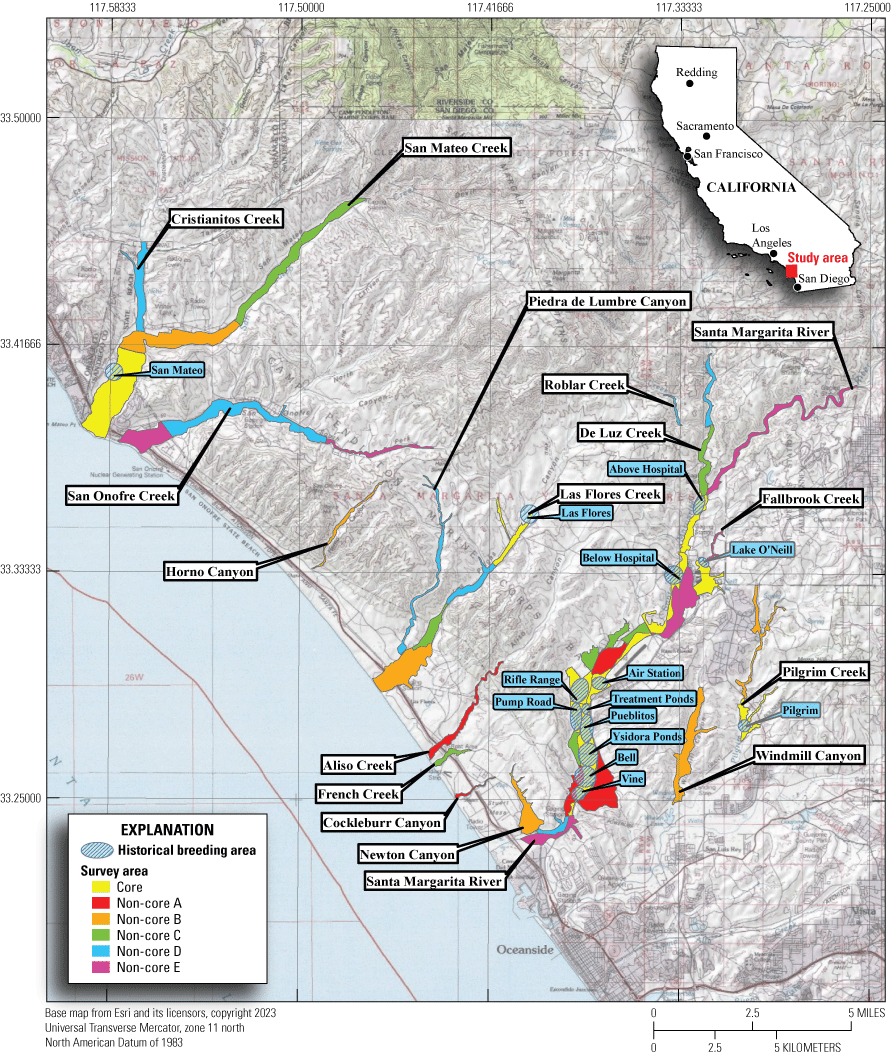
Southwestern Willow Flycatcher survey and historical breeding areas at Marine Corps Base Camp Pendleton, 2023. White labels describe drainages; blue labels describe historical breeding areas. Only the core area was surveyed in 2023.
Core Areas
-
1. Santa Margarita River:
-
(a) Air Station East, Effluent Seep, Bell North, Bell South: from Basilone Road to a point approximately 8.5 kilometer (km) downstream on the east side of the Santa Margarita River (appendix 1, fig. 1.2).
-
(b) Rifle Range, Pump Road North: from the Rifle Range along Stagecoach Road to a point approximately 2.5 km downstream (appendix 1, fig. 1.2).
-
(c) Above Hospital, Below Hospital West: from the confluence with De Luz Creek to Basilone Road (appendix 1, fig. 1.1).
-
-
2. Fallbrook Creek, Lake O’Neill: at the inflow to Lake O’Neill, as well as around the lake (appendix 1, fig. 1.1).
-
3. Las Flores Creek, Upper Las Flores North: between a point 1.6 km downstream from Basilone Road to the Zulu Impact Area boundary approximately 0.8 km upstream from Basilone Road, including the side drainage adjacent to the 43 area (appendix 1, fig. 1.3).
-
4. San Mateo Creek, Lower San Mateo Bottom: between the Pacific Ocean and a point approximately 3.6 km upstream, including habitat south of the creek and south of the agricultural fields (appendix 1, fig. 1.4).
-
5. Pilgrim Creek, South of Vandegrift: between the southern Base boundary and Vandegrift Boulevard, including the two side drainages east of Pilgrim Creek (appendix 1, fig. 1.5).
Investigators followed standard survey protocol (Sogge and others, 2010), moving slowly (approximately 2 km per hour) through the riparian habitat while searching and listening for Willow Flycatchers. Observers walked along the edge(s) of the riparian corridor on the upland or riverside where habitat was narrow enough to detect a bird on the opposite edge. In wider stands, observers traversed the habitat, choosing routes that permitted detection of all birds throughout its extent. Surveys typically began at sunrise and were completed by early afternoon, avoiding conditions of high winds and extreme heat that can reduce bird activity and detectability.
Upon initiation of the survey, investigators stood quietly for 1–2 minutes (min), listening for spontaneously singing Willow Flycatchers and acclimating to surrounding conditions, such as road noise, air traffic, and other bird songs. If flycatchers were not detected during the initial listening period, investigators broadcasted the Willow Flycatcher song (fitz-bew), using an MP3 player or phone and an amplified speaker, at the volume of typical bird songs, for approximately 10–15 seconds (s) and then looked and listened for approximately 1 min for a response. Song playback was ceased immediately upon detection of a Willow Flycatcher. Willow Flycatchers typically responded by moving silently toward the song, singing in response to the song or responding with some other call or vocalization. This procedure was repeated (including a 10-s, quiet, pre-broadcast listening period) every 20–30 m throughout the survey site and more often if background noise was loud. If a Willow Flycatcher was detected, the investigator moved approximately 80–100 m beyond the detection before implementing additional playback to avoid double-counting birds. Because Empidonax flycatchers look very similar and species other than Willow Flycatchers may be present in the habitat, identification of Willow Flycatchers was not made by sight alone; the primary song (fitz-bew) was required for detection purposes (Sogge and others, 2010). If a potential Willow Flycatcher responded silently, approached, or responded with another vocalization (for example, whitts) but did not sing, observers carefully backed away and waited quietly. In most cases, if the bird was a Willow Flycatcher, it sang within a short time (5–10 min). Flycatchers that did not sing by the end of the encounter but were suspected to be breeding were revisited within 3 days (see the “Breeding Productivity” section). Flycatchers that did not sing and were not suspected to be breeding individuals were not counted in survey results, unless the flycatcher was detected again in a subsequent survey period (Sogge and others, 2010).
For each bird encountered, investigators recorded age (adult or juvenile), breeding status (paired, undetermined, or transient), and if possible, if the bird was banded. Flycatcher locations were mapped using Esri Field Maps (Environmental Systems Research Institute, 2022) on Samsung Galaxy S7 and S8 and LG G5 mobile phones with Android operating systems and built-in Global Positioning Systems to determine geographic coordinates (World Geodetic System 1984 [WGS 84]).
Habitat Characteristics
Habitat was characterized by visual inspection within 50 m of each flycatcher location. Habitat type was recorded according to the following categories, based on dominant vegetation:
-
Mixed willow riparian: Habitat dominated by one or more willow species, including black willow (S. gooddingii), arroyo willow (S. lasiolepis), and red willow (S. laevigata), with mule fat (Baccharis salicifolia) as a frequent co-dominant.
-
Willow-cottonwood: Willow riparian habitat in which Fremont cottonwood (Populus fremontii) is a co-dominant.
-
Willow-sycamore: Willow riparian habitat in which California sycamore (Platanus racemosa) is a co-dominant.
-
Sycamore-oak: Woodlands in which California sycamore and coast live oak (Quercus agrifolia) occur as co-dominants.
-
Riparian scrub: Dry or sandy habitat dominated by sandbar willow (S. exigua) or mule fat, with few other woody species.
-
Upland scrub: Coastal sage scrub adjacent to riparian habitat.
-
Non-native: Areas vegetated primarily with non-native species, such as giant reed (Arundo donax) and saltcedar (Tamarix ramosissima).
Percent cover of exotic vegetation at each location was estimated using cover categories of less than 5 percent, 5–50 percent, 51–95 percent, and greater than 95 percent; the dominant exotic species was recorded.
Conspecific Playback Surveys
Historical breeding territories (identified by a single GPS location per year) at MCBCP were grouped into 14 plots; 7 of the plots received conspecific vocalization broadcasts designed to attract Southwestern Willow Flycatchers, and the remaining 7 served as a control group, receiving no vocalization broadcasts (fig. 2; Schofield and others, 2018). Of the seven conspecific playback plots, five were on the Santa Margarita River, one was at Lake O’Neill, and one was at Pilgrim Creek. Six of the control plots were on the Santa Margarita River, and the remaining plot was on Pilgrim Creek. In the conspecific playback plots, an automated unit broadcasted a combination of Willow Flycatcher vocalizations (primary “fitz-bew” song and various calls, interspersed with silence) from 0100 to 0600, 0700 to 0900, and 2000 to 2100 Pacific Standard Time (PST). Vocalizations were broadcast at a volume level mimicking the typical level of spontaneously singing Willow Flycatchers and could be heard by observers at a maximum of 80 m away from the broadcast unit. Automated broadcast units consisted of a FOXPRO NX4 wildlife caller (FOXPRO, Lewiston, Pennsylvania) connected to a Favolcano CN101A digital programmable timer (Favolcano, Fujian, China) and an external power source (12-volt, 9 amp-hours, AH, battery). The automated broadcast units were operated from May 1 to August 10, 2023, spanning the time when northbound flycatchers would be searching for locations to settle and potentially encompassing southbound flycatchers that might settle in future breeding seasons. Control plots not receiving broadcast vocalizations were located a minimum of 200 m from the broadcast unit to eliminate influence from the broadcast.
Surveys were done every other week from May to July in the conspecific playback and control plots to determine if any Southwestern Willow Flycatchers had established a territory. Surveys in 2023 began on May 8 and concluded on July 26. Investigators surveyed within 50 m of all historical breeding territories that fell within the playback or control plot, following a slightly modified survey protocol developed to attract Willow Flycatchers of the adastus and brewsteri subspecies to restored Sierra Nevada meadows (Schofield and others, 2018). Upon initiation of the survey, investigators stood quietly for 3–5 min, listening for spontaneously singing or calling Willow Flycatchers. If flycatchers were not detected during the initial listening period, investigators broadcasted the Willow Flycatcher song for approximately 30 s and then looked and listened for approximately 2 min for a response. If no response was detected, investigators repeated the 30-s broadcast and 2-min listening period. If flycatchers were not detected after the second round of broadcasting/listening, the investigator moved to the next historical location within the survey plot and repeated the sequence with a 1-min, pre-broadcast listening period before beginning the 30-s playback. In plots with automated broadcast units, if the survey was done during the time the broadcast was scheduled, the units were turned off before beginning the survey.
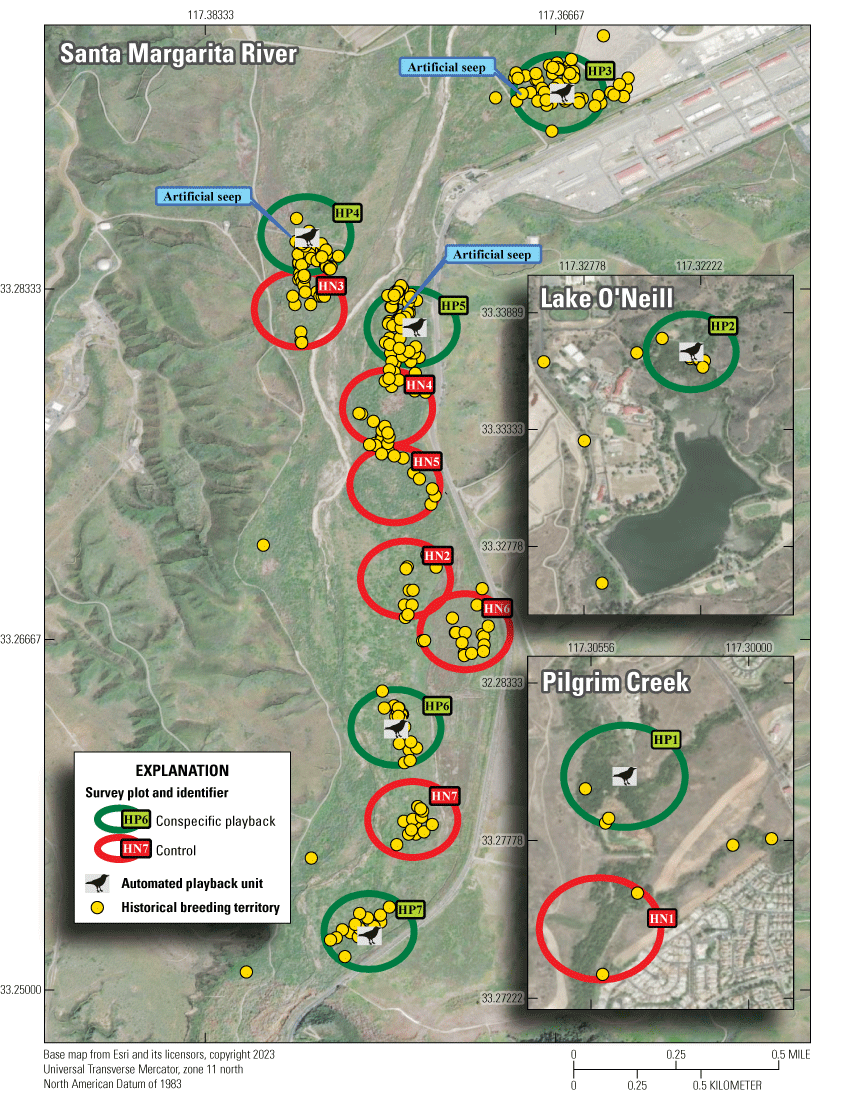
Southwestern Willow Flycatcher conspecific playback survey plots, automated playback unit locations, artificial seep locations, and historical breeding territories at Marine Corps Base Camp Pendleton, 2023.
Artificial Seep Monitoring
Three artificial seeps were installed by MCBCP to increase surface water in Southwestern Willow Flycatcher breeding habitat: one in 2019 and two in 2021. The seeps were located within three of the conspecific playback plots (fig. 2) along the Santa Margarita River. As a result of heavy winter precipitation, the artificial seep in HP4 was not operational during the 2023 breeding season. During the course of conspecific playback surveys, we observed the habitat immediately surrounding the seeps and recorded if any Willow Flycatchers were using the area.
Breeding Productivity
Flycatchers observed during protocol surveys that were suspected to be resident birds (for example, observed in more than one survey period, pair vocalizations heard, evidence of nesting seen) were revisited within 3 days of the detection date. Resident birds were observed for evidence of nesting, and nests were located and monitored following standard protocol (Rourke and others, 1999). Nests were visited as infrequently as possible to minimize disturbance and reduce the chances of leading predators or cowbirds to nest sites. Typically, there were three to four visits per nest, spaced approximately 5–10 days apart, depending on the stage of the nest when initially detected. The first visit was timed to determine the number of eggs laid, the next to confirm hatching and age of young, and the last to band nestlings. After a nest became inactive, six possible nest fates were assigned based on the following parameters:
-
(SUC) Successful: Nests that fledged at least one young. Fledging was confirmed by detection of young outside the nest.
-
(PRE) Nest failed as a result of predation: This category included (1) nests seen in the process of ant or other predation; (2) nests found with evidence such as eggshell fragments, feathers, or partially consumed nestlings in or below the nest; (3) nests with eggs or nestlings later found empty and torn from supporting branch, either partially or completely, typically indicative of mammal predation (Peterson and others, 2004); and (4) nests that had eggs or nestlings but were later found intact and empty before the expected fledge date with no evidence of eggs or nestlings on the ground, consistent with snake and bird predation, which typically leave no sign (Peterson and others, 2004).
-
(PAR) Nest failed as a result of parasitism: This category included (1) nests that were abandoned with one or more cowbird eggs in the nest and (2) nests that were tended by the host but contained only cowbird eggs.
-
(INC) Incomplete: Nests that were seen under construction but were never completed.
-
(OTH) Nest failed for other reasons that are known: This category included (1) nests that failed for reasons that were known, such as host plant failure or surrounding vegetation falling and crushing a nest; (2) nests with inviable eggs that did not hatch after more than two weeks; (3) or human disturbance, such as mowing or weed-whacking. This category also included nests that appeared to have failed as a result of cowbird “predation,” such as (1) abandoned nests containing punctured eggs in or below the nest; (2) nests where nestlings were killed by a puncture wound to the skull; or (3) nests where nestlings were ejected from the nest and found on the ground.
-
(UNK) Nest failed for unknown reasons: This designation was used when no other reason could be confirmed. In many instances, the fate “UNK” was assigned to nests that were likely depredated but, because we could not confirm egg-laying, did not fit the criteria of the “PRE” fate; these failures are explained more fully in the “Results” section.
Nest Site Characteristics
Nest site characteristics were recorded after the abandonment or fledging of nests. Measurements included: nest height, host species, host height, distance from the nest to the edge of the host species, and distance from the nest to the edge of the clump of riparian vegetation (Rourke and others, 1999). Distance to edge of the clump was expressed as a negative number if the nest was not in a clump of riparian vegetation. For example, if the nest was in a field of poison hemlock (Conium maculatum) without any other riparian vegetation present, the distance to the nearest clump of riparian vegetation was measured and the value expressed as a negative number.
Survivorship, Fidelity, and Movement
To facilitate analyses of survival, fidelity, and movement, we attempted to capture and color band all resident flycatchers detected on MCBCP starting in 2000. Attempts were made each year to capture any unbanded adults within their territories using mist nets and band them with a numbered federal band on one leg and a solid or bi-colored metal band on the other. Nestlings were banded at 7–10 days of age with a silver, aluminum, federal numbered band on the right leg. Returning adults previously banded as nestlings (natal) were target netted to determine their identity, and their original band supplemented with one additional band to generate a unique color combination.
Annual Survivorship
During surveys, we attempted to resight all Willow Flycatchers to determine whether they were banded, and if so, to confirm their identity by reading their unique color band combination or by recapturing birds with single federal bands. We used resighting and recapture data to calculate annual survival, or the probability of surviving from one year to the next. Annual survival was calculated separately for adults and for first-year flycatchers that were banded as nestlings or juveniles (first-year survival). Imperfect detectability of banded individuals is typical of mark-recapture studies and occurs for various reasons (for example, females are more cryptic and may be missed on surveys, birds are detected as banded but their full color combinations [and thus identities] are not obtained, or birds with single federal bands are not recaptured and thus their identities not determined). Therefore, we analyzed annual survival of banded flycatchers during 2000–23 at MCBCP with the Cormack-Jolly-Seber (CJS) model in Program MARK (White and Burnham, 1999) using the RMark package (Laake, 2013) in R (R Core Team, 2022), which accounts for individuals that were present but not detected or captured by modeling both survivorship and detection probabilities.
Annual survivorship models were built by creating an encounter history matrix of all individual Southwestern Willow Flycatchers ever detected on MCBCP and if they were observed in each year from 2000 to 2023. Flycatchers were grouped by age (first-year [birds first encountered and banded as nestlings or juveniles] versus adult [birds first encountered and banded as adults and any first-year bird that survived to adulthood]) and sex (female versus male). We created two sets of models: (1) a set including only adults (n=131; birds banded as adults or first-year birds that survived beyond their first year and returned to breed), and thus of known sex (“Adults Only”), and (2) a set including adults and nestlings (n=377; “Adults and First-year Birds”). We used the “Adults Only” models to test the effects of sex, year, and winter precipitation on adult survival and used the “Adults and First-year Birds” models to evaluate the effects of age, year, and winter precipitation on flycatcher survival. This model set did not include sex because we were unable to determine sex of flycatchers banded as nestlings unless they returned and were recaptured and identified as adults. Therefore, only the nestlings that survived their first winter could be classified retroactively as “male” or “female,” which would severely bias the estimate of sex-related survivorship of first-year flycatchers. To evaluate the influence of age, sex, year, and winter precipitation on detection probability, we built and compared models holding survivorship constant. For the Adults Only models, we constrained detection probability to be influenced by sex to account for sex-related behaviors (for example, males sing frequently from exposed perches and are more easily detected than females, females may not respond to playback). For the models that included adults and first-year birds, we determined that detection probability was influenced by age, so it was included in all models of age-dependent flycatcher survivorship.
Winter precipitation was grouped into two periods of each bio-year (fig. 3; from July 1 to June 30; Office of Water Resources, 2023): early winter (October–December of the calendar year preceding the breeding season [PrecipEW]) and late winter (January–March of the calendar year of the breeding season [PrecipLW]). We created a set of models using total winter precipitation ([PrecipTW]; the sum of EW and LW precipitation), early winter precipitation, and late winter precipitation as independent variables, and an additive model that evaluated early and late winter precipitation together (PrecipEW+PrecipLW) to estimate the coefficients for one variable while controlling for the other.
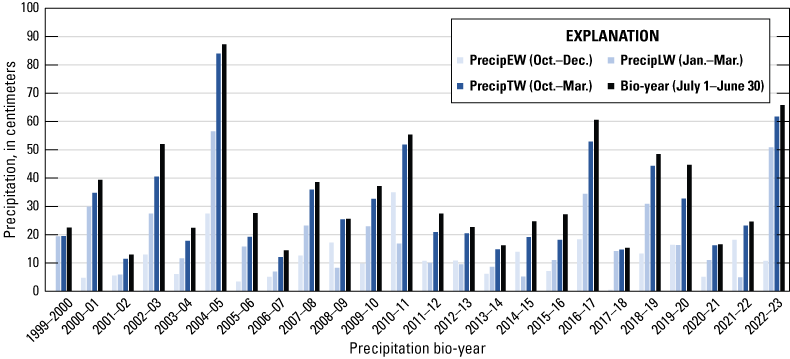
Precipitation totals from the Lake O’Neill weather station at Marine Corps Base Camp Pendleton, California, 2000–23. Abbreviations: PrecipEW, early winter precipitation from October 1 to December 31 of the calendar year before the breeding season year; PrecipLW, late winter precipitation from January 1 to March 31 of the breeding season year; PrecipTW, total winter precipitation from October 1 of the calendar year before the breeding season to March 31 of the breeding season year.
We used an information-theoretic approach (Akaike’s Information Criterion for small sample size [AICc]) to evaluate support for models that tested the effects of age, sex, year, and winter precipitation on survival (Burnham and Anderson, 2002). We used logistic regression with a logit link to build and rank models by AICc, and identified the top model. First, we generated a constant survival model to serve as a reference for the effects of age, sex, year, and winter precipitation on survival. We then modeled the covariates and evaluated support for the models in relation to the constant survival model. We considered models “well-supported” if they were within 2 AICc units of the top model (ΔAICc) and had an Akaike Information Criterion (AIC) weight (the weight of evidence for the given model relative to the other models in the set) greater than 0.05. We evaluated the contributions of covariates within our top models by calculating the odds ratio for each covariate (the odds that the covariate had an effect on survival, where “no effect” is equal to 1, negative effect is less than 1, and positive effect is greater than 1). We then examined the 95-percent confidence interval of the odds ratio to determine the likelihood that the effect was significant. Where the confidence interval did not span 1, we concluded that we had 95-percent confidence that the covariate had a positive or negative effect on survival. We present real estimates of annual survival from the top model. If there were multiple well-supported models (ΔAICc less than or equal to 2), but it was determined that none of the covariates contributed to survival, we selected the most parsimonious model (constant model) to obtain real estimates of annual survival for adult females, adult males, all adults, and all first-year flycatchers.
Site Fidelity and Movement
Site fidelity and between-year and within-year movements of flycatchers were determined by measuring the distance between the center of a flycatcher’s breeding territory in 2022 (or last year detected) and the center of the same flycatcher’s breeding territory in 2023. Adult flycatchers exhibited site fidelity if they returned to within 100 m of their last occupied territory, and natal flycatchers exhibited natal site fidelity if detected anywhere on Base.
Data Comparisons
Data from most years at MCBCP used in comparisons with current data can be found in the following: Kus, 2001; Kus and Ferree, 2003; Kus and Kenwood, 2003, 2005, 2006a, b; Kenwood and Kus, 2007; Rourke and others, 2008; Howell and Kus, 2009a, b, 2010, 2011, 2012, 2013, 2014, 2015, 2016, 2017, 2024a, b, c; and Howell and others, 2018, 2020.
Results
Population Size and Distribution
Transients
There were 14 Willow Flycatchers of unknown subspecies observed during protocol and conspecific playback surveys (appendix 2, figs. 2.1–2.3; appendix 3, figs. 3.1–3.5). All transients were detected between May 10 and June 9. Transients were detected on the Santa Margarita River and San Mateo Creek but were not detected on Fallbrook, Las Flores, or Pilgrim Creeks.
Residents
One Southwestern Willow Flycatcher (female) was detected during the 2023 breeding season (table 1; appendix 2, fig. 2.2; appendix 3, fig. 3.5; appendix 4, fig. 4.1). The resident female was initially detected during conspecific playback surveys. One territory was established, consisting of one unpaired female. No males were observed in 2023. Overall, the resident flycatcher population on Base increased to one individual compared to zero individuals in 2022 (fig. 4; table 1).
Table 1.
Distribution of territorial Southwestern Willow Flycatchers at Marine Corps Base Camp Pendleton, 2000–23.[Refer to fig. 1 for drainage/breeding areas. Drainage/breeding area: FC, Fallbrook Creek, LF, Las Flores Creek; PC, Pilgrim Creek; SO, San Mateo Creek; SR, Santa Margarita River]
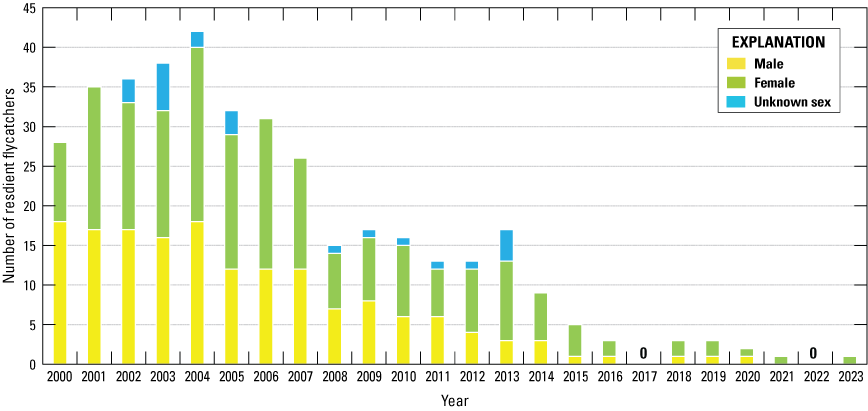
The number of resident Southwestern Willow Flycatchers at Marine Corps Base Camp Pendleton, 2000–23.
The population of resident flycatchers on Base in 2023 (one individual) was restricted to the Santa Margarita River (appendix 2, fig. 2.2; appendix 4, fig. 4.1). In 2023, only the Air Station flycatcher breeding area along the Santa Margarita River was occupied, which hosted the unpaired female (table 1). Overall, flycatcher distribution on the Santa Margarita River remained contracted relative to previous years. All other breeding areas along the Santa Margarita River that historically supported resident flycatchers (Vine, Bell, Ysidora Ponds, Pump Road, Pueblitos, and Treatment Ponds; fig. 1) were devoid of flycatcher territories in 2023 (table 1).
Conspecific Playback Surveys
We detected a resident flycatcher in 14 percent (1/7) of conspecific playback plots and none of the control plots. The resident flycatcher (female) detected on Base in 2023 settled within 110 m of an automated playback unit. Transient flycatchers were detected in 29 percent (2/7) of conspecific playback plots and 14 percent (1/7) of control plots with no playback.
Habitat Characteristics
A total of 60 percent (9/15) of all flycatcher detections occurred in habitat classified as mixed willow riparian, all of which occurred along the Santa Margarita River (table 2). The remaining locations were in riparian scrub, dominated by mule fat or sandbar willow. Exotic vegetation was present at 93 percent of flycatcher locations in 2023 (14/15). The most common exotic plant in habitat used by flycatchers was poison hemlock (table 2). Of the flycatcher locations, 80 percent (12/15) contained 5–50 percent exotic vegetation, and 13 percent (2/15) were dominated by exotic vegetation (percent cover of exotics greater than 50 percent).
Table 2.
Habitat characteristics of Willow Flycatcher locations at Marine Corps Base Camp Pendleton, 2023.[Habitat was evaluated within 50 meters of bird location. Abbreviations: BRA, black mustard (Brassica nigra); CEN, star thistle (Centaurea spp.); CON, poison hemlock (Conium cmaculatum); <, less than; —, no data]
During the course of surveys, observers incidentally observed large stands of dead and dying trees within many of the historical flycatcher breeding areas. We suspected that the tree death may have been the result of past invasive shothole borer (Euwallacea spp.) infestation (Nobua-Behrmann and others, 2023). The tops of many willow trees were snapped off, which reduced overall canopy height and density. In addition to trees that were already dead, others showed evidence of active infestation (for example, frass and wet staining at entrance holes; Nobua-Behrmann and others, 2023).
Breeding Productivity Results
Nesting was observed for the one unpaired female and was initiated in late June. The earliest estimated egg-laying date was June 27 and nesting continued into late July. One nesting attempt was documented during the 2023 breeding season. The nest ultimately failed because of presumably infertile eggs, as the eggs remained unhatched after 25+ days.
Nest Site Characteristics
The flycatcher nest at MCBCP in 2023 was placed in sandbar willow. Nest height was 2.1 m, whereas the host vegetation height was 2.7 m. The nest was placed 0.5 m from the edge of the willow and 1.2 m from the edge of the clump of vegetation.
Cowbird Parasitism
No nest parasitism of Southwestern Willow Flycatcher nests by cowbirds was documented in 2023.
Survivorship, Site Fidelity, and Movement
Overview of Banded Population
All resident flycatchers were observed closely enough to determine with confidence whether they were banded. One resident female that was banded with a single federal band as a nestling was recaptured in 2023 and banded with a second band to provide a unique combination. The flycatcher was originally banded in 2020, making her 3 years old. Of the 14 transient Willow Flycatchers, 8 were observed well enough to determine band status (57 percent); none of the observed transient Willow Flycatchers were seen to carry bands.
Annual Survivorship
The recapture and resighting of banded birds allowed us to determine the proportion of Southwestern Willow Flycatchers previously documented on Base that returned to hold territories in 2023. No banded adult flycatchers were detected during the 2022 breeding season, and no fully banded adult flycatchers present before 2022 were observed on MCBCP in 2023.
Survivorship Models—Adults-Only
Of the eight models we built, the four highest-ranked models included an effect of winter precipitation (table 3); however, none of these effects were significant contributors to adult survival (table 4). The models that included the effects of early winter precipitation (PrecipEW) and total winter precipitation (PrecipTW) were virtually identical and were ranked as the number one and number two models. However, for both models, the parameter estimates (β) were near zero, the odds ratios equaled 1, and the 95-percent confidence interval of the odds ratio included 1, indicating that these variables had little influence on survival (table 4). The next two highest-ranking models also included winter precipitation in varying time intervals (PrecipLW, PrecipEW+PrecipLW), but based on low β values and confidence intervals spanning 1, none of these precipitation measures appeared to have a significant influence on survival. The constant survival model was ranked just below the models that included winter precipitation. The model that included an effect of sex was weighted just below the constant survival model; however, the 95-percent confidence interval of the odds ratio included 1, indicating that sex did not significantly influence the model (table 4). Year appeared only in the two lowest ranked models and was not as well supported as the constant survival model. Based on the constant model, annual adult survival was 58±3 percent (SE). Detection probability for males (91±5 percent) was higher than for females (82±5 percent).
Table 3.
Logistic regression models for the effects of sex (male versus female), year, and winter precipitation variables on annual survival of adult Southwestern Willow Flycatchers on Marine Corps Base Camp Pendleton, 2000–23.[The effect of sex on detection probability was included in all models. Models are ranked from best to worst based on Akaike’s Information Criterion for small samples (AICc), difference in AICc between this model and the top model (ΔAICc), and AICc weights. AICc is based on −2×loge likelihood and the number of parameters in the model. Abbreviations: +, plus; PrecipEW, early winter precipitation from October 1 to December 31 of the calendar year before the breeding season; PrecipLW, late winter precipitation from January 1 to March 31 of the breeding season year; PrecipTW, total winter precipitation from October 1 of the calendar year before the breeding season to March 31 of the breeding season year]
Table 4.
Parameter estimate (β), standard error (SE), odds ratios, and 95-percent confidence intervals (CI) for the top models explaining annual survival of adult Southwestern Willow Flycatchers on Marine Corps Base Camp Pendleton, 2000–23.[Models are in order of best-supported to least-supported. Abbreviations: PrecipEW, early winter precipitation from October 1 to December 31 of the calendar year before the breeding season; PrecipLW, late winter precipitation from January 1 to March 31 of the breeding season year; PrecipTW, total winter precipitation from October 1 of the calendar year before the breeding season to March 31 of the breeding season year; +, plus]
Survivorship Models—Adults and First-year Birds
Of the eight models built to examine the effects of age, year, and winter precipitation on annual survivorship of all flycatchers, the top model included age (table 5). This model had an AICc weight greater than 0.99, which was well above any other model in the model set. In this top model, adult flycatcher survival was significantly higher than that of first-year flycatchers (95-percent confidence interval of the odds ratio did not include 1; table 6). Based on the top model that included age, adult survival was 60±3 percent, whereas first-year survival was 20±3 percent.
Table 5.
Logistic regression models for the effects of age (first-year versus adult), year, and winter precipitation variables on survival of Southwestern Willow Flycatchers on Marine Corps Base Camp Pendleton, 2000–23.[The effect of age on detection probability was included in all models. Models are ranked from best to worst based on Akaike’s Information Criterion for small samples (AICc), difference in AICc between this model and the top model (ΔAICc), and AICc weights. AICc is based on −2×loge likelihood and the number of parameters in the model. PrecipEW, early winter precipitation from October 1 to December 31 of the calendar year before the breeding season; PrecipLW, late winter precipitation from January 1 to March 31 of the breeding season year; PrecipTW, total winter precipitation from October 1 of the calendar year before the breeding season to March 31 of the breeding season year. Abbreviation: +, plus]
Table 6.
Parameter estimate (β), standard error (SE), odds ratios, and 95-percent confidence intervals (CI) for the top model explaining annual survival of Southwestern Willow Flycatchers on Marine Corps Base Camp Pendleton, 2000–23.[The Intercept includes first-year flycatchers. All other effects values are the difference between that parameter and the Intercept]
Site Fidelity and Movement
Southwestern Willow Flycatchers at MCBCP generally settle into historically occupied breeding areas to establish territories (see fig. 1 for historical breeding areas). Resighting banded birds allowed us to examine between-year and within-year site fidelity of flycatchers. No between-year or within-year movement of fully banded adult flycatchers was observed in 2023. The returning natal female, originally banded as a nestling in the Pueblitos breeding area, dispersed to the Air Station breeding area, approximately 1.7 km away from her natal location. The natal female was not detected on Base in 2021 or 2022. No emigration or immigration of banded flycatchers was documented in 2023.
Discussion
In 2023, one Southwestern Willow Flycatcher was detected on MCBCP, after no resident flycatchers were detected in 2022. Although it is encouraging that a resident flycatcher returned to MCBCP in 2023, the population remains in a critical state, having declined 98 percent from the record high of 42 individuals in 2004. An overall downward trend began in 2005, characterized by several stepwise population declines, where the resident population dropped by more than 24 percent from one year to the next (2004–05: 24 percent; 2007–08: 42 percent; 2013–14: 47 percent; 2014–15: 44 percent; and 2015–16: 40 percent). Resident flycatchers were not detected on Base in 2017, but in 2018, three flycatchers that were previously detected on Base returned and resumed breeding. The resident population remained at three individuals from 2018 to 2019 before resuming the downward trend, with a 67-percent decline from 2019 to 2020, followed by a 50-percent decline from 2020 to 2021 when no breeding male flycatchers were detected on Base, leaving a single, resident female that was not detected in 2022.
The number of transient Willow Flycatchers detected annually in the core survey area has varied greatly, despite consistent survey scope and effort, from a low of 2 in 2000 to a high of 42 in 2016. Although factors influencing the migratory route and variable timing of transient Willow Flycatchers are unclear, it remains clear that MCBCP provides important stopover habitat for migrating Willow Flycatchers. Transient flycatchers were observed along two drainages on Base in 2023, including the Santa Margarita River and San Mateo Creek. Transient flycatchers used multiple habitat types, with most observed in mixed willow riparian habitat along the Santa Margarita River. Exotic vegetation was dominant at multiple transient locations in 2023.
Dramatic changes were observed in the riparian habitat on Base in 2023, stemming from a winter with above-average precipitation (65.8 centimeters [cm], Office of Water Resources, 2023). Bio-year precipitation was nearly double the average from 2000 to 2022 (33.2±18.1 cm). In many places along the Santa Margarita River, flood waters scoured the floodplain, leaving the understory without vegetation in some areas, and piles of dead trees and debris in other areas. At the start of the flycatcher breeding season in May, deep water was still standing in some areas, and small rivulets flowed through the habitat well away from the main channel of the river. Many of these small rivulets were still flowing at the end of July. The increased water levels in historical flycatcher breeding habitat may have prompted a resident flycatcher to return to MCBCP following a 1-year absence.
Of the seven primary breeding areas on the Santa Margarita River (those that supported multiple breeding pairs in multiple years), only the Air Station breeding area was occupied in 2023. A female flycatcher was detected late in the breeding season (June 22), but no male flycatcher was detected. The unpaired breeding female built a nest and laid eggs that failed to hatch. Before 2023, the Air Station breeding area was last occupied by breeding flycatchers in 2019. The Air Station breeding area had been occupied by breeding birds on and off since 2000 and provided habitat for one to five breeding pairs in most years before the 2014 Las Pulgas fire, which burned approximately 350 hectares (ha) of riparian habitat along the Santa Margarita River. The Air Station breeding area has not been occupied by a male flycatcher since the fire; however, an unpaired breeding female attempted to nest in the area in 2016 and 2018, building a nest and laying presumably infertile eggs both years. In 2018, the breeding female present in the Air Station breeding area remained in the area for approximately 1 month before moving to the Pueblitos breeding area to pair with a male in that area. In 2019, the same breeding female returned to the Air Station breeding area and successfully fledged young. In 2020, 2021, and 2022, breeding flycatchers were not detected in the Air Station breeding area.
All other breeding areas more recently occupied by Southwestern Willow Flycatchers on MCBCP remained vacant in 2023, including the Pueblitos and Treatment Ponds breeding areas. The Pueblitos breeding area has been the most consistently occupied breeding area on Base, supporting up to six pairs annually in 19 of the 24 years since annual monitoring began in 2000. Beginning in 2009, occupancy fluctuated between zero and one pair, with the exception of 2018 when two pairs occupied the area. In 2019 and 2020, Pueblitos was occupied by a single pair, and in 2021, Pueblitos was occupied only by an unpaired female. Resident flycatchers were not detected in the Pueblitos breeding area in 2022 or 2023. The Treatment Ponds area was last occupied by breeding birds in 2018; the area hosted one to four breeding pairs from 2006 to 2016, was unoccupied in 2017 (when no breeding birds were detected anywhere on Base), and was occupied by one female at the beginning of the 2018 breeding season before she moved to Pueblitos.
The reasons for the declines in the Pueblitos and Treatment Ponds breeding areas remain unclear; however, it is possible that the habitat may have reached a stage of ecological succession that is unsuitable for breeding flycatchers because these areas have not experienced any disturbance since giant reed removal occurred in 2001. Flycatchers often occupy early successional habitat, which was historically created by natural processes, such as annual flooding that scoured the floodplain and created a mosaic of different aged stands of habitat (U.S. Fish and Wildlife Service, 2002; Theimer and others, 2018). Because natural processes such as flooding have been largely interrupted in modern times, disturbances such as vegetation removal can sometimes mimic the disturbance caused by flooding and can create early successional habitat. If the lack of birds is related to habitat senescence, then flooding-related habitat changes that occurred in 2023 may refresh the habitat and make it attractive for breeding flycatchers again.
At the Pump Road breeding area, habitat senescence was also originally suspected as a possible reason for the declines in occupancy. The Pump Road breeding area was last occupied by breeding birds in 2013; from one to six breeding pairs annually occupied the area from 2000 to 2013. The Pump Road breeding area was also affected by the 2014 Las Pulgas wildfire, which should have created a new patch of early successional habitat for flycatchers to occupy following habitat recovery. Although the habitat seems to have recovered to pre-fire condition at the Pump Road breeding area, it remains unoccupied. Based on habitat recovery after previous fires in Southwestern Willow Flycatcher-occupied habitat in other locations, a minimum of 3–5 years is necessary for burned habitat to become suitable again for breeding (Paxton and others, 2007). However, burned areas may take more than a decade to regain suitability for flycatchers after catastrophic wildfire and may not recover at all. A site along the San Pedro River in Arizona burned in June 1996 and still was not reoccupied after 10 years (Durst and others, 2008), with the lack of suitable habitat regeneration suggested as the reason for extirpation (English and others, 2006). Habitat recovery after fire depends on many factors, including hydrologic conditions during regrowth; conditions such as drought, reduced groundwater, and altered river flow may impede recovery (Smith and others, 2009).
The three remaining primary breeding areas along the Santa Margarita River (Vine, Bell, and Ysidora Ponds) have been unoccupied since 2004, 2007, and 2008, respectively. The decline in these areas may have been related to prolonged overgrowth of exotic vegetation and poor recovery of the riparian habitat after exotics removal. All flycatcher breeding areas upstream from these three areas experienced some form of exotic vegetation removal between 1996 and 2002, but the overgrowth of exotic vegetation persisted in Vine, Bell, and Ysidora Ponds. Exotic vegetation (giant reed and saltcedar) was removed from these areas in 2008 and 2009; however, the areas remain unoccupied. It is possible that drought conditions experienced in San Diego County slowed habitat recovery following exotic removal. In the past, flycatchers have reoccupied areas on Base after exotic vegetation removal within 5–7 years: exotic vegetation was removed from the Pump Road area in 1996, which supported multiple breeding pairs by 2001; the Air Station area had exotic vegetation removed in 2000 and had returned to pre-removal occupancy by 2007; and the Treatment Ponds area had exotic vegetation removed in 2001 with recolonization by flycatchers by 2006. Mean (±SD) annual precipitation for the first 5 years following exotics removal at Pump Road, Air Station, and Treatment Ponds breeding areas was 41.9±23.9, 42.8±29, and 40.5±29.9 cm, respectively (Office of Water Resources, 2023). In contrast, the mean annual precipitation for the first 5 years after exotics removal in 2008 (Ysidora Ponds) and 2009 (Bell and Vine) was 33.7±13.3 and 31.8±12.2 cm, respectively. Reduced precipitation in the post-removal years may have suppressed natural regrowth of riparian vegetation after removal. Although more precipitation fell in more recent years (2017, 2019, 2020, and 2023), providing some relief from the drought, the 2018, 2021, and 2022 bio-years produced less than average precipitation, perpetuating drought conditions that did not favor vegetation growth.
Although we speculate that insufficient quantity or quality of breeding habitat may have contributed to the flycatcher decline on Base, a flycatcher habitat suitability model developed by U.S. Geological Survey biogeographer James Hatten predicted that there was still plenty of suitable habitat at MCBCP as of 2022 (Hatten and Paradzick, 2003; Hatten, 2016, 2022). Despite this prediction, flycatchers on Base have continued to decline for unknown reasons. However, the habitat suitability model is unlikely to pick up fine-scale changes such as habitat senescence, because the model uses criteria such as the amount of green vegetation and floodplain width to predict suitable habitat (Hatten and Paradzick, 2003; Hatten, 2016, 2022), and is probably more useful for identifying previously unknown or newly developed flycatcher habitat, rather than evaluating the fine details of historically occupied habitat and continued suitability. Aging habitat that still appears to be green and within the appropriate floodplain width would still be predicted to be suitable, even if flycatchers have long abandoned the areas for younger, early successional habitat elsewhere.
A newly emerging threat to flycatcher habitat along the Santa Margarita River may be responsible for some recent habitat changes observed in 2023. We suspected that much of the historical flycatcher breeding habitat on the Santa Margarita River had been infested by shot hole borer, which has now been confirmed by MCBCP (R. Besser, MCBCP, written commun., 2023). Large stands of trees, including willow and sycamore, along the river appeared to be infested and were declining or dead. The canopy appeared to be less dense in many historically occupied breeding areas, and there were many dead trees with the tops snapped off. Although some willow trees that appeared to have been affected by shot hole borer in past years are crown sprouting and may eventually recover, the overall character of the area has changed, and this may be evident in future releases of the habitat suitability model. At the very least, tree death associated with shot hole borer could decrease suitability for flycatchers in the short term as black willow greater than 6 m was one of the attributes associated with flycatcher nest locations in previous nest vegetation studies (Rourke and others, 2004; Howell and others, 2018).
Annual survival of adults does not appear to be a factor contributing to the declines seen in the flycatcher population on Base. Survival estimates for adults were within the range of estimates reported in other long-term studies of flycatchers. Based on the constant model, annual adult survival at MCBCP was 58±3 percent, which is slightly below survival estimates for adults at Roosevelt Dam in Arizona from 1996 to 2005 (64 percent; Paxton and others, 2007) and higher than the adult return rate reported at the Kern River from 1989 to 2007 (52±18 percent; Whitfield and Henneman, 2009). In 2023, precipitation appeared in the top four survival models, but none appeared to have an influence on survival. In addition, the model that included sex (male or female) did not appear to influence adult survival like it had in previous years, which may be an effect of small sample sizes and unequal sex ratios (no male present on Base since 2020) in recent years. Year also did not appear to influence adult annual survival.
Overall, first-year survival was lower than adult survival, which is typical for most passerines. Based on the top model that included age, first-year survival was 20±3 percent. In other flycatcher populations, first-year survival estimates have been roughly half those of adult survival (Paxton and others, 2007; Howell and others, 2022), but first-year survival was only 30 percent of adult estimates at MCBCP. For the first time since 2012, a natal bird hatched at MCBCP returned to MCBCP and attempted to breed in 2023. From 2001 to 2012, one to six MCBCP natal birds annually recruited into their natal site (MCBCP) and established their first breeding territory. From 2013 to 2022, no juveniles that hatched at MCBCP returned in subsequent years to breed on Base. The reasons for the lack of returns from 2013 to 2022 are unclear, but it is possible that first-year flycatchers since 2013 encountered habitat conditions that were unsuitable, such as habitat burned by the 2014 Las Pulgas fire. Any first-year flycatchers that attempted to recruit in 2014 would have encountered a large area of burned habitat, which may have prompted them to settle elsewhere. Two MCBCP natal birds that fledged between 2013 and 2020 have been detected in other areas of San Diego County; a single male was discovered at the Otay River in 2014, 86 km from his 2013 natal site (Howell and Kus, 2014), and in 2015, a female was discovered breeding on the upper San Luis Rey River near Lake Henshaw, 55 km from her 2013 natal site (Howell and others, 2022). First-year flycatchers have been documented dispersing up to 444 km to establish their first breeding territory (Paxton and others, 2007). Because survivorship estimates cannot separate annual mortality from permanent emigration, especially in studies that only cover a small geographic area, it is possible that first-year survival is not low, the birds simply dispersed elsewhere. The lack of recruitment to MCBCP may be a result of low first-year survival, young birds dispersing to areas outside the Base, or both. Although the small number of fledglings produced on Base between 2013 and 2020 may have contributed to the metapopulation in southern California as a whole, the failure of recruits to return to MCBCP and perpetuate local breeding, for whatever reason, likely contributed to local extirpations seen in 2017 and 2022. Although the return of one recruit in 2023 is encouraging, more flycatchers are needed to create a healthy, self-sustained population on Base.
In past years, our banding studies have allowed us to document immigration into and emigration out of the MCBCP population, providing clear evidence that MCBCP played a role in the regional metapopulation. Immigration from nearby populations on the San Luis Rey River occurred multiple times in the early years of the study (2002, 2004, 2006–08), with adult and first-year flycatchers moving onto Base. However, populations along the San Luis Rey River that once augmented the MCBCP population, Guajome Lake, Whelan Lake, and Bonsall, were extirpated in 2006, 2008, and 2021, respectively, and there is no longer a close source of potential immigrants (Houston and others, 2021; Allen and Kus, 2022). The closest known population of Southwestern Willow Flycatchers in San Diego County is at Lake Henshaw on the upper San Luis Rey River, approximately 60 km from MCBCP. Although long-distance dispersal can occur, most of the movements documented on MCBCP and other locations in San Diego County have been shorter dispersals (Howell and others, 2022).
Although the drivers of the decline of resident flycatchers on MCBCP remain unclear, several measures have been initiated in recent years in an attempt to reverse the declines, including the use of conspecific attraction to facilitate recolonization of historically occupied breeding areas. An experimental study using conspecific playback was initiated on Base in 2018 and has continued annually through 2023 (Howell and others, 2018, 2020; Howell and Kus, 2024a, b, c). In 2018, when the study on Base was first initiated, a previously unknown male settled adjacent to the playback, allowing breeding activities to resume after no breeding flycatchers were detected on Base in 2017. This male returned for two additional breeding seasons (2019, 2020) but was not present in 2021 or 2022. In 2023, a natal female settled within 110 m of the conspecific attraction playback in the Air Station breeding area. Although the female remained unpaired through the end of the 2023 breeding season, it is possible that conspecific attraction will be effective in attracting a male to this area in future years. The continuation of conspecific attraction playback may play an important role in restoring the population of resident flycatchers on Base.
The seep habitat enhancement project initiated by AC/S Environmental Security to augment surface water in historically occupied habitat is another important step in attempting to mitigate declines in the flycatcher population that could be related to changes in surface water on Base. In 2023, a resident flycatcher was observed using an area approximately 90 m from the closest seep output in the Air Station breeding area. It would be difficult to conclude that the flycatcher was attracted to the area because of the seep, as there was increased surface water across all historical breeding areas in 2023 because of above-average winter precipitation. Additional surface water provided by the seeps is likely to have greater effect on the riparian habitat in drought years. Increasing surface water may decrease the severity of drought effects to vegetation and food resources in years with below-average rainfall. The addition of surface water may also assist in creating desirable habitat conditions for breeding flycatchers, such as a dense understory from 0 to 3 m, which was reported to be an important variable in previous nest vegetation studies (Rourke and others, 2004; Howell and others, 2018). Recreating these conditions may prompt flycatchers to establish territories in the enhanced areas in future years. A combination of surface water enhancement and the related benefits to breeding habitat, and subsequently playing conspecific broadcasts in enhanced areas could be key to restoring the Southwestern Willow Flycatcher population on MCBCP.
Conclusions
The Southwestern Willow Flycatcher population in California seems to be experiencing a statewide decline that is not isolated to Marine Corps Base Camp Pendleton (MCBCP or “Base”). Populations on the Kern River (Mary Whitfield, Southern Sierra Research Station, written commun., 2020), Bonsall on the San Luis Rey River (Allen and Kus, 2022), and the lower San Luis Rey River (Houston and others, 2021) have experienced steep declines or have been extirpated in recent years. The one exception within the San Diego region appears to be the upper San Luis Rey River population at Lake Henshaw, which has experienced rapid growth since 2018, increasing to 74 individuals by 2023 (Howell and Kus, 2024d). After a high of 42 flycatchers in 2004, the population at MCBCP has been on a downward trajectory from 2005 to the present (2023), with temporary extirpations occurring in 2017 and 2022. Although one resident Willow Flycatcher returned to the Base in 2023, the population continues to be at a critical low. Habitat loss from fire, changes in habitat composition, prolonged drought, and invasive insects have likely been detrimental to the long-term persistence of this endangered species on Base. Southwestern Willow Flycatchers also may be facing pressures on their wintering grounds, including, but not limited to, habitat degradation and conversion to agriculture (M. Whitfield, Southern Sierra Research Station, written commun., 2020).
Based on our long-term observations (2000–23) of Southwestern Willow Flycatchers breeding under a variety of environmental conditions, the following actions have high potential for enhancing habitat suitability and availability on Base, thereby contributing to flycatcher recovery:
-
1. Evaluating potential changes in vegetation structure related to invasive shot hole borer that may have reduced the suitability of historically occupied areas on Base, and developing restoration scenarios if warranted.
-
2. Continuing to operate artificial seeps to create desirable habitat conditions for breeding flycatchers.
-
3. Continuing to operate conspecific broadcasts to facilitate recolonization of historically occupied breeding areas.
Until the Southwestern Willow Flycatcher population on Base increases, any projects that alter the habitat in current and historically occupied areas warrant careful consideration. In addition, communication between the Assistant Chief of Staff (AC/S) Environmental Security and other military departments will become increasingly important. Our findings and experience indicate that effects to flycatcher habitat can be minimized when maintenance activities, such as clearing vegetation, are coordinated among personnel. This coordination and cooperation among various departments could help maintain a balance among the sometimes-competing land uses on Base, including military activities, recreation, habitat protection, and endangered species management.
References Cited
Allen, L.D., and Kus, B.E., 2022, Distribution and abundance of Least Bell’s Vireos (Vireo bellii pusillus) and Southwestern Willow Flycatchers (Empidonax traillii extimus) on the Middle San Luis Rey River, San Diego County, southern California—2021 Data summary: U.S. Geological Survey Data Report 1147, 12 p., accessed September 20, 2023, at https://doi.org/10.3133/dr1147.
Browning, M.R., 1993, Comments on the taxonomy of Empidonax traillii (Willow Flycatcher): Western Birds, v. 24, no. 4, p. 241–257. [Available at https://sora.unm.edu/sites/default/files/journals/wb/v24n04/p0241-p0257.pdf.]
Durst, S.L., Sogge, M.K., Stump, S.D., Walker, H.A., Kus, B.E., and Sferra, S.J., 2008, Southwestern willow flycatcher breeding sites and territory summary—2007: U.S. Geological Survey Open-File Report 2008–1303, 31 p., 2 app., accessed September 19, 2022, at https://doi.org/10.3133/ofr20081303.
Grinnell, J., and Miller, A.H., 1944, The distribution of the birds of California: Berkeley, Calif., Cooper Ornithological Club, Pacific Coast Avifauna, no. 27, 608 p. [Available at https://sora.unm.edu/sites/default/files/journals/pca/pca_027.pdf.]
Hatten, J.R., 2016, A satellite model of Southwestern Willow Flycatcher (Empidonax traillii extimus) breeding habitat and a simulation of potential effects of tamarisk leaf beetles (Diorhabda spp.), southwestern United States: U.S. Geological Survey Open-File Report 2016–1120, 88 p., accessed March 18, 2022, at https://doi.org/10.3133/ofr20161120.
Hatten, J.R., 2022, Southwestern Willow Flycatcher habitat viewer: U.S. Geological Survey interactive map, accessed March 20, 2023, at https://usgs.maps.arcgis.com/apps/webappviewer/index.html?id=0fea104260ef465fbd53b69b25a2a5f9.
Hatten, J.R., and Paradzick, C.E., 2003, A multiscaled model of Southwestern Willow Flycatcher breeding habitat: The Journal of Wildlife Management, v. 67, no. 4, p. 774–788, accessed December 8, 2022, at https://doi.org/10.2307/3802685.
Houston, A., Allen, L.D., Pottinger, R.E., and Kus, B.E., 2021, Least Bell’s Vireos and Southwestern Willow Flycatchers at the San Luis Rey flood risk management project area in San Diego County, California—Breeding activities and habitat use—2020 annual report: U.S. Geological Survey Open-File Report 2021–1053, 67 p., accessed September 19, 2022, at https://doi.org/10.3133/ofr20211053.
Howell, S.L., and Kus, B.E., 2009a, Distribution, abundance, and breeding activities of the Southwestern Willow Flycatcher at Marine Corps Base Camp Pendleton, California—2008 annual report: U.S. Geological Survey, prepared for U.S. Marine Corps, Assistant Chief of Staff, Environmental Security, U.S. Marine Corps Base Camp Pendleton, 52 p. [Available at https://sdmmp.com/view_article.php?cid=SDMMP_CID_184_665761e848c3c.]
Howell, S.L., and Kus, B.E., 2009b, Distribution, abundance, and breeding activities of the Southwestern Willow Flycatcher at Marine Corps Base Camp Pendleton, California—2009 annual report: U.S. Geological Survey, prepared for U.S. Marine Corps, Assistant Chief of Staff, Environmental Security, U.S. Marine Corps Base Camp Pendleton, 51 p. [Available at https://sdmmp.com/view_article.php?cid=SDMMP_CID_187_659c2d7323a65.]
Howell, S.L., and Kus, B.E., 2010, Distribution, abundance, and breeding activities of the Southwestern Willow Flycatcher at Marine Corps Base Camp Pendleton, California—2010 annual report: U.S. Geological Survey, prepared for U.S. Marine Corps, Assistant Chief of Staff, Environmental Security, U.S. Marine Corps Base Camp Pendleton, 48 p. [Available at https://sdmmp.com/view_article.php?cid=SDMMP_CID_187_659c31b8f377f.]
Howell, S.L., and Kus, B.E., 2011, Distribution, abundance, and breeding activities of the Southwestern Willow Flycatcher at Marine Corps Base Camp Pendleton, California—2011 annual data summary: U.S. Geological Survey, prepared for U.S. Marine Corps, Assistant Chief of Staff, Environmental Security, U.S. Marine Corps Base Camp Pendleton, 40 p. [Available at https://sdmmp.com/view_article.php?cid=SDMMP_CID_187_659c336dabdd2.]
Howell, S.L., and Kus, B.E., 2012, Distribution, abundance, and breeding activities of the Southwestern Willow Flycatcher at Marine Corps Base Camp Pendleton, California—2012 annual data summary: U.S. Geological Survey, prepared for U.S. Marine Corps, Assistant Chief of Staff, Environmental Security, U.S. Marine Corps Base Camp Pendleton, 48 p. [Available at https://sdmmp.com/view_article.php?cid=SDMMP_CID_187_659c346466ae0.]
Howell, S.L., and Kus, B.E., 2013, Distribution, abundance, and breeding activities of the Southwestern Willow Flycatcher at Marine Corps Base Camp Pendleton, California—2013 annual data summary: U.S. Geological Survey, prepared for U.S. Marine Corps, Assistant Chief of Staff, Environmental Security, U.S. Marine Corps Base Camp Pendleton, 49 p. [Available at https://sdmmp.com/view_article.php?cid=SDMMP_CID_187_659c3583b50bd.]
Howell, S.L., and Kus, B.E., 2014, Distribution, abundance, and breeding activities of the Southwestern Willow Flycatcher at Marine Corps Base Camp Pendleton, California—2014 annual data summary: U.S. Geological Survey, prepared for U.S. Marine Corps, Assistant Chief of Staff, Environmental Security, U.S. Marine Corps Base Camp Pendleton, 56 p. [Available at https://sdmmp.com/view_article.php?cid=SDMMP_CID_187_659c367d91e45.]
Howell, S.L., and Kus, B.E., 2015, Distribution, abundance, and breeding activities of the Southwestern Willow Flycatcher at Marine Corps Base Camp Pendleton, California—2015 annual data summary: U.S. Geological Survey, prepared for U.S. Marine Corps, Assistant Chief of Staff, Environmental Security, U.S. Marine Corps Base Camp Pendleton, 89 p. [Available at https://sdmmp.com/view_article.php?cid=SDMMP_CID_187_659c377866e97.]
Howell, S.L., and Kus, B.E., 2016, Distribution, abundance, and breeding activities of the Southwestern Willow Flycatcher at Marine Corps Base Camp Pendleton, California—2016 annual data summary: U.S. Geological Survey, prepared for U.S. Marine Corps, Assistant Chief of Staff, Environmental Security, U.S. Marine Corps Base Camp Pendleton, 87 p. [Available at https://sdmmp.com/view_article.php?cid=SDMMP_CID_187_659c42972d23a.]
Howell, S.L., and Kus, B.E., 2017, Distribution, abundance, and breeding activities of the Southwestern Willow Flycatcher at Marine Corps Base Camp Pendleton, California—2017 annual data summary: U.S. Geological Survey, prepared for U.S. Marine Corps, Assistant Chief of Staff, Environmental Security, U.S. Marine Corps Base Camp Pendleton, 73 p. [Available at https://sdmmp.com/view_article.php?cid=SDMMP_CID_187_659c45704d6fb.]
Howell, S.L., and Kus, B.E., 2024a, Distribution, abundance, and breeding activities of the Southwestern Willow Flycatcher at Marine Corps Base Camp Pendleton, California—2020 annual report: U.S. Geological Survey Open-File Report 2024–1005, 35 p. [Available at https://doi.org/10.3133/ofr20241005.]
Howell, S.L., and Kus, B.E., 2024b, Distribution, abundance, and breeding activities of the Southwestern Willow Flycatcher at Marine Corps Base Camp Pendleton, California—2021 annual report: U.S. Geological Survey Open-File Report 2024–1039, 35 p. [Available at https://doi.org/10.3133/ofr20241039.]
Howell, S.L., and Kus, B.E., 2024c, Distribution, abundance, and breeding activities of the Southwestern Willow Flycatcher at Marine Corps Base Camp Pendleton, California—2022 annual report: U.S. Geological Survey Open-File Report 2023–1080, 27 p. [Available at https://doi.org/10.3133/ofr20231080.]
Howell, S.L., and Kus, B.E., 2024d, Distribution and abundance of Southwestern Willow Flycatchers (Empidonax traillii extimus) on the Upper San Luis Rey River, San Diego County, California—2023 data summary: U.S. Geological Survey Data Report 1194, 13 p. [Available at https://doi.org/10.3133/dr1194.]
Howell, S.L., Kus, B.E., and Mendia, S.M., 2022, Distribution and demography of Southwestern Willow Flycatchers in San Diego County, 2015–19: U.S. Geological Survey Open-File Report 2022–1082, 43 p., accessed November 29, 2022, at https://doi.org/10.3133/ofr20221082.
Howell, S.L., Lynn, S., and Kus, B.E., 2018, Distribution, abundance, and breeding activities of the Southwestern Willow Flycatcher at Marine Corps Base Camp Pendleton, California—2018 annual data summary: Restricted-File Federal Interagency Report, prepared for Assistant Chief of Staff, Environmental Security, U.S. Marine Corps Base Camp Pendleton.
Howell, S.L., Lynn, S., and Kus, B.E., 2020, Distribution, abundance, and breeding activities of the Southwestern Willow Flycatcher at Marine Corps Base Camp Pendleton, California—2019 annual data summary: Restricted-File Federal Interagency Report, prepared for Assistant Chief of Staff, Environmental Security, U.S. Marine Corps Base Camp Pendleton.
Kenwood, K.E., and Kus, B.E., 2007, Distribution, abundance, and breeding activities of the Southwestern Willow Flycatcher at Marine Corps Base Camp Pendleton, California—2006 annual data summary: U.S. Geological Survey, prepared for U.S. Marine Corps, Assistant Chief of Staff, Environmental Security, U.S. Marine Corps Base Camp Pendleton, 53 p. [Available at https://sdmmp.com/view_article.php?cid=SDMMP_CID_184_65985edc6f1aa.]
Kus, B.E., 2001, Distribution, abundance, and breeding activities of the Southwestern Willow Flycatcher at Marine Corps Base Camp Pendleton, California, in 2000—Final report: U.S. Geological Survey, prepared for U.S. Marine Corps, Assistant Chief of Staff, Environmental Security, U.S. Marine Corps Base Camp Pendleton, 34 p. [Available at https://sdmmp.com/view_article.php?cid=CID_ctamanah%40usgs.gov_5751ba4d123be.]
Kus, B.E., Beck, P.P., and Wells, J.M., 2003, Southwestern Willow Flycatcher populations in California—Distribution, abundance, and potential for conservation: Studies in Avian Biology, v. 26, p. 12–21. [Available at https://www.researchgate.net/publication/260061725_Southwestern_Willow_Flycatcher_populations_in_California_Distribution_abundance_and_potential_for_c onservation.]
Kus, B.E., and Ferree, K., 2003, Distribution, abundance, and breeding activities of the Southwestern Willow Flycatcher at Marine Corps Base Camp Pendleton, California—2001 annual report: U.S. Geological Survey, prepared for U.S. Marine Corps, Assistant Chief of Staff, Environmental Security, U.S. Marine Corps Base Camp Pendleton, 22 p. [Available at https://sdmmp.com/view_article.php?cid=CID_ctamanah%40usgs.gov_5751bbad0c289.]
Kus, B.E., and Kenwood, K.E., 2003, Distribution, abundance, and breeding activities of the Southwestern Willow Flycatcher at Marine Corps Base Camp Pendleton, California—2002 annual report: U.S. Geological Survey, prepared for U.S. Marine Corps, Assistant Chief of Staff, Environmental Security, U.S. Marine Corps Base Camp Pendleton, 27 p. [Available at https://sdmmp.com/view_article.php?cid=CID_ctamanah%40usgs.gov_5751bc9b0060f.]
Kus, B.E., and Kenwood, K.E., 2005, Distribution, abundance, and breeding activities of the Southwestern Willow Flycatcher at Marine Corps Base Camp Pendleton, California—2003 annual report: U.S. Geological Survey, prepared for U.S. Marine Corps, Assistant Chief of Staff, Environmental Security, U.S. Marine Corps Base Camp Pendleton, 45 p. [Available at https://sdmmp.com/view_article.php?cid=SDMMP_CID_184_6657554122ddf.]
Kus, B.E. and Kenwood, K.E., 2006a, Distribution, abundance, and breeding activities of the Southwestern Willow Flycatcher at Marine Corps Base Camp Pendleton, California—2004 annual report: U.S. Geological Survey, prepared for U.S. Marine Corps, Assistant Chief of Staff, Environmental Security, U.S. Marine Corps Base Camp Pendleton, 52 p. [Available at https://sdmmp.com/view_article.php?cid=SDMMP_CID_184_65984dd42f59f.]
Kus, B.E. and Kenwood, K.E., 2006b, Distribution, abundance, and breeding activities of the Southwestern Willow Flycatcher at Marine Corps Base Camp Pendleton, California—2005 annual report: U.S. Geological Survey, prepared for U.S. Marine Corps, Assistant Chief of Staff, Environmental Security, U.S. Marine Corps Base Camp Pendleton, 47 p. [Available at https://sdmmp.com/view_article.php?cid=SDMMP_CID_184_6598544b3fee9.]
Laake, J.L., 2013, RMark—An R interface for analysis of capture-recapture data with MARK: National Oceanic and Atmospheric Administration, Alaska Fisheries Science Center [AFSC] Processed Report 2013‒01, 25 p. [Available at https://repository.library.noaa.gov/view/noaa/4372.]
Lynn, S., and Kus, B.E., 2024, Distribution, abundance, breeding activities, and habitat use of the Least Bell's Vireo at Marine Corps Base Camp Pendleton, California—2023 annual report: U.S. Geological Survey Open-File Report 2024–1065, 84 p. [Available at https://doi.org/10.3133/ofr20241065.]
Marine Corps Base Camp Pendleton, 2023, Draft final integrated natural resources management plan for Marine Corps Base Camp Pendleton, California: Marine Corps Base Camp Pendleton, Environmental Security Department, Resource Management Branch report, [variously paged; 637 p.], assessed September 22, 2023, at https://www.pendleton.marines.mil/Portals/98/Docs/Environmental/Natural%20Resources/Draft%20Final%20INRMP%202023.pdf?ver=WNqtAVJu2A33bgqUjYI6Kg%3d%3d.
Nobua-Behrmann, B., Eskalen, A., Hishinuma, S., Lynch, S., Eatough-Jones, M., and Kabashima, J., 2023, Pest notes—Invasive shothole borers: University of California Division of Agriculture and Natural Resources Publication 741749, 9 p., accessed October 5, 2023, at https://ipm.ucanr.edu/legacy_assets/pdf/pestnotes/pninvasiveshotholeborer.pdf.
Paxton, E.H., Sogge, M.K., Durst, S.L., Theimer, T.C., and Hatten, J.R., 2007, The ecology of the Southwestern Willow Flycatcher in central Arizona—A 10-year synthesis report: U.S. Geological Survey Open-File Report 2007–1381, 143 p., accessed September 19, 2022, at https://doi.org/10.3133/ofr20071381.
Peterson, B.L., Kus, B.E., and Deutschman, D.H., 2004, Determining nest predators of the Least Bell’s Vireo through point counts, tracking stations, and video photography: Journal of Field Ornithology, v. 75, no. 1, p. 89–95, accessed September 19, 2022, at https://doi.org/10.1648/0273-8570-75.1.89.
R Core Team, 2022, R—A language and environment for statistical computing: Vienna, Austria, R Foundation for Statistical Computing, accessed September 19, 2022, at http://www.R-project.org.
Rourke, J.W., Howell, S.L., and Kus, B.E., 2008, Distribution, abundance, and breeding activities of the Southwestern Willow Flycatcher at Marine Corps Base Camp Pendleton, California—2007 annual data summary: Prepared for U.S. Marine Corps, Assistant Chief of Staff, Environmental Security, U.S. Marine Corps Base Camp Pendleton, 55 p. [Available at https://sdmmp.com/view_article.php?cid=CID_ctamanah%40usgs.gov_5756db9944298.]
Rourke, J.W., Kus, B.E., and Whitfield, M.J., 2004, Distribution and abundance of the Southwestern Willow Flycatcher at selected southern California sites in 2001: Sacramento, Calif., Prepared for the California Department of Fish and Game, Species Conservation and Recovery Program Report 2004–05, 60 p. [Available at https://nrm.dfg.ca.gov/FileHandler.ashx?DocumentID=7098.]
Schlorff, R.W., 1990, Report to the Fish and Game Commission—Status review of the Willow Flycatcher (Empidonax traillii) in California: California Department of Fish and Game, Candidate Species Status Report 90-04, 23 p., accessed September 19, 2022, at https://nrm.dfg.ca.gov/FileHandler.ashx?DocumentVersionID=68768.
Schofield, L.N., Loffland, H.L., Siegel, R.B., Stermer, C.J., and Mathewson, H.A., 2018, Using conspecific broadcast for Willow Flycatcher restoration: Avian Conservation & Ecology, v. 13, no. 1, 10 p., accessed September 19, 2022, at https://doi.org/10.5751/ACE-01216-130123.
Smith, D.M., Finch, D.M., Gunning, C., Jemison, R., and Kelly, J.F., 2009, Post-wildfire recovery of riparian vegetation during a period of water scarcity in the southwestern USA: Fire Ecology, v. 5, no. 1, p. 38–55, accessed August 15, 2023, at https://doi.org/10.4996/fireecology.0501038.
Sogge, M.K., Ahlers, D., and Sferra, S.J., 2010, A natural history summary and survey protocol for the Southwestern Willow Flycatcher: U.S. Geological Survey Techniques and Methods, book 2, chap. A10, 38 p., accessed September 19, 2022, at https://doi.org/10.3133/tm2A10.
Theimer, T.C., Sogge, M.K., and Paxton, E.H., 2018, Patch age since disturbance drives patch dynamics for flycatchers breeding in both reservoir and riverine habitat: Ecosphere, v. 9, no. 9, 16 p., accessed September 19, 2022, at https://doi.org/10.1002/ecs2.2425.
Unitt, P., 1987, Empidonax traillii extimus—An endangered subspecies: Western Birds, v. 18, no. 3, p. 137–162. [Available at https://riversedgewest.org/sites/default/files/Unitt_1987_et%20extimus_an%20endangered%20subspecies.pdf.]
U.S. Fish and Wildlife Service, 1993, Endangered and threatened wildlife and plants; proposed rule to list the Southwestern Willow Flycatcher as endangered with critical habitat: Federal Register, v. 58, no. 140, p. 39495–39522. [Available at https://www.fws.gov/species-publication-action/etwp-proposed-rule-list-southwestern-willow-flycatcher-endangered.]
U.S. Fish and Wildlife Service, 1995, Biological opinion (1-6-95-F-02)—Programmatic activities and conservation plans in riparian and estuarine/beach ecosystems on Marine Corps Base, Camp Pendleton: U.S. Fish and Wildlife Service report, [variously paged; 270 p.]. [Available at https://ucanr.edu/sites/CCESU/files/324632.pdf.]
U.S. Fish and Wildlife Service, 2002, Final recovery plan—Southwestern Willow Flycatcher (Empidonax traillii extimus): Albuquerque, N. Mex., U.S. Fish and Wildlife Service, [variously paged; 539 p.], accessed December 8, 2022, at https://www.fs.usda.gov/rm/pubs_other/rmrs_2002_finch_d001.pdf.
U.S. Fish and Wildlife Service, 2006, Least Bell’s Vireo (Vireo bellii pusillus) 5-year review summary and evaluation: U.S. Fish and Wildlife Service report, 24 p. [Available at https://www.waterboards.ca.gov/waterrights/water_issues/programs/hearings/santa_ana_river/exhibits/riverside/rs3_3.pdf.]
U.S. Fish and Wildlife Service, 2014, Southwestern Willow Flycatcher (Empidonax traillii extimus) 5-year review—Summary and evaluation: Phoenix, Ariz., U.S. Fish and Wildlife Service report, 104 p., accessed August 28, 2024, at https://ecos.fws.gov/docs/five_year_review/doc4437.pdf.
Wheelock, I.G., 1912, Birds of California—An introduction to more than three hundred common birds of the State and adjacent islands: Chicago, A.C. McClurg & Co., 578 p. [Available at https://www.biodiversitylibrary.org/page/37239493.]
White, G.C., and Burnham, K.P., 1999, Program MARK—Survival estimation from populations of marked animals: Bird Study, v. 46, no. S1, p. S120–S139, accessed September 19, 2022, at https://doi.org/10.1080/00063659909477239.
Whitfield, M.J., and Henneman, C., 2009, Southwestern Willow Flycatcher monitoring and removal of Brown-headed Cowbirds for the South Fork Kern River Valley in 2008, Final report (Contract number W91238-04-C-0014): Sacramento, Calif., Prepared for the U.S. Army Corps of Engineers, Sacramento District.
Whitfield, M.J., and Sogge, M.K., 1999, Range-wide impact of Brown-headed Cowbird parasitism on the Southwestern Willow Flycatcher (Empidonax traillii extimus): Studies in Avian Biology, v. 18, p. 182–190. [Available at https://sora.unm.edu/sites/default/files/SAB_018_1999%20P182-190_Range-Wide%20Impact%20of%20Brown-Headed%20Cowbird%20Parasitism%20on%20the%20Southwest ern%20Willow%20Flycatcher_Mary%20J.%20Whitfield%2C%20Mark%20K.%20Sogge.pdf.]
Willett, G., 1912, Birds of the Pacific slope of southern California: Hollywood, Calif., Cooper Ornithological Club, Pacific Coast Avifauna, v. 7, 120 p. [Available at https://sora.unm.edu/node/102.]
Willett, G., 1933, A revised list of the birds of southwestern California: Los Angeles, Cooper Ornithological Club, Pacific Coast Avifauna, v. 21, 204 p. [Available at https://sora.unm.edu/node/116.]
Appendix 1. Southwestern Willow Flycatcher Survey Areas at Marine Corps Base Camp Pendleton, 2023
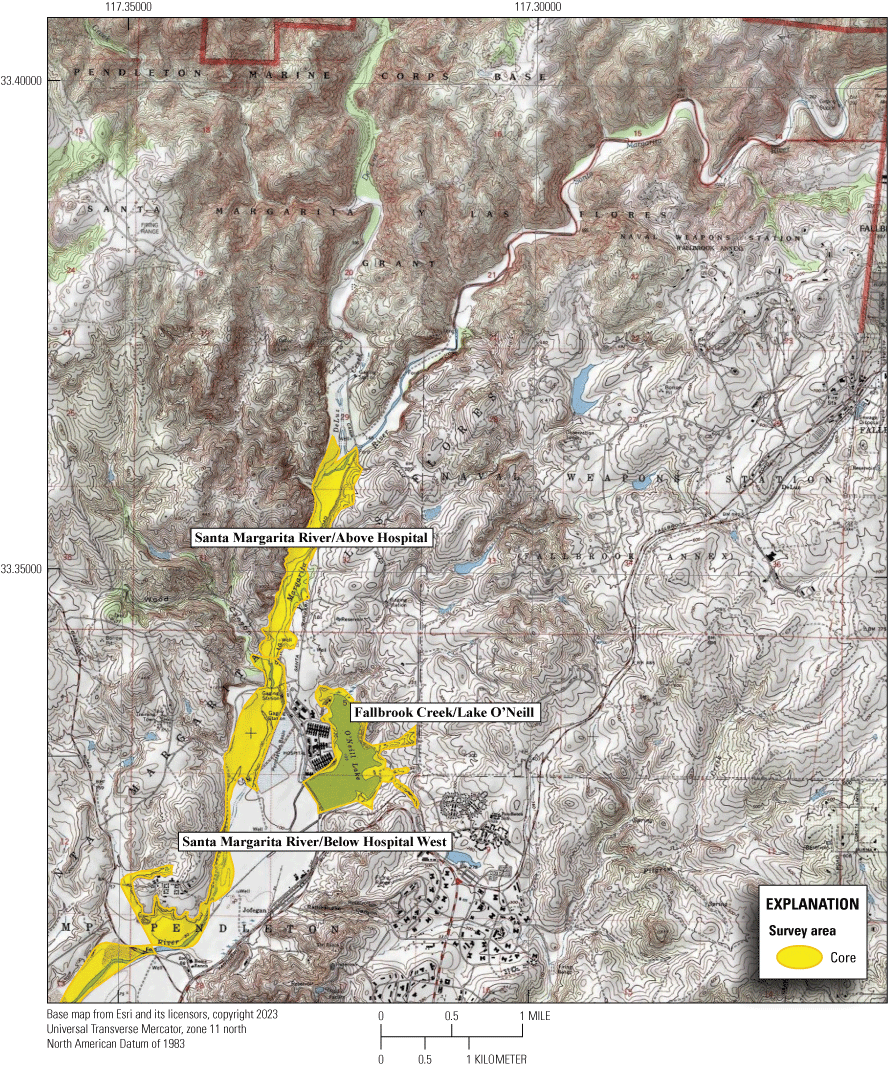
Southwestern Willow Flycatcher survey areas at Marine Corps Base Camp Pendleton, 2023: Santa Margarita River (upstream) and Fallbrook Creek.
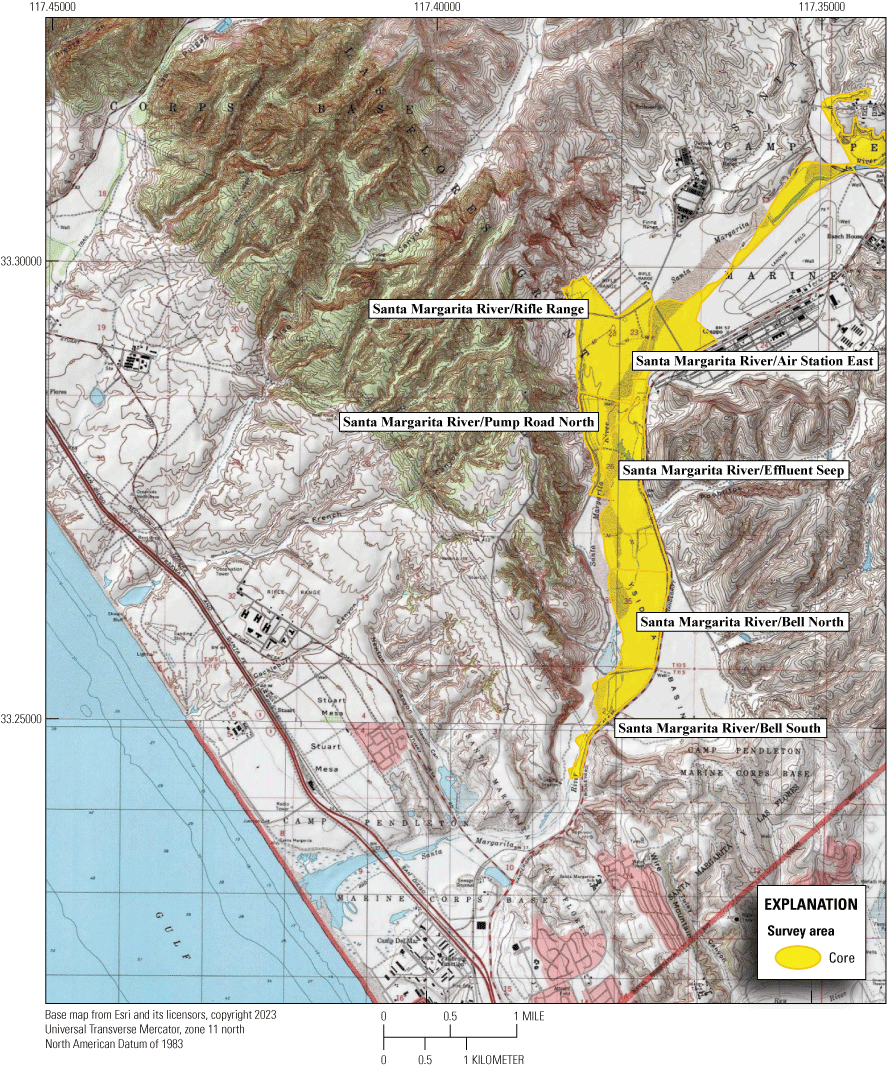
Southwestern Willow Flycatcher survey areas at Marine Corps Base Camp Pendleton, 2023: Santa Margarita River (downstream).
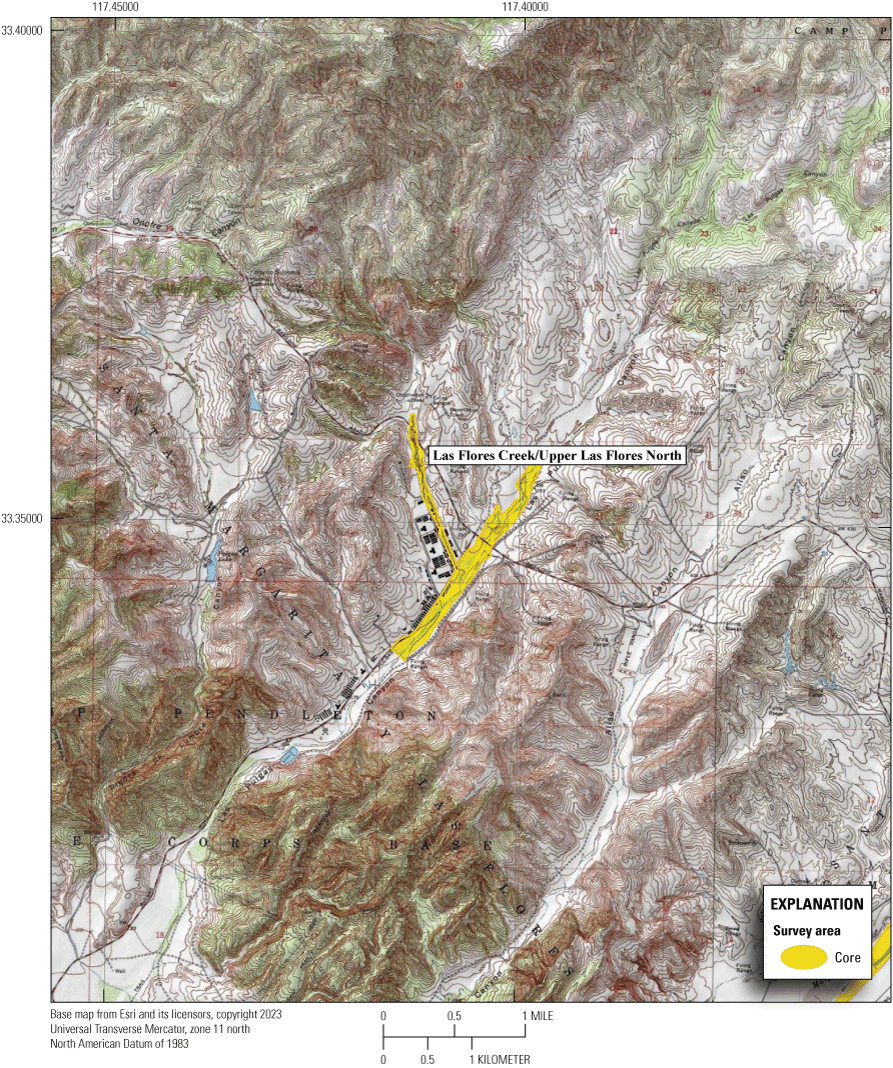
Southwestern Willow Flycatcher survey areas at Marine Corps Base Camp Pendleton, 2023: Las Flores Creek.
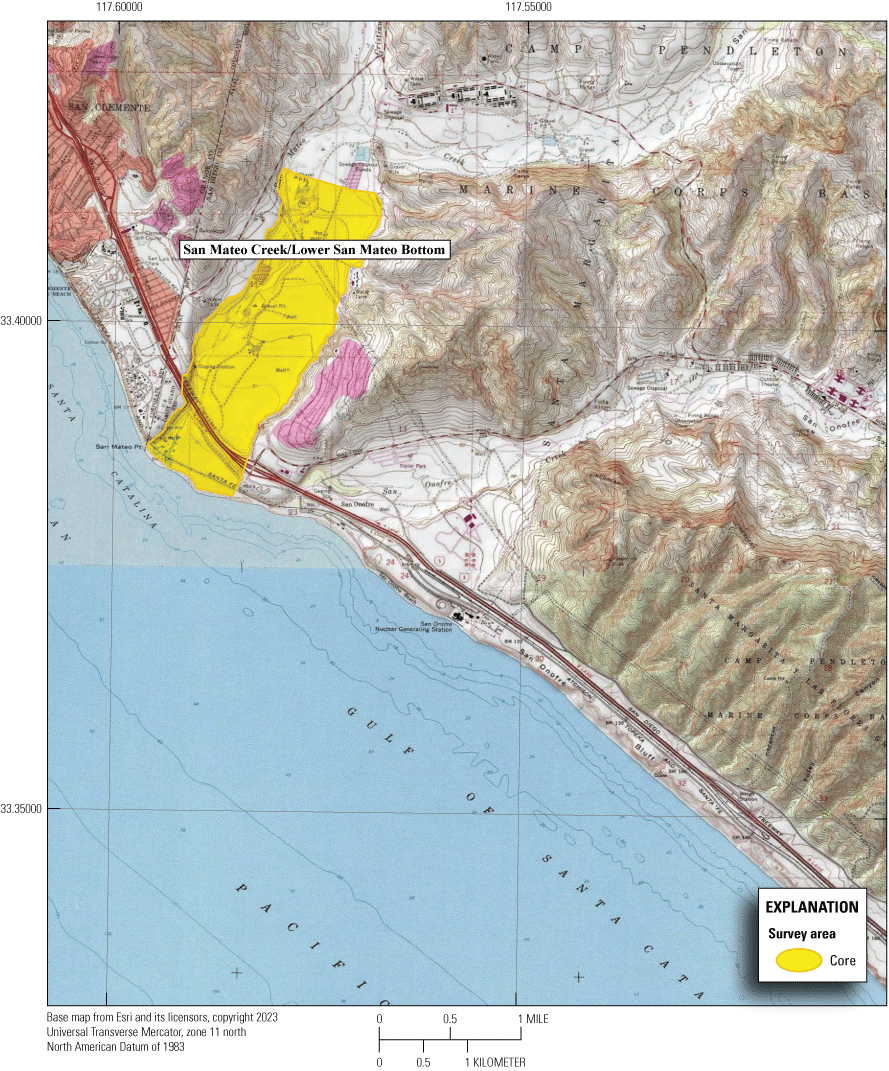
Southwestern Willow Flycatcher survey areas at Marine Corps Base Camp Pendleton, 2023: San Mateo Creek (downstream).
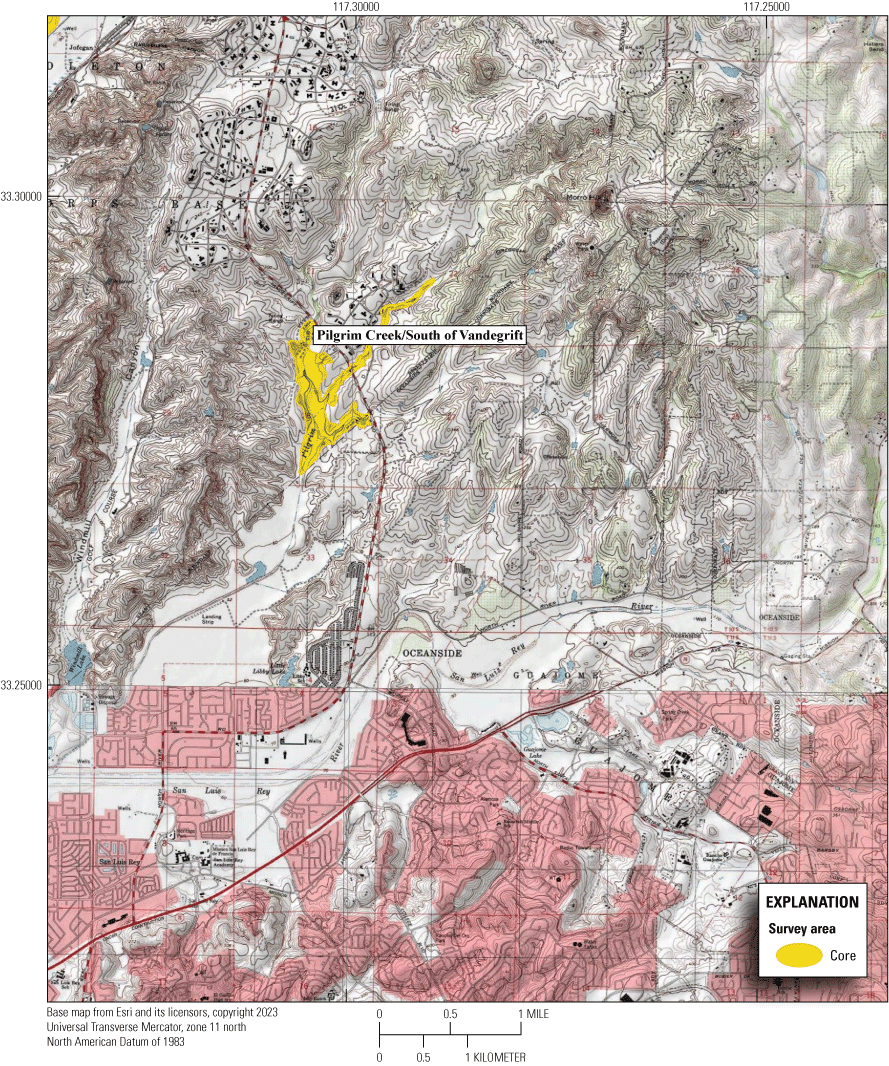
Southwestern Willow Flycatcher survey areas at Marine Corps Base Camp Pendleton, 2023: Pilgrim Creek.
Appendix 2. Locations of Willow Flycatchers at Marine Corps Base Camp Pendleton, 2023
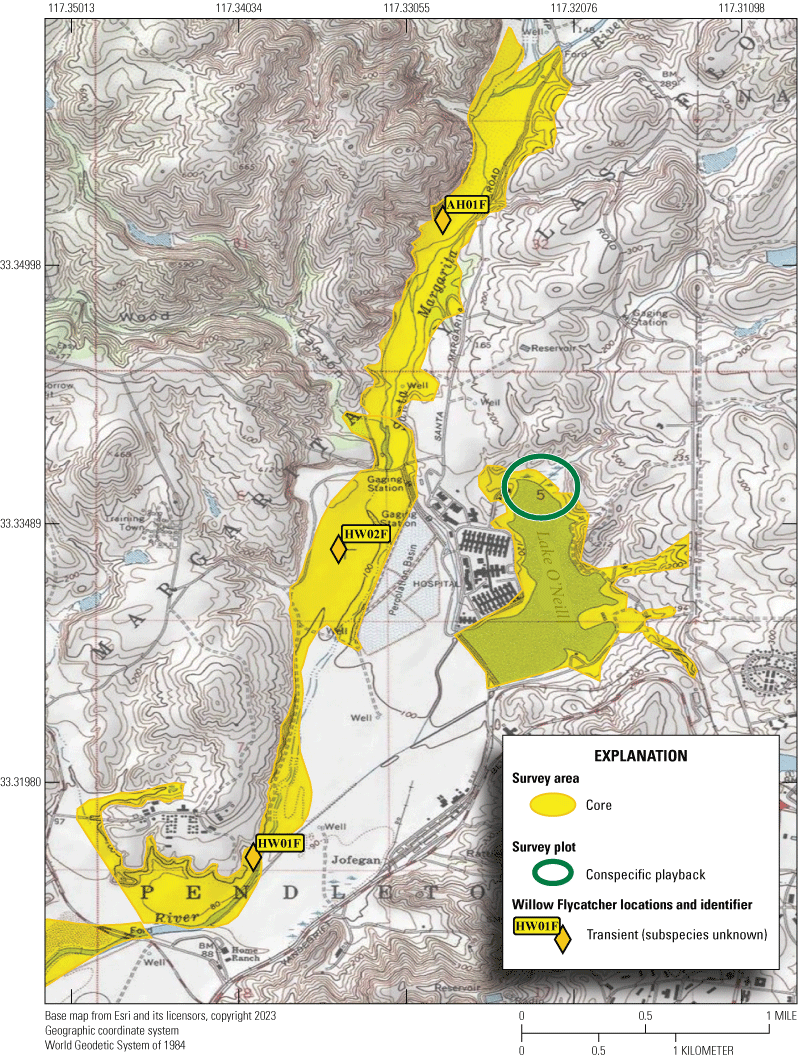
Locations of Willow Flycatchers at Marine Corps Base Camp Pendleton, 2023: Santa Margarita River (upstream).
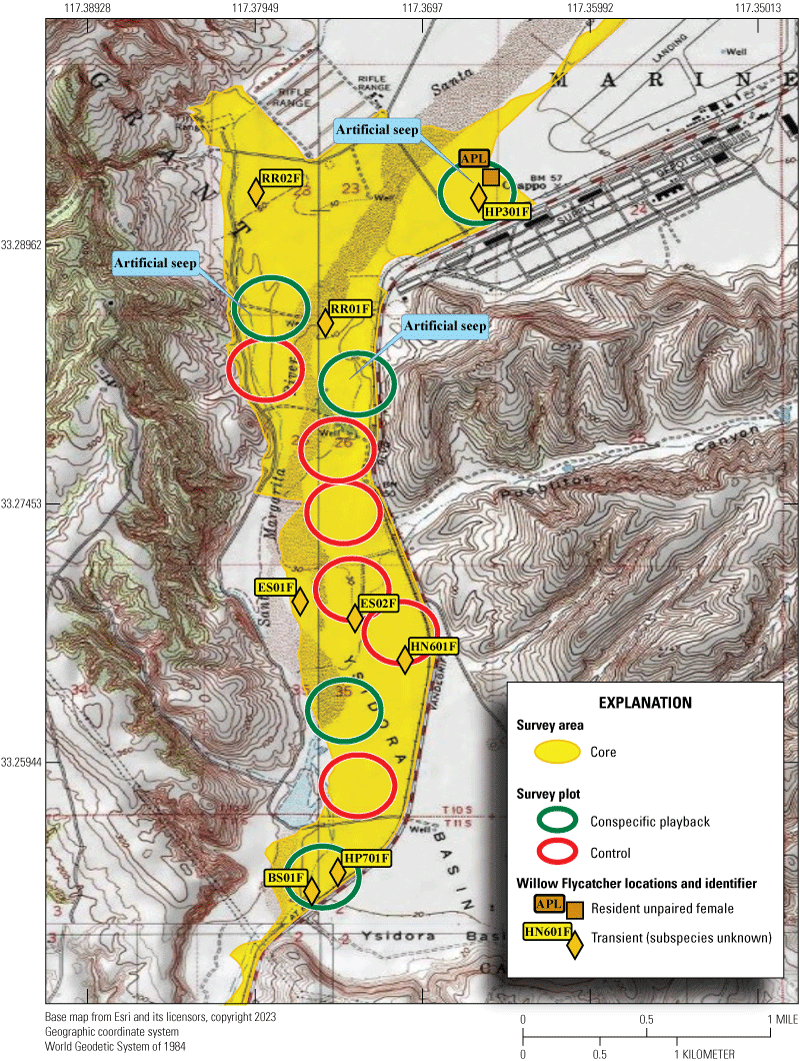
Locations of Willow Flycatchers at Marine Corps Base Camp Pendleton, 2023: Santa Margarita River (downstream).
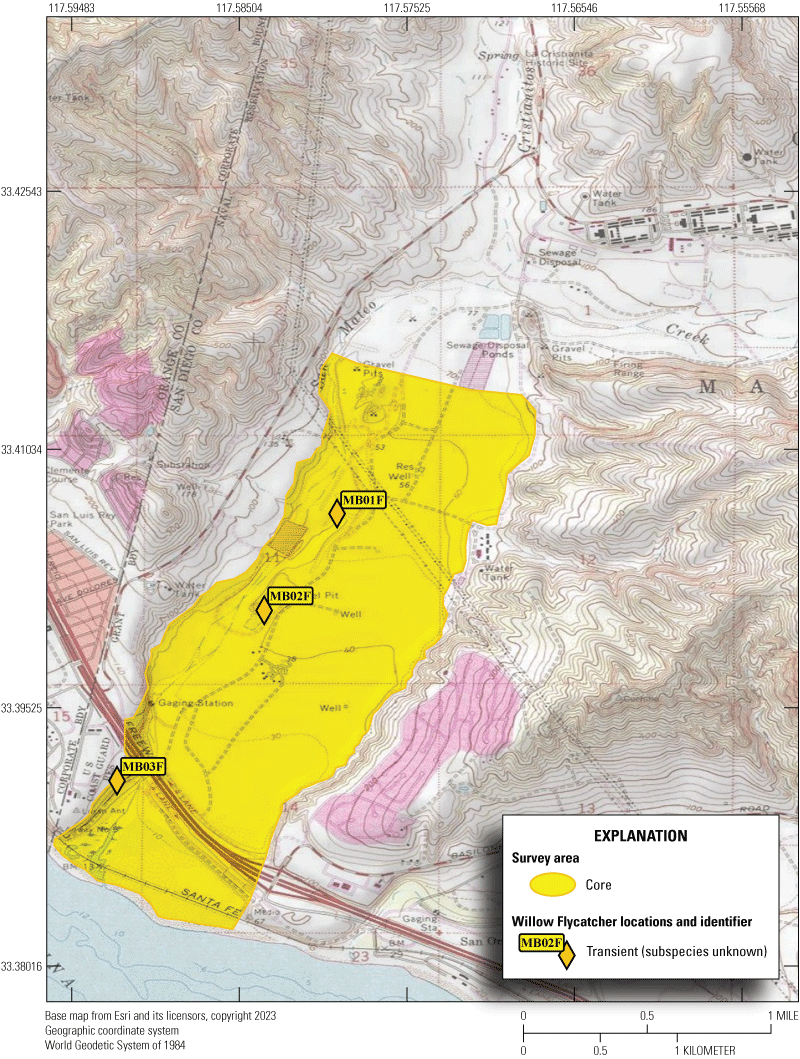
Locations of Willow Flycatchers at Marine Corps Base Camp Pendleton, 2023: San Mateo Creek.
Appendix 3. Willow Flycatcher Detections at Marine Corps Base Camp Pendleton, by Drainage, 2000–23
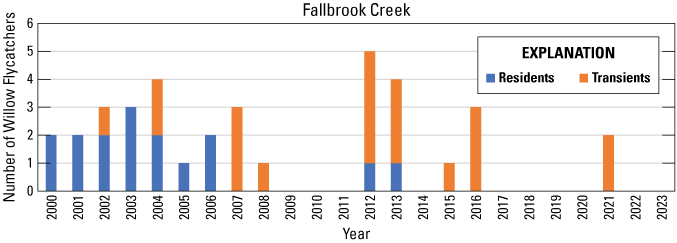
Willow Flycatcher detections at Marine Corps Base Camp Pendleton, 2000–23: Fallbrook Creek.
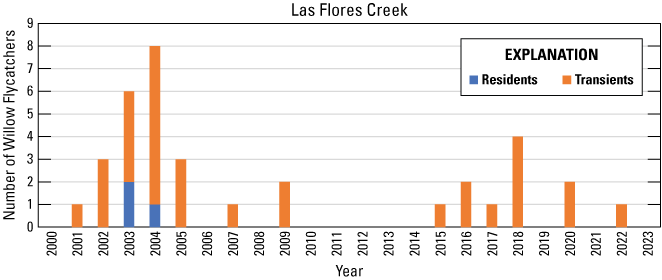
Willow Flycatcher detections at Marine Corps Base Camp Pendleton, 2000–23: Las Flores Creek.
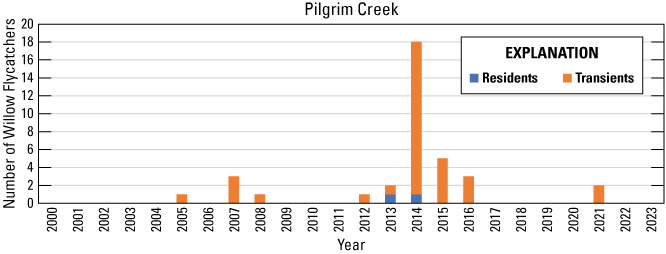
Willow Flycatcher detections at Marine Corps Base Camp Pendleton, 2000–23: Pilgrim Creek.
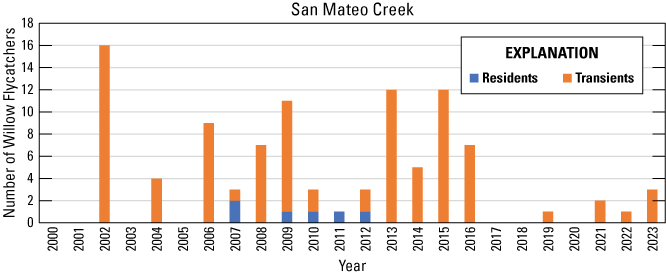
Willow Flycatcher detections at Marine Corps Base Camp Pendleton, 2000–23: San Mateo Creek.
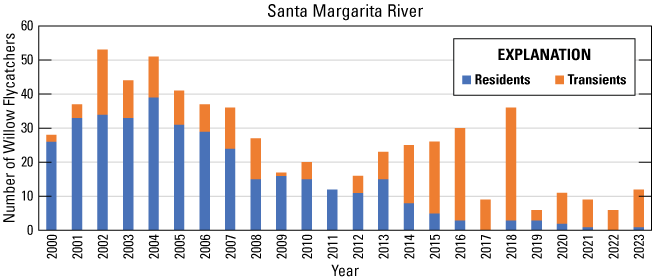
Willow Flycatcher detections at Marine Corps Base Camp Pendleton, 2000–23: Santa Margarita River.
Appendix 4. Southwestern Willow Flycatcher Territory Locations at Marine Corps Base Camp Pendleton, 2023
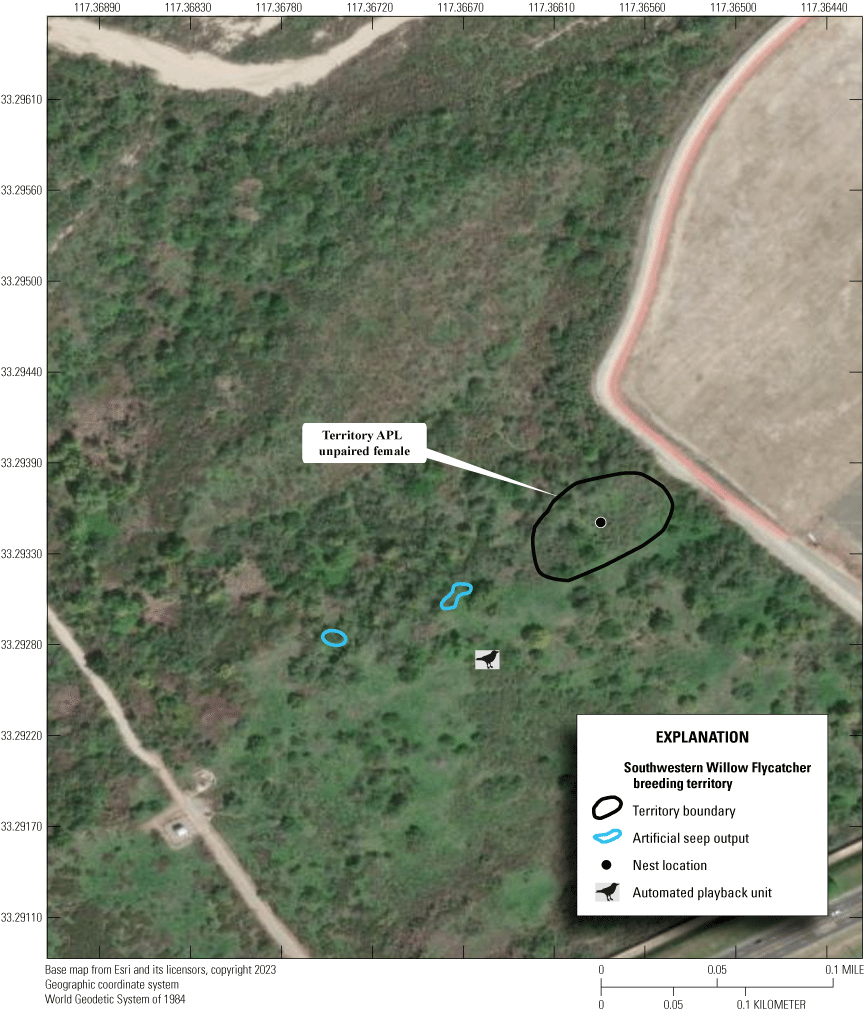
Southwestern Willow Flycatcher territories at Marine Corps Base Camp Pendleton, 2023: Air Station Breeding Area, Santa Margarita River.
Datums
Horizontal coordinate information is referenced to the North American Datum of 1983 (NAD 83) and the World Geodetic System of 1984 (WGS 84).
For more information concerning the research in this report, contact the
Director, Western Ecological Research Center
U.S. Geological Survey
3020 State University Drive East
Sacramento, California 95819
https://www.usgs.gov/centers/werc
Publishing support provided by the Science Publishing Network,
Sacramento Publishing Service Center
Disclaimers
Any use of trade, firm, or product names is for descriptive purposes only and does not imply endorsement by the U.S. Government.
Although this information product, for the most part, is in the public domain, it also may contain copyrighted materials as noted in the text. Permission to reproduce copyrighted items must be secured from the copyright owner.
Suggested Citation
Howell, S.L., and Kus, B.E., 2025, Distribution, abundance, and breeding activities of the Southwestern Willow Flycatcher at Marine Corps Base Camp Pendleton, California—2023 Annual report: U.S. Geological Survey Open-File Report 2025–1001, 33 p., https://doi.org/10.3133/ofr20251001.
ISSN: 2331-1258 (online)
Study Area
| Publication type | Report |
|---|---|
| Publication Subtype | USGS Numbered Series |
| Title | Distribution, abundance, and breeding activities of the Southwestern Willow Flycatcher at Marine Corps Base Camp Pendleton, California—2023 Annual report |
| Series title | Open-File Report |
| Series number | 2025-1001 |
| DOI | 10.3133/ofr20251001 |
| Publication Date | January 31, 2025 |
| Year Published | 2025 |
| Language | English |
| Publisher | U.S. Geological Survey |
| Publisher location | Reston, VA |
| Contributing office(s) | Western Ecological Research Center |
| Description | viii, 33 p. |
| Country | United States |
| State | California |
| Other Geospatial | Marine Corps Base Camp Pendleton |
| Online Only (Y/N) | Y |