


Developing Research Tools for Demographic Study of Rhynchophanes mccownii (Thick-billed Longspurs)
Links
- Document: Report (6.2 MB pdf) , HTML , XML
- Download citation as: RIS | Dublin Core
Acknowledgments
We thank the private landowners in Valley County, Montana, for allowing access to their lands and for their cooperation with our field research. We also appreciate all the biologists and researchers who lent us their expertise and ideas on how to capture grassland-nesting songbirds. We particularly thank Marisa Sather (U.S. Fish and Wildlife Service) for her assistance with land access permissions and logistical support. We also thank Mike Borgreen (Bureau of Land Management) for his help gaining the proper authorizations for completing research on Bureau of Land Management lands. We thank the State of Montana for granting access to State trust lands. We especially appreciate the hard work and dedication of Ella Engelhard throughout the 2022 field season. We acknowledge the Macaulay Library at the Cornell Lab of Ornithology and Xeno-canto for the audio recordings used in our project. We appreciate support and collaboration from the U.S. Fish and Wildlife Service. This study was funded by the U.S. Fish and Wildlife Service’s Migratory Bird Program.
The U.S. Geological Survey’s Northern Prairie Wildlife Research Center also provided financial and technical support. The findings and conclusions in this article represent the views of the authors and the U.S. Geological Survey but do not necessarily represent the views of the U.S. Fish and Wildlife Service.
Abstract
Like numerous other North American grassland bird species, Rhynchophanes mccownii (thick-billed longspur) has experienced severe population declines in the last 50 years. Little is known about population-limiting factors, and knowledge gaps limit conservation efforts on the species; however, before research studies aimed at improving conservation and management actions can be developed, other research must resolve notable knowledge gaps that exist in field techniques for efficient and effective large-scale demographic studies. We examined several techniques for the capture, marking (metal and color bands), and reencountering (resights and telemetry) of thick-billed longspurs in croplands and prairies in Valley County, Montana, during the 2022 and 2023 breeding seasons. Our goal was to evaluate the feasibility of obtaining within- and between-season resights of individual thick-billed longspurs using optical equipment and cameras, transmitter receivers, and the Motus automatic receiving station network. This report includes observations and insights that may aid researchers embarking on future demographic studies of thick-billed longspurs, as well as other grassland birds that provide similar research challenges.
Introduction
Populations of grassland birds have declined more rapidly than any other group of land birds in North America in the last 50 years (Rosenberg and others, 2019). Specifically, Rhynchophanes mccownii (thick-bill longspur; herein TBLO) has lost more than 90 percent of its global population since 1970 (Rosenberg and others, 2019). Steep population declines of TBLO and numerous other grassland species have been attributed to habitat loss and degradation (Rosenberg and others, 2019); however, we lack information on population-limiting factors including when and where conservation actions may improve demographic vital rates for many of these species (Somershoe, 2018). Some grassland-nesting species, like TBLO, include cultivated fields as alternative breeding habitat (Swicegood and others, 2023); however, these habitats may act as ecological traps—when an animal prefers a habitat that confers upon itself lower fitness—as is the case for Anas acuta (northern pintails, Buderman and others, 2020). For TBLO, the full demographic implications (for example, adult and postfledging survival) of this habitat type remain unknown, although no negative consequences have been detected (Swicegood and others, 2023). Effective conservation to mitigate potential climate and land-use change threats requires understanding linkages among anthropogenic activities, habitat features, climate, management practices, and demographic vital rates throughout the annual cycle. However, we lack information about the key demographic vital rates (for example, age-specific survival or habitat-specific fecundity) necessary to implement conservation and management actions that may help increase TBLO populations. Research focused on vital rates for this species is sparse (Somershoe, 2018), and considerable uncertainty exists about which capture and reencounter techniques are effective enough to support studies of adequate scale to address research and knowledge gaps.
Open-cup nesting grassland songbirds are generally time consuming and difficult to capture on the breeding grounds (particularly at the nest) with standard trapping techniques, such as passive mist net arrangements (Martin, 1969; Sousa and Stewart, 2011). However, a prerequisite to studying demographic rates is the ability to effectively capture, mark, and reencounter individuals. Capture attempts broadly fall into three categories: traps set up (1) away from breeding territories (for example, on nearby two-track roads or at waterbodies), (2) within a male’s breeding territory, and (3) at the nest. Some trapping techniques may work better than others in different capture categories or situations. To capture individuals at nests, additional time-consuming field efforts to first find and monitor well-concealed nests is a prerequisite. Several trap types can be tested based on techniques previously described (Keyes and Grue, 1982; Bub, 1991), including mist net arrays (for example, H, V, and T arrays using both four- and two-shelf mist nets; Martin, 1969), walk-in traps, hand nets, dropped mist nets, noose mats, and bow nets (for more information on trap types, method of deployment, how each trap type restrains individuals, and the potential to capture nontarget species, refer to table 1.1 in app. 1). Additionally, trap placement, time of day, and weather will likely affect capture success (Keyes and Grue, 1982; Glosler, 2004; Schemnitz and others, 2009). Capture efficiency may benefit from audio and visual lures such as speakers projecting TBLO vocalizations (for example, generic TBLO song, playback of an individual’s song back to itself, contact call, nestling begging, neighbor call); painted decoys of conspecifics (male and female); predator decoys (for example, Corvus corax [common raven] and Urocitellus richardsonii [Richardson’s ground squirrel]); and audio lures from predators. When capturing adult TBLO away from their territories and nests, attractants such as artificial perches, bait (for example, seed), and water may be used. Researcher presence may decrease capture efficiency, so nonpermanent blinds (for example, layout blinds or popup blinds) may also aid capture efficiency. In contrast, the presence of movement and (or) researchers can also be used to startle longspurs into traps through flushing or through the use of motorized decoys. It seems likely that the usefulness of various combinations of trap types, lures, subterfuge, and movement may prove context dependent, and that different setups may be ideal for different age classes, sexes, and periods of the breeding season.
Beyond the complications of capturing TBLO, there is a tradeoff in the types of information provided by the various marking and reencounter methods. Color bands are commonly used to uniquely identify individuals from a distance with optical equipment (Kikkawa, 1997; but refer to Milligan and others [2003] for discussion on accuracy) and ostensibly can be observed if the bird is alive and detectable and the bands remain on the individual. As an alternative to typical visual resighting efforts, tracking devices could provide valuable insights into resource use, fecundity, and mortality during breeding and nonbreeding periods; however, the small body size of TBLO precludes use of many types of tracking tags. Coded radio-transmitter technology such as the Motus Wildlife Tracking System (Motus; https://motus.org/) allows for tracking individuals throughout the annual cycle. The value of the Motus network to track bird movements is limited by the geographic distribution of automatic receiving stations. With further development in the Great Plains, data collected via Motus may fill key information gaps needed to inform full life-cycle models that would help to reveal limiting factors and identify critical habitat for TBLO throughout the annual cycle (refer to review in Somershoe [2018]).
During two pilot field seasons, we trialed several reencounter techniques such as Cellular Tracking Technologies- (CTT-) compatible nodes (hereafter, CTT Nodes), handheld receivers, and visual observations to better understand the detection of transmitters compared to color bands. It is important to note that these mobile detection strategies would likely be deployed in conjunction with fixed receiving stations in future studies. Together, these data should inform decisions on using marking and reencounter techniques, which in turn, will inform research on TBLO vital rates.
In this pilot study, we evaluated several methods and techniques to capture, mark, and reencounter TBLO on their breeding grounds in northeastern Montana to develop techniques for future demographic studies. Here, we summarize the main observations related to our objectives from two field seasons. First, we discuss our limited nest monitoring effort in 2022 followed by capture trials including vertical and horizontal mist nets, baiting, audio and visual lures, as well as other techniques. Next, we discuss the marking schemes deployed and reencountering methods trialed. Finally, we provide a summary of our primary findings and observations.
Objectives of Pilot Field Seasons
-
1. Trial several methods for capturing TBLO in prairie and cropland habitats during the breeding season.
-
2. Mark adult and hatch-year TBLO with either a unique color-band combination or a radio transmitter.
-
3. Trial several methods to reencounter and resight TBLO marked with transmitters and (or) color bands during the breeding season.
Study Species
TBLO breed in the northwestern part of the North American Great Plains, including parts of southern Alberta and Saskatchewan in Canada, and in central and eastern Montana, central Wyoming, western Nebraska, and northeastern Colorado in the United States. The species’ historical breeding range was more expansive and included Manitoba, North Dakota, South Dakota, Oklahoma, and western Minnesota. During the breeding season, TBLO are detected in open environments with short, sparse vegetation associated with disturbance, drought, and (or) low soil productivity. Such habitats may include native shortgrass, mixed-grass prairies, or short-statured agricultural fields (typically small grains, such as wheat or barley; With, 2021). During the stationary nonbreeding season, TBLO inhabit arid shortgrass prairies in the southwestern United States and northern Mexico. TBLO are presumed to exhibit low interannual philopatry—the tendency of an animal to remain in or return to the area of its birth—as natural disturbance patterns may shift the location of appropriate habitat conditions from year to year (Shaffer and others, 2019; With, 2021). In prairie habitats, management practices such as grazing can be used to provide appropriate breeding habitat (Shaffer and others, 2019). In cropland, modifying agricultural practices (for example, earlier seeding or reduced mechanical disturbances) may reduce hazards for nesting TBLO (Swicegood, 2023).
TBLO nests are constructed by females and consist of a shallow depression on the ground, often beneath or next to a clump of vegetation, a dung pat, or a small shrub (Mickey, 1943; With, 2021). Females typically lay one egg per day on consecutive days, and clutch size is 3–5 eggs (Mickey, 1943). Only females incubate, and the incubation period is reported to be 12–13 days (Baicich and Harrison, 1997). The altricial young spend about (~) 10 days in the nest before fledging (Baicich and Harrison, 1997). During the nestling period, both adults feed young at the nest (With, 2021).
Field Efforts
We completed two field seasons as part of this pilot study, and they ran from May 2 to July 22, 2022, and from May 20 to May 31, 2023, in northern Valley County, Montana, a core breeding area for TBLO. Study sites were in prairie and cropland habitats; a recent study on TBLO nesting ecology (refer to Swicegood [2022] for more information; fig. 1) informed the identification of specific field sites for our TBLO research. In both years, we coordinated with two private landowners for access to croplands and with the Bureau of Land Management and the State of Montana for access to prairie lands. All necessary State and Federal permits for the capture, handling, and marking of TBLO were obtained before each field season. All capture, handling, and tag attachment methodologies were completed following recommended procedures in the Guidelines to the Use of Wild Birds in Research of the Ornithological Council (Fair and others, 2023), and were completed after appropriate ACUC review with all necessary permits.
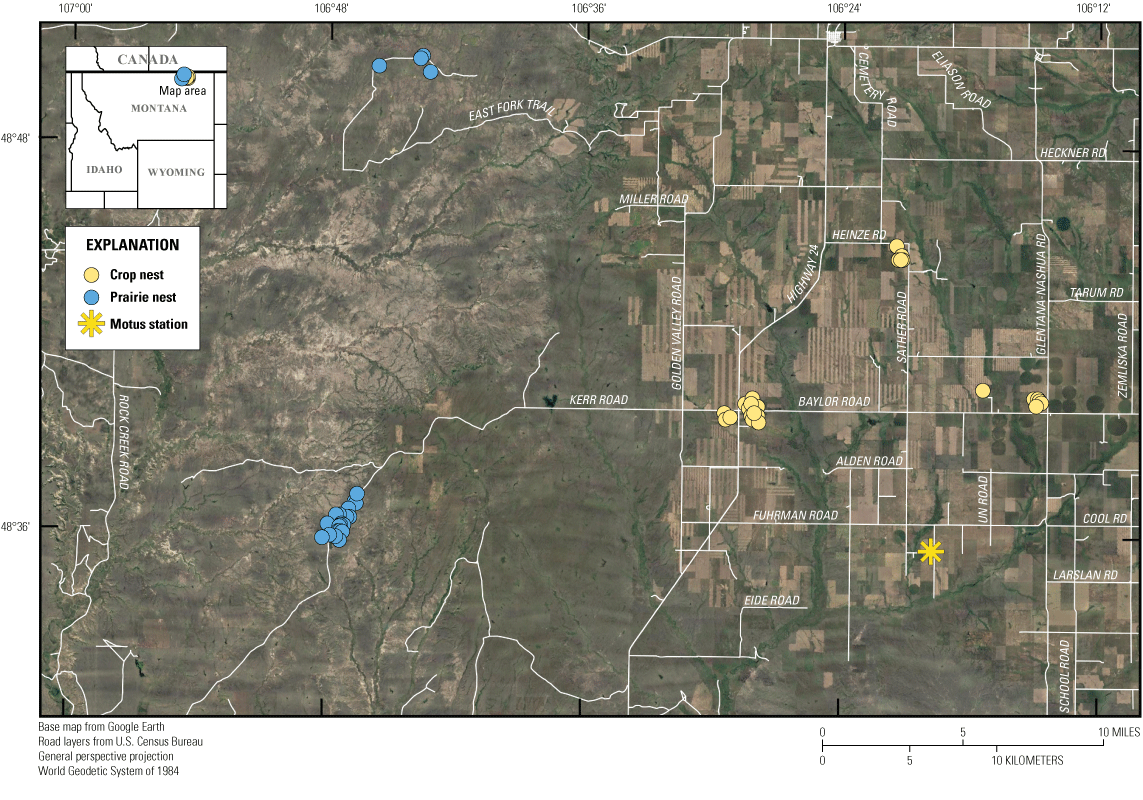
Map showing locations of Rhynchophanes mccownii (thick-billed longspur) nests located in Valley County, Montana, in 2022. These locations are also representative of banding locations and the general areas where research activities were completed.
In 2022, a two-person crew searched appropriate areas for the presence of TBLO and returned to those areas throughout the breeding season, trying to split time evenly between the two habitat types. Our 2022 field efforts were primarily focused on trialing methods for the capture, marking, and subsequent reencounter of TBLO. A secondary focus involved nest searching and monitoring, largely to aid capture efforts.
In 2023, our abbreviated (less than 2 weeks) field season focused on resighting or reencountering individuals marked the previous year. As such, our two-person crew made no effort to search for nests. We focused our 2023 field effort at the same sites as in 2022 while also extending limited effort to areas that we did not visit in 2022 that had historical records of TBLO (for example, other sites from Swicegood [2022] and eBird locations [eBird, 2024]).
Nest Searching and Monitoring
Nest searching and monitoring were not primary objectives of our pilot study; however, during the 2022 field season, finding nests was a prerequisite for trialing adult captures at nests and for banding hatch-year birds (individuals hatched during the current breeding season). We were neither consistently searching for nor monitoring nests at regular intervals; therefore, we only discovered some of the possible nests in 2022. We did not search for nests in 2023.
When actively searching for nests, we primarily used behavioral observations and rope dragging—a technique whereby two or more people drag a heavy rope across the ground to flush incubating birds off nests—but we also discovered nests incidentally while completing other activities. Because we did not monitor all nests at regular intervals, we used a variety of techniques to estimate nest age. Upon nest discovery, we recorded a global positioning system location and aged the nest contents depending on the stage of the nesting cycle (fig. 2). We either floated one or two eggs to determine clutch age (Liebezeit and others, 2007) or aged nestlings based on developmental cues (Jongsomjit and others, 2007). We estimated hatch dates using a 12-day incubation period (Mickey, 1943). We estimated fledge dates either by adding 10 days to the estimated hatch date or by backcalculating the date based on the estimated age of the nestlings (Jongsomjit and others, 2007). To aid relocating nests during subsequent visits, we placed two small markers (for example, popsicle sticks or wooden dowels) at each nest (3 meters [m] north and 3 m east of the nest cup). Nests were monitored opportunistically when crews engaged in capture attempts in areas with known nests nearby. Nests were approached from different directions to avoid trampling vegetation and creating paths that predators might follow.
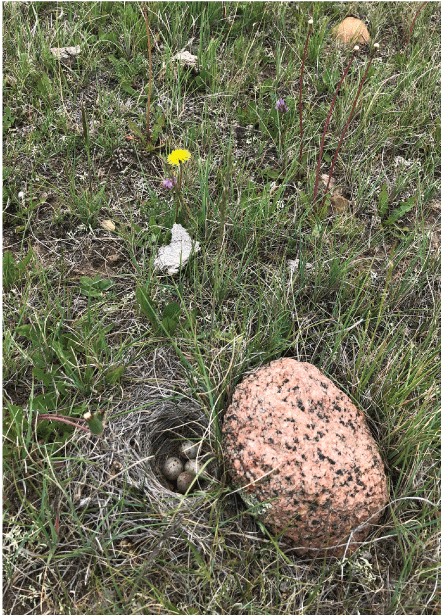
Photograph showing a Rhynchophanes mccownii (thick-billed longspur) nest with four eggs next to a rock in a prairie site. Photograph by the U.S. Geological Survey.
During the 2022 field season, we discovered 53 TBLO nests that were at various stages of the nesting cycle (table 1). In 2023, we serendipitously discovered one TBLO nest with nestlings in cropland. We monitored nests as time allowed, and we attributed potential fates of nests using the information we gathered during our monitoring efforts (table 2). Five nests, all in prairies, were still “active” at the end of the 2022 field season (table 2). We categorized two nests as “abandoned.” We determined that a nest was “abandoned” if the eggs were cold and if no parental care was observed. Of the two abandoned nests, one nest was abandoned at the time of discovery and the other had no activity on subsequent nest visits. This nest was discovered with three cold eggs, including one Molothrus ater (brown-headed cowbird) egg, and had no obvious attending adults exhibiting parental care. A total of 10 nests failed in the incubation stage before their estimated hatch dates, and 13 nests failed in the nestling stage before their estimated fledge dates (table 2). We categorized nine nests as “failed: unknown hatch”; those nests may have hatched between visits but then subsequently failed. We categorized five nests as “unknown: fledged”; these nests had nestlings observed in the nest cup at 8–10 days old, but fledglings were not observed in the area on a later date (nest checked again 2–3 days later). Only three nests met our definition of “fledged” (table 2); in these instances, we observed one or more fledglings with short, sustained flight near the nest. Additionally, on several occasions, we observed fledglings from nests that we had not previously located, but these nests were not included in our totals. For six nests, we could not assign nest fate because monitoring intervals were more than 7 days between the last known active nest date and the final visit.
Table 1.
Number of nests in each nesting stage at discovery of Rhynchophanes mccownii (thick-billed longspur) nests located in Valley County, Montana.[--, no data]
Table 2.
Number of nests for each nest fate of Rhynchophanes mccownii (thick-billed longspur) nests located in 2022 in Valley County, Montana, for each habitat type.Capture Methods
We made about 150 capture attempts for adult TBLO throughout the 2022 breeding season and roughly 6 capture attempts during the 2023 field season (for example, fig. 3). Capture attempts in 2023 were limited and focused on two objectives: (1) to remove any nonfunctional telemetry transmitters deployed on birds during the 2022 field season (Lotek NanoTags with dead batteries); and (2) to test the horizontal mist net method in early season croplands and prairies when vegetation was short. Species captured incidentally were promptly extracted from traps and released. Eremophila alpestris (horned larks) were the most common species caught incidentally. Generally, nontarget species were captured at established bait sites or near water and did not typically occur during capture attempts at or near TBLO nests or while using audio calls targeting male TBLO.
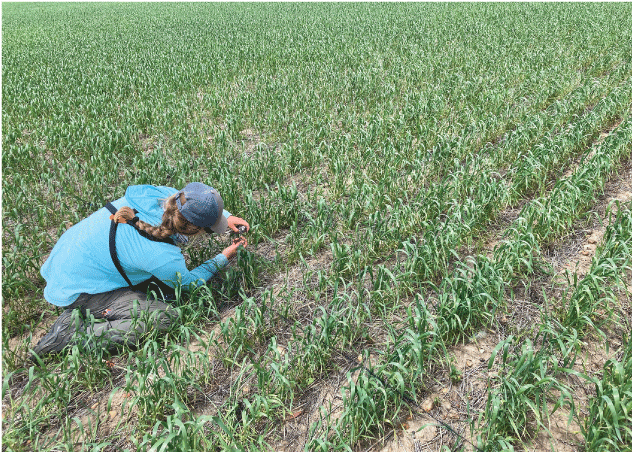
Photograph showing a researcher extracting an adult Rhynchophanes mccownii (thick-billed longspur) from a horizontal mist net in cropland. Photograph by the U.S. Geological Survey.
We did not make direct comparisons among the several capture methods trialed nor did we calculate capture success rates because of the evolution and refinement of our methods throughout the field seasons. We observed the behaviors of targeted birds during capture attempts and successful captures to qualitatively determine effectiveness of methods trialed. In the following paragraphs, we briefly describe the capture methods that indicate promise for future TBLO research, and we describe the positives (pros) and negatives (cons) of only the methods that led to TBLO captures (we do not include methods that never succeeded; table 3). We discuss the use of two-shelf versus four-shelf vertical mist nets, horizontal two-shelf mist nets, bait sites, audio lures and decoys, and other techniques. Researchers may need to be adaptive and opportunistic to take advantage of ephemeral conditions, like the presence of water, during the breeding season; similarly, some methods may be more easily used in one habitat compared to another because of landscape features or permission from landowners.
Table 3.
List of methods used to successfully capture Rhynchophanes mccownii (thick-billed longspurs), the locations each method was used relative to nests, the number of captures in each habitat type, and the positives (pros) and negatives (cons) of each method. Not all methods were attempted an equal number of times for all ages or sexes. Total capture attempts for each method were not included because methods evolved during the field seasons and effort was not comparable.[C, cropland; P, prairie; F, adult female; M, adult male; HY, hatch year]
Vertical Mist Nets
We trialed several vertical configurations (for example, T-angle, several different V-angles, straight lines) of four- and two-shelf mist nets. Two-shelf mist nets, also known as puddle nets, were more effective at capturing TBLO than were four-shelf mist nets in most situations. Two-shelf mist nets were less visible, especially during windy conditions, and they were quicker to deploy. We used a combination of four-shelf and two-shelf mist nets while attempting to capture TBLO along shorelines of waterbodies, but we primarily used two-shelf mist nets for capture attempts in open habitats after initial field trials using four-shelf mist nets were unsuccessful.
To capture displaying male TBLO, the most effective arrangement was a V formation of two-shelf mist nets with an audio lure placed off center of the net junction (fig. 4). The precise location where we set up each mist net V formation depended on the behavior of the bird, the weather, and other factors. If a displaying male did not approach the trapping area within about the first 20 minutes, we typically did not capture that individual. As the season progressed, we used 20 minutes as a benchmark to determine when to terminate a capture attempt using the V formation. We also attempted to flush TBLO into the net when they were near the net junction, either by tossing a benign object (for example, a soft frisbee or foam airplane) towards the general trapping area (but not at the bird) or by running toward the bird. After several attempts, mostly with displaying males, we determined that these flushing techniques were ineffective and not worth continuing.
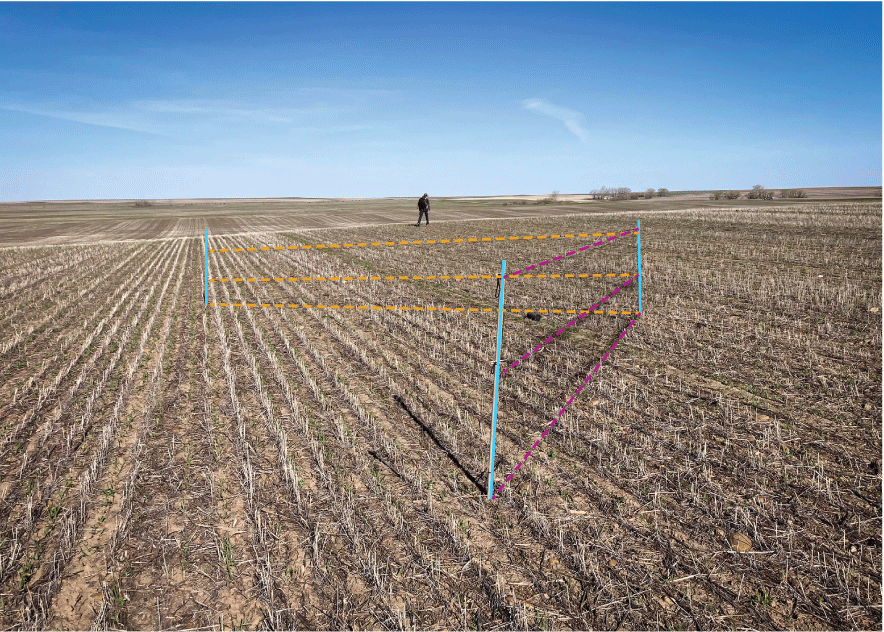
Photograph showing an example of a vertical two-shelf mist net V-formation setup with a speaker used for an audio lure in early-season cropland. Mist net poles are shown in teal, and mist net shelves are shown as orange and pink dashed lines. Photograph by the U.S. Geological Survey.
We also tested vertical mist nets away from active territories over baited sites and near areas where TBLO congregated (for example, water or bare ground). At baited sites, we used the same V formation described above, but usually with a more acutely (less than 90 degrees) angled V surrounding the bait. Trapping at large waterbodies posed a different challenge: directing TBLO use to the part of the shoreline containing the nets as opposed to the part of the shoreline with no nets. First, we observed which parts of the shoreline TBLO tended to use before net placement and then placed multiple mist nets near the water’s edge in this section. Second, we determined that birds needed to be deterred from other parts of the open shoreline to use the part of the shoreline with the mist net arrangement. We did this by placing butterfly nets along the water’s edge or by sitting along the shoreline (fig. 5). Other items, like flagging tied to a short stick, would likely function similarly by encouraging TBLO to use the shoreline near the mist net arrangement. During water and baited site capture attempts, to increase efficiency of time spent in the field, we often completed other field activities nearby, such as nest searching, and visually inspected nets every 15–30 minutes for captured birds.
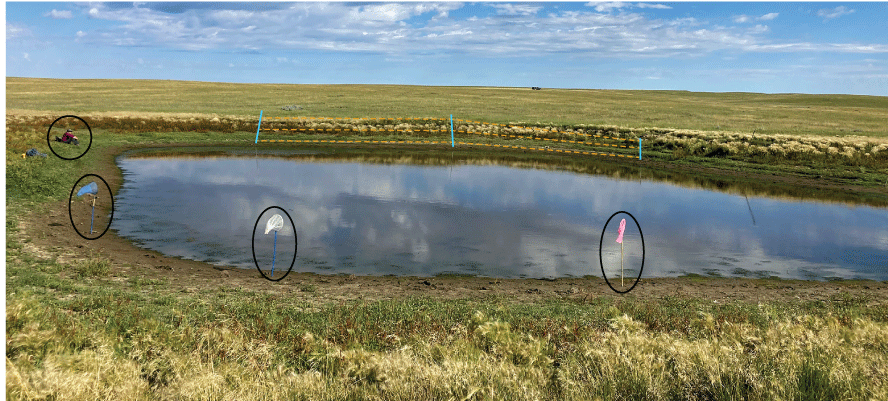
Photograph showing an example of a vertical mist net arrangement at a waterbody in a prairie landscape, including bird deterrents (for example, a researcher with a backpack and three butterfly nets, shown with black ovals) along open shoreline. Bird deterrents were used to encourage use of shoreline by Rhynchophanes mccownii (thick-billed longspurs) near the mist net arrangement. Mist net shelves are shown with orange dashed lines and mist net poles are shown in teal. Photograph by the U.S. Geological Survey.
We used vertical two-shelf mist nets to capture fledglings that could sustain short flights but that could not be captured via a hand net We located the fledgling, placed a net nearby, then slowly “herded” the fledgling towards the net, often using hand nets to extend our arm lengths for more effective herding. As we got closer to the net, we narrowed our spacing between researchers and attempted to flush the fledgling into the net. We terminated the effort if unsuccessful after roughly three attempts.
Vertical two-shelf mist nets also were used near nests for “on-nest” captures. We generally placed vertical mist nets about 1 m away from nests. We trialed this method to capture incubating females, as well as both sexes while they provisioned food to nestlings. For incubating females, we waited about 15 minutes after deploying the net before walking towards the nest to flush the female towards the net. We were successful in capturing one incubating female using this method, but only one attempt to flush the female was usually possible. If we failed on the first flush attempt, the female seemed to be aware of the net and would fly over or around the net on subsequent attempts. For nests with nestlings, we did not attempt to flush individual adults into the vertical mist net. Although this method occasionally led to a successful capture, we determined that placing the mist net horizontally (refer to the “Horizontal Mist Nets” section) led to less time spent near the nest and quicker, more efficient captures.
Horizontal Mist Nets
Orienting two-shelf mist nets horizontally over vegetation (parallel to the ground)—rather than the traditional vertical (perpendicular to the ground) arrangement—was effective for capturing TBLO. The horizontal mist nets had a low profile on the landscape and were thus less disturbed by wind, likely making them less visible to birds compared to vertical mist nets.
A horizontal mist net can be laid directly over vegetation or suspended parallel to the ground with short supports. It can also be carefully lowered over a nest to capture an incubating female (we call this technique the dropped mist net). We determined that horizontal mist nets were effective when used with lures. Horizontal mist nets can be used over an established bait site; over small, shallow areas of pooled water (nets need to be suspended high enough above the water to ensure captured birds cannot drown); along the shorelines of larger bodies of water; over nests; or over audio lures. A typical capture using this method involves a TBLO walking under the suspended net towards the lure (for example, a nest, nestling, speaker, or water) and becoming caught in the ground-facing side of the net when it flushes upwards. In our trials, some birds attempted to land from above the net, but these individuals typically freed themselves from the net before we could reach them. It should be noted that deploying a horizontal (including dropped) mist net can cause damage to the net, particularly with repeated use and especially when certain types of vegetation, such as shrubs, are present.
In areas lacking taller vegetation in which to suspend the net naturally, we positioned supports (for example, polyvinyl chloride pipe) so the net was raised above the ground about 25 centimeters (cm) and tightened to prevent it from sagging to the ground (fig. 6A–C). We trialed this support technique during early-season conditions (when vegetation was still short) in 2023. We determined that the nets were not as well supported by short vegetation compared to our use of this method later in the season in 2022 when taller vegetation was present. Even though some fields had residual crop stubble in 2023, the nets still tended to droop and were more affected by wind. Some minor alterations to the support poles might alleviate these issues, but the presence of some vegetation beneath the mist net seems to benefit the horizontal mist net method (with and without supports) because TBLO were more likely to walk underneath nets in 2022; however, vegetation also can be too tall for this method to be effective. In cropland, vegetation taller than about 50 cm seemed to be too tall for effective captures because a taller vertical gap between the ground and the net allowed birds to evade capture. We did not try four-shelf mist nets horizontally, but the increased capture area may make them more effective than the two-shelf mist nets we used.
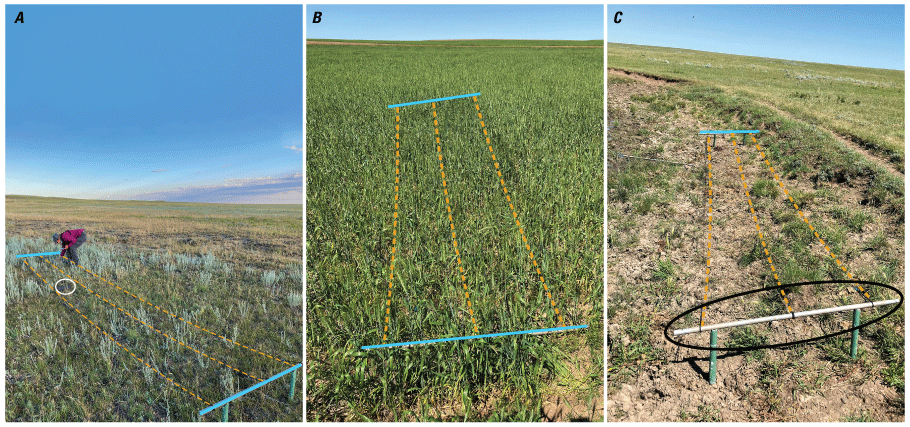
Photographs showing examples of a horizontal two-shelf mist net used in (A) a prairie site with a speaker (white circle), (B) in a cropland site, and (C) in a prairie site along the edge of a waterbody with supports used to raise the net off the ground (black circle). Mist net poles are shown in teal, and mist net shelves are shown with dashed yellow lines. Photographs by the U.S. Geological Survey.
For captures involving incubating or brooding females, it was better to have two researchers carry a mist net horizontally and lower it over the nest (dropped mist net) on the initial approach as opposed to suspending the net over the nest after the female had flushed (second chances at capturing the female were limited and more time consuming). Although this method was effective at capturing incubating or brooding females, it would likely be less effective than other methods when adults are provisioning nestlings. This dropped mist net method also may be useful for capturing fledglings that have left the nest; we did not trial this method for fledglings, but knowledge of the fledgling’s precise location would be pertinent to ensure the safety of the targeted bird.
Bait
We used commercial songbird seed mix and white millet as bait to attract TBLO at certain prairie sites. We used bait in areas where we observed groups of TBLO; bait locations were near water, on patches of open bare ground, and on the territorial edges of displaying males. Our bait sites occasionally attracted other bird species and small mammals (for example, ground squirrels and mice), which may be a concern for landowners and managers and may increase the possibility of incidentally capturing other species; for example, bait sites may attract small mammals that depredate crops and possibly TBLO nests. It would be prudent to maintain clear communication with landowners and managers before using bait and to consider risks of introducing nonnative plant species into the landscape. We did not use bait near known nests, and we made sure to place bait on the boundaries (rather than at the center) of male territories when territorial boundaries were known. We used a variety of capture methods near and over bait including walk-in traps, bow nets, and vertical and horizontal mist nets. We sometimes used conspecific audio lures (refer to the “Conspecific Audio Lures” section) when we were trapping in baited areas as a way of increasing efficiency to attract adult TBLO, but we are unsure if this addition was worthwhile.
When starting to bait a new area, it was useful to spread the seed around the intended capture site to increase the chances of birds finding the bait (about two to five times the area of the intended capture location). Once birds were observed foraging on the bait, we concentrated the bait into smaller areas where the trap would eventually be placed, and we often created a small depression, about the size of a fist, where the seed was deposited. We used white millet for our concentrated bait piles because animals were less likely to scatter millet than the songbird seed mix, presumably because of the uniform small size of millet or preferences for certain seeds in the mix. We observed a hierarchy of visitors at the bait piles. Early on, ground squirrels and birds larger than TBLO seemed to relegate TBLO to the periphery of the bait piles. Eventually, when the ground squirrels and larger birds left the bait area, even if just temporarily, TBLO would begin to feed more at the center of the bait pile. We placed camera traps near some of our bait sites to assess visitation by TBLO and to determine the optimal timing for capture attempts.
There are several considerations when using bait to attract TBLO. First, attracting birds to bait stations takes time (to allow birds to find and habituate to bait sites), so baiting would generally need to begin several days before an anticipated TBLO capture attempt. Second, maintaining a consistent supply of bait was often challenging because of seed consumption by ground squirrels and other bird species (for example, brown-headed cowbirds and Euphagus cyanocephalus [Brewer’s blackbirds]). This method also increases the chances of capturing other bird species in traps near bait. Additionally, wet weather and its effects on the roads at our field sites limited our ability to restock bait regularly. Automatic seed feeders might be useful in future efforts, especially feeders designed to only allow seed consumption by birds. Third, the use of bait aggregates individuals and species across taxonomic groups, which may increase risk of transmission of diseases such as avian influenza. Finally, providing supplemental food could introduce additional forms of bias that may be counterproductive in a study of population vital rates.
Conspecific Audio Lures
We used audio recordings of TBLO vocalizations from Xeno-canto (https://xeno-canto.org) and the Macaulay Library at the Cornell Lab of Ornithology (https://www.macaulaylibrary.org) as conspecific audio lures. Some of the recordings we played on repeat, and some we combined to create unique audio tracks. After a few weeks of trials, we settled on the use of self-mixed tracks that were a combination of TBLO songs and calls that we interspersed with about 20–30 seconds of silence. These audio tracks were played on repeat during capture attempts, and they included the following recordings from the Macaulay Library catalog: ML191116, ML191119, ML191756, ML169500, and ML504310521. We also created an additional audio track of TBLO vocalizations from audio recordings made by field staff from our field sites during the 2022 season: ML457153121, ML457151001, ML457150151, and ML455900151. These vocalizations were recorded using a Marantz PMD661 MKIII solid-state digital recorder (48-kilohertz sampling rate, 24 bit) with a Sennheiser ME62/K6 microphone and a Telinga Pro Universal parabola. We felt that the silent audio breaks were useful because they allowed birds time to inspect the speaker (during capture attempts) and reduced habituation to the repeated recording. Audio lures were good at drawing the interest of territorial male TBLO, but females displayed little interest. We also recorded vocalizations from a hatch-year TBLO, and we subsequently used that recording to capture a male TBLO associated with 8–10-day old fledglings. We had opportunistically recorded an 8-day old nestling TBLO vocalizing in-hand on a previous date and location, but the recording had considerable background noise that was difficult to remove. Higher quality recordings of hatch-year TBLO, including begging and alarm calls, would likely aid future TBLO capture attempts for adult birds caring for young.
Visual Decoys
We tested several visual decoys including conspecific TBLO, heterospecifics, and potential predators with and without audio lures. We used a variety of painted clay TBLO decoys (both male and female) and a preserved specimen of a female Calcarius lapponicus (lapland longspur). We occasionally attached decoys to a motor modified from the Lucky Duck Lil’ Critter Predator Decoy (https://www.luckyduck.com/lil-critter/) to provide the visual decoy with subtle movements. Our observations indicated that TBLO that were targeted for capture focused more on the audio lures than to the visual lures and decoys (both conspecific and heterospecific) during our trials. We eventually stopped using any of the TBLO visual decoys as they did not seem to improve the odds of a successful capture. We did not have access to a TBLO specimen nor were any of our clay decoys feathered, which may have hampered the success of our TBLO decoys during these trials.
Predator decoys were effective at creating disturbances that invoked inspection and defensive behaviors (for example, swooping) by TBLO adults. We tried a few different predator decoys. First, we used a ground squirrel specimen attached to the previously mentioned motor (fig. 7). Inspection and swooping behaviors were exhibited only when the moving squirrel decoy was placed near a nest, as opposed to greater than or equal to 5 m from any known nests. Early in the breeding season, we also trialed the use of a plastic common raven placed on a T-post perch. We accompanied our raven decoy with an audio recording of raven vocalizations from Xeno-canto (XC36492). TBLO did not respond to the raven decoy or vocalizations during those trials. Later in the season, we trialed the raven again, but without the perch, and observed inspection behaviors from horned larks, Calcarius ornatus (chestnut-collared longspurs), and TBLO (fig. 7A–C); however, we observed that individuals would only approach the plastic raven decoy during the initial inspection, after which individuals maintained a distance that was not useful for our capture methods. The lack of interest early in the season towards the perched raven decoy may have been because perches are uncommon in this open landscape, the general unfamiliarity with ravens as a predator (they are uncommon in this landscape), or the possibility that TBLO had not yet established territories. Lastly, we also trialed an aerial predatory bird kite to flush birds and solicit mobbing behaviors that would attract them towards the kite. During our trials, we did not observe any response to justify further use of this method (fig. 7A–C).
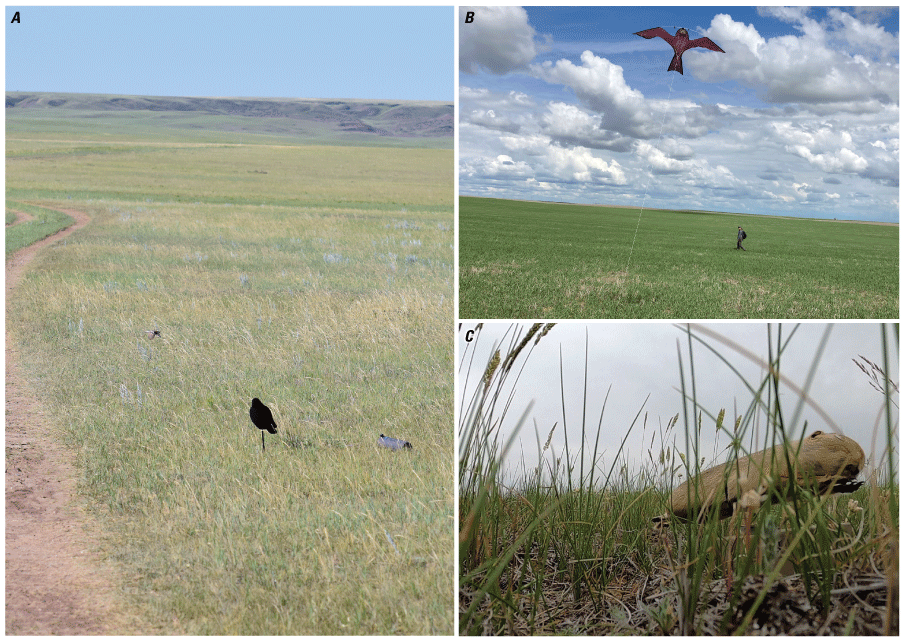
Photographs showing examples of predatory decoys trialed include (A) Corvus corax (common raven) used with audio lure in a prairie site, (B) predatory bird kite in a prairie site, and (C) a moving Urocitellus richardsonii (Richardson’s ground squirrel) in a cropland site. Photographs by the U.S. Geological Survey.
Other Capture Methods
In addition to the previously mentioned capture methods, we also used a variety of other trap types in our capture trials. We trialed the use of bow nets and walk-in traps to capture TBLO at nests and over bait (fig. 8A–C). Although these traps allowed for selective captures using a remotely triggered mechanism, visibility of the trap and trapping area was often obscured by vegetation and topography, making these methods challenging. In our experience, TBLO tended to land away from the lure or nest and then approach it via walking for several meters. This meant having an unobscured visual of the trapping area was particularly important. We tried using blinds (for example, popup and layout) to aid in our observation of the traps, but we did not find that blinds substantially increased our visibility of the trapping area once vegetation had grown more than several centimeters tall. Adding a live video feed for visual observation by a person in a blind 10–30 m away from a trap had limited success as topography limited the wireless connection of the feed. Use of a camouflaged endoscope camera may be more suitable for this task; however, bow nets and walk-in traps may still prove useful for targeting specific individuals provisioning young. TBLO did not seem deterred by blinds, and we were able to capture individuals successfully with these setups; however, the increased deployment time and potential for vegetation to still obscure visibility, especially later in the season, detracted from the efficiency of using bow nets and walk-in traps with blinds. Unless a selective capture is required, other methods would likely be more efficient. A passive walk-in trap (the trap is triggered by the target bird rather than by a remote mechanism) would not require a visual of the target bird and may work as well, but we did not trial this method.
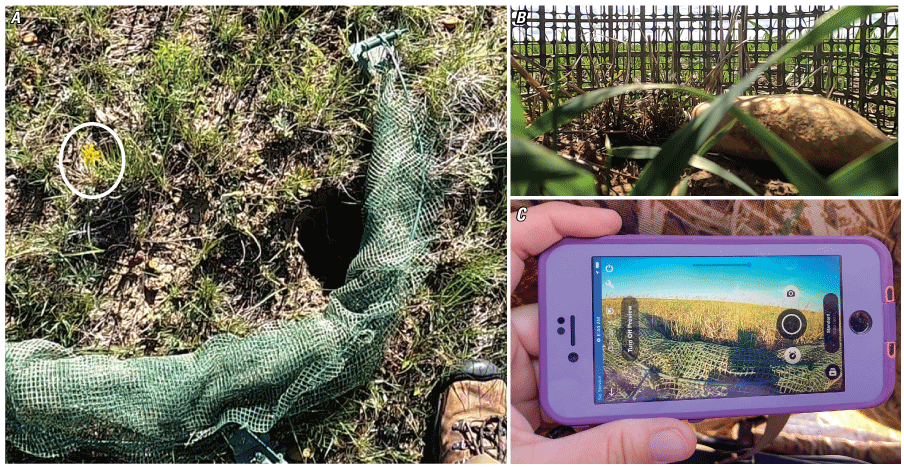
Photographs showing examples of some on-nest capture methods include (A) a bow net before triggering (nest shown by white circle) in a prairie site and a walk-in trap (photograph from inside trap; B) in a cropland site. (C) A smartphone linked to a camera that was placed in the trapping area was used to observe the trapping area. Photographs by the U.S. Geological Survey.
We also used hand nets (butterfly nets) to capture fledglings that could not sustain flight or that could not be captured by hand. We did not trial hand nets for capturing incubating females because the dropped mist net method allowed a larger capture area to ensure coverage of the nest and nest vicinity and reduced risk of injuring the target bird (refer to the “Horizontal Mist Nets” section). We mostly used hand nets to direct birds towards vertical mist nets (refer to the “Vertical Mist Nets” section).
Finally, we used noose mats at nests and near bait sites or audio lures. We captured one adult female by covering the entryways to the nest with noose mats (fig. 9). In this instance, the female was able to return to the nest to incubate without entanglement, but upon our approach to check the mats, we observed her leg get caught as she left the nest. We were unsuccessful using noose mats near bait sites and audio lures. In these instances, birds did not walk over the noose mats to access bait or investigate the audio lure, thereby eluding capture. Although the smaller size of our noose mats was ideal for surrounding nests and their more obvious entryways, the smaller size meant that large areas near bait sites and audio lures were not covered by mats. Noose mats that are larger than those that we trialed (our mats measured about 20 square centimeters) would cover more area surrounding bait sites or an audio lure, which may be beneficial. Additionally, noose mats do not work well in tall vegetation because they are difficult to deploy properly and because the vegetation reduces visibility of the mat. Lastly, construction and maintenance of noose mats can be time consuming. Although we trialed a variety of capture methods, our list of methods was not exhaustive.
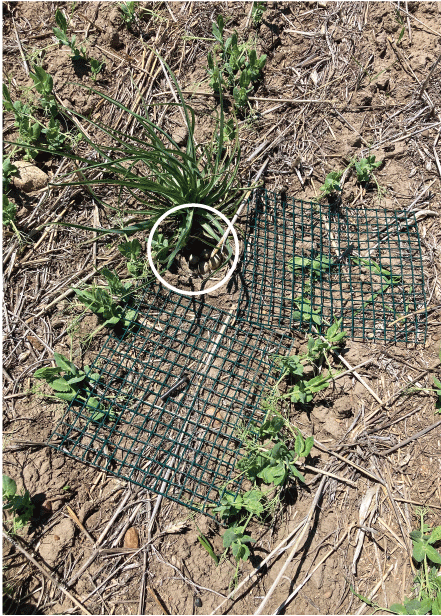
Photograph showing two noose mats (about 20 square centimeters) surrounding entryways to a Rhynchophanes mccownii (thick-billed longspur) nest (white circle) under a tuft of grass in early-season cropland. Photograph by the U.S. Geological Survey.
Banding and Marking
We marked TBLO in several ways (table 4). Overall, we banded 53 TBLO in 2022 and 1 TBLO in 2023 (table 5; fig. 10). Of the 54 banded TBLO, 33 were adults (after hatch year; 21 males and 12 females) and 21 were hatch-year birds (refer to the “Hatch-Year Captures” section; table 5). Each TBLO was banded with a single U.S. Geological Survey (USGS) metal band (size 1) on the right tarsometatarsus for permanent individual identification. In addition, all individuals (except for the single capture in 2023) of sufficient mass received some combination of as many as three Darvic color bands (arranged in combination with the USGS metal band to create two-band combinations on the tarsus of each leg for a unique four-band combination) and (or) a radio transmitter (table 4). Some individuals received either a Lotek NanoTag (~0.57 gram [g]), a CTT LifeTag (~0.47 g), or a CTT HybridTag (~0.65 g). We heat-sealed all Darvic color bands. We attached radio transmitters to adult (number of samples [n] =27) and hatch-year (n=3) TBLO using a modified figure-eight, elastic leg-loop harness (Rappole and Tipton, 1991; Streby and others, 2015). Per our permit restrictions, the total mass of all auxiliary markers was less than or equal to (≤) 3 percent of an individual’s body mass, which is below the typical guideline of 5 percent of the individual’s mass for the attachment of radio transmitters on birds (Fair and others, 2023). To weigh birds, we placed them individually in a cloth bag and recorded their mass using a spring scale. Capture efforts were not carried out when there was the potential of thermal stress such as inclement weather (for example, rain or hail), extremes of hot or cold temperatures, or strong, gusty winds. Banding data for the 54 longspur banding records are available to the public from the USGS Bird Banding Laboratory (https://www.usgs.gov/labs/bird-banding-laboratory) by submitting a request to The Bander Portal on the Banding and Encounter Data Requests website. Include the species [thick-billed longspur], country [United States], State [Montana], and years [2022, 2023].
Table 4.
List of methods used to mark Rhynchophanes mccownii (thick-billed longspurs), the number marked in each habitat type, and the positives (pros) and negatives (cons) of each method. Not all methods were used an equal number of times for all ages or sexes.[C: cropland; P, prairie; HY, hatch year; CTT, Cellular Tracking Technologies]
Table 5.
Number, sex, age, transmitter type, and leg bands applied to captured Rhynchophanes mccownii (thick-billed longspurs) in Valley County, Montana. Hatch-year birds were not sexed and could not receive a Lotek NanoTag or Cellular Tracking Technologies HybridTag transmitter because of restrictions on auxiliary marker mass in relation to a bird’s body mass.[The number inside the parentheses is the number of individuals that were marked with color bands in addition to a transmitter. CTT, Cellular Tracking Technologies; --, transmitter not used because of restrictions]
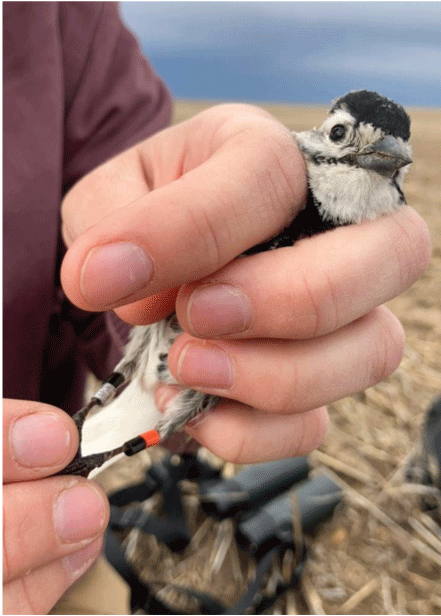
Photograph showing a male Rhynchophanes mccownii (thick-billed longspur) with a unique color-band combination in early-season cropland (combination: orange black: black metal).
Adult Captures
We banded 32 adult TBLO during the 2022 field season and 1 adult in 2023 (table 5). Most adult birds were marked with a transmitter (n=24; table 5). We attempted to distribute captured individuals evenly among the different marking techniques and habitat types (table 4), including a cohort of individuals with only color and metal bands to serve as a comparison with individuals marked with transmitters. Lotek NanoTags and CTT LifeTags were evenly distributed among sexes as best as possible (table 5). Because the CTT HybridTags were heavier than the other two transmitters and because we caught fewer females, we only deployed these on males (table 5). We banded 16 adults in croplands and 17 in prairies.
Additional Transmitter Notes
We deployed three types of transmitters: Lotek NanoTag, CTT LifeTag, and CTT HybridTag (table 4). The different transmitters have visual and technical differences that affect future study designs. Two key technical differences are the mass and longevity of the transmitter. We used Lotek NanoTag transmitters weighing about 0.57 g, CTT LifeTag transmitters weighing about 0.47 g, and CTT HybridTag transmitters weighing about 0.65 g. There were lighter versions of the Lotek NanoTag transmitters on the market at the time of this study, but these versions have a shorter battery life; we were using the lightest CTT LifeTag available at the time. We were limited by the mass of transmitters when applying them to hatch-year birds and by the combined mass when adding both color bands and transmitters to lighter adults. The Lotek NanoTag’s longevity is constrained to battery life, which is about 291 days for the transmitter size and transmission interval we were using (NTQB2–5–1; 29-second interval; Lotek). Both models of CTT transmitters are solar powered and have the potential for full annual cycle transmission if the transmitter remains attached to the bird and does not malfunction. The CTT LifeTags are strictly solar powered and are thus restricted to transmitting during daylight hours; the CTT HybridTag has both a solar panel and a rechargeable battery and can transmit 24 hours per day under ideal conditions.
All transmitters were applied using a modified leg-loop harness (Rappole and Tipton, 1991; Streby and others, 2015), but where the transmitter lays on the bird’s back is different for the two brands of transmitters (fig. 11A–B). The CTT LifeTag and HybridTag transmitters rest lower on the bird’s back compared to the Lotek transmitter, with an attachment point at the upper tip of the transmitter if using the manufacturer’s “Flex Tab” (fig. 12A–B). The antenna end of the transmitter, therefore, is not secured to the bird. The Lotek NanoTag is secured on the bird at both the top and antenna end of the transmitter through tubes (an optional feature that can be requested at purchase); therefore, although the two brands attach to the bird at a similar location via the leg-loop harness, the entirety of the Lotek transmitter rests higher on the bird’s back than the CTT transmitters.

Photographs showing a comparison of the two transmitter brands and the positioning of each brand of transmitter on the back of a Rhynchophanes mccownii (thick-billed longspur) using a modified leg-loop harness. (A) The Lotek NanoTag rests on the back and is attached on the top and bottom, and (B) the Cellular Tracking Technologies LifeTag rests lower on the bird’s back, just above the tail, and is attached only at the top of the transmitter. Photographs by the U.S. Geological Survey.
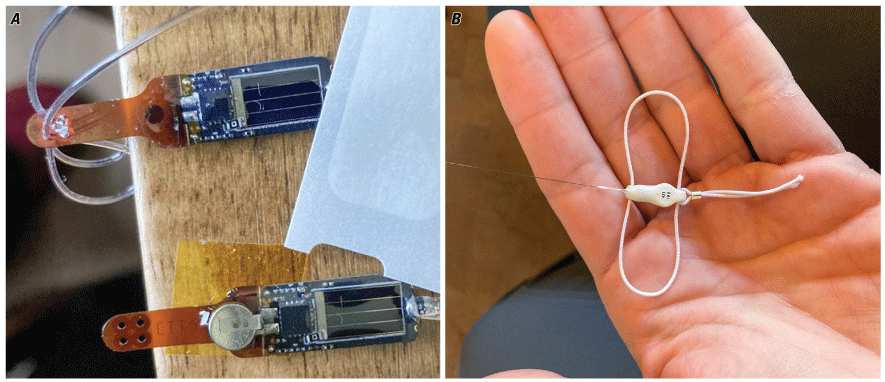
Photographs showing examples of transmitters applied to Rhynchophanes mccownii (thick-billed longspur) in 2022 using a modified leg-loop harness. (A) Cellular Tracking Technologies (CTT) LifeTag with clear cord through “Flex Tab” (top), CTT HybridTag with the additional battery (bottom), and (B) the all-white Lotek NanoTag with optional tubes. Photographs by the U.S. Geological Survey.
The transmitter’s concealment and color while on the bird also varied between the two brands. The CTT LifeTag and HybridTag are more reflective because they contain a solar panel, whereas the Lotek NanoTag transmitter is bright white (figs. 11A–B and 12A–B). Feathers eventually help cover some or all of the Lotek transmitters in adults (fig. 13), but the CTT solar panel stays visible because it is needed to function (fig. 14). We are unsure if these differences affect an individual’s survival or preening ability, visibility to other birds (including predators), or the transmitter’s ability to be detected by a receiver (refer to Jones and others [2024] for more discussion on the topic). We discuss differences in detections with handheld receivers used during a field detection test in the “2023 Reencounters” section.
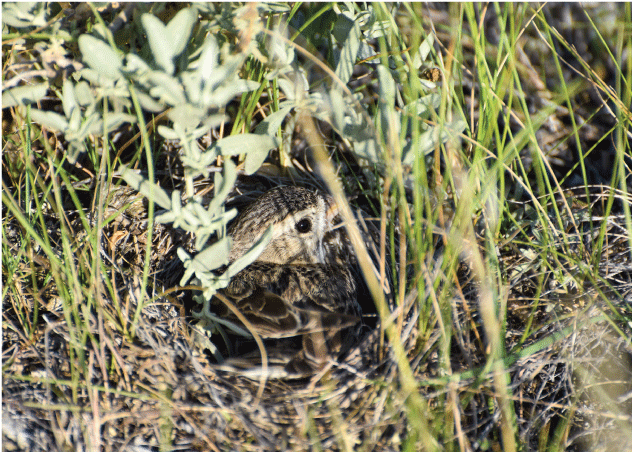
Photograph showing a female Rhynchophanes mccownii (thick-billed longspur) incubating eggs in a nest at a prairie site. This female was marked with a Lotek transmitter that is not visible. Photograph by the U.S. Geological Survey.
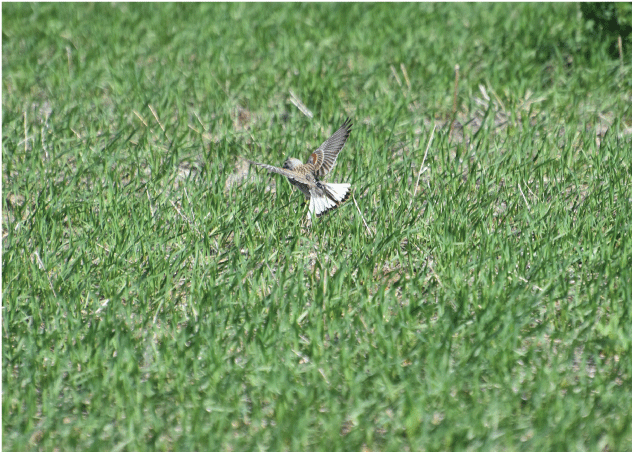
Photograph showing a male Rhynchophanes mccownii (thick-billed longspur) in cropland with a Cellular Tracking Technologies LifeTag transmitter. Photograph by the U.S. Geological Survey.
Adult Birds Captured on Nests
During 2022, we captured 12 adult TBLO on 12 unique nests using a variety of trapping methods; we never captured a complete breeding pair at a nest (table 6). We trialed capture techniques at 23 of the 53 nests that we located in both cropland and prairie habitats (table 7). We used the dropped mist net method (refer to the “Horizontal Mist Nets” section) to capture four of the five incubating females. The fifth incubating female was flushed from her nest into a vertical mist net. As discussed in the “Other Capture Methods” section, the walk-in trap, bow net, and noose mats have limited applicability for captures on nests. We were also able to capture two adult males provisioning food to nestlings using a walk-in trap, though the visibility issues discussed previously are a limitation of this method. All methods used for on-nest captures performed similarly between the two habitat types; visual obstruction by vegetation was the main factor affecting the efficacy of the different methods.
Table 6.
Number, sex, nesting stage at capture, and method used for on-nest captures of adult Rhynchophanes mccownii (thick-billed longspurs) in Valley County, Montana, in 2022.Table 7.
Number of nests with attempted captures and successful on-nest captures of adult Rhynchophanes mccownii (thick-billed longspurs) in Valley County, Montana, in 2022.One concern related to trapping TBLO on nests was that trapping might cause nest abandonment. To assess potential abandonment by the captured individual, we tried to return to nests within 1–2 days (if weather allowed) after capture to assess nest status and adult presence. Capture attempts of incubating females were attempted either at or after day 10 of incubation (based on egg flotation) or during the nestling stage to reduce risk of nest abandonment by capturing adults early in the nesting cycle (Winter and others, 2003).
Of the 10 females captured on nests, we observed 4 that continued to attend to their nests (we defined these as “stayed”; table 8). Individuals were assigned this status if the nest was still active on our next nest visit and if we observed the focal adult on or near the nest. One of the four females that stayed was captured on the last day of our field season but was observed incubating 2 hours later after her initial capture.
Two females presumably abandoned their nests after capture, but the cause of abandonment was unknown. In one case, the nest had cold eggs on the next visit (1 day after the capture), and we only detected her once on subsequent visits. The bird was detected using a handheld receiver, but we never obtained a visual of the bird. We did not detect the other female categorized as abandoning nor did we observe her in the area after her initial capture; however, this female was detected after the breeding season during migration (refer to the “Motus Network Detections” section); therefore, she may have still been in the area, but we failed to detect her using the handheld receiver.
Two females and two males were assigned a status of “unknown and not detected” after capture. In all three instances, their nests had failed before the next visit after capture (1–7 days later), and the marked adults were not observed thereafter.
Two females were assigned a status of “unknown and detected” after capture (table 8). In both cases, we observed the marked adult near the nest, which had failed between visits (4–15 days later). One female (female a) was observed on a new nest within 36 m of her previous nest where she had been captured. This second nest was still active at the end of the field season. For the other female (female b), her nest contained dead nestlings, and we detected this female twice near the nest in the week after nest failure. Two other nests in the area also had dead nestlings in the nest cup that week, and we attributed this to a storm with heavy rainfall that had passed through the area after capture of the adult but before our return, which also prohibited a shorter return interval at this nest. We had not captured the females associated with the other two failed nests. It is possible that female b may have stayed on the nest (after capture) as she was still in the area after the weather-related nest failure (table 8).
Table 8.
Status of adult Rhynchophanes mccownii (thick-billed longspurs) caught on nests by marker method and sex in Valley County, Montana, in 2022.[--, no data; F, female; M, male]
Hatch-Year Captures
We banded 21 hatch-year TBLO during the 2022 field season (table 5). Most hatch-year birds were banded with only a metal band (n=12); others were banded with a unique color-band combination (n=6) or a transmitter (n=3; table 5). Hatch-year birds included two age classes of young-of-the-year: nestlings (present in the nest cup) and fledglings (present outside of the nest cup). We banded most nestlings with only a metal band in hopes of capturing them later when their mass and age were appropriate for a transmitter. We banded 12 nestlings (cropland: n=5; prairie: n=7) from 4 monitored nests (range: 2–4 nestlings per nest; cropland: n=2 nests; prairie: n=2 nests). An additional nine fledglings (cropland: n=7; prairie: n=2) were located; five were from three known nests, and four fledglings were discovered opportunistically.
We captured four fledglings that were heavy enough for a transmitter. Transmitters were applied to three of these four fledglings, including one from a nest that we were monitoring; the other three fledglings were discovered opportunistically by observing adults in areas without a previously known nest. We chose to deploy transmitters on no more than one fledgling per brood. Two of the three TBLO fledglings fitted with transmitters were detected for almost a week after deployment (detected for 4 and 6 days each) using handheld receivers (refer to the “Handheld Transmitter Reencounters” section). It is possible that these birds were still in the area after this time, but we were unable to detect them because of limitations of the handheld receivers (refer to the “Transmitter Detection Field Tests” section), and limitations associated with private land access that restricted where we could search. Lastly, our ability to find fledglings of appropriate mass was limited by our reduced nest searching and monitoring effort and the high failure rate of nests.
The appropriate age for transmitter application on fledgling TBLO appeared to be 12–14 days old based on mass, feather development, and mobility of birds postdeployment. To stay within our permitted ≤3 percent of an individual’s mass, we deployed only CTT LifeTags on hatch-year TBLO as this transmitter was the lightest of the three units that we tested. This meant that hatch-year birds needed to weigh at least 18.5 g to receive a transmitter (considering transmitter harness material and the metal band). Hatch-year TBLO also needed to be able to flutter-fly (achieve sustained flight for a short distance) but still be able to be guided towards a vertical mist net for capture. In our experience, if the hatch year was still able to be captured by hand or with a hand net, it was generally too light or would likely have trouble maneuvering with a transmitter (fig. 15A–B). Of note, transmitters were too heavy and feather development was too limited to deploy transmitters on nestlings that were still in the nest cup, which may have important ramifications for studies using CTT LifeTags with an objective to evaluate postfledgling juvenile survival. Future study questions focusing on juveniles may require a lighter transmitter that can be applied at an earlier stage of development or other marking and modeling schemes used to identify individuals earlier in their development. The potential effects of transmitters on juveniles and the potential of transmitter removal by adults may need to be considered (Mattsson and others, 2006; Fisher and others, 2010).
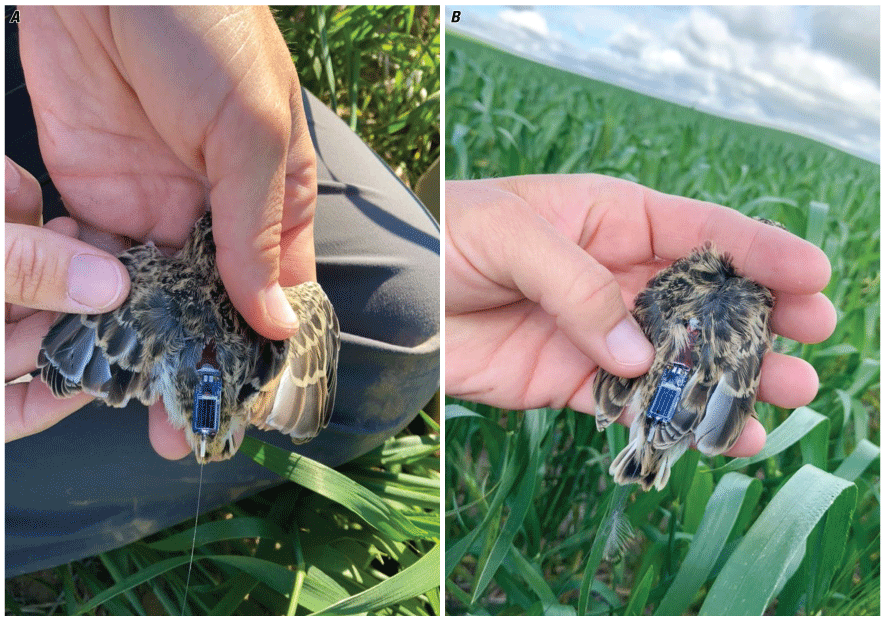
Photographs showing (A) a hatch-year Rhynchophanes mccownii (thick-billed longspur) that was captured as a fledgling using a hand net. We checked on this individual 30 minutes after the transmitter had been attached and decided to remove the transmitter because of concerns about the bird’s mobility. (B) We caught the same individual 2 days later using a vertical mist net and redeployed a transmitter. This individual was observed the following week and exhibited increased flight abilities and was attended by adults. Note the primary and rectrix feather development and increased body size between the two pictures, which were taken 2 days apart. Photographs by the U.S. Geological Survey.
Reencounters
After several successful captures of TBLO in 2022, we began trialing several methods of reencountering marked individuals (table 9). One Motus receiving station was installed within the study area (northern Valley County, Mont.) during the fall of 2022 (after our initial field season). We either used a handheld receiver to detect deployed transmitters or we used optics (binoculars, spotting scopes, or cameras) to resight color-banded individuals. Additionally, we completed three field detection tests of the two transmitter brands with the handheld receivers, the newly installed Motus receiving station, and the use of CTT Nodes. The 2023 field season was focused on the ease of resighting or reencountering birds 1 year after marking. Return rates of marked birds (the proportion of marked individuals in 1 year that are recaptured or resighted in the next year) provide an estimate of between-year site fidelity and allows for the calculation of annual survival after multiple years. In the following paragraphs, we outline some of the limitations of our initial reencounter efforts for both color bands and transmitters, our transmitter detection tests, our 2023 reencounters, and the greater Motus network detections of our marked TBLO.
Table 9.
List of methods used to reencounter Rhynchophanes mccownii (thick-billed longspurs) in cropland or prairie habitats and the positives (pros) and negatives (cons) of each method.[SLR, single-lens reflex; m, meter; CTT, Cellular Tracking Technologies]
Color-Band Reencounters
One way that we relocated marked individuals was by reading their unique color-band combinations using optical equipment (resighting). Obtaining color-band resights can be difficult because of the species’ behaviors during the breeding season (for example, tendency to spend time on the ground, aerial song flights of males). This difficulty can be exacerbated as vegetation grows throughout the season. It was generally easiest to see TBLO legs when birds stood on a rock or dung pat or when they walked to the top of a crop row mound during early season conditions or between crop rows during later season conditions. In the following paragraphs, we elaborate on the various methods (binoculars, spotting scopes, digital single-lens reflex [SLR] cameras, camera traps, and video cameras) we used to resight color-banded individuals (table 9).
Binoculars had limited utility in determining color-band combinations as the magnification (for example, 10 × 42 Nikon Monarch 5 or 8 × 42 Swarovski NL Pure) that we used, in combination with the birds’ skulky behavior, often made it difficult to resolve leg detail. If the bird was close enough (for example, within about 100 feet), the presence of color bands could often be determined, but the precise color-band combination was difficult to discern. Spotting scopes on tripods (for example, 20–60 zoom Nikon Prostaff 5 or Leica Televid) functioned better in this regard as they provided the greatest optical reach of the equipment we trialed. Spotting scopes were most useful early in the season when vegetation was absent in croplands and short in prairies. As the vegetation grew during the breeding season it became more challenging to find and follow birds with a spotting scope to get a clear view of a bird’s legs. In 2023, we determined that spotting scopes were useful for quick assessments to determine if a TBLO was marked, especially for TBLO detected at a great distance. Such information (knowing if the bird is marked) could be useful for directing further efforts to read the color-band combination.
Digital SLR cameras proved useful for obtaining color-band resights. We used a Nikon D5500 with a 70–300-millimeter telephoto lens. This setup was light and easily portable compared to spotting scopes, but still allowed for determination of the presence of color bands on distant, perched TBLO. As vegetation grows, it may be more efficient to use digital SLR cameras for resighting as there are brief lines of sight for determining if a bird is banded amid the taller vegetation. Cameras allow quick snapshots through available sightlines, whereas spotting scopes may require more time to confirm a bird’s markings. Multiple images may be necessary to identify the color and position of all bands; however, the use of digital cameras may require additional time to process images taken in the field and the development of a data storage and archiving plan.
We also used camera traps pointed at an elevated, baited surface to resight banded TBLO (fig. 16A–B). Although this method required time to attract birds to an area, it provided a passive method for reencounters that can be used in conjunction with capture efforts (refer to the “Bait” section). It was unclear how far birds were traveling to and from the baited sites; therefore, further investigation on the actual area being covered by the camera traps at bait sites may be needed. We used a Bushnell Trophy Cam with settings set to take a picture every 5 minutes during daylight hours and anytime when motion triggered. With these parameters, we were able to obtain resights of color-banded individuals and clear images of unbanded TBLO and other bird species. Other brands of cameras may have settings and features that provide better quality photographs, but we did acquire images of TBLO with both the motion triggered and 5-minute interval settings. Researchers may want to balance photograph capture rate with the time needed to assess the photographs during postprocessing. In 2023, no banded TBLO were observed during a 3-day camera deployment, but we did obtain quality photos of unbanded TBLO legs during that short window of deployment. In areas with cattle, we had occasional issues with livestock knocking the camera out of position. Fencing to exclude livestock from the camera vicinity may be a solution to this issue; however, adding additional structures to an otherwise open landscape may need to be carefully considered. Camera traps also may be useful away from bait but would require a lure at the camera location. Deploying cameras near water sources or short-term (that is, for a few days) deployments near audio or visual lures may allow for passive resights of color-banded individuals. Lastly, a combination of a camera trap, bait, and a transmitter receiver may be of use to increase reencounters.
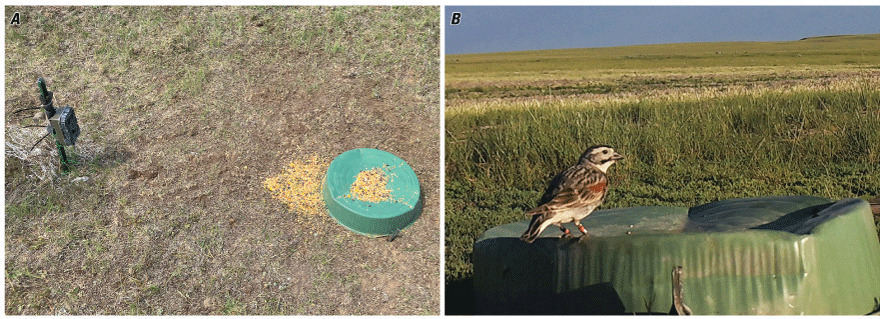
Photographs showing (A) an example of a camera trap setup for resighting color-band combinations and (B) an example image from the camera of a successful resight of a color-banded male Rhynchophanes mccownii (thick-billed longspur; combination: black orange: orange metal). Photographs by the U.S. Geological Survey.
We used small video cameras placed near TBLO nests for ≤30 minutes to resight nesting adults. We were able to successfully resight color bands and get clear images of unbanded TBLO legs (fig. 17A–B). We trialed two cameras in 2022: a Go Pro Hero 8 and a Kodak PixPro (Toy and others, 2017). We obtained resights with both cameras, but both were also used in trials when the bird did not return to the nest during the 30-minute session. We did not know if birds failed to return to the nest because of the camera’s presence or because of the birds’ nest attendance behaviors. The Kodak PixPro camera sat about 14 cm above the ground on a small tripod, whereas the Go Pro camera could be placed on the ground with a camera height of about 4.5 cm. Notably, when placed on the ground, the Go Pro camera had to be set up close to the nest to obtain a clear view because of vegetation obstructing the camera’s view. We suspected birds would be deterred by the proximity of the Go Pro in those situations, and, therefore, we needed to elevate the camera to obtain a clearer view while also increasing the distance of the camera from the nest.
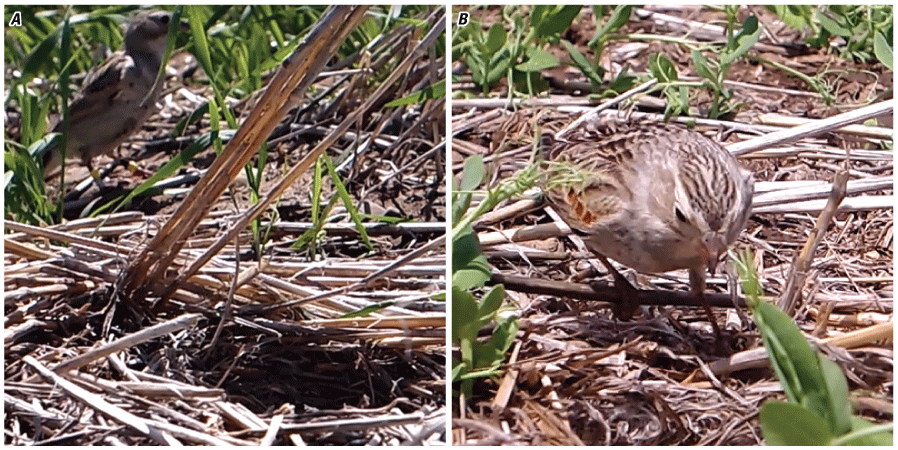
Photographs showing example images from nest cameras used to resight color-band combinations in cropland. One Rhynchophanes mccownii (thick-billed longspur) (A) is banded (combination: black yellow: yellow metal) whereas the other longspur (B) is unbanded. Photographs by the U.S. Geological Survey.
We also tested the idea that a well-camouflaged camera placed next to the nest may be more effective than cameras that require an elevated view placed further away (greater than or equal to 25 cm) from the nest; therefore, in 2023 we trialed a Vsysto helmet camera, a cylinder action camera that can be placed on the ground with a lower vertical profile than the cameras we used in 2022. We placed the camouflaged (painted three-dimensional-printed cover) camera roughly 10 cm from the nest, which was necessary to obtain an unobstructed view of birds returning to the nest. We trialed this camera on a TBLO nest with three 5-day old nestlings present in a cropland field for 30 minutes before retrieving the camera. We were able to see the legs of the adult male and female to confirm both were unbanded (fig. 18A–C). With this camera, we also obtained video of the adults provisioning the nestlings; however, this camera model can overheat and had lower video quality than a similar camera (Fire Cam Mini 1080) that we tested for another project. Therefore, a different camera model may be better suited for this task, but we did obtain resights with our field test. In general, a camera placed near the nest would tie banded individuals to a nest and may be the most effective way to resight a marked incubating female without capturing her. Nest cameras also may be useful to assess if the adults tending the nest need to be captured (for example, unbanded, lost color band, or dead transmitter) or if a large portion of the population is marked. Additionally, this tool could assess if marked birds return to nests after capture attempts. Long-term deployments of nest cameras would, however, require careful thought as to potential indirect effects or biases on predation risk and nest survival (for more discussion on this topic, refer to Richardson and others [2009]). We limited our trials to 30 minutes to minimize disturbance at nests.
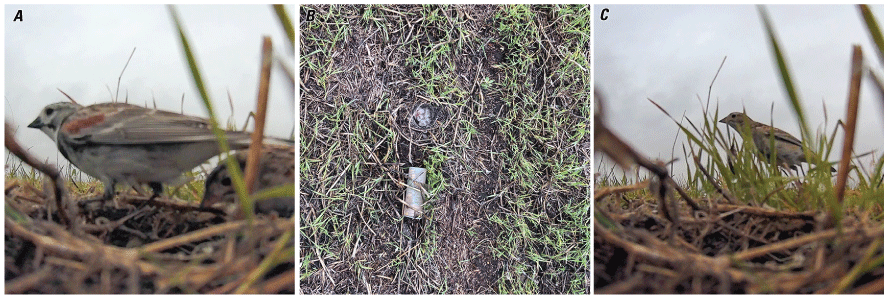
Photographs showing screenshots of unbanded Rhynchophanes mccownii (thick-billed longspur; [A] male and [C] female) taken with (B) a small cylindrical video camera placed near a longspur nest. Photographs by the U.S. Geological Survey.
We used several methods to resight color-banded birds, and each method varied in both the amount of time required to obtain a resight and in its effectiveness. Of note, the visibility of a transmitter’s antenna aided in focusing resighting efforts for individuals with transmitters as we knew that bird was marked and may also have color bands. Spotting scopes and digital SLR cameras allow for mobile efforts compared to the nest or camera traps, but tall vegetation can hinder resighting capabilities. For longspurs that were particularly difficult to view to determine if they were banded, we played TBLO vocalizations via a small Bluetooth speaker to get the bird’s attention. This method had mixed results but did work on several occasions by increasing opportunities to view the individual at a closer distance. It was also advantageous to place the speaker on bare ground to improve the odds of a TBLO landing in an unvegetated area to improve the view of its legs. Based on our experience, spotting scopes and digital SLR cameras were more effective in areas of bare substrate such as along two track roads, at waterbodies, and at baited sites. Camera traps provide a low-effort opportunity for passive viewing but are limited by a prerequisite lure (bait, audio lure, or possibly water sources) and the distance that birds travel to the lure from their territories. The nest cameras proved effective and may be especially useful when nest monitoring is an objective; however, careful attention to the nest-camera deployment is needed to increase the chances of a clear view of the bird’s legs and to minimize disturbance to the study subject. Future study objectives and site characteristics will likely determine which combination of methods would be most useful to obtain visual resights of color-banded birds.
Handheld Transmitter Reencounters
We used handheld receivers specific to each brand of transmitter to detect radio-marked birds (fig. 19). We detected 19 of 27 deployed transmitters at least once on a different day after initial deployment in 2022. We detected 13 transmitters on multiple days after deployment in 2022. We did not use a standardized method for obtaining reencounters via transmitter detection. In general, we attempted to detect transmitters in and around areas where we fitted TBLO with a transmitter previously. We did not detect any transmitters in areas other than where we initially deployed them in 2022; however, we noticed that transmitter detection range with the handheld receivers was limited, particularly when a transmitter was near the ground (refer to the “Transmitter Detection Field Tests” section). Additionally, we were restricted to areas where we had obtained land access. It is possible that a TBLO with a transmitter may have moved to a nearby field that we did not have permission to access, and, thus, we were less likely to detect that bird’s transmitter.
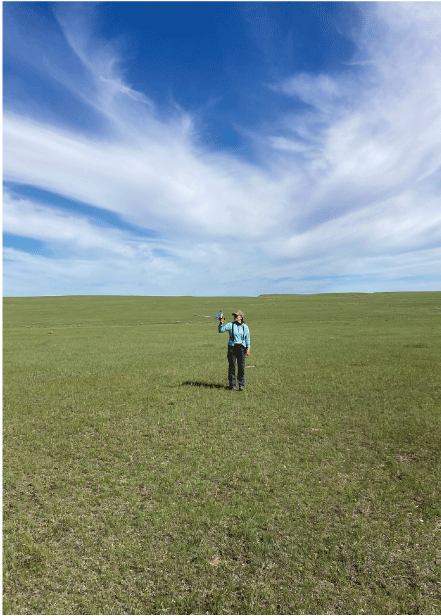
Photograph showing a researcher using a handheld receiver to detect deployed transmitters in a prairie site. Photograph by the U.S. Geological Survey.
In 2023, we returned to areas that we had marked individuals in 2022 and areas that had historical records of TBLO that we did not visit in 2022 (for example, other sites from Swicegood [2022] and eBird locations). We did not detect any transmitters using either brand of handheld receiver. The Lotek NanoTags, with a roughly 291-day battery lifespan, were not expected to be detectable (May 3, 2023, was the predicted last day the latest deployed 2022 Lotek transmitter would still be active). At sites we did not have permission to access (in both years), we only attempted to detect TBLO from public roads which limited our ability to detect transmitters in those areas.
Transmitter Detection Field Tests
We completed three different field tests to assess transmitter detectability. In the first test, we assessed the range for the handheld receivers to detect transmitters on the ground or about 2 m in the air. In the second, we assessed detections by the stationary Motus receiving station for transmitters held about 5 m in the air in areas where transmitters were deployed in 2022. Lastly, we tested the use of a CTT Node to detect transmitters about 50 m away.
We completed a field test to assess transmitter detection range with the handheld receivers by having one person who was holding a transmitter walk away from a second person that was holding the handheld receiver. To determine if the transmitter could be detected by the handheld receiver, the person with the transmitter would stop and hold the transmitter in the air (about 2 m above the ground), followed by holding the transmitter to the ground (mimicking an incubating female, prefledging hatch-year bird, or any individual on the ground). We repeated this procedure roughly every 100 m. We recorded if a detection was recorded, the distance from the receiver, and the signal strength of the detection at various distances (table 10). We used the Lotek SRX1200 M1 receiver to detect Lotek transmitters and the CTT Locator to detect CTT transmitters. At about 200 m, neither brand of transmitter was detected when the transmitter was held near the ground. One key difference between the two brands of transmitters was the ability of the receiver to identify an individual transmitter. For CTT transmitters, the identity was always known if it was detected. For Lotek NanoTags, the transmitter can be detected when the signal is strong, but the transmitter identity can remain unknown when the signal is weak with the receiver we used; therefore, sometimes we detected a Lotek transmitter without knowing which transmitter it was until we were closer. The ability to detect the transmitters seemed dependent on multiple factors including, but not limited to, whether the transmitter was moving, transmitter height above the ground, and transmitter antenna direction (pointing toward or away from the receiver). Male TBLO may be easier to detect than either hatch-year or female birds because of their aerial song displays.
Table 10.
Results of the single transmitter field test performed with a Cellular Tracking Technologies (CTT) LifeTag and a Lotek NanoTag. The transmitters were held in the air (roughly 2 meters above ground) and near the ground to assess the ability to detect them with a handheld receiver. The identity of the CTT transmitter was always known if detected.[CTT, Cellular Tracking Technologies; ~, about; m, meter]
In 2023, we used both CTT and Lotek transmitters (same versions as 2022 field efforts) to trial the Motus receiving station in northern Valley County, Mont. (https://motus.org/data/receiverDeployment?id=9124). We turned the transmitters on and off at several locations near and within study sites where we deployed transmitters in 2022. We also placed transmitters on a long pole and stood in a truck bed for 5–10 minutes, elevating the transmitter to roughly 5 m above ground to mimic heights of flying or displaying TBLO (fig. 20). Both transmitters were detected but only on the day that we tested them within eyesight of the Motus station, which is the expected behavior given line-of-sight conditions. On all other days, the transmitters were not detected based on publicly available data on the Motus website. Of note, several locations we tested were outside the estimated antenna ranges as indicated on the Motus website; however, other locations were within the antenna ranges, but topography and our limited testing heights may have prevented detections.
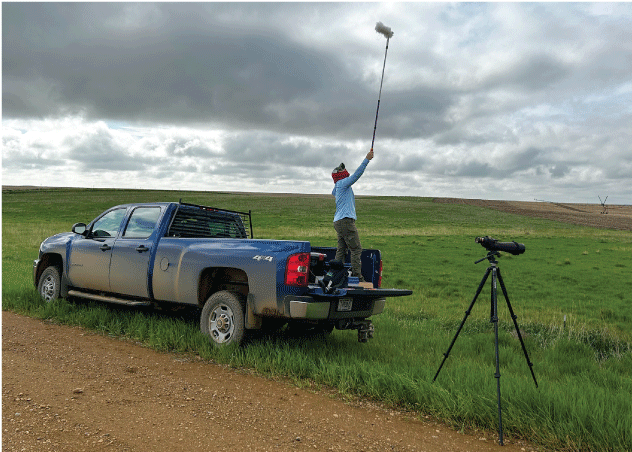
Photograph showing a researcher extending an active transmitter in the air to test for possible detection by the new Motus receiving station in northern Valley County, Montana. Photograph by the U.S. Geological Survey.
We also completed transmitter detection tests at a water source using a CTT Node V2, which is a temporarily deployed solar-powered receiver station. We simulated a TBLO flying towards a small waterbody in cropland habitat and taking a drink at the water (active transmitter on a long pole moved close to ground near water). The transmitter was detected by the Node from each of the four cardinal directions (north, south, east, west). The waterbody was small such that the transmitters were within 50 m of the Node during the simulated drinking. We also tried this method at a larger waterbody in a prairie site, but we did not use a pole to simulate a flying or drinking bird. Results were similar between the two trials. Placing Nodes in areas of known TBLO use, like standing waterbodies, or near bait may be a useful method for passively reencountering CTT transmitters. Although our testing was limited, the use of nodes or other temporarily deployed receivers may be helpful in reencountering TBLO. Of note, the manufacturer has discontinued the model of CTT Nodes we used, but a new version is planned to be available sometime in the future.
2023 Reencounters
Most of our efforts in 2023 were focused on reencountering previously marked individuals in areas we had previously marked TBLO in 2022. Where we had permission to access land (in both years), our two-person field crew walked slow transects through TBLO habitat using spotting scopes, binoculars, a digital SLR camera, and (or) handheld receivers to attempt to reencounter TBLO. As birds were encountered, we stopped to scan TBLO legs with optics and periodically listened with handheld receivers. We estimated that we visually encountered (clearly saw the legs of) more than 200 unique adult TBLO across all sites in the 2023 field effort. Most birds encountered were males (~83 percent); this is not surprising as sex-specific behaviors of males, such as display flights, make them easier to detect. We did not detect any transmitters with the handheld receivers. Although we did explore areas that were not visited in 2022, we were limited to view these areas of TBLO use from public roads. In these areas, we did not obtain any additional resights of marked or unmarked TBLO; the distance was too far to obtain clear views of TBLO legs from the road, even with spotting scopes, nor did we detect any transmitters with handheld receivers.
We detected one previously banded TBLO, a male with a nonfunctional Lotek transmitter and color bands seen at a prairie site (fig. 21). We tried on two days to capture this male to remove the transmitter, but we were unsuccessful. Unfortunately, we were unable to identify the bird as a unique individual because one of its color bands had fallen off since we marked the male in 2022. Based on the color bands the bird retained, the bird’s sex, and the type of transmitter the bird carried (Lotek), we were able to narrow the identity of this male to one of three individuals that we banded nearby in this same prairie site in 2022, suggesting it did return to the same general area. The marked individual we resighted in 2023 maintained a consistent territory during our 2023 field season which gave us multiple chances to resight and photograph the bird. We also could quickly determine which individual we were targeting when other males entered the area because the marked bird’s transmitter antenna was visible when the bird was flying (and occasionally when the bird perched on a rock or dung pat).
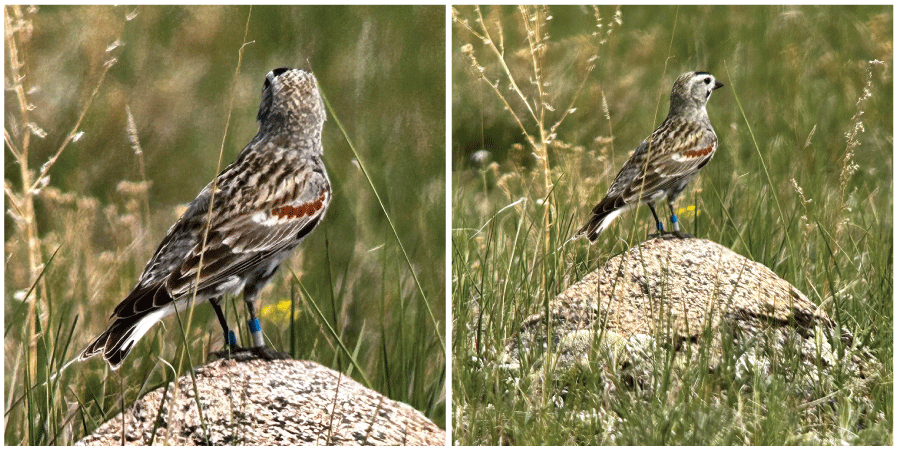
Photographs showing a previously marked Rhynchophanes mccownii (thick-billed longspur) from 2022 (combination: blue: blue metal; one color band had been lost) that was observed during our 2023 field season efforts in a prairie site. This bird was carrying a nonfunctional Lotek transmitter. Photographs by the U.S. Geological Survey.
Motus Network Detections
During our 2022 field season, no Motus receiving stations were operating within our study area. In October 2022, a single Motus station was installed in northern Valley County, Mont. (fig. 1), but the station has not detected any TBLO with transmitters at the time of this report. Within the Great Plains, the number of fixed Motus receiving stations has been increasing since roughly 2020, and a map of available receiving stations through time is available at https://motus.org/data/receiversMap.
As of January 27, 2025, four different TBLO with transmitters from this study have been detected by two Motus receiving stations. Detections were during southbound migration (n=2), at stationary nonbreeding sites (n=1), and during northbound migration (n=1). In this section, we describe the birds’ original captures and subsequent detections.
An adult female was detected once on October 20, 2022, at 7:59 p.m. local time, at a Motus station near Karval, Colorado. This detection likely was during southbound migration, as the area is not a known breeding or stationary nonbreeding area for the species. The female was captured with a horizontal mist net in cropland on July 14, 2022, on a nest containing 8–10-day old nestlings. She received a Lotek NanoTag and a USGS metal band.
The second TBLO detected by Motus was an adult male that pinged the same station near Karval, Colo., on November 6, 2022, at 8:19 a.m. local time, likely during southbound migration. This individual was captured and banded at a prairie site on July 13, 2022, using a horizontal mist net over an audio lure. He received a Lotek NanoTag and a USGS metal band. We did not detect the transmitter again after the bird’s initial capture.
The third TBLO, an adult female, was detected at a Motus station on the Mimms Ranch near Marfa, Texas. She was captured and fitted with a CTT LifeTag, color bands, and a USGS metal band in a prairie site on July 21, 2022—our last day of field efforts—using a horizontal mist net on a nest containing a 1-day-old nestling and three eggs. She was detected most days from November 30, 2022, to January 14, 2023, ranging between 9:12 a.m. to 6:36 p.m. local time on the Mimms Ranch. This is a known nonbreeding area for TBLO.
The fourth TBLO, an adult female, was detected on April 11, 2023, at 6:45 a.m. local time, at the same Motus station near Karval, Colo. This detection likely was during northbound migration given the time of year. This female was captured using an array of two-shelf mist nets near an established baiting site on June 3, 2022. She received a CTT LifeTag, color bands, and a USGS metal band. She was detected once on June 27, 2022, using a handheld receiver during our 2022 field efforts. She was not detected during our 2023 field efforts.
It is possible that new detections will have been reported since the release of this report. To view detections for this project, visit the Motus website: https://motus.org/data/project?id=423.
Interannual Habitat Variability
Habitat suitability may change from year-to-year, which may affect both the likelihood of a TBLO returning to a field that it nested in the previous year, as well as resight probability. The decisions of farmers (for example, the timing of planting, harvest methods, and crop types planted) can contribute to interannual variability in habitat suitability. The easiest location to resight TBLO during our 2023 field season was a cropland field that had recently been seeded, was mostly free of residual debris (compared to other fields at that time) and had plenty of rocks for birds to stand on, yielding opportunities for clear views of their legs. Another cropland field we visited often in 2022, which had TBLO throughout the entire field, was completely devoid of TBLO in 2023. In 2022 this field had limited vegetation present at the time of our arrival (early May); whereas, in late May 2023, tall stalks of residual plant cover were present, possibly from using a stripper header for harvest (fig. 22). The tall residual vegetation is not ideal nesting habitat for TBLO (With, 2021). Future researchers should be aware that habitat suitability can change dramatically from year to year and that changes in habitat may affect habitat use by TBLO, as well as resighting probabilities.
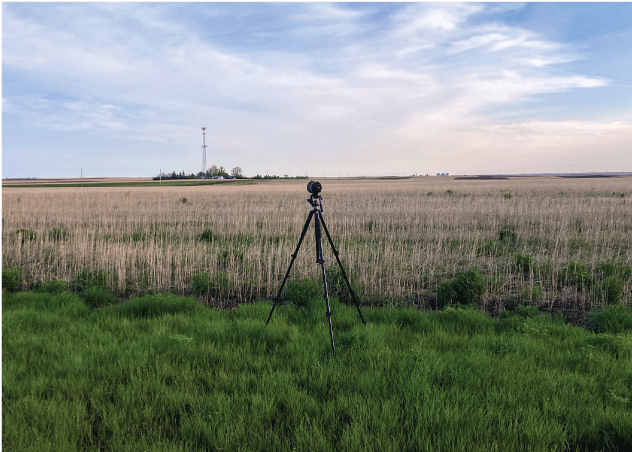
Photograph showing an example of a cropland field that was used by Rhynchophanes mccownii (thick-billed longspur) in 2022 when it was planted with a small grain. This field was not used by longspurs in 2023, when it was tall, residual vegetation. Photograph by the U.S. Geological Survey.
Conclusions
Our two field seasons were able to provide insights into capture methods, marking schemes, and reencounter techniques of TBLO to meet our objectives and inform future studies that are designed to investigate TBLO demographic vital rates or movement ecology.
During our 2022 pilot field season, we were successful in assessing capture methods for TBLO. Vertical two-shelf mist nets were more effective than four-shelf mist nets, and results from the use of the horizontal mist net method indicate that it would be appropriate for almost all capture scenarios. The horizontal mist net method provided quicker net deployments, lower visual obstructions, and increased versatility compared to the traditional vertical implementation. Horizontal mist nets seem to be more effective later in the season when taller vegetation is present, particularly in cropland. Combining the use of bait with water on the landscape exhibited great promise for adult TBLO captures, though using this combination may be more challenging in cropland sites, where there is less water on the landscape compared to prairie sites. The effectiveness of baiting and capturing at water sources would likely be variable within and among seasons as conditions on the landscape change (for example, wet versus dry). Our efforts suggest that the use of bait in TBLO common use areas (for example, bare ground, near waterbodies) would allow for effective capture efforts throughout the breeding season; however, the effectiveness of baiting in cropland still needs assessment, and careful consideration of potential side effects to the study system (for example, the introduction of exotic plants through the germination of the bait seed) and possible introduction of bias in vital rate estimation minimize its utility. We attempted to determine status of adults after on-nest captures (stayed, abandoned, unknown) but had limited data to support broad conclusions. A more intensive nest monitoring effort may lead to conclusions on possible effects for on-nest captures. We worked with a small portion of the TBLO population, and inferences on potential population-level effects from these efforts are limited.
Our field efforts provide useful insights regarding appropriate marking schemes for TBLO. Only the CTT LifeTag was light enough to attach to recently fledged birds (≤3 percent of their body mass). Studies focusing on hatch-year birds may require lighter transmitters that can be attached while individuals are still in the nest cup. One of the transmitters (Lotek NanoTag) also was limited by battery life, making interannual detections impossible. Additionally, handheld receivers did not detect either brand of transmitter beyond 200 m from an observer. However, the additional benefit of using Motus transmitters is the potential for other Motus stations to detect the transmitter outside of the project’s study area. Relying solely on color bands or standard very high frequency transmitters limits studies to the breeding season and would likely require large-scale field efforts. Future studies could benefit from identifying the marking scheme necessary to meet project objectives and effort levels, considering sample sizes and the part of the annual cycle where tracking will be occurring (during the breeding season, during migration, or throughout the entire year).
We determined differences in our ability to reencounter birds fitted with transmitters based on the different types of transmitters and receivers. We were able to reencounter birds within a breeding season that had transmitters, but the efficiency of these methods may require further assessment for a larger project effort. We were limited in our ability to detect transmitters using the handheld receivers, especially when a bird with a transmitter was on the ground. The use of fixed Motus receiving stations may be useful for further studies, but as of this report’s publishing date, only one station has been installed within our study area. For further studies, using Motus-compatible transmitters would likely require that additional stations be installed in the study area, including stations that can detect individuals in prairie sites. However, we were able to document a proof-of-concept that the wider Motus network can detect migrating and nonbreeding TBLO and provide data to recategorize birds with unknown fates to “survived the breeding season” based on detections later in the annual cycle.
Because of limitations on the longevity of transmitter batteries and biases they can present in survival analyses, unique color-band combinations could be an important method to reencounter marked TBLO in subsequent years (without recapturing individuals) to address questions related to annual survival and breeding-season site fidelity. Expanding on the resighting efforts from our pilot field seasons may improve our ability to reencounter birds annually and to understand the effort needed to effectively obtain resights to address study objectives. During the 2022 pilot field season, we had limited time and effort with which to do multiple tasks, and, thus, we were unable to devote considerable time to the resighting of marked birds, especially since we needed to capture TBLO before trials. We were able to successfully resight color-banded birds in 2022, which could provide data for certain questions such as territory occupancy within a breeding season or within-season survival. A combination of different optical equipment seems necessary to collect enough observations of individuals for demographic study; however, our efforts in 2023 suggest that using color-band combinations to derive interannual estimations may be exceedingly difficult in an open population based on presumed annual mortality, low breeding-site fidelity, and color band loss. We only resighted one previously marked individual in 2023 and were unable to identify the individual because a color band had been lost. Although our efforts in 2023 were limited, only one of 53 individuals banded in 2022 was seen in 2023, although a second individual was recorded at a Motus station during its northward migration in 2023. Therefore, it is critical to mark enough individuals, and to complete extensive interannual reencounter efforts to estimate annual survival.
In conclusion, we identified several field methods that exhibit promise for future TBLO research. We were able to mark 54 TBLO that together contribute data to address demographic questions for this declining species. Radio transmitters that connect to the Motus network have already begun to provide information on migration and nonbreeding locations for TBLO breeding in Valley County, Mont., and will be increasingly useful in addressing information needs in future years as new Motus stations are added to the growing network. In general, it was easy to determine if a TBLO was marked or not, but resighting color bands was more difficult, especially when a TBLO was not faithful to a location (for example, territory or nest) to allow multiple opportunities to resight it. Finally, it was apparent that environmental and habitat conditions varied between years, as conditions at several of our field sites were noticeably different in 2023 than they were in 2022 (for example, because of the timing of planting, the presence of tall residual vegetation from the prior year’s crop harvest, more water on the landscape), and TBLO distributions varied accordingly.
Summary
Like numerous other North American grassland bird species, Rhynchophanes mccownii (thick-billed longspur) has experienced severe population declines in the last 50 years. Little is known about population-limiting factors, and knowledge gaps limit conservation efforts on the species; however, before research studies aimed at improving conservation and management actions can be developed, other research must resolve notable knowledge gaps that exist in field techniques for efficient and effective large-scale demographic studies. We examined several techniques for the capture, marking (metal and color bands), and reencountering (resights and telemetry) of thick-billed longspurs in croplands and prairies in Valley County, Montana, during the 2022 and 2023 breeding seasons. Our goal was to evaluate the feasibility of obtaining within- and between-season resights of individual thick-billed longspurs using optical equipment and cameras, transmitter receivers, and the Motus automatic receiving station network. This report includes observations and insights that may aid researchers embarking on future demographic studies of thick-billed longspurs, as well as other grassland birds that provide similar research challenges.
References Cited
Buderman, F.E., Devries, J.H., and Koons, D.N., 2020, Changes in climate and land use interact to create an ecological trap in a migratory species: Journal of Animal Ecology, v. 89, no. 8, p. 1961–1977. [Also available at https://doi.org/10.1111/1365-2656.13228.]
eBird, 2024, eBird: An online database of bird distribution and abundance [web application]. eBird, Cornell Lab of Ornithology, Ithaca, New York, accessed February 15, 2024, at https://ebird.org.
Fair, J., Paul, E., Jones, J., and Bies, L., eds., 2023, Guidelines to the use of wild birds in research: Washington, D.C., Ornithological Council, 260 p. [Also available at https://birdnet.org/wp-content/uploads/2023/09/Guidelines-September-2023.pdf.]
Fisher, R.J., Dohms, K.M., and Davis, S.K., 2010, Removal of nestling radio-transmitters by adult Sprague’s pipit (Anthus spragueii): Journal of Ornithology, v. 151, no. 3, p. 749–753. [Also available at https://doi.org/10.1007/s10336-010-0503-2.]
Jones, T.M., Cooper, N.W., Haradon, H.A., Brunner, A.R., Dossman, B.C., Ward, M.P., Sillett, T.S., and Kaiser, S.A., 2024, Considerations for radio-transmitter specifications on songbirds—Color and antenna length matter too: Journal of Field Ornithology, v. 95, no. 1. [Also available at https://doi.org/10.5751/JFO-00426-950107.]
Jongsomjit, D., Jones, S.L., Gardali, T., Geupel, G.R., and Gouse, P.J., 2007, A guide to nestling development and aging in altricial passerines: U.S. Fish and Wildlife Service Biological Technical Publication FWS/BTP-R6008-2007, 56 p. [Also available at https://digitalcommons.unl.edu/cgi/viewcontent.cgi?article=1160&context=usfwspubs.]
Keyes, B.E., and Grue, C.E., 1982, Capturing birds with mist nets—A review: North American Bird Bander, v. 7, no. 1, p. 1–13. [Also available at https://pubs.usgs.gov/publication/5221771.]
Kikkawa, J., 1997, Individual colour banding for 8 000 birds: Corella, v. 21, p. 26–30. [Also available at https://absa.asn.au/wp-content/uploads/2021/08/Cor-Vol-21-Pg26-31_ColourBanding_8000Birds.pdf.]
Liebezeit, J.R., Smith, P.A., Lanctot, R.B., Schekkerman, H., Tulp, I., Kendall, S.J., Tracy, D.M., Rodrigues, R.J., Meltofte, H., Robinson, J.A., Gratto-Trevor, C., Mccaffery, B.J., Morse, J., and Zack, S.W., 2007, Assessing the development of shorebird eggs using the flotation method—Species-specific and generalized regression models: The Condor, v. 109, no. 1, p. 32–47. [Also available at https://doi.org/10.1093/condor/109.1.32.]
Martin, S.G., 1969, A technique for capturing nesting grassland birds with mist nets: Bird-Banding, v. 40, no. 3, p. 233–237, accessed January 15, 2024, at https://doi.org/10.2307/4511583.
Mattsson, B.J., Meyers, J.M., and Cooper, R.J., 2006, Detrimental impacts of radiotransmitters on juvenile Louisiana waterthrushes: Journal of Field Ornithology, v. 77, no. 2, p. 173–177. [Also available at https://doi.org/10.1111/j.1557-9263.2006.00038.x.]
Mickey, F.W., 1943, Breeding habits of McCown’s longspurs: The Auk, v. 60, no. 2, p. 181–209. [Also available at https://doi.org/10.2307/4079644.]
Milligan, J.L., Davis, A.K., and Altizer, S.M., 2003, Errors associated with using colored leg bands to identify wild birds: Journal of Field Ornithology, v. 74, no. 2, p. 111–118. [Also available at https://doi.org/10.1648/0273-8570-74.2.111.]
Rappole, J.H., and Tipton, A.R., 1991, New harness design for attachment of radio transmitters to small passerines: Journal of Field Ornithology, v. 62, no. 3, p. 335–337. [Also available at https://www.jstor.org/stable/20065798.]
Richardson, T.W., Gardali, T., and Jenkins, S.H., 2009, Review and meta-analysis of camera effects on avian nest success: The Journal of Wildlife Management, v. 73, no. 2, p. 287–293. [Also available at https://doi.org/10.2193/2007-566.]
Rosenberg, K.V., Dokter, A.M., Blancher, P.J., Sauer, J.R., Smith, A.C., Smith, P.A., Stanton, J.C., Panjabi, A., Helft, L., Parr, M., and Marra, P.P., 2019, Decline of the North American avifauna: Science, v. 366, no. 6461, p. 120–124. [Also available at https://doi.org/10.1126/science.aaw1313.]
Shaffer, J.A., Igl, L.D., Johnson, D.H., Sondreal, M.L., Goldade, C.M., Rabie, P.A., Wooten, T.L., and Euliss, B.R., 2019, The effects of management practices on grassland birds—thick-billed longspur (Rhynchophanes mccownii) (ver. 1.1, March 2022), in Johnson, D.H., Igl, L.D., Shaffer, J.A., and DeLong, J.P., eds., The effects of management practices on grassland birds: U.S. Geological Survey Professional Paper 1842, 10 p. [Also available at https://doi.org/10.3133/pp1842Y.]
Somershoe, S.G., ed., 2018, A full annual-cycle conservation strategy for Sprague’s pipit, chestnut-collared and McCown’s longspurs, and Baird’s sparrow: U.S. Fish and Wildlife Service Report, 181 p. [Also available at https://ppjv.org/assets/pdf/SPPI/Conservation_strategy_for_Grassland_birds.pdf.]
Sousa, B.F., and Stewart, S.L.M., 2011, Design and effectiveness of a novel trap for capturing nesting songbirds: Journal of Field Ornithology, v. 82, no. 4, p. 425–429. [Also available at https://doi.org/10.1111/j.1557-9263.2011.00346.x.]
Streby, H.M., McAllister, T.L., Peterson, S.M., Kramer, G.R., Lehman, J.A., and Andersen, D.E., 2015, Minimizing marker mass and handling time when attaching radio transmitters and geolocators to small songbirds: The Condor, v. 117, no. 2, p. 249–255. [Also available at https://doi.org/10.1650/CONDOR-14-182.1.]
Swicegood, A.E., 2022, Fatal attraction for an imperiled songbird—Is cropland in the northern Great Plains an ecological trap for breeding thick-billed longspur?: Bozeman, Mont., Montana State University, master’s thesis, 77 p. [Also available at https://scholarworks.montana.edu/xmlui/handle/1/17407.]
Swicegood, A.E., 2023, Management recommendations for thick-billed longspur (Rhynchopanes mccownii) in Montana: Montana Fish, Wildlife and Parks Report, 21 p. [Also available at https://fwp.mt.gov/binaries/content/assets/fwp/conservation/non-game/13---tblo_mngmtrecs_montanafwp.pdf.]
Swicegood, A.E., Ellison, K.S., Sather, M., Somershoe, S.G., and McNew, L.B., 2023, Detecting ecological traps in human-altered landscapes—A case study of the thick-billed longspur nesting in croplands: Ecology and Evolution, v. 13, no. 4, article e9993, 19 p., accessed February 7, 2024, at https://doi.org/10.1002/ece3.9993.
Toy, D.L., Roche, E.A., and Dovichin, C.M., 2017, Small high-definition video cameras as a tool to resight uniquely marked interior least terns (Sternula antillarum athalassos): Waterbirds, v. 40, no. 2, p. 180–186. [Also available at https://doi.org/10.1675/063.040.0211.]
With, K.A., 2021, Thick-billed longspur (Rhynchophanes mccownii) (ver. 1.1): Cornell Lab of Ornithology web page, accessed February 1, 2024, at https://doi.org/10.2173/bow.mcclon.01.1.
Appendix 1. Capture Methods for Rhynchophanes mccownii (Thick-billed Longspurs)
Table 1.1.
Description of capture methods for Rhynchophanes mccownii (thick-billed longspurs) referenced in document.[mm, millimeter; m, meter; cm2, square centimeter]
For more information about this publication, contact:
Director, USGS Northern Prairie Wildlife Research Center
8711 37th Street SE
Jamestown, ND 58401
701–253–5500
For additional information, visit: https://www.usgs.gov/centers/npwrc
Publishing support provided by the
Rolla Publishing Service Center
Disclaimers
Any use of trade, firm, or product names is for descriptive purposes only and does not imply endorsement by the U.S. Government.
Although this information product, for the most part, is in the public domain, it also may contain copyrighted materials as noted in the text. Permission to reproduce copyrighted items must be secured from the copyright owner.
Suggested Citation
Ring, M.M., Swift, R.J., Anteau, M.J., Igl, L.D., Seamans, M.E., Somershoe, S.G., VonBank, J.A., Yeiser, J.M., and MacDonald, G.J., 2025, Developing research tools for demographic study of Rhynchophanes mccownii (thick-billed longspurs): U.S. Geological Survey Open-File Report 2025–1002, 33 p., https://doi.org/10.3133/ofr20251002.
ISSN: 2331-1258 (online)
| Publication type | Report |
|---|---|
| Publication Subtype | USGS Numbered Series |
| Title | Developing research tools for demographic study of Rhynchophanes mccownii (thick-billed longspurs) |
| Series title | Open-File Report |
| Series number | 2025-1002 |
| DOI | 10.3133/ofr20251002 |
| Publication Date | February 10, 2025 |
| Year Published | 2025 |
| Language | English |
| Publisher | U.S. Geological Survey |
| Publisher location | Reston, VA |
| Contributing office(s) | Northern Prairie Wildlife Research Center |
| Description | viii, 33 p. |
| Online Only (Y/N) | Y |
| Additional Online Files (Y/N) | N |