


Distribution and Abundance of Least Bell’s Vireos (Vireo bellii pusillus) and Southwestern Willow Flycatchers (Empidonax traillii extimus) at the Mojave River Dam, San Bernardino County, California—2024 Data Summary
Links
- Document: Report (1.9 MB pdf) , HTML , XML
- Download citation as: RIS | Dublin Core
Acknowledgments
This work was funded by the U.S. Army Corps of Engineers. Data either are not available or have limited availability owing to restrictions of the funding entity (U.S. Army Corps of Engineers). Please contact Jon L. Rishi, Operations Division, Los Angeles District, U.S. Army Corps of Engineers, for more information. All activities were authorized under federal 10(a)1(A) Recovery Permit ESPER0004080_0.2.
Executive Summary
We surveyed for Least Bell’s Vireos (Vireo bellii pusillus; vireo) and Southwestern Willow Flycatchers (Empidonax traillii extimus; flycatcher) at the Mojave River Dam study area near Hesperia, California, in 2024. Four vireo surveys were completed between April 17 and July 2, 2024, and three flycatcher surveys were completed between May 23 and July 2, 2024.
We detected three territorial male vireos, all of which were paired. No juveniles were observed during surveys. Vireo territories were reported in two habitat types: riparian scrub and willow-cottonwood. Red or arroyo willow (Salix laevigata or lasiolepis) was the dominant plant species in most vireo territories. No territorial or transient flycatchers were observed.
Introduction
The Least Bell’s Vireo (Vireo bellii pusillus; vireo) is a small, migratory songbird that breeds in southern California and northwestern Baja California, Mexico, from April through July. Historically abundant within lowland riparian ecosystems, vireo populations began declining in the late 1900s as a result of multiple anthropogenic factors, including habitat loss and alteration associated with urbanization and agricultural conversion of land adjacent to rivers, the expansion in range of the brood-parasitic Brown-headed Cowbird (Molothrus ater; cowbird), and the introduction of invasive exotic plant species, such as giant reed (Arundo donax) into riparian systems (U.S. Fish and Wildlife Service 1986, 1998; Franzreb, 1989; Kus, 1998, 1999; Riparian Habitat Joint Venture, 2004; Kus and others, 2020). By 1986, the vireo population in California numbered just 300 territorial males (U.S. Fish and Wildlife Service, 1986).
In response to the dramatic numeric decline of vireos in California, the California Fish and Game Commission listed the species as endangered in 1980, and the U.S. Fish and Wildlife Service (USFWS) followed suit in 1986. Since listing, the vireo population in southern California has rebounded, largely in response to cowbird control and habitat restoration and preservation (Kus and Whitfield, 2005). As of 2006, the statewide vireo population was estimated to be approximately 2,500–3,000 territories (U.S. Fish and Wildlife Service, 2006).
The Southwestern Willow Flycatcher (Empidonax traillii extimus; flycatcher) is one of four subspecies of Willow Flycatcher in the United States, with a breeding range including southern California, Arizona, New Mexico, extreme southern parts of Nevada and Utah, southwestern Colorado, and western Texas (Hubbard, 1987; Unitt, 1987; Browning, 1993). Restricted to riparian habitat for breeding, the flycatcher has declined over the past five decades in response to widespread habitat loss throughout its range and, possibly, brood-parasitism by cowbirds (Wheelock, 1912; Willett, 1912, 1933; Grinnell and Miller, 1944; Remsen, 1978; Garrett and Dunn, 1981; Unitt, 1984, 1987; Gaines, 1988; Schlorff, 1990; Whitfield and Sogge, 1999). By 1993, the species was believed to number approximately 70 pairs in California (U.S. Fish and Wildlife Service, 1993) in small, disjunct populations. The flycatcher was listed as endangered by the State of California in 1992 and by the USFWS in 1995. After listing, population estimates for flycatchers in California increased to 256 territories, with the increase largely attributed to expanded survey efforts rather than population growth at known sites (U.S. Fish and Wildlife Service, 2002). In the 2014 5-year status review, estimates of California flycatcher territories decreased to 172, with declines occurring statewide (Durst and others, 2008; U.S. Fish and Wildlife Service, 2014).
Flycatchers in southern California co-occur with vireos. However, unlike the vireo, which has increased tenfold since the mid-1980s in response to management practices alleviating threats (U.S. Fish and Wildlife Service, 2006), the number of flycatchers has remained low. As of 2023, most of the Southwestern Willow Flycatchers in California are concentrated at two known sites: (1) the Owens River valley in Inyo County (approximately 56 territories; M. Whitfield, Southern Sierra Research Station, written commun., 2023), and (2) the upper San Luis Rey River at Lake Henshaw in San Diego County (approximately 51 territories; Howell and Kus, 2024). Outside of these sites, flycatchers occur as small, isolated populations of one to half-dozen pairs.
Male vireos arrive on breeding grounds in southern California in mid-March. Males are vocally conspicuous and frequently sing their diagnostic primary song from exposed perches throughout the breeding season. Females arrive approximately 1–2 weeks after males and are more secretive but are often seen early in the season traveling through habitat with the males. The female, with the male's help, builds an open cup nest in dense vegetation approximately 1 meter (m) above the ground. Nesting occurs from early April through July, but adults and juvenile birds remain on the breeding grounds into late September and early October before migrating to their wintering grounds in southern Baja California, Mexico.
Male flycatchers begin arriving in southern California in early to mid-May, whereas females arrive approximately 1 week later. While on the breeding grounds, males sing repeatedly from exposed perches. Once the pair bond is established, the female builds an open cup nest that is usually placed in a branch fork of a willow (Salix spp.) or plant with a similar branching structure approximately 1–3 m above the ground. Adults usually depart from their breeding territory in mid-August and early September to their wintering grounds in central America and northern South America.
The Mojave River Dam is within USFWS-designated critical habitat for the flycatcher, and although this area is not designated critical habitat for the vireo, breeding birds have been documented at Mojave River Dam since 2019 (R. Fisher, U.S. Geological Survey, written commun., 2020; Howell and Kus, 2022). Managed by the U.S. Army Corps of Engineers for flood control, the Mojave River Dam requires regular operational maintenance, including debris, sediment, and vegetation removal and management. As mandated by the USFWS, the U.S. Army Corps of Engineers is required to perform surveys and assess activities that might have adverse effects on these federally endangered bird species. The purpose of this report is to summarize the results of vireo and flycatcher surveys completed by the U.S. Geological Survey (USGS) at the Mojave River Dam in 2024. These data will inform natural resource managers about the status of these endangered species at the Mojave River Dam and guide land use and management practices as appropriate to ensure the species’ continued existence.
Methods
Study Area
The study area is upstream and downstream from the Mojave River Dam, where Deep Creek and the West Fork Mojave River come together and flow through the Mojave River Dam forming the Mojave River north of the dam (fig. 1). The Mojave River Dam is outside the city of Hesperia, off Arrowhead Lake Road and north of State Route 173, in San Bernardino County, California. The dam was completed in 1974 for the purpose of flood control. The reservoir behind the dam is typically dry but can fill temporarily after heavy rains. The area that was surveyed includes 0.8 kilometers (km) of the West Fork Mojave River flowing east toward the dam, 3.1 km of Deep Creek flowing west toward the dam, and 2.0 km of the Mojave River flowing north away from the dam. The riparian habitat south of the dam is dominated by willow (Salix spp.) and Fremont’s cottonwood (Populus fremontii). The area north of the dam is highly disturbed by illegal off-road vehicle use, and the riparian habitat is patchy and degraded. Water flowed swiftly throughout the rocky Deep Creek section of the survey area, whereas the Mojave and West Fork Mojave River sections were sandier and included areas of dry riverbed, slow-moving water, and standing pools. In 2024, water flows were extremely high and continued to flow in all three sections throughout the study period (April–July).
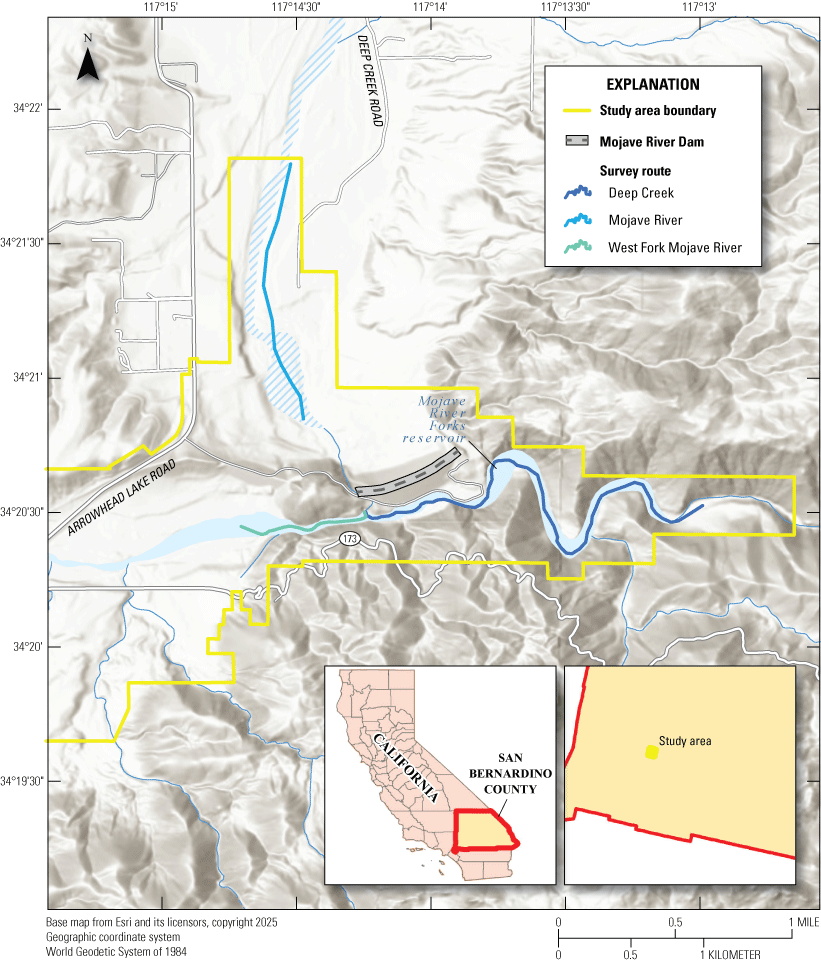
Location of Least Bell’s Vireo (Vireo bellii pusillus) and Southwestern Willow Flycatcher (Empidonax traillii extimus) study area at the Mojave River Dam, San Bernardino County, California, 2024.
Surveys
Surveys were done during the breeding season (April–July) and followed standard survey techniques for vireos (U.S. Fish and Wildlife Service, 2001) and flycatchers (Sogge and others, 2010). Four surveys for vireos were completed throughout the study area between April 17 and July 2, 2024, and three surveys for flycatchers were completed between May 23 and July 2, 2024. During the first two survey dates, the survey route for the Deep Creek section was limited to the first 1.8 km from the dam because of deep and swift water (table 1). Observers walked slowly through or adjacent to suitable riparian habitat, listening and searching for vireos and flycatchers, occasionally playing a recording of a vireo or flycatcher song to elicit a territorial response. Surveys typically began at sunrise and were completed by late morning, avoiding conditions of high winds and extreme heat that can reduce bird activity and detectability. Vireo and flycatcher surveys were completed by USGS biologists Barbara Kus and Scarlett Howell under federal 10(a)1(A) Recovery Permit ESPER0004080_0.2.
Table 1.
Survey dates and results of Least Bell’s Vireo (Vireo bellii pusillus) and Willow Flycatcher (Empidonax traillii) surveys at the Mojave River Dam, San Bernardino County, California, 2024.[The number of birds detected on individual survey dates does not sum to the total number of territorial birds. Abbreviations: F, female; J, juvenile; M, male; —, no data]
For each vireo or flycatcher encountered, observers recorded age (adult or juvenile), sex, breeding status (paired, undetermined, or transient), and if the bird was banded. A male was considered paired if a female also was visually detected, by hearing vocalizations unique to mated birds, or by observing breeding behavior (for example, food carry, a nest, or dependent juveniles in the territory). A vireo or flycatcher was considered transient if detected only once. Vireo and flycatcher locations were mapped using Esri Field Maps (Esri, 2024) on Samsung Galaxy XCover6 Pro mobile phones with Android operating systems and built-in Global Positioning System to determine geographic coordinates (World Geodetic System of 1984 [WGS 84]). Because multiple subspecies of flycatchers may be encountered during surveys, we refer to flycatchers in tables and figures as Willow Flycatchers (Empidonax traillii) to include all subspecies.
Dominant native and exotic plants were recorded at each territory location, and the percentage cover of native vegetation was estimated using categories of less than 5 percent, 5–50 percent, 51–95 percent, and greater than 95 percent. Overall habitat type was specified according to the following categories:
-
Mixed willow riparian: Habitat dominated by one or more willow species, including Goodding’s black willow (Salix gooddingii), arroyo willow, and red willow, with mule-fat (Baccharis salicifolia) as a frequent co-dominant.
-
Willow-cottonwood: Willow riparian habitat in which Fremont’s cottonwood is a co-dominant.
-
Willow-sycamore: Willow riparian habitat in which California sycamore (Platanus racemosa) is a co-dominant.
-
Sycamore-oak: Woodlands in which California sycamore and coast live oak (Quercus agrifolia) occur as co-dominants.
-
Riparian scrub: Dry or sandy habitat dominated by narrowleaf willow (Salix exigua) or mule-fat, with few other woody species.
-
Upland scrub: Desert scrub adjacent to riparian habitat.
-
Non-native: Areas vegetated primarily with non-native species, such as giant reed and tamarisk (Tamarix ramosissima).
Results
A total of three territorial male vireos were detected at the Mojave River Dam in 2024, all of which were confirmed as paired (tables 1, 2; fig. 2). Two nests were incidentally observed in two separate territories (MO01 and MO03), but the nests were inactive on subsequent visits. No juveniles were detected in 2024 (table 1). No banded vireos were observed in 2024 (table 2). Two pairs were south of the dam, and one was north of the dam (fig. 2). No flycatchers were detected in 2024 (table 1).
Table 2.
Locations, breeding status, and band status of Least Bell’s Vireos (Vireo bellii pusillus) detected at the Mojave River Dam, San Bernardino County, California, 2024.[ID, identification]
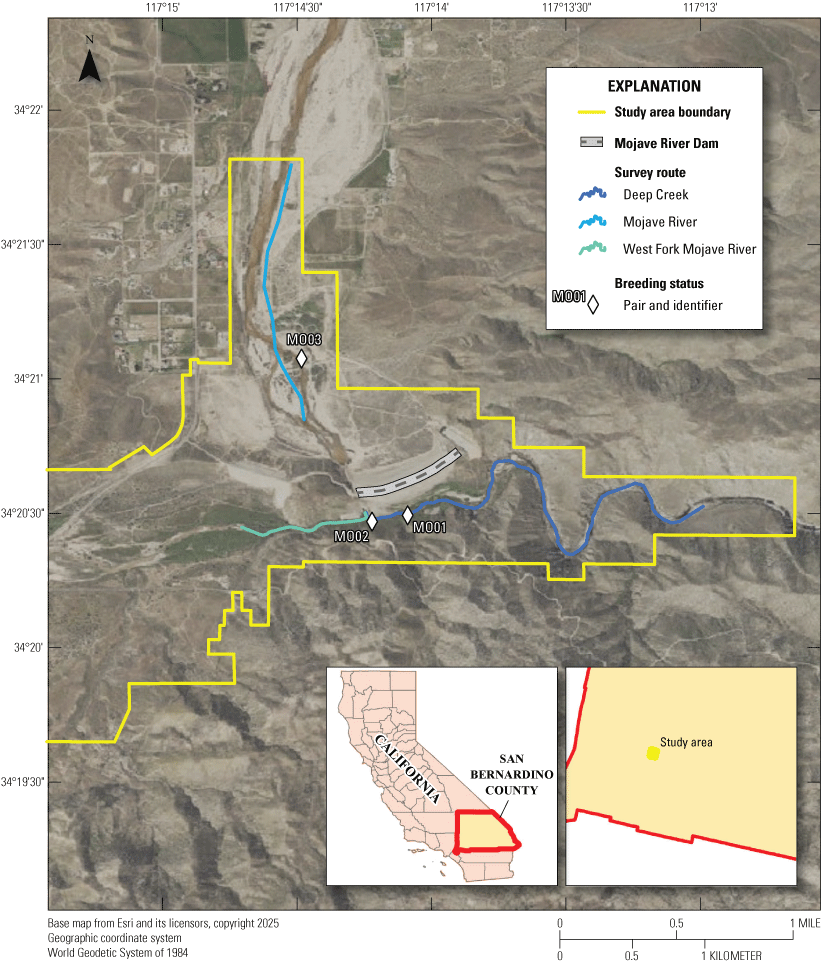
Least Bell’s Vireo (Vireo bellii pusillus) detections and breeding status at the Mojave River Dam, San Bernardino County, California, 2024.
Vireos used two habitat types within the study area: riparian scrub and willow-cottonwood. Most of the vireo territories were in willow-cottonwood habitat (table 3). Several willow species were dominant in vireo territories, including arroyo or red willow and narrowleaf willow (table 3). Exotic vegetation was sparse in vireo territories.
Table 3.
Habitat characteristics of Least Bell’s Vireo (Vireo bellii pusillus) locations at the Mojave River Dam, San Bernardino County, California, 2024.[Willow-cottonwood: Willow riparian habitat in which Fremont’s cottonwood is a co-dominant. Red or arroyo willow (Salix laevigata or lasiolepis), Narrowleaf willow (Salix exigua). Riparian scrub: Dry or sandy habitat dominated by narrowleaf willow or mule-fat, with few other woody species. Abbreviations: ID, identification; >, greater than]
Summary
In 2024, we documented three vireo territories at the Mojave River Dam study area. The population of vireos at the Mojave River Dam has fluctuated between one and four territories since 2019 (R. Fisher, U.S. Geological Survey, written commun., 2020; Howell and Kus, 2022). For the first time, a vireo territory was documented within the Mojave River Dam study area in the area north of the dam; all other reported territories have been south of the dam.
Although no flycatchers were detected in 2024, the vegetation at the Mojave River Dam appears to be suitable habitat for flycatchers, especially within the more hydric Deep Creek section of the study area.
References Cited
Browning, M.R., 1993, Comments on the taxonomy of Empidonax Traillii (Willow Flycatcher): Western Birds, v. 24, no. 4, p. 241–257. [Available at https://sora.unm.edu/sites/default/files/journals/wb/v24n04/p0241-p0257.pdf.]
Durst, S.L., Sogge, M.K., Stump, S.D., Walker, H.A., Kus, B.E., and Sferra, S.J., 2008, Southwestern Willow Flycatcher breeding sites and territory summary—2007: U.S. Geological Survey Open-File Report 2008–1303, 31 p., accessed August 28, 2024, at https://doi.org/10.3133/ofr20081303.
Franzreb, K.E., 1989, Ecology and conservation of the endangered Least Bell’s Vireo: U.S. Fish and Wildlife Service, Biological Report, v. 89, no. 1, 17 p., accessed August 28, 2024, at https://apps.dtic.mil/sti/tr/pdf/ADA322886.pdf.
Grinnell, J., and Miller, A.H., 1944, The distribution of the birds of California: Berkeley, Calif., Cooper Ornithological Club, Pacific Coast Avifauna, no. 27, 608 p. [Available at https://sora.unm.edu/sites/default/files/journals/pca/pca_027.pdf.]
Howell, S.L., and Kus, B.E., 2022, Distribution and abundance of Least Bell’s Vireos (Vireo bellii pusillus) and Southwestern Willow Flycatchers (Empidonax traillii extimus) at the Mojave River Dam, San Bernardino County, California—2021 Data Summary: U.S. Geological Survey Data Report 1149, 7 p. [Available at https://doi.org/10.3133/dr1149.]
Howell, S.L., and Kus, B.E., 2024, Distribution and abundance of Southwestern Willow Flycatchers (Empidonax traillii extimus) on the Upper San Luis Rey River, San Diego County, California—2023 data summary: U.S. Geological Survey Data Report 1194, 13 p. [Available at https://doi.org/10.3133/dr1194.]
Kus, B.E., 1998, Use of restored riparian habitat by the endangered Least Bell’s Vireo (Vireo bellii pusillus): Restoration Ecology, v. 6, no. 1, p. 75–82, accessed February 24, 2025, at https://doi.org/10.1046/j.1526-100x.1998.06110.x.
Kus, B.E., 1999, Impacts of Brown-headed Cowbird parasitism on the productivity of the endangered Least Bell’s Vireo: Studies in Avian Biology, v. 18, p. 160–166. [Available at https://sora.unm.edu/sites/default/files/SAB_018_1999%20P160-166_Impacts%20of%20Brown-Headed%20Cowbird%20Parasitism%20on%20Productivity%20of%20the%20E ndangered%20Least%20Bell%27s%20Vireo_Barbara%20E.%20Kus.pdf.]
Kus, B.E., Hopp, S.L., Johnson, R.R., and Brown, B.T., 2020, Bell’s Vireo (Vireo bellii), version 1.0, in Poole, A.F., ed., Birds of the world: Ithaca, N.Y., Cornell Lab of Ornithology, accessed August 28, 2024, at https://doi.org/10.2173/bow.belvir.01.
Kus, B.E., and Whitfield, M.J., 2005, Parasitism, productivity, and population growth—Response of Least Bell’s Vireos (Vireo bellii pusillus) and Southwestern Willow Flycatchers (Empidonax traillii extimus) to cowbird (Molothrus spp.) control: Ornithological Monographs, no. 57, p. 16–27. [Available at https://doi.org/10.2307/40166811.]
Remsen, J.V., Jr., 1978, Bird species of special concern in California: Sacramento, Calif., California Department of Fish and Game, prepared by Western Field Ornithologists, Inc., Wildlife Management Division, Administrative Report 78-1, 54 p. [Available at https://nrm.dfg.ca.gov/FileHandler.ashx?DocumentID=169067&inline.]
Riparian Habitat Joint Venture, 2004, The riparian bird conservation plan—A strategy for reversing the decline of riparian associated birds in California (ver. 2.0): California Partners in Flight report, 170 p., accessed October 12, 2021, at https://partnersinflight.org/wp-content/uploads/2024/05/riparian_v-2.pdf.
Schlorff, R.W., 1990, Report to the Fish and Game Commission—Status review of the Willow Flycatcher (Empidonax traillii) in California: California Department of Fish and Game, Department Candidate Species Status Report 90-04, 23 p., accessed August 28, 2024, at https://nrm.dfg.ca.gov/FileHandler.ashx?DocumentID=22572.
Sogge, M.K., Ahlers, D., and Sferra, S.J., 2010, A natural history summary and survey protocol for the Southwestern Willow Flycatcher: U.S. Geological Survey Techniques and Methods, book 2, chap. A10, 38 p., accessed August 28, 2024, at https://doi.org/10.3133/tm2A10.
U.S. Fish and Wildlife Service, 1986, Endangered and threatened wildlife and plants; determination of endangered status for the Least Bell’s Vireo [final rule]: Federal Register, v. 51, no. 85, p. 16474–16482. [Available at https://www.govinfo.gov/app/details/FR-1986-05-02.]
U.S. Fish and Wildlife Service, 1993, Endangered and threatened wildlife and plants; proposed rule to list the Southwestern Willow Flycatcher as endangered with critical habitat: Federal Register, v. 58, no. 140, p. 39495–39522. [Available at https://www.govinfo.gov/app/details/FR-1993-07-23.]
U.S. Fish and Wildlife Service, 1998, Draft recovery plan for the Least Bell’s Vireo (Vireo bellii pusillus): Portland, Oreg., U.S. Fish and Wildlife Service report, 154 p. [Available at https://ecos.fws.gov/docs/recovery_plan/980506.pdf.]
U.S. Fish and Wildlife Service, 2001, Least Bell’s Vireo survey guidelines: U.S. Fish and Wildlife Service, Internal Memo, 3 p., accessed August 28, 2024, at https://www.fws.gov/sites/default/files/documents/survey-protocol-for-least-bells-vireo.pdf.
U.S. Fish and Wildlife Service, 2002, Final recovery plan—Southwestern Willow Flycatcher (Empidonax traillii extimus): Albuquerque, N. Mex., U.S. Fish and Wildlife Service report, 210 p., accessed August 28, 2024, at https://www.fs.usda.gov/rm/pubs_other/rmrs_2002_finch_d001.pdf.
U.S. Fish and Wildlife Service, 2006, Least Bell’s Vireo (Vireo bellii pusillus) 5-year review—Summary and evaluation: Carlsbad, Calif., U.S. Fish and Wildlife Service report, 24 p. [Available at https://www.waterboards.ca.gov/waterrights/water_issues/programs/hearings/santa_ana_river/exhibits/riverside/rs3_3.pdf.]
U.S. Fish and Wildlife Service, 2014, Southwestern Willow Flycatcher (Empidonax traillii extimus) 5-year review—Summary and evaluation: Phoenix, Ariz., U.S. Fish and Wildlife Service, 104 p., accessed August 28, 2024, at https://ecos.fws.gov/docs/five_year_review/doc4437.pdf.
Whitfield, M.J., and Sogge, M.K., 1999, Range-wide impact of Brown-headed Cowbird parasitism on the Southwestern Willow Flycatcher (Empidonax traillii extimus): Studies in Avian Biology, v. 18, p. 182–190. [Available at https://sora.unm.edu/sites/default/files/SAB_018_1999%20P182-190_Range-Wide%20Impact%20of%20Brown-Headed%20Cowbird%20Parasitism%20on%20the%20Southwest ern%20Willow%20Flycatcher_Mary%20J.%20Whitfield%2C%20Mark%20K.%20Sogge.pdf.]
Willett, G., 1912, Birds of the Pacific slope of southern California: Hollywood, Calif., Cooper Ornithological Club, Pacific Coast Avifauna, v. 7, 120 p. [Available at https://sora.unm.edu/node/102.]
Willett, G., 1933, A revised list of the birds of southwestern California: Los Angeles, Cooper Ornithological Club, Pacific Coast Avifauna, v. 21, 204 p. [Available at https://sora.unm.edu/node/116.]
For more information concerning the research in this report, contact the
Director, Western Ecological Research Center
U.S. Geological Survey
3020 State University Drive East
Sacramento, California 95819
https://www.usgs.gov/centers/werc
Publishing support provided by the Science Publishing Network,
Sacramento Publishing Service Center
Disclaimers
Any use of trade, firm, or product names is for descriptive purposes only and does not imply endorsement by the U.S. Government.
Although this information product, for the most part, is in the public domain, it also may contain copyrighted materials as noted in the text. Permission to reproduce copyrighted items must be secured from the copyright owner.
Suggested Citation
Howell, S.L., and Kus, B.E., 2025, Distribution and abundance of Least Bell’s Vireos (Vireo bellii pusillus) and Southwestern Willow Flycatchers (Empidonax traillii extimus) at the Mojave River Dam, San Bernardino County, California—2024 data summary: U.S. Geological Survey Open-File Report 2025–1025, 8 p., https://doi.org/10.3133/ofr20251025.
ISSN: 2331-1258 (online)
Study Area
| Publication type | Report |
|---|---|
| Publication Subtype | USGS Numbered Series |
| Title | Distribution and abundance of Least Bell’s Vireos (Vireo bellii pusillus) and Southwestern Willow Flycatchers (Empidonax traillii extimus) at the Mojave River Dam, San Bernardino County, California—2024 data summary |
| Series title | Open-File Report |
| Series number | 2025-1025 |
| DOI | 10.3133/ofr20251025 |
| Publication Date | May 13, 2025 |
| Year Published | 2025 |
| Language | English |
| Publisher | U.S. Geological Survey |
| Publisher location | Reston, VA |
| Contributing office(s) | Western Ecological Research Center |
| Description | vi, 8 p. |
| Country | United States |
| State | California |
| County | San Bernardino County |
| Other Geospatial | Mojave River Dam |
| Online Only (Y/N) | Y |