


Geomorphic Habitat Response Units for Urban Stream Rehabilitation, Milwaukee, Wisconsin
Links
- Document: Report (7 MB pdf) , HTML , XML
- Data Release: USGS data release - Geomorphic habitat response units attributes for the Wisconsin DNR 24k hydrography flowline network in the Milwaukee River Basin, Wisconsin
- Download citation as: RIS | Dublin Core
Acknowledgments
Funding for this study was provided by the Milwaukee Metropolitan Sewerage District and the U.S. Geological Survey Cooperative Matching Funds.
Assistance from Molly Breitmun (formerly with the U.S. Geological Survey) included initial characterization of the stream network in a geographic information system. Michael Smith helped with the overall development of the concept of the techniques for the Kinnickinnic River analysis while he completed his geographic information systems certificate at the University of Wisconsin-Madison. Michelle Nott (U.S. Geological Survey) assisted with the initial idea for the maps and helped to build the datasets.
Abstract
Urban stream rehabilitation plans can benefit from knowledge of the landscape setting and vegetative communities that were adjacent to streams prior to urbanization. Downstream to upstream connections of these characteristics can be relevant for native migratory fish species that have a range of preferred spawning habitats. Based on a need for more quantitative data on these potential connections, the U.S. Geological Survey assembled geomorphic characteristics, surficial geology, and pre-Euro-American settlement vegetation for 333 kilometers of stream segments in the Kinnickinnic River and Menomonee River subbasins of the Milwaukee River, Wisconsin. Channel slopes ranged from less than 0.3 percent to greater than 2 percent, covering at least two channel morphology and bedform types spanning low-energy irregular and pool-riffle complexes. Postglacial surficial geology ranged from coarse-grained outwash sand and gravel to lacustrine silt and clay, allowing for a range of stream substrate sizes. Presettlement riparian vegetation was mainly forest, including forested uplands, forested lowlands, and to a lesser extent, conifer-dominated wetlands in headwaters. This resulting framework of geomorphic habitat response units can be used for habitat rehabilitation projects for migratory native fish in other urban Great Lakes tributaries.
Plain Language Summary
The U.S. Geological Survey intersected stream network geomorphic characteristics with maps of original pre-Euro-American settlement vegetation, surficial geology, and land-use attributes for the Kinnickinnic River and Menomonee River subbasins of the Milwaukee River Basin in eastern Wisconsin. The resulting framework of geomorphic habitat response units can be used for planning, designing, and evaluating ongoing and future native fish passage and spawning habitat rehabilitation projects in other urban areas where concrete-lined channels are being replaced with more natural counterparts.
Introduction
Geomorphic and physical habitat characteristics along stream corridor networks have frequently been classified for environmental and ecological assessments, characterizing nutrient sources, identifying fluvial hazard zones, and assessing and prioritizing aquatic and riparian habitat rehabilitation needs (Thoms and Sheldon, 2002; Lindenschmidt and Long, 2012; Buffington and Montgomery, 2013; Rinaldi and others, 2013; Roux and others, 2015; Martínez-Fernández and others, 2018). These network-based classifications typically encompass the nested hierarchical nature of physical habitat and ecosystem function characteristics and geoecological associations along stream networks driven by hydrologic processes and the connectivity of sediment sources, transport, and deposition (Frissell and others, 1986; Petts, 1996; Fitzpatrick and others, 1998; Brierley and Fryirs, 2005; Wohl and others, 2018, 2024). The data resolution and scale needed to assemble these characteristics may come from various sources, from broad, basinwide geospatial analyses of stream networks based on digital elevation models overlayed with thematic maps to visual observations of aerial photographs along segments over several kilometers and field-based data collections along reaches that span between 100 and 300 meters (m) in length.
In the Great Lakes region, spatial frameworks for hierarchical, geographic information system (GIS) based habitat classification on a basin scale were developed by McKenna and Castiglione (2010) and McKenna and others (2015). Their framework for classifying riverine aquatic species assemblages and prioritizing protection and rehabilitation of rare and common habitat types included valley segments over several kilometers and reach scales. The integration of riparian vegetation into stream hydrogeomorphology assessments has become increasingly important for its role in providing essential context for understanding hydrology and sediment characterizations at multiple spatial scales (González del Tánago and others, 2021). At a basin scale, riparian vegetation may be related to basin geomorphology and surficial geology (Engelhardt and others, 2012). Reach-scale geomorphic classification schemes may include descriptions of stream order and channel dimensions, geomorphic processes, channel sinuosity and morphology, channel bedforms and bed stability, and connections between channels and floodplains (Rosgen, 1994; Thorne, 1998; Brierley and Fryirs, 2005; Harman and others, 2012; Buffington and Montgomery, 2013). Brierley and Fryirs (2005) define the reach scale as being characterized by recognizable patterns of channel and floodplain landforms and their linkages to hydrogeomorphic process zones. Australian rivers, for example, were grouped into hydrogeomorphic zones of confined, armored, mobile, meandering, and anastomosing based on channel planform, bedforms, sediment size and mobility, and floodplain characteristics (Thoms and Sheldon, 2002). Montgomery and Buffington’s (1998) reach-based classification of mountain streams, which focused on bedforms and channel continuity, recognized physical-based functional zones manifested as identifiable bedform types that could be expected along a longitudinal gradient of slope (energy) and sediment size as one proceeds from steep headwaters to lowland river mouths.
For Great Lakes tributaries in young, postglacial landscapes, a geomorphic classification scheme was developed for the Duluth, Minnesota, area that used a combination of stream size, channel slope, landforms, and an adaptation of bedform types from Montgomery and Buffington (1998) to characterize sediment connectivity and sensitivity to geomorphic change associated with changes in runoff and extreme floods (Fitzpatrick and others, 2006, 2016). The diversity of postglacial landforms in the Great Lakes Basin and geologically young drainage networks (roughly 10,000–14,000 years old) affects the distribution of channel slopes and associated channel bedforms. The adaptation of bedform types was needed in the Duluth area to include relatively flat and gentle sloped (less than 0.3 percent) headwaters draining wetlands with no adjacent hillslopes and relatively steep and short midbasin main stem reaches with eroding valley side walls. The headwater wetland channels lack recognizable bedforms and typically have peat or fine-grained substrates, have low banks with cohesive soils, and are usually surrounded by and connected to riparian wetlands. Many of the headwater wetland channels were artificially created and (or) historically ditched and straightened. Adjacent wetland vegetation may range from wet prairies to floodplain forests (Eggers and Reed, 1997). Some wetlands (and the channels that drain them) may be groundwater fed with plant communities associated with fens and coniferous swamps (Eggers and Reed, 1997). The dynamic combination of stream geomorphology with lateral and longitudinal hydrologic connectivity provides a wealth of habitat heterogeneity that leads to healthy and diverse stream ecosystems (Ward and Stanford, 1995; Wang and others, 2006; McKenna and others, 2015).
Multiagency stream rehabilitation efforts for Great Lakes streams are largely driven by removing barriers for native and nonnative migratory fish species and recreating or protecting spawning habitat (National Oceanic and Atmospheric Administration, 2023). Urban tributaries to Lake Michigan in the Milwaukee, Wisconsin, area are no exception, and several kilometers of concrete-lined channels have been replaced with more naturalized channels and floodplains with native riparian vegetation (Great Lakes Interagency Task Force, 2014). Rehabilitation efforts include protection and reintroduction of native species, including fish, insects, and vegetation. Even partial rehabilitation can support native plants and wildlife (U.S. Army Corps of Engineers, 2000). Linking potential geomorphic characteristics with riparian vegetation is informative and a prerequisite for rehabilitation planning, especially since native fish species have different requirements for refuge, spawning, and rearing. For example, Esox lucius (northern pike) like shallow marshy banks for spawning, whereas Acipenser fulvescens (lake sturgeon) prefer rocky areas along river banks (Priegel and Krohn, 1975; Fago, 1977; Dehring and Krueger, 2008; Mecozzi, 2008). These examples illustrate how slope and channel bedform types can inform rehabilitation planning.
Purpose and Scope
The goal of this study was to summarize the development of a stream-network-based framework by the U.S. Geological Survey for describing and classifying stream geomorphic characteristics with surrounding glacial setting and presettlement vegetation into geomorphic habitat response units (GHRUs) for the Menomonee and Kinnickinnic Rivers in the Milwaukee Metropolitan Sewerage District’s Watercourse Corridor Study in Milwaukee, Wis., for rehabilitation planning (fig. 1). The purpose of the report is to (1) describe the methods used in developing the framework, and (2) provide examples from five subbasins within the Menomonee and the Kinnickinnic Rivers. The scope of the report includes detailed geographic coverage of these subbasins and an analysis of the habitat response units developed within the context of current rehabilitation efforts. This approach adapts methods from the U.S. Army Corps of Engineers for quantifying habitat types for stream mitigation design projects (U.S. Army Corps of Engineers and Northwest Habitat Institute, 2013). The GHRUs are similar in size to the sectors outlined by Frissell and others (1986). Smith (2016) developed a pilot demonstration of the framework for the Kinnickinnic River.
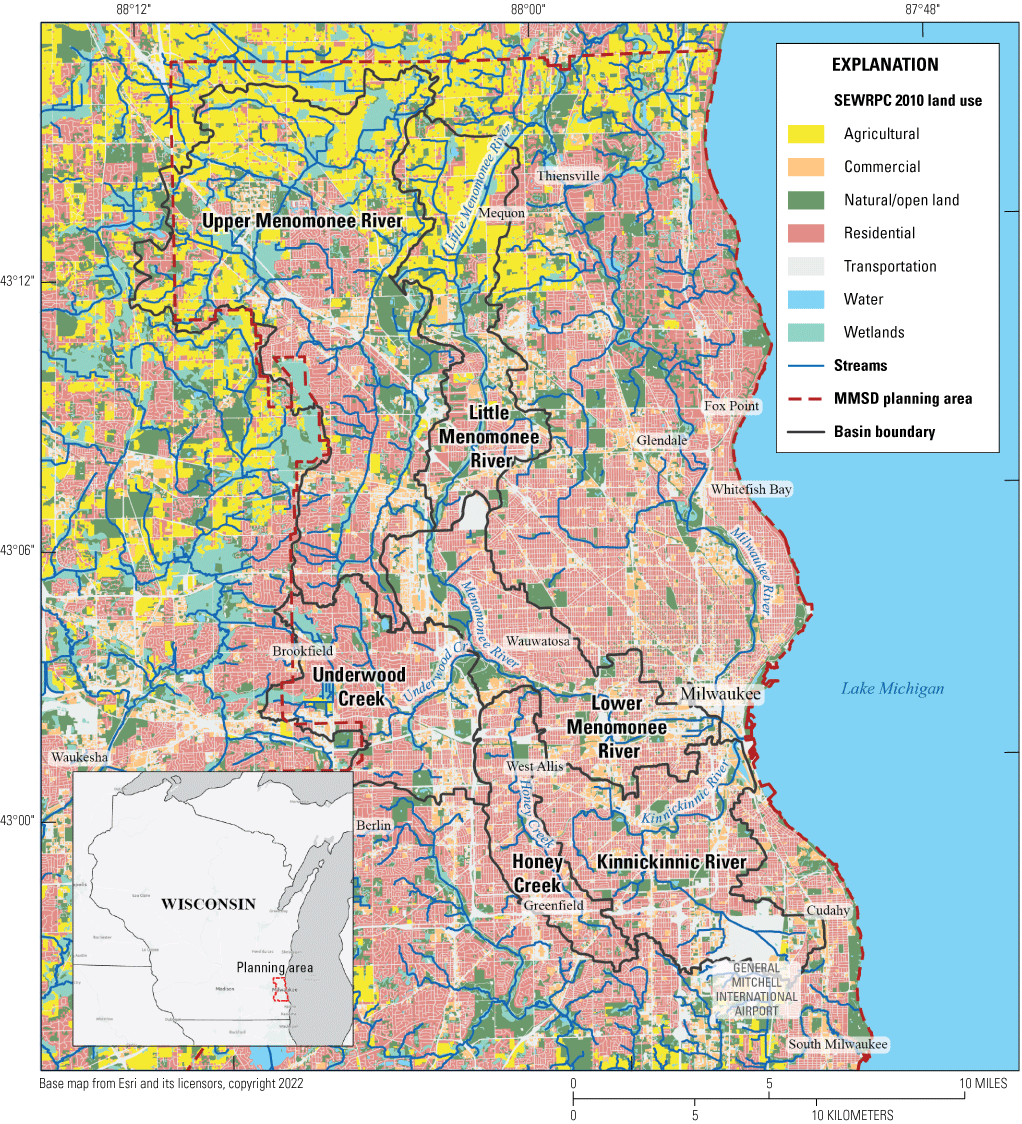
Map showing location and 2010 land use of the Menomonee and Kinnickinnic River Basins in the Milwaukee Metropolitan Sewerage District’s (MMSD’s) planning area. The Menomonee River Basin includes the upper Menomonee River, Little Menomonee River, lower Menomonee River, Underwood Creek, and Honey Creek. Kinnickinnic River Basin includes the Kinnickinnic River. Commercial land use also includes industrial land use (Southeastern Wisconsin Regional Planning Commission [SEWRPC], 2013).
Study Area
The study area encompasses the Menomonee and Kinnickinnic River Basins, which are in the larger Milwaukee River Basin and Lake Michigan Basin. Both river basins are in the Southern Lake Michigan Coastal Ecological Landscape (Cleland and others, 1997) and have glacial deposits of mainly silt-clay till with hummocky topography in and between moraines (Richmond and others, 1983; Rawling and others, 2025). A minor part of sandy gravel and mixed sandy deposits associated with outwash plains and fans is found in the upper Menomonee River Basin.
The Menomonee and Kinnickinnic River Basins are dominated by urban land use, including residential, commercial (including industrial), and transportation (fig. 1). The Menomonee River Basin has a drainage area of 350 square kilometers and has agricultural land in its headwaters that transitions to more urban downstream (17 and 68 percent, respectively), whereas the Kinnickinnic River, with a drainage area of 50 square kilometers, is predominantly urban (98 percent) (Jin and others, 2019).
Historically, the rivers have been channelized, diverted, lined with concrete, and moved underground (Southeastern Wisconsin Regional Planning Commission, 2010). Both basins have concrete removal projects to rehabilitate streams and improve fish passage and aquatic and riparian habitat (Fincher, 2016; Bergquist, 2019). Concrete removal projects are in the lower Menomonee River, Underwood Creek, and Honey Creek subbasins of the Menomonee River Basin and the Kinnickinnic River (fig. 1).
Methods
The geomorphic and habitat framework and resulting GIS layers encompass stream geomorphic characteristics and current land use, as well as original pre-Euro-American settlement vegetation and postglacial geologic setting. The GIS layers are available through a U.S. Geological Survey data release (Sterner and others, 2023). Datasets were assembled using Esri ArcGIS Pro version 3.0 (Esri, 2022). The basic GHRUs were derived from a combination of channel slope and stream order. The stream-network categorization used segments from the Wisconsin Department of Natural Resources (DNR) 1:24,000-scale hydrography dataset (Wisconsin Department of Natural Resources, 2007). Minor edits were applied to the flow lines in the Underwood Creek main stem where a straight concrete reach had been replaced with a meandering stretch. The DNR flow lines were broken into segments using the DNR stream junctions. Stream order (Strahler, 1957) and length were assigned to each segment.
For channel slope calculations, the altitudes of the starting and ending points of each segment were obtained from an overlay of the two sets of light detection and ranging (lidar) data from Milwaukee and Waukesha Counties (Milwaukee County, 2010; Waukesha County, 2012). The altitude at the downstream point was subtracted from the altitude of the upstream point and divided by the segment length to obtain the channel slope. In some cases, the segment was underground, so an accurate endpoint altitude was not available. The segment length that was used in the calculation was measured only where the channel was visible in aerial photographs. If the entire segment was underground, then it was flagged and given a slope category of −1. Slopes that were calculated across a flat-water surface, detention pond, or wetland were given a slope category of 0. All other calculated slopes were classified by their percentage value into four categories of less than 0.3 percent, 0.3–1.0 percent, 1.0–2.0 percent, and greater than 2 percent, following categories used in Fitzpatrick and others (2006) for geomorphic classification of Duluth, Minn., streams.
Slope measurements for segments crossing county lines were confounded by having two lidar datasets that had different horizontal and vertical datums. Milwaukee County was measured in the North American Datum of 1927 and National Geodetic Vertical Datum of 1929, whereas Waukesha County was measured in North American Datum of 1983, National Adjustment Project of 2011, and North American Vertical Datum of 1988. A horizontal projection transformation was run on the Milwaukee lidar dataset to match the Waukesha lidar dataset (Milwaukee County, 2010; Waukesha County, 2012). Channel slopes included in a value-added dataset compiled by the Wisconsin DNR for the 1:24,000-scale flow network were considered (Wisconsin Department of Natural Resources, 2024); however, slopes based on the higher resolution county lidar data were preferred over the 10-m digital elevation model data used in the Wisconsin DNR layer.
For riparian characterization, a 30-m (60-m total width) buffer was applied to the stream segments using a buffer tool in the GIS with no dissolve option. Datasets included original (pre-Euro-American settlement) vegetation types (Wisconsin Department of Natural Resources, 1990), 2010 land use (Southeastern Wisconsin Regional Planning Commission, 2013), and surficial geology (Richmond and others, 1983). A dominant class field was created and assigned to the segment based on the attribute with the highest percentage in the riparian buffers (Sterner and others, 2023).
Geomorphic Habitat Response Units
Segment-scale GHRUs were defined for 333 kilometers of the Menomonee River and Kinnickinnic River Basins by geomorphic setting (stream order and slope), land use, surficial geology, and presettlement vegetation. The Menomonee River had 439 GHRUs encompassing 87 percent of the stream-network length, and the Kinnickinnic River had 46 GHRUs over 13 percent of the stream-network length. The stream segments from the GHRUs ranged in length from 46 to 4,911 m. Results were summarized and mapped for the five subbasins of the Menomonee River Basin—upper (North Branch) Menomonee River, Little Menomonee River, Underwood Creek, Honey Creek, and lower Menomonee River—and the Kinnickinnic River Basin (tables 1, 2, 3, 4, 5, and 6; figs. 1, 2, and 3; Sterner and others, 2023). Some general highlights are described in this section for the distribution and interaction of geomorphic setting, surficial geology, presettlement vegetation, and current land use. The GHRUs can be used for finding connectivity with potentially different riparian and aquatic habitat combinations and for spatial context along with more detailed reach-scale geomorphic and habitat assessments that were previously completed (Southeastern Wisconsin Regional Planning Commission, 2010).
Table 1.
Geomorphic habitat response unit characteristics for the upper Menomonee River subbasin of the Menomonee River. Slope categories are in percent (Strahler, 1957; Richmond and others, 1983; Wisconsin Department of Natural Resources, 1990; Southeastern Wisconsin Regional Planning Commission, 2013).[%, percent; <, less than; >, greater than; km, kilometer; --, no data]
Table 2.
Geomorphic habitat response unit characteristics for the Little Menomonee River subbasin of the Menomonee River. Slope categories are in percent (Strahler, 1957; Richmond and others, 1983; Wisconsin Department of Natural Resources, 1990; Southeastern Wisconsin Regional Planning Commission, 2013).[%, percent; <, less than; >, greater than; km, kilometer; --, no data]
Table 3.
Geomorphic habitat response unit characteristics for the lower Menomonee River subbasin of the Menomonee River. Slope categories are in percent (Strahler, 1957; Richmond and others, 1983; Wisconsin Department of Natural Resources, 1990; Southeastern Wisconsin Regional Planning Commission, 2013).[%, percent; <, less than; >, greater than; km, kilometer; --, no data]
Table 4.
Geomorphic habitat response unit characteristics for the Underwood Creek subbasin of the Menomonee River. Slope categories are in percent (Strahler, 1957; Richmond and others, 1983; Wisconsin Department of Natural Resources, 1990; Southeastern Wisconsin Regional Planning Commission, 2013).[%, percent; <, less than; >, greater than; km, kilometer; --, no data]
Table 5.
Geomorphic habitat response unit characteristics for the Honey Creek subbasin of the Menomonee River. Slope categories are in percent (Strahler, 1957; Richmond and others, 1983; Wisconsin Department of Natural Resources, 1990; Southeastern Wisconsin Regional Planning Commission, 2013).[%, percent; <, less than; >, greater than; km, kilometer; --, no data]
Table 6.
Geomorphic habitat response unit characteristics for the Kinnickinnic River. Slope categories are in percent (Strahler, 1957; Richmond and others, 1983; Wisconsin Department of Natural Resources, 1990; Southeastern Wisconsin Regional Planning Commission, 2013).[%, percent; <, less than; >, greater than; km, kilometer; --, no data]
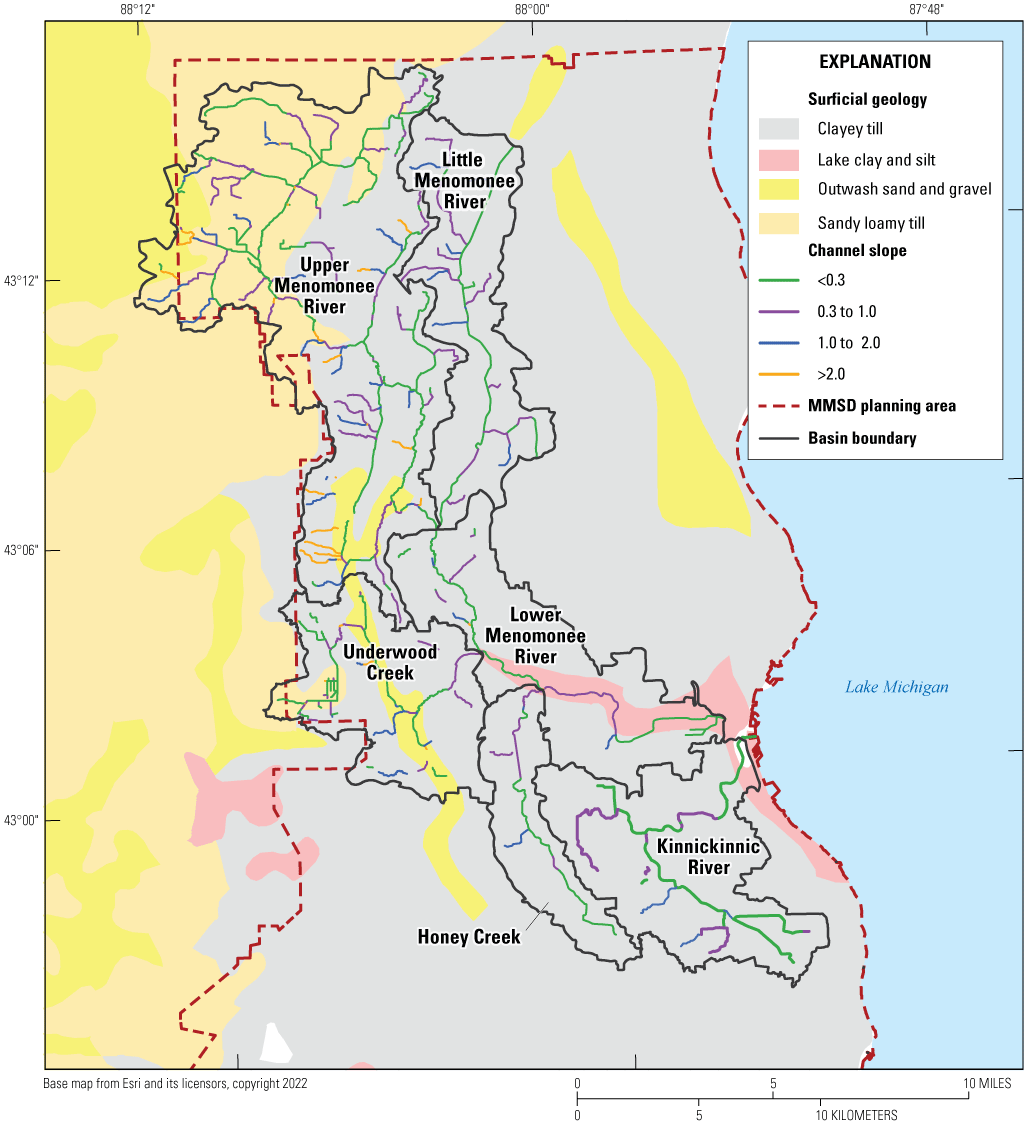
Map showing distribution of channel slope relative to surficial geology (Richmond and others, 1983). [<, less than; >, greater than; MMSD, Milwaukee Metropolitan Sewerage District]
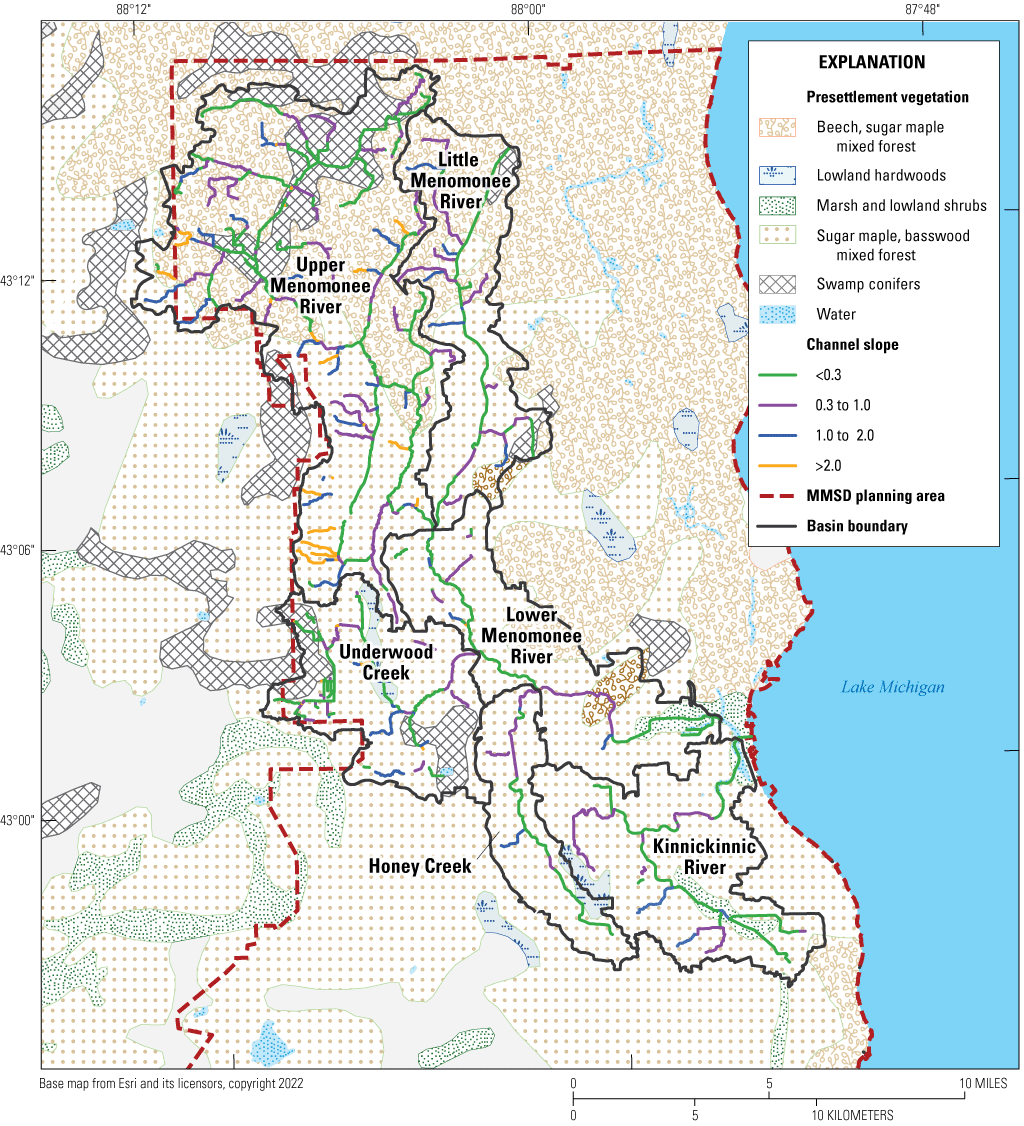
Map showing distribution of channel slope relative to original presettlement vegetation (Wisconsin Department of Natural Resources, 1990). [<, less than; >, greater than; MMSD, Milwaukee Metropolitan Sewerage District]
The relatively large spatial extent of the five subbasins of the Menomonee River allowed for more varied segment characteristics than the Kinnickinnic River, even though both rivers are stream order 4 (tables 1, 2, 3, 4, 5, and 6). The distribution of channel slopes varied among stream orders in the Menomonee and Kinnickinnic River basins, with gentle sloped segments in the headwaters (stream orders 1 and 2) and the main stems (stream orders 3 and 4). About 30 percent of the total stream length was in headwaters with less than 0.3-percent slopes. All four slope categories were represented in the Menomonee River Basin, but the Kinnickinnic River Basin did not have any streams with slopes greater than 2 percent (tables 1, 2, 3, 4, 5, and 6). The upper Menomonee River subbasin streams with slopes greater than 2 percent were in its headwaters and main stem with a mix of current land use and presettlement mixed forest.
The slope categories help to describe expected bedforms, sediment size, and planform. For example, headwater segments with slopes less than 0.3 percent would be expected to have relatively flat surficial geology settings near wetlands with a close connection to a local or regional groundwater table, slow currents, minimal bedforms, fine-grained silt/clay/organic substrate, and perhaps low vegetated banks, especially if the flows are driven more from groundwater discharge than floods (Jurmu, 2002; Fitzpatrick and others, 2006; Kolka and Thompson, 2007). Segments with slopes in the 1–2-percent category would be expected to have more undulating glacial landforms or be in an alluvial valley and have relatively faster currents, mixed fine- and coarse-grained substrates, pool-riffle bedforms, and meandering planforms (Montgomery and Buffington, 1998; Fitzpatrick and others, 2006). The upper end of the 0.3–1-percent slope category spans where riffles may begin to appear, given that there may be shorter, steeper sections within the segments.
The headwater streams in the upper Menomonee River subbasin with slopes greater than 2 percent were mainly in clayey till, outwash sand and gravel, and sandy loamy till surficial deposits (fig. 2). Like the upper Menomonee River Basin, Underwood Creek also had a mix of streams with clayey till, sandy loamy till surficial deposits, and outwash sand and gravel but with more gentle slopes. The Little Menomonee River, lower Menomonee River, Honey Creek, and Kinnickinnic River subbasins were in clayey till and lake clay and silt with a range of slopes less than 2 percent.
In addition to slope, the surficial deposits intersected by the stream segments indicate available substrate sizes and also help to describe the likelihood of a source for gravel to support spawning riffles and the groundwater discharge or springs (fig. 2). All four surficial deposit categories were in the Menomonee River Basin, but the Kinnickinnic River Basin only had fine-grained deposits of clayey till and lake clay and silt (tables 1, 2, 3, 4, 5, and 6, fig. 2; Richmond and others, 1983). Considering the relatively coarse resolution of 1:1,000,000 for the surficial geology dataset compared to 1:24:000 for hydrography, outwash sand and gravel generally were located along most of Underwood Creek and the downstream part of the upper Menomonee River (Richmond and others, 1983). Some of the steeper tributaries are located along the southwestern and western edges of the upper Menomonee River Basin near the outwash sand and gravel. The two till units in the area may also have a gravel component, especially the sandy loamy till. The border of the lake clay and silt unit bounded by paleo shorelines also has the potential for more gravel and larger sizes including boulder zones not mapped (fig. 2). Additionally, streams in outwash might have more groundwater contributions and higher base flow (continuous flow between runoff events) than those in clayey till and lake clay and silt. Only 6 percent of channels were headwater channels with slopes greater than 2 percent, and these were mainly in the northern and western parts of the upper Menomonee River subbasin, likely on end moraines where the postglacial landscape is relatively steep. Channels with slopes greater than 2 percent may have had step pool bedform complexes prior to urbanization, especially if there was abundant large wood (Montgomery and Buffington, 1998; Fitzpatrick and others, 2006).
The overlay of the channel slopes with the presettlement vegetation cover gives an indication of the diversity of natural and potential rehabilitation of riparian habitats across the subbasins (fig. 3; Wisconsin Department of Natural Resources, 1990). The resolution of the original vegetation mapping is 1:500,000; thus, the map may not depict smaller areas of riparian wetlands that likely offered important habitats for resident and migrant species. Some generalities can be made while keeping this limitation in mind. Much of the upland areas consisted of a southern forest mix of sugar maple, basswood, red oak, white oak, and black oak with some beech in the upper and Little Menomonee River subbasins. All three wetland types (conifer swamp, lowland hardwoods, and marsh and lowland shrubs) mapped by Finley (1976) were in the study area. Pockets of the southern extent of conifer swamp (white cedar, black spruce, tamarack, and hemlock) and lowland hardwoods (willow, soft maple, box elder, ash, elm, cottonwood, and river birch) were near floodplains or poorly drained drainage divides such as between Honey Creek and the Kinnickinnic River. Marsh and lowland shrubs (marsh and sedge meadow, wet prairie, and lowland shrubs) were near the mouths of the Menomonee and Kinnickinnic Rivers and the headwaters of the Kinnickinnic River (fig. 3).
Added to the channel diversity are the potential riparian vegetation types that could be rehabilitated, reflected in the presettlement vegetation patterns (fig. 3, tables 1, 2, 3, 4, 5, and 6). For example, presettlement vegetation patterns include swamp conifers in the upper Menomonee River (18 percent), Little Menomonee River (3 percent), and Underwood Creek (10 percent) subbasins, mainly in headwaters with less than 0.3 percent channel slopes. Even though these subbasins currently have 45 to 61 percent of their channels with wetland vegetation (Southeastern Wisconsin Regional Planning Commission, 2013) they are missing a swamp conifer subtype that would be dominated by white cedar and tamarack in areas where the water table is close to the ground surface (Curtis, 1959). Marsh and lowland swamp were in the mouths of the Menomonee and Kinnickinnic Rivers, but the Kinnickinnic River also had a unique headwater marsh area near the present-day international airport (the large area of transportation shown in fig. 1). The Kinnickinnic River currently has very few riparian wetlands compared to the other subbasins. The extent of beech and sugar maple mixed forest was mainly through the headwaters of the upper Menomonee and Little Menomonee Rivers but absent to the south. Altered hydrology from impervious surfaces and the extended drainage network, including underground sections and storm sewers, and construction of extended inset floodplains and riparian wetlands, such as that along Underwood Creek, may affect the potential to reestablish presettlement vegetation. Current hydrologic conditions and available land for floodplain expansion for flood mitigation are likely important factors in future rehabilitation plans. Reestablishment of lowland hardwood vegetation may be limited to headwater locations where there is more space for floodwater to spread out without the possibility of flooding nearby infrastructure.
Summary and Conclusions
Because knowledge of the landscape setting and vegetative communities that were adjacent to streams prior to urbanization can benefit urban stream rehabilitation plans, the U.S. Geological Survey assembled geomorphic characteristics, surficial geology, and pre-Euro-American settlement vegetation for 333 kilometers of stream segments in the Kinnickinnic River and Menomonee River subbasins of the Milwaukee River to collect more quantitative data on these potential connections. Geomorphic habitat response units were defined for a combination of stream order and channel slope. The habitat response units were further characterized for the presettlement vegetation and surficial geology within each subbasin’s riparian zone.
The diverse range of channel slopes for headwaters and main stems in the Menomonee and Kinnickinnic River Basins span at least two channel bedform types and planform types, multiple sediment sizes and riparian vegetation communities that have benefits for a wide range of organisms from aquatic and riparian plants to terrestrial insects, benthic macroinvertebrates, spawning and rearing fish, and migrating waterfowl. These include channels with shallow, slow-moving currents with forested wetland or marsh vegetation along the banks and channels with pool-riffle bedforms with faster currents and gravel beds for spawning. Most of the basins are characterized by clayey surficial deposits, except for more coarse-grained deposits along Underwood Creek and the upper Menomonee River. Riparian zones offered a diverse mix of wetland types in headwaters, along main stems, and at the mouths of both basins. The presettlement vegetation cover maps indicated that most of the Menomonee and Kinnickinnic River Basins had forested riparian zones, including a mix of conifer swamps and lowland hardwoods. Additionally, the marsh/lowland shrub complex was at the mouths of the Menomonee and Kinnickinnic Rivers.
This spatially hierarchical framework helped to quantify the extent of lateral and longitudinal linkages between potential geomorphic and habitat features that were present before urbanization. These habitat features, including those for native migratory fish with different spawning constraints, can be designed within the physical limitations inherent in an urbanized basin’s altered hydrology, flood, and sediment regime. This framework could be useful for planning and managing rehabilitation plans for other Great Lakes tributaries that potentially include a similar range of bedform and channel types, as well as varied riparian vegetation.
References Cited
Bergquist, L., 2019, Massive $390 million transformation of Milwaukee’s ‘forgotten river’ underway: Milwaukee Journal Sentinel, May 30, 2019, accessed July 23, 2025, at https://www.jsonline.com/story/news/2019/05/30/milwaukees-forgotten-river-poised-390-million-face-lift/1151553001/.
Cleland, D.T., Avers, P.E., McNab, W.H., Jensen, M.E., Bailey, R.G., King, T., and Russell, W.E., 1997, National hierarchical framework of ecological units, in Boyce, M.S., and Haney, A., eds., Ecosystem management applications for sustainable forest and wildlife resources: New Haven, Conn., Yale University Press, p. 181–200, accessed July 16, 2025, at https://www.leg.mn.gov/docs/2015/other/150681/PFEISref_1/Cleland%20et%20al.%201997.pdf.
Dehring, T., and Krueger, C.C., 2008, Northern pike (Esox lucius): Wisconsin Department of Natural Resources, PUBL–FM–707 08, 5 p., accessed July 16, 2025, at https://dnr.wisconsin.gov/sites/default/files/topic/Fishing/Species_northernpike.pdf.
Engelhardt, B.M., Weisberg, P.J., and Chambers, J.C., 2012, Influences of watershed geomorphology on extent and composition of riparian vegetation: Journal of Vegetation Science, v. 23, no. 1, p. 127–139, accessed July 16, 2025, at https://doi.org/10.1111/j.1654-1103.2011.01328.x.
Esri, 2022, ArcGIS Pro 3.0: Esri software release, accessed July 16, 2025, at https://pro.arcgis.com/en/pro-app/3.0/get-started/get-started.htm.
Fago, D., 1977, Northern pike production in managed spawning and rearing marshes: Wisconsin Department of Natural Resources Technical Bulletin no. 96, 36 p., accessed July 17, 2025, at https://search.library.wisc.edu/digital/A6JYKP65Y7MFO78W.
Fincher, J., 2016, Removing concrete from the Menomonee River: Southeastern Wisconsin Watersheds Trust, Inc. (Sweet Water), website, accessed March 2024 at https://www.swwtwater.org/news/2016/6/28/removing-concrete-from-the-menomonee-river.
Finley, R.W., 1976, Original vegetation cover of Wisconsin: St. Paul, Minn., Forest Service, scale 1:500,000, accessed July 16, 2025, at https://wgnhs.wisc.edu/catalog/publication/000386.
Fitzpatrick, F.A., Ellison, C.A., Czuba, C.R., Young, B.M., McCool, M.M., and Groten, J.T., 2016, Geomorphic responses of Duluth-area streams to the June 2012 flood, Minnesota: U.S. Geological Survey Scientific Investigations Report 2016–5104, 53 p. with appendixes, accessed February 23, 2017, at https://doi.org/10.3133/sir20165104.
Fitzpatrick, F.A., Peppler, M.C., DePhilip, M.M., and Lee, K.E., 2006, Geomorphic characteristics and classification of Duluth-area streams, Minnesota: U.S. Geological Survey Scientific Investigations Report 2006–5029, accessed May 15, 2014, at https://doi.org/10.3133/sir20065029.
Fitzpatrick, F.A., Waite, I.R., D’Arconte, P.J., Meador, M.R., Maupin, M.A., and Gurtz, M.E., 1998, Revised methods for characterizing stream habitat in the National Water-Quality Assessment Program: U.S. Geological Survey Water-Resources Investigations Report 98–4052, 67 p., accessed July 16, 2025, at https://doi.org/10.3133/wri984052.
Frissell, C.A., Liss, W.J., Warren, C.E., and Hurley, M.D., 1986, A hierarchical framework for stream habitat classification—Viewing streams in a watershed context: Environmental Management, v. 10, no. 2, p. 199–214, accessed July 16, 2025, at https://doi.org/10.1007/BF01867358.
González del Tánago, M., Martínez-Fernández, V., Aguiar, F.C., Bertoldi, W., Dufour, S., García de Jalón, D., Garófano-Gómez, V., Mandzukovski, D., and Rodríguez-González, P.M., 2021, Improving river hydromorphological assessment through better integration of riparian vegetation—Scientific evidence and guidelines: Journal of Environmental Management, v. 292, article 112730, 19 p., accessed July 16, 2025, at https://doi.org/10.1016/j.jenvman.2021.112730.
Great Lakes Interagency Task Force, 2014, Great Lakes Restoration Initiative, action plan II, September 2014: Great Lakes Interagency Task Force website, accessed July 17, 2025, at https://www.glri.us/sites/default/files/glri-action-plan-2-201409-30pp.pdf.
Harman, W., Starr, R., Carter, M., Tweedy, K., Clemmons, M., Suggs, K., and Miller, C., 2012, A function-based framework for stream assessments and restoration projects: Washington, D.C., U.S. Environmental Protection Agency, Office of Wetlands, Oceans, and Watersheds, EPA 843–K–12–006, 344 p., accessed July 16, 2025, at https://www.spk.usace.army.mil/Portals/12/documents/regulatory/pdf/A_Function-Based_Framework.pdf.
Jin, S., Homer, C., Yang, L., Danielson, P., Dewitz, J., Li, C., Zhu, Z., Xian, G., and Howard, D., 2019, Overall methodology design for the United States National Land Cover Database 2016 products: Remote Sensing (Basel), v. 11, no. 24, article 2971, 32 p., accessed July 16, 2025, at https://doi.org/10.3390/rs11242971.
Jurmu, M.C., 2002, A morphological comparison of narrow, low-gradient streams traversing wetland environments to alluvial streams: Environmental Management, v. 30, no. 6, p. 831–856, accessed July 16, 2025, at https://doi.org/10.1007/s00267-002-2681-z.
Kolka, R.K., and Thompson, J.A., 2007, Wetland geomorphology, soils, and formative processes, chap. 2 of Batzer, D., ed., Ecology of freshwater and estuarine wetlands: Oakland, Calif., University of California Press, p. 7–42, accessed May 9, 2025, at https://doi.org/10.1525/california/9780520247772.003.0002.
Lindenschmidt, K.E., and Long, J., 2012, A GIS approach to define the hydro-geomorphological regime for instream flow requirements using geomorphic response units (GRU): River Systems, v. 20, nos. 3–4, p. 261–275, accessed July 17, 2025, at https://www.schweizerbart.de/papers/rs/detail/20/79865/A_GIS_approach_to_define_the_hydro_geomorphologica?af=crossref.
Martínez-Fernández, V., Van Oorschot, M., De Smit, J., González del Tánago, M., and Buijse, A.D., 2018, Modelling feedbacks between geomorphological and riparian vegetation responses under climate change in a Mediterranean context: Earth Surface Processes and Landforms, v. 43, no. 9, p. 1825–1835, accessed July 16, 2025, at https://doi.org/10.1002/esp.4356.
McKenna, J.E., Jr., and Castiglione, C., 2010, Hierarchical multi-scale classification of nearshore aquatic habitats of the Great Lakes—Western Lake Erie: Journal of Great Lakes Research, v. 36, no. 4, p. 757–771, accessed July 16, 2025, at https://doi.org/10.1016/j.jglr.2010.09.005.
McKenna, J.E., Jr., Schaeffer, J.S., Stewart, J.S., and Slattery, M.T., 2015, Development of a spatially universal framework for classifying stream assemblages with application to conservation planning for Great Lakes lotic fish communities: Restoration Ecology, v. 23, no. 2, p. 167–178, accessed July 16, 2025, at https://doi.org/10.1111/rec.12146.
Mecozzi, M., 2008, Lake sturgeon (Acipenser fulvenscens): Wisconsin Department of Natural Resources PUBL–FM–704–08, 4 p., accessed July 16, 2025, at https://dnr.wisconsin.gov/sites/default/files/topic/Fishing/Species_lakesturgeon.pdf.
Milwaukee County, 2010, LiDAR 2010, DEM 5 ft: Milwaukee County digital data, accessed July 16, 2025, at https://county.milwaukee.gov/ImageLibrary/Groups/MCLIO/Metadata/LIDAR_2010_DEM5ft.xml.
Montgomery, D.R., and Buffington, J.M., 1998, Channel processes, classification, and response, chap. 2 of Naiman, R.J., and Bilby, R.E., eds., River ecology and management—Lessons from the Pacific Coastal ecoregion: New York, Springer-Verlag, Inc., p. 13–42, accessed July 17, 2025, at https://www.fs.usda.gov/rm/boise/publications/watershed/rmrs_1998_montomeryr001.pdf.
National Oceanic and Atmospheric Administration, 2023, Habitat restoration in the Great Lakes—By the numbers: National Oceanic and Atmospheric Administration website, accessed December 20, 2023, at https://www.fisheries.noaa.gov/feature-story/habitat-restoration-great-lakes-numbers.
Petts, G.E., 1996, Water allocation to protect river ecosystems: Regulated Rivers, v. 12, nos. 4–5, p. 353–365, accessed July 16, 2025, at https://doi.org/10.1002/(SICI)1099-1646(199607)12:4/5<353::AID-RRR425>3.0.CO;2-6.
Rawling, J.E., III, Carson, E.C., Attig, J.W., Mickelson, D.M., Mode, W.N., Johnson, M.D., and Syverson, K.M., 2025, Quaternary geology of Wisconsin: Wisconsin Geological and Natural History Survey map M512, scale 1:500,000, accessed July 16, 2025, at https://wgnhs.wisc.edu/catalog/publication/001011/resource/m512.
Richmond, G.M., Fullerton, D.S., Lineback, J.A., Bleuer, N.K., Mickelson, D.M., Farrand, W.R., and Goldthwait, R.P., 1983, Quaternary geologic map of the Chicago 4 degrees x 6 degrees quadrangle, United States: U.S. Geological Survey IMAP 1420 (NK–16), scale 1:1,000,000, accessed July 16, 2025, at https://doi.org/10.3133/i1420(NK16).
Rinaldi, M., Surian, N., Comiti, F., and Bussettini, M., 2013, A method for the assessment and analysis of the hydromorphological condition of Italian streams—The Morphological Quality Index (MQI): Geomorphology, v. 180–181, p. 96–108, accessed July 16, 2025, at https://doi.org/10.1016/j.geomorph.2012.09.009.
Rosgen, D.L., 1994, A classification of natural rivers: Catena, v. 22, no. 3, p. 169–199, accessed July 17, 2025, at https://doi.org/10.1016/0341-8162(94)90001-9.
Roux, C., Alber, A., Bertrand, M., Vaudor, L., and Piégay, H., 2015, “FluvialCorridor”—A new ArcGIS toolbox package for multiscale riverscape exploration: Geomorphology, v. 242, p. 29–37, accessed July 16, 2025, at https://doi.org/10.1016/j.geomorph.2014.04.018.
Smith, M., 2016, River restoration in Milwaukee, WI—Geomorphic characterization and classification of stream segments in the Kinnickinnic River Basin: University of Wisconsin-Madison GIS Certificate Program Capstone Project, 21 p., accessed July 23, 2025, at https://www.usgs.gov/media/files/river-restoration-milwaukee-wi#:~:text=Smith%2C%20Michael%2C%202016%2C%20River%20Restoration%20in%20Milwaukee%2C%20WI %3A,Project.%2021%20p.%20Faith%20Fitzpatrick%20%28USGS%29%2C%20Project%20Supervisor.
Southeastern Wisconsin Regional Planning Commission, 2010, Stream habitat conditions and biological assessment of the Kinnickinnic and Menomonee River watersheds—2000–2009: Waukesha, Wis., Southeastern Regional Planning Commission Memorandum Report no. 194, 152 p., accessed July 17, 2025, at https://www.sewrpc.org/SEWRPCFiles/Publications/mr/mr-194-kk-mnr-stream-habitat-biological-assessment.pdf.
Southeastern Wisconsin Regional Planning Commission, 2013, 2010 land use inventory: Southeastern Wisconsin Regional Planning Commission digital data, accessed July 17, 2025, at https://gis.sewrpc.org/portal/apps/webappviewer/index.html?id=b64030c1df664f61afd7e96bdffa0cce.
Sterner, S.P., Fitzpatrick, F.A., Blount, J.D., and Stewart, J.S., 2023, Geomorphic habitat response units attributes for the Wisconsin DNR 24k hydrography flowline network in the Milwaukee River Basin, Wisconsin: U.S. Geological Survey data release, accessed July 16, 2025, at https://doi.org/10.5066/P90S2FMB.
Strahler, A.N., 1957, Quantitative analysis of watershed geomorphology: Eos, Transactions of the American Geophysical Union, v. 38, no. 6, p. 913–920, accessed July 16, 2025, at https://doi.org/10.1029/TR038i006p00913.
Thoms, M.C., and Sheldon, F., 2002, An ecosystem approach for determining environmental water allocations in Australian dryland river systems—The role of geomorphology: Geomorphology, v. 47, nos. 2–4, p. 153–168, accessed July 16, 2025, at https://doi.org/10.1016/S0169-555X(02)00085-5.
U.S. Army Corps of Engineers, 2000, Planning guidance notebook: U.S. Army Corps of Engineers ER 1105–2–100, 712 p., accessed July 17, 2025, at https://planning.erdc.dren.mil/toolbox/library/ERs/ER1105_2_100_Apr2000.pdf.
Wang, L., Seelbach, P.W., and Hughes, R.M., 2006, Introduction to landscape influences on stream habitats and biological assemblages: American Fisheries Society Symposium, v. 48, p. 1–23, accessed July 16, 2025, at https://fisheries.org/docs/books/x54048xm/com.pdf.
Ward, J.V., and Stanford, J.A., 1995, Ecological connectivity in alluvial river ecosystems and its disruption by flow regulation: Regulated Rivers, v. 11, no. 1, p. 105–119, accessed July 16, 2025, at https://doi.org/10.1002/rrr.3450110109.
Waukesha County, 2012, LiDAR-derived bare earth points for Waukesha County, WI 2012: WisconsinView digital data, accessed July 16, 2025, at https://geodata.wisc.edu/catalog/0a21a96e-a6ab-444b-8f4f-bbb0974d39bc.
Wisconsin Department of Natural Resources, 1990, Polygon representative of the original vegetation of Wisconsin: Wisconsin Department of Natural Resources digital data, accessed July 16, 2025, at https://data-wi-dnr.opendata.arcgis.com/datasets/wi-dnr::original-vegetation-polygons/about.
Wisconsin Department of Natural Resources, 2007, 24,000 hydrography, version 6: Wisconsin Department of Natural Resources digital data, accessed July 16, 2025, at https://data-wi-dnr.opendata.arcgis.com/datasets/cb1c7f75d14f42ee819a46894fd2e771/about.
Wisconsin Department of Natural Resources, 2024, 24K hydro—Value added full file geodatabase: Wisconsin Department of Natural Resources digital data, accessed July 16, 2025, at https://data-wi-dnr.opendata.arcgis.com/datasets/c4bc634ba115498487174bda137f8de8/.
Wohl, E., Brierley, G., Cadol, D., Coulthard, T.J., Covino, T., Fryirs, K.A., Grant, G., Hilton, R.G., Lane, S.N., Magilligan, F.J., Meitzen, K.M., Passalacqua, P., Poeppl, R.E., Rathburn, S.L., and Sklar, L.S., 2018, Connectivity as an emergent property of geomorphic systems: Earth Surface Processes and Landforms, v. 44, no. 1, p. 4–26, accessed July 16, 2025, at https://doi.org/10.1002/esp.4434.
Wohl, E., Rathburn, S., Dunn, S., Iskin, E., Katz, A., Marshall, A., Means-Brous, M., Scamardo, J., Triantafillou, S., and Uno, H., 2024, Geomorphic context in process-based river restoration: River Research and Applications, v. 40, no. 3, p. 322–340, accessed July 16, 2025, at https://onlinelibrary.wiley.com/doi/10.1002/rra.4236.
Datums
Vertical coordinate information is referenced to the National Geodetic Vertical Datum of 1929 (NGVD 29) and the North American Vertical Datum of 1988 (NAVD 88).
Horizontal coordinate information is referenced to the North American Datum of 1927 (NAD 27), the North American Datum of 1983 (NAD 83), and the National Adjustment Project of 2011.
Altitude, as used in this report, refers to distance above the vertical datum.
For more information about this publication, contact:
Director, USGS Upper Midwest Water Science Center
1 Gifford Pinchot Dr.
Madison, WI 53726
608–828–9901
For additional information, visit: https://www.usgs.gov/centers/umid-water
Publishing support provided by the
Rolla and Baltimore Publishing Service Centers
Disclaimers
Any use of trade, firm, or product names is for descriptive purposes only and does not imply endorsement by the U.S. Government.
Although this information product, for the most part, is in the public domain, it also may contain copyrighted materials as noted in the text. Permission to reproduce copyrighted items must be secured from the copyright owner.
Suggested Citation
Fitzpatrick, F.A., Sterner, S.P., Blount, J.D., and Stewart, J.S., 2025, Geomorphic habitat response units for urban stream rehabilitation, Milwaukee, Wisconsin: U.S. Geological Survey Open-File Report 2025–1049, 17 p., https://doi.org/10.3133/ofr20251049.
ISSN: 2331-1258 (online)
Study Area
| Publication type | Report |
|---|---|
| Publication Subtype | USGS Numbered Series |
| Title | Geomorphic habitat response units for urban stream rehabilitation, Milwaukee, Wisconsin |
| Series title | Open-File Report |
| Series number | 2025-1049 |
| DOI | 10.3133/ofr20251049 |
| Publication Date | November 20, 2025 |
| Year Published | 2025 |
| Language | English |
| Publisher | U.S. Geological Survey |
| Publisher location | Reston, VA |
| Contributing office(s) | Upper Midwest Water Science Center |
| Description | Report: vi, 17 p.; Data Release |
| Country | United States |
| State | Wisconsin |
| City | Milwaukee |
| Online Only (Y/N) | Y |
| Additional Online Files (Y/N) | N |