


Monitoring Nesting Waterbirds for the South Bay Salt Pond Restoration Project—2024 Breeding Season
Links
- Document: Report (4.15 MB pdf) , HTML , XML
- Data Release: USGS data release - Waterbird nest abundance in south San Francisco Bay
- Download citation as: RIS | Dublin Core
Acknowledgments
Funding for this study was provided by a grant from the California State Coastal Conservancy to the California Wildlife Foundation, with additional support from the U.S. Geological Survey Ecosystems Mission Area. We thank Richard Hasegawa, Tyler Gianni, Evan Sorlie, and Brady Fettig of the U.S. Geological Survey for assistance in the field and with data entry. We thank the U.S. Fish and Wildlife Service’s Don Edwards San Francisco Bay National Wildlife Refuge, the California Department of Fish and Wildlife’s Eden Landing Ecological Reserve, and the South Bay Salt Pond Restoration Project for logistical and project support. We also thank the San Francisco Bay Bird Observatory for collaboration and sharing of waterbird data.
Abstract
The San Francisco Bay supports thousands of breeding waterbirds annually and hosts large populations of American avocets (Recurvirostra americana), black-necked stilts (Himantopus mexicanus), and Forster’s terns (Sterna forsteri). These three species have relied largely on former commercial salt ponds in south San Francisco Bay, which provide wetland foraging habitat and island nesting habitat. The South Bay Salt Pond Restoration Project is in the process of restoring as much as 15,100 acres of these former salt ponds to tidal marsh and tidal mudflats. Although this restoration is expected to have numerous benefits, including providing habitat for tidal wetland-dependent species, improving water quality, buffering against storm surge, and protecting inland areas from sea level rise, the reduction in former salt-pond habitat and nesting islands may negatively affect breeding waterbirds. To address the reduction in former salt-pond habitat available to waterbirds, the South Bay Salt Pond Restoration Project will maintain some pond habitat for wildlife and provide enhancements such as the construction of new islands for nesting. The South Bay Salt Pond Restoration Project follows an adaptive management plan in which waterbird response to the changing landscape is monitored over time to ensure that existing breeding waterbird populations are maintained.
In this report, we provide results of waterbird nest monitoring in south San Francisco Bay during the 2024 breeding season and present these results in the context of annual nest monitoring in south San Francisco Bay since 2005. Overall, Forster’s tern nest abundance in 2024 (1,808 nests) was the highest recorded between 2005 and 2024, and it maintained the high abundance first observed in 2022 (1,727 nests), which reversed the historically low abundance observed during 2015–17. In contrast, nest abundance remained at or near 20-year lows for American avocets (222 nests) and black-necked stilts (126 nests) in 2024, but both species had small increases in their nesting population sizes compared to 2022. In 2024, there were only 3 Forster’s tern, 5 American avocet, and 3 black-necked stilt major colony nesting sites, which is down from the annual averages of 6.6, 12.4, and 6.6 observed during 2005–09. Nest success (73 percent for American avocets, 54 percent for black-necked stilt, and 64 percent for Forster’s terns) increased compared to 2022 (30 percent for American avocets, 29 percent for black-necked stilt, and 53 percent for Forster’s terns) and during 2005–10 (37 percent for American avocets, 24 percent for black-necked stilt, and 61 percent for Forster’s terns). Nest success in 2024 was above (American avocets and black-necked stilts) or slightly below (Forster’s terns) baseline values established for the South Bay Salt Pond Restoration Project. Average egg-hatching success was lower for American avocets (86 percent) and Forster’s terns (86 percent) and similar for black-necked stilts (96 percent) than the values observed during 2005–10. Average clutch sizes for American avocets (3.87 eggs), black-necked stilts (3.88 eggs), and Forster’s terns (2.73 eggs) were greater than what was observed in 2022 and during 2005–10. Average nest-initiation dates in 2024 were substantially earlier among all three species (April 19 for American avocets, April 25 for black-necked stilts, and May 12 for Forster’s terns) than in 2022 (May 4 for American avocets, May 13 for black-necked stilts, and May 20 for Forster’s terns) and during 2005–10 (May 15 for American avocets, May 3 for black-necked stilts, and May 30 for Forster’s terns). Finally, the enhanced managed ponds with newly constructed islands (Ponds A16 and SF2) supported 52 percent of American avocet nests, 47 percent of black-necked stilt nests, and 94 percent of all the Forster’s tern nests recorded in south San Francisco Bay in 2024.
Introduction
The San Francisco Bay is a designated site of hemispheric importance to shorebirds and supports more than 1 million waterbirds annually (Page and others, 1999; Stenzel and others, 2002; Takekawa and others, 2011, 2012). Long recognized for its importance to migrating and wintering waterbirds, the San Francisco Bay also supports thousands of breeding waterbirds every year. In particular, managed pond habitat in south San Francisco Bay has supported the largest breeding populations of American avocets (Recurvirostra americana) and black-necked stilts (Himantopus mexicanus), and nearly 30 percent of the breeding population of Forster’s terns (Sterna forsteri) along the Pacific coast (Stenzel and others, 2002; Rintoul and others, 2003; Strong and others, 2004; McNicholl and others, 2020). These three species have some of the largest populations among the colonial nesting waterbirds in the San Francisco Bay and greatly depend on managed ponds for nesting habitat, with more than 70 percent of American avocet and more than 90 percent of Forster’s tern nests on islands in managed pond habitats (Strong and others, 2004; Ackerman and Herzog, 2012; Ackerman and others, 2014a, 2020, 2023; Hartman and others, 2016a, 2016b).
The South Bay Salt Pond Restoration Project (https://www.southbayrestoration.org/) is in Phase 2 of restoring 50–90 percent of 15,100 acres of managed ponds to tidal marsh habitats (Goals Project, 1999). In Phase 1 (2003–18), about 3,000 acres of managed ponds were converted to tidal influence to begin the process of tidal restoration. These Phase 1 changes included Ponds A7 and A8, where islands that had supported large waterbird nesting colonies (Strong and others, 2004; Ackerman and Herzog, 2012) have been inundated and are no longer available for nesting. Other previously important nesting sites that no longer support nesting, Ponds A1 and A2W, will also be converted to tidal marsh as part of Phase 2 implementation. Habitat enhancements for birds, in the form of nesting island construction, also have been carried out in Ravenswood Pond SF2 (30 islands built in 2010), Alviso Pond A16 (16 islands built in 2013), and Ponds E12 and E13 in the Eden Landing Ecological Reserve (6 islands built in 2015), and new nesting islands are planned in Ponds A1 and A2W. Because breeding waterbirds depend on nesting islands in managed ponds for nesting, evaluating how nesting populations are responding to habitat changes associated with the South Bay Salt Pond Restoration Project (for example, loss of historic nesting habitat due to levee breaches and gain of potential nesting habitat from newly constructed islands) is critical to the adaptive management plan.
The U.S. Geological Survey (USGS) monitored nesting waterbird populations in the South Bay Salt Pond Restoration Project area from 2005 to 2022, including nesting sites in the U.S. Fish and Wildlife Service’s (USFWS) Don Edwards San Francisco Bay National Wildlife Refuge and the California Department of Fish and Wildlife’s Eden Landing Ecological Reserve. The comprehensive dataset of the USGS includes more than 29,000 nests of Forster’s terns, American avocets, and black-necked stilts in more than 80 wetland sites in the South Bay Salt Pond Restoration Project area (fig. 1; tables 1–3); and additional nesting data for black skimmers (Rynchops niger) and Caspian terns (Hydroprogne caspia). This comprehensive dataset (Ackerman and Herzog, 2012; Hartman and others, 2021; Ackerman and others, 2023) has proven useful to management in the following ways: (1) the creation of a recipe for building nesting islands to implement future phases of the South Bay Salt Pond Restoration Project (Ackerman and others, 2014b; Hartman and others, 2016a, 2016b); (2) identifying gull predation as the primary factor affecting chick survival and a contributing factor to egg survival (Herring and others, 2011; Ackerman and others, 2014c, 2014e; Takekawa and others, 2015); (3) informing management of ponds and the Pond A8 Notch (Ackerman and others, 2010, 2012, 2013b; J.T. Ackerman, U.S. Geological Survey, unpub. data, 2014, 2015, 2016, 2017); (4) evaluating bird use of managed habitats (Ackerman and others, 2007, 2008a, 2009); and (5) understanding mercury contamination and ecotoxicological risk to birds in ponds of the South Bay Salt Pond Restoration Project (Ackerman and others, 2008b, 2013a, 2014a, 2014d, 2016; Ackerman and Eagles-Smith, 2009). Importantly, this USGS nest monitoring dataset has indicated that the numbers of nests and nesting colonies in the South Bay Salt Pond Restoration Project area have declined for Forster’s terns, American avocets, and black-necked stilts between 2005 and 2019 (Hartman and others, 2021; fig. 2). American avocet and black-necked stilt nest abundance has declined steadily since 2007–08, the decline in Forster’s tern nest numbers occurred more recently, dropping from 865 to 1,259 nests annually in 2006–16, to 471–784 nests annually in 2017–19. In 2022, the number of Forster’s tern nests rebounded substantially, reaching an 18-year high (2005–22) of 1,727 nests, yet American avocet and black-necked stilt nest numbers remained at historical lows (Ackerman and others, 2023).
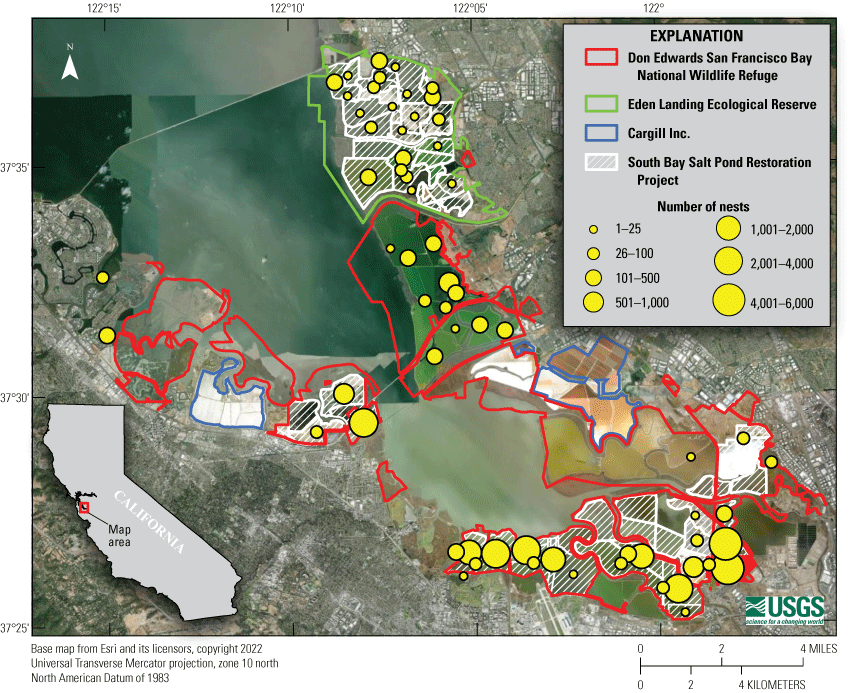
Cumulative distribution and abundance of American avocet, black-necked stilt, and Forster’s tern nests in south San Francisco Bay during 2005–19, 2022, and 2024.
Table 1.
American avocet nests monitored by complex, site, and year in south San Francisco Bay during 2005–19, 2022, and 2024.[For site-years with (0) nests, we are reasonably confident that no nests were created at that site in that year. For site-years with (—) nests, we are confident there were not large numbers of nests at that site in that year; however, it is possible that a few nests may have been active briefly and were missed by investigators because not all potential nesting sites were monitored each year because of staffing shortages]
Table 2.
Black-necked stilt nests monitored by complex, site, and year in south San Francisco Bay during 2005–19, 2022, and 2024.[For site-years with (0) nests, we are reasonably confident that no nests were created at that site in that year. For site-years with (—) nests, we are confident there were not large numbers of nests at that site in that year; however, it is possible that a few nests may have been active briefly and were missed by investigators because not all potential nesting sites were monitored each year because of staffing shortages]
Table 3.
Forster’s tern nests monitored by complex, site, and year in south San Francisco Bay during 2005–19, 2022, and 2024.[For site-years with (0) nests, we are reasonably confident that no nests were created at that site in that year. For site-years with (—) nests, we are confident there were not large numbers of nests at that site in that year; however, it is possible that a few nests may have been active briefly and were missed by investigators because not all potential nesting sites were monitored each year because of staffing shortages]
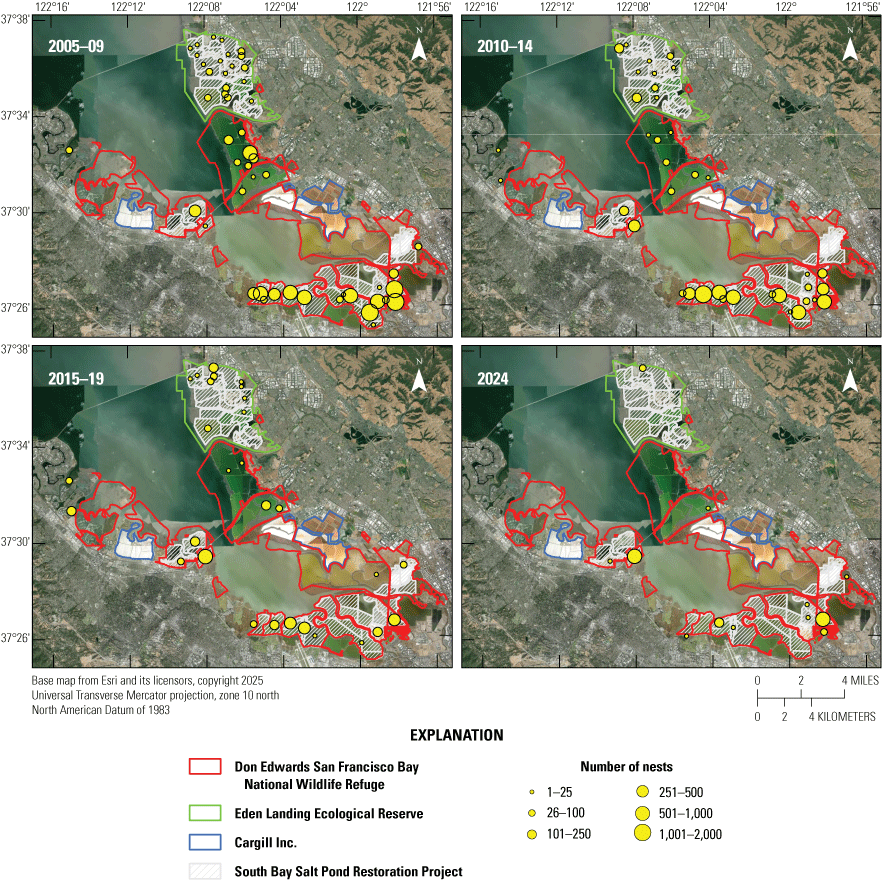
Distribution and abundance of American avocet, black-necked stilt, and Forster’s tern nests in south San Francisco Bay during four periods: A, 2005–09 (n=10,759 nests); B, 2010–14 (n=8,156 nests); C, 2015–19 (n=6,564 nests); and D, 2024 (n=2,156 nests).
In contrast, the California gull (Larus californicus) breeding population in San Francisco Bay has grown substantially, from 24 birds in 1980 to a peak of more than 53,000 birds in 2014 (Burns and others, 2018). California gulls are major predators of breeding waterbirds in south San Francisco Bay, accounting for more than 50 percent of American avocet and Forster’s tern chick mortalities and 38 percent of western snowy plover (Anarhynchus nivosus nivosus) egg predation events (Demers and Robinson-Nilsen, 2012; Ackerman and others, 2014c, 2014e). Additionally, the growing California gull breeding population may take over nesting habitat, particularly nesting islands, and exclude other priority waterbirds such as American avocets, black-necked stilts, and Forster’s terns. To address this issue, gull hazing is done as part of the USFWS Don Edwards San Francisco Bay National Wildlife Refuge Avian Predator Management Plan, with a permit from the USFWS Migratory Bird Permit Office.
In cooperation with the California State Coastal Conservancy, California Wildlife Foundation, the USFWS’s Don Edwards San Francisco Bay National Wildlife Refuge, the California Department of Fish and Wildlife’s Eden Landing Ecological Reserve, and the South Bay Salt Pond Restoration Project, we provide a summary of nesting ecology data for Forster’s terns, American avocets, and black-necked stilts in areas of the South Bay Salt Pond Restoration Project for the 2024 breeding season. Moreover, we compare current (2024) nest abundance, distribution, and reproductive success to historical data collected during 2005–19 and 2022. We also report on gull hazing efforts in 2024 to deter nesting by California gulls at high-priority sites on the Don Edwards San Francisco Bay National Wildlife Refuge. These results provide the most recent assessment of the breeding waterbird populations and nesting population trends in south San Francisco Bay.
Methods
Nest Abundance and Distribution
From April to September of 2024, we surveyed wetland habitats in south San Francisco Bay for waterbird nesting activity. The data generated during this study are available as a USGS data release (Ackerman and others, 2025). This survey included areas on the Don Edwards San Francisco Bay National Wildlife Refuge, the Eden Landing Ecological Reserve, and nearby sites. Sites with high nesting activity in previous years, as well as sites with newly constructed islands, were prioritized for weekly monitoring. Additionally, we visited many other wetlands to try and find additional colonies and to count nests at sites with lower nesting activity. We accessed nesting colonies weekly, located and marked all new nests, floated eggs to determine stage of embryo development and to estimate nest-initiation date (Ackerman and Eagles-Smith, 2010), and revisited previously discovered nests to monitor nest progression and determine nest fate. We also assessed habitat and vegetation at the nest site. At each nest, we visually estimated the amount of ground within a 1-square meter (m2) area centered on the nest bowl that was covered by vegetation (percent cover) and measured the average height of vegetation within the 1-m2 area.
Nest abundance was defined as the cumulative total number of nests initiated throughout the breeding season and was estimated separately for Forster’s terns, American avocets, and black-necked stilts by summing the total number of unique nests discovered in each site from our weekly nest monitoring efforts. However, in Ponds A16 and SF2, the number of Forster’s tern nests at the peak of the nesting season was too numerous for us to monitor each individual nest given our limited staffing during weekly visits. Therefore, we performed additional counts for nests we were not able to monitor in these sites, either by physically accessing the nesting islands or by observing them from a nearby vantage point (adjacent island or levee) using binoculars and spotting scopes. We then used counts of unmonitored nests in these two sites in combination with direct nest monitoring data to estimate nest abundance throughout the breeding season. However, all demographic variables (nest survival, egg-hatching success, and clutch size) were accurately estimated using the weekly nest monitoring data for a smaller subset of nests in each site.
Nest Success and Egg-Hatching Success
A successful nest was defined as a nest where at least one egg hatched (Klett and Johnson, 1982). Nest daily survival rate, or the probability that a nest survived 1 day, was estimated separately for each species using a logistic exposure model (Shaffer, 2004). In this model, daily survival rates varied by nest age. Once daily nest survival rates by nest age were estimated, nest success was calculated as the product of the individual daily survival rates from the laying of the first egg (nest age=1) through hatching (nest age=27 for American avocets and black-necked stilts [5 days of egg laying and 22 days of incubation]). For Forster’s terns, hatching occurs at nest age=28 (4 days of egg laying and 24 days of incubation; Ackerman and others, 2020; McNicholl and others, 2020; Robinson and others, 2020). Unlike apparent nest success, in which nest success is calculated by dividing the number of nests that hatch by the number of nests observed, the logistic exposure method accounts for nests that fail before they can be discovered, thereby providing a much more accurate assessment of nest success (Mayfield, 1961; Shaffer, 2004).
Egg-hatching success was defined as the proportion of eggs from successful nests that hatched and produced a chick. We calculated egg-hatching success for each successful nest by dividing the number of hatched eggs by the full clutch size and then averaging all nests by species. Our egg-hatching success estimates only included nests that were confirmed to have hatched, nests that contained a known full clutch size, and nests where the fate of each individual egg was known.
Nest-Initiation Date
Nest-initiation date is the date that the first egg is laid in the nest. For nests found during the incubation stage after clutch completion, we floated eggs (Ackerman and Eagles-Smith, 2010) to determine incubation stage (which is the number of days since clutch completion) and then subtracted the average egg-laying period of 5 days for avocets and stilts and 4 days for Forster’s terns (Ackerman and others, 2020; McNicholl and others, 2020; Robinson and others, 2020) to estimate nest-initiation date. For nests found during egg laying, we subtracted the number of eggs in the nest from the date of discovery to estimate nest-initiation date. We present the median and 80-percent central span (the range of dates in which 80 percent of individual nests were initiated) of nest-initiation dates.
Because of the large number of Forster’s tern nests in Ponds A16 and SF2, we were unable to monitor all nests and float eggs to determine nest-initiation date. Therefore, during site visits, we counted the number of unmonitored nests in Ponds A16 and SF2 and used the counts during these visits to estimate the number of new nests initiated since the prior visit. We then set the nest-initiation date of these new nests as 3 days before the current visit (when new nests were first observed). This allowed us to adjust our nest-initiation date estimates to account for nests for which we were unable to float individual eggs. We made similar adjustments for unmonitored American avocet and black-necked stilt nests in Ponds A16 and SF2.
Clutch Size
Clutch size for each nest was defined as the number of eggs in the nest after egg laying was completed. We estimated average clutch size for each species and only included nests for which we were confident that the final clutch size had been observed. Thus, nests that failed during egg laying or were found later in incubation (after 8 days), when there is more opportunity for partial clutch depredation to occur (Ackerman and others, 2003), were excluded from estimates of clutch sizes.
Gull Hazing
We were asked to haze gulls under the USFWS Don Edwards San Francisco Bay National Wildlife Refuge Avian Predator Management Plan and the Refuge’s gull hazing permit granted by the USFWS Migratory Bird Permit Office. For the 2024 breeding season, the Don Edwards San Francisco Bay National Wildlife Refuge developed a three-tiered ranking of potential California gull nesting sites for hazing, which included Tier 1 sites (Pond SF2 in the Ravenswood Complex, Pond A16 in the Alviso Complex, Pond AB1 in the Moffett Complex, and Ponds A22 and A23 in Warm Springs) being of the highest priority due to the presence of waterbird colonies and recency of gull nesting attempts. Tier 2 sites (Pond AB2 and the Pond AB2/A3W levee in the Moffett Complex, and New Chicago Marsh in Alviso) were sites where refuge biologists preferred that gulls do not nest, and Tier 3 sites (Mowry Complex; Alviso Ponds A1, A2W, A3W, A5–A15; and ponds in the Newark Complex) were not considered ecologically sensitive and may already contain gull nesting colonies. We visited all Tier 1 and Tier 2 sites weekly, except Ponds A22 and 23 in Warm Springs, beginning in early April and continuing through May of 2024. We visited Ponds A22 and A23 a few times in April and did not observe any indication of gull nesting activity. During each weekly visit, we scanned all available habitat for the presence of gulls and gull nesting activity. If gull presence or nesting activity was observed, we approached the nesting areas, counted all gull nests and eggs, and deposited the eggs and nest material into the water, according to the Refuge’s hazing plans and permit authorizations.
Results and Discussion
Nest Abundance and Distribution
During the 2024 breeding season, we estimated a total of 222 American avocet nests, 126 black-necked stilt nests, and 1,808 Forster’s tern nests among wetland nesting sites in south San Francisco Bay (tables 1–3; figs. 3, 4). Compared to 2022 (Ackerman and others, 2023), the last year waterbird nest monitoring was done, nest abundance increased by 26 percent for American avocets (176 nests in 2022), 30 percent for black-necked stilts (97 nests in 2022), and 5 percent for Forster’s terns (1,727 nests in 2022; fig. 3). Forster’s tern nests were on constructed islands (66 percent of nests) or on low-lying and exposed mudflat islands (34 percent of nests). American avocet nests were on constructed islands (51 percent of nests), in salt flats (27 percent, mostly in Pond R3 and Cell 3 of Pond SF2), marsh habitat (18 percent), or exposed mudflat islands (4 percent). In contrast, only 26 percent of black-necked stilt nests were on islands (16 percent on constructed islands, 10 percent on exposed mudflat islands), 12 percent were in salt flats, 1 percent were on levees and peninsulas, and 61 percent were in marsh habitat, particularly within New Chicago Marsh. We had to pause or stop monitoring midseason in areas closed for nesting western snowy plovers or California least tern (Sterna antillarum browni), including Ponds E12 and E13 in the Eden Landing Ecological Reserve and Pond R3 and Cell 3 of Pond SF2 in the Ravenswood Complex of the Don Edwards San Francisco Bay National Wildlife Refuge.
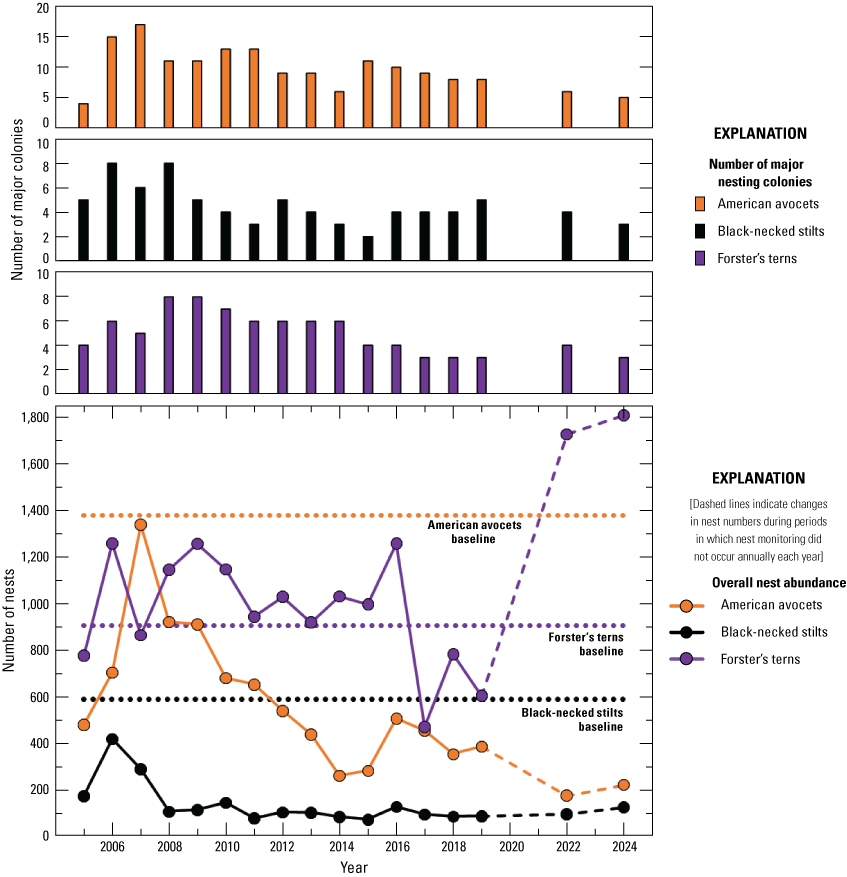
The number of major nesting colonies (top three panels) and overall nest abundance (bottom panel) of American avocets (orange bars, solid orange line), black-necked stilts (black bars, solid black line), and Forster’s terns (purple bars, solid purple line) in south San Francisco Bay during 2005–19, 2022, and 2024. Stippled lines denote periods in which nesting colonies were not monitored annually.
Nest monitoring was not completed in 2020 or 2021 during the Coronavirus pandemic or during 2023. Horizontal stippled lines denote the South Bay Salt Pond Restoration Project baseline abundance (R. Tertes, written commun., 2025) for American avocet nests (1,380 nests, orange stippled line), black-necked stilt nests (590 nests, black stippled line), and Forster’s tern nests (907 nests, purple stippled line), which were calculated by dividing by 2 the number of breeding birds observed during south San Francisco Bay surveys by Rintoul and others (2003; American avocets and black-necked stilts) and Strong and others (2004; Forster’s terns).
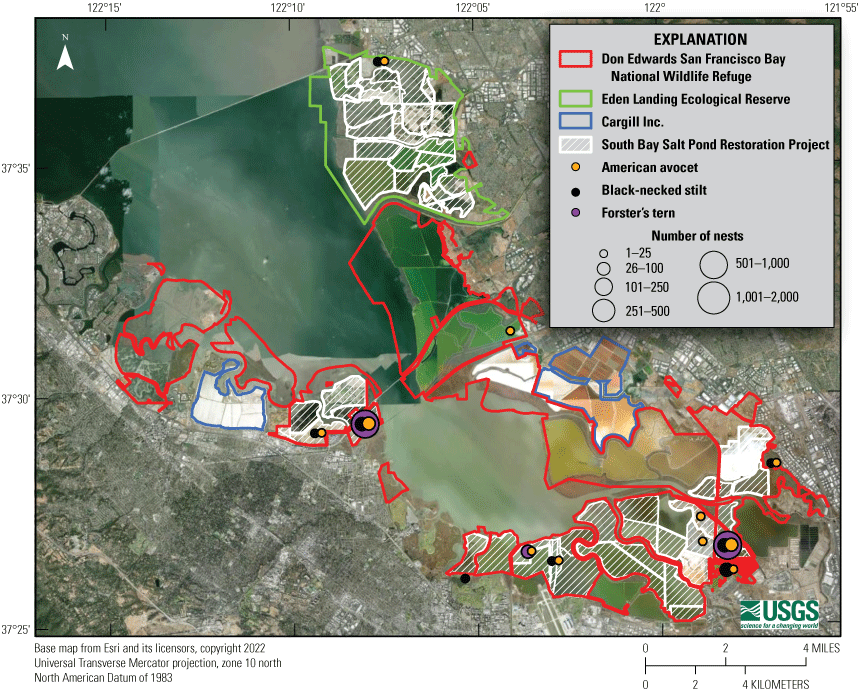
Distribution and abundance of American avocet (orange circles), black-necked stilt (black circles), and Forster’s tern (purple circles) nests monitored in south San Francisco Bay in 2024.
In 2024, we observed only five major American avocet colonies, three major black-necked stilt colonies, and three major Forster’s tern colonies (fig. 3). Major colony sites were defined as those with nest numbers greater than or equal to (≥) the median number of nests among all sites and years from 2005 to 2019 for each species (≥12 American avocet nests, ≥6 black-necked stilt nests, ≥40 Forster’s tern nests). Reductions in the number of major nesting colonies have been documented previously and have been attributed to the loss of historical island nesting habitat, particularly in the Moffett and Alviso complexes, caused by tidal wetland restoration and island erosion (Hartman and others, 2021). In 2024, just two sites, Ponds A16 and SF2, accounted for 52 percent (116 of 222 nests) of American avocet nests, 47 percent (59 of 126 nests) of black-necked stilt nests, and 94 percent (1,708 of 1,808 nests) of Forster’s tern nests in south San Francisco Bay. For comparison, between 2015 and 2019, Ponds A16 and SF2 accounted for only 33 percent of American avocet nests, 15 percent of black-necked stilt nests, and 13 percent of Forster’s tern nests in south San Francisco Bay. In Pond SF2, Forster’s terns nested on constructed islands in both Cell 1 (Islands 23, 24, 29, 30) and Cell 2 (Islands 8, 13, 16, and 20) and on dredge spoil mudflat islands in the northeast corner of Cell 1 (fig. 5). American avocets in Pond SF2 nested on Island 16, in the marsh area south of Cell 1, and in the salt flats in Cell 3 (fig. 5). Black-necked stilts nested on Island 30, in the marsh area south of Cell 1, in the salt flats in Cell 3, and on the dredge spoil mudflat islands in the northeast corner of Cell 1. In Pond A16, Forster’s terns nested on Islands 1, 3, 5, 6, 7, 8, 9, 10, and 13 and on exposed mudflats adjacent to islands throughout the pond (fig. 6). American avocets in Pond A16 nested on Islands 1, 5, 7, 8, 9, 10, 12, and 13, and on exposed mudflats adjacent to islands throughout the pond (fig. 6). Finally, black-necked stilts in Pond A16 nested on Islands 1, 3, 5, 7, 8, 9, and 10 and on exposed mudflats adjacent to islands throughout the pond (fig. 6). In 2024, there was considerable construction activity at the south end of Pond A16 associated with the South San Francisco Bay Shoreline Project, and the historic long and narrow southern islands in the pond were purposely covered to prevent birds from nesting.
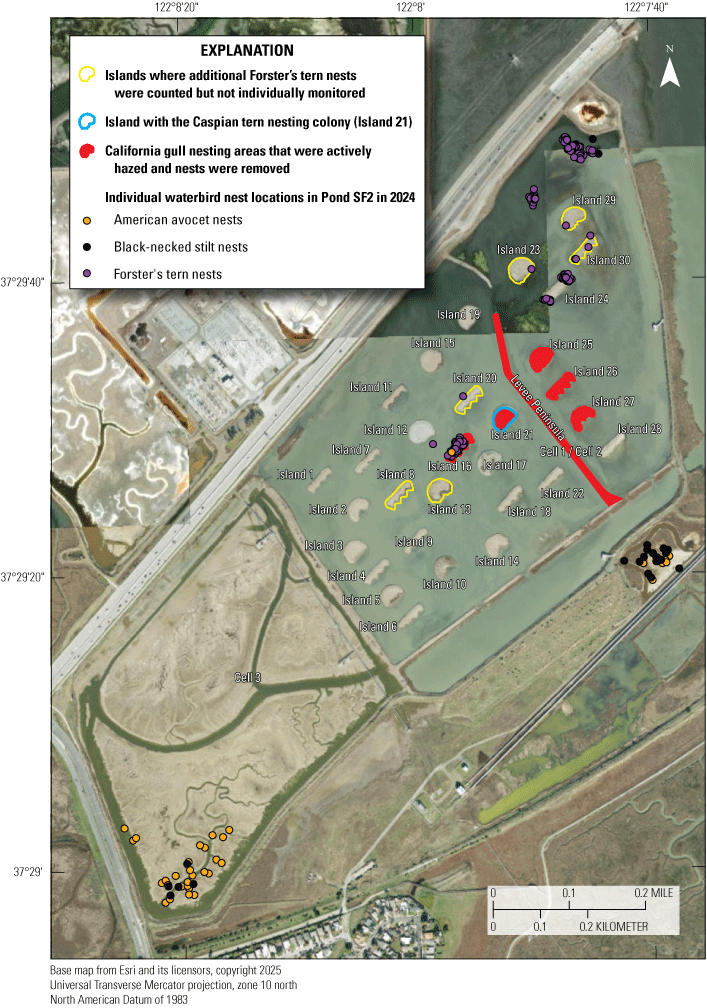
Individual waterbird nest locations (colored circles) and location of islands in Pond SF2 in 2024 where additional Forster’s tern nests were counted but not individually monitored (outlined in yellow). The island outlined in blue (Island 21) denotes the island with the Caspian tern nesting colony. Islands and areas in red denote California gull nesting areas that were actively hazed and where nests were removed.
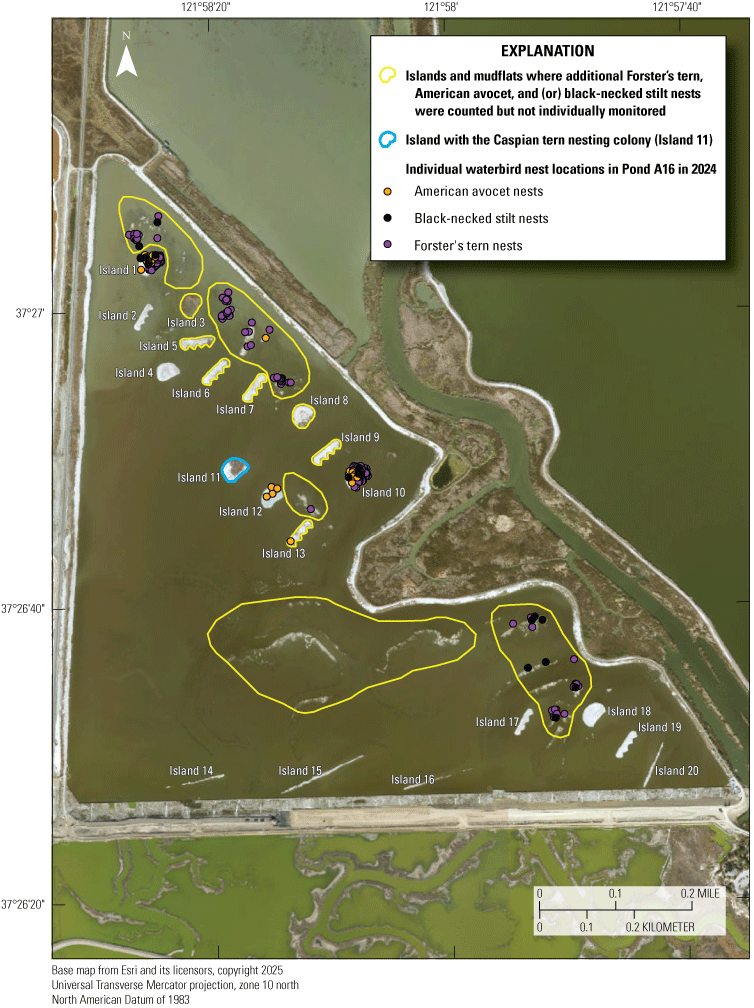
Individual waterbird nest locations (colored circles) and location of islands in Pond A16 in 2024 where additional Forster’s tern, American avocet, and black-necked stilt nests were counted but not individually monitored. The island outlined in blue (Island 11) denotes the island with the Caspian tern nesting colony.
In addition to the three focal species (American avocet, black-necked stilt, and Forster’s tern), we counted a high of 243 Caspian tern nests on Island 11 in Pond A16 and a high of 193 Caspian tern nests on Island 21 in Pond SF2 from the surrounding levees. Furthermore, Oregon State University conducted one aerial survey of Caspian tern nesting colonies in San Francisco Bay, including colonies in Pond A16 and Pond SF2. On June 10, 2024, 315 Caspian tern nests were observed on Island 11 in Pond A16, and 303 Caspian tern nests were observed on Island 21 in Pond SF2 (M. McGuire, Oregon State University, written commun., 2025). These large Caspian tern colonies are the result of successful social attraction efforts by USGS, in partnership with the USFWS and U.S. Army Corps of Engineers in 2015–17, which established two of the largest Caspian tern nesting colonies in San Francisco Bay in Ponds A16 and SF2 (Hartman and others, 2018, 2019). Compared to the final year of USGS social attraction efforts, Caspian tern nest abundance was 88 percent higher (167 peak nest count in 2017) on Island 11 in Pond A16 and 9 percent lower (334 peak nest count in 2017) on Island 21 in Pond SF2 in 2024. We also observed peak counts of 15 black skimmer nests on Island 12 in Pond A16 and 24 black skimmer nests on Island 16 in Pond SF2. Approximately 30–50 elegant terns (Thalasseus elegans) were observed roosting on Island 21 in Pond SF2 in late June and early July after their typical breeding season, and nesting was not observed.
Clutch Size
Average clutch size in 2024 was 3.87 for American avocets, 3.88 for black-necked stilts, and 2.73 for Forster’s terns (table 4). Average clutch sizes were slightly greater in all three species in 2024 compared to 2022 (American avocet: 3.68, black-necked stilt: 3.70, Forster’s tern: 2.63; Ackerman and others, 2023), and greater than during 2005–10 (American avocet: 3.47, black-necked stilt: 3.48, Forster’s tern: 2.27; Ackerman and Herzog, 2012). Clutch size estimates by site for each species are provided in table 5.
Table 4.
Summary of nesting demographic and habitat parameters for American avocets, black-necked stilts, and Forster’s terns in south San Francisco Bay, California, in 2024 in relation to 2022 and the 2005–10 averages.[cm, centimeter; NA, not applicable]
Total number of nests monitored weekly and used for estimating demographic and nest habitat parameters.
In 2024, Forster’s tern nesting populations in ponds A16 and SF2 were extremely large, so we counted all nests and monitored a subset of nests weekly to estimate demographic variables.
Source: Ackerman and others (2023), Monitoring Nesting Waterbirds for the South Bay Salt Pond Restoration Project—2022 Breeding Season: U.S. Geological Survey Open-File Report 2023–1067.
Source: Ackerman and Herzog (2012), Waterbird nest monitoring program in San Francisco Bay (2005–10): U.S. Geological Survey Open-File Report 2012–1145.
Table 5.
Summary nesting information for American avocets, black-necked stilts, and Forster’s terns in south San Francisco Bay, California, in 2024.[Nests were not individually monitored at Pond A13, Coyote Creek Lagoon, or South of Pond A1 and nesting metrics are listed as not applicable (NA). Abbreviation: cm, centimeter]
Nest Success
Overall, average nest success in 2024 was 73 percent for American avocets, 54 percent for black-necked stilts, and 64 percent for Forster’s terns (table 4). Total egg depredation by predators accounted for 45 percent of nest failures among American avocets, 81 percent of nest failures among black-necked stilts, and 39 percent of nest failures among Forster’s terns. Although predators accounted for a relatively lower percentage of nest failures among American avocets and Forster’s terns compared to black-necked stilts, many avocet and tern nests on low-lying mudflats in Ponds A16 and AB1 were flooded. Nest success was considerably higher in 2024 compared to 2022 among American avocets (30 percent in 2022) and black-necked stilts (29 percent in 2022) and slightly higher among Forster’s terns (53 percent in 2022; Ackerman and others, 2023). Nest success in 2024 was also higher compared to the average for 2005–10 among American avocets (37 percent in 2005–10) and black necked stilts (24 percent in 2005–10) and similar to the 2005–10 average among Forster’s terns (61 percent; table 4; Ackerman and Herzog, 2012). Nest-success estimates by site for each species are provided in table 5.
Egg-Hatching Success
Egg-hatching success in 2024 averaged 86 percent for American avocets, 96 percent for black-necked stilts, and 86 percent for Forster’s terns (table 4). Compared to 2022 (Ackerman and others, 2023), egg-hatching success in 2024 was 12 percentage points lower among American avocets (98 percent in 2022), but similar (4-percentage-point decrease) among black-necked stilts (100 percent in 2022) and Forster’s terns (90 percent in 2022). Egg-hatching success in 2024 was also lower compared to the average values observed in 2005–10 for American avocets (93 percent) and Forster’s terns (95 percent) but was similar to values observed for black-necked stilts (99 percent; table 4; Ackerman and Herzog, 2012). Egg-hatching success estimates by site for each species are provided in table 5.
Nest-Initiation Date
American avocets, black-necked stilts, and Forster’s terns all nested earlier in 2024 than in previous years. In 2024, the median nest-initiation date was April 19 for American avocets, April 25 for black-necked stilts, and May 12 for Forster’s terns; which was 8 days (Forster’s terns), 15 days (American avocets), and 18 days (black-necked stilts) earlier than in 2022; and 18 days (Forster’s terns), 26 days (American avocets), and 8 days (black-necked stilts) earlier than during 2005–10 (table 4). In 2024, the central span of nest-initiation dates (when the central 80 percent of nests were initiated) was 52 days (March 28–May 19) for American avocets, 57 days (April 3–May 30) for black-necked stilts, and 35 days (April 28–June 2) for Forster’s terns (table 4). Median nest-initiation dates by site are provided in table 5.
Nesting Vegetation and Habitat
Vegetation at the nest varied by species. Similar to previous years, American avocet nests had the shortest (9.3 centimeter [cm] average height) and sparsest (52.1-percent vegetation cover; table 4) vegetation among the three species. However, whereas in previous years, Forster’s tern nests had only slightly taller and denser vegetation cover compared to American avocets, Forster’s tern nests in 2024 had the tallest (17.9-cm average height) and densest (75.1-percent vegetation cover) vegetation among the three species; vegetation height and density at black-necked stilt nests (14.3-cm average height, 61.1-percent vegetation cover) are between those of the Forster’s tern and the American avocet (table 4). In 2024, nest vegetation height was greater for all three species and vegetation cover was greater for American avocets and Forster’s terns but lower for black-necked stilts than in 2022 (table 4). We attribute this result to the higher use of constructed islands (Ponds A16 and SF2) and mudflat islands in Pond SF2, which had taller and denser vegetation than in previous years. Indeed, several constructed islands in Ponds A16 and SF2 have been slow to be colonized by vegetation, but in 2024, there was considerably more vegetation growth, particularly along the perimeter of the islands along the water’s edge, where Forster’s terns nested. Vegetation characteristics at the nest by site are provided in table 5.
Hazing of California Gulls
California gull nests were hazed in Pond SF2 (Tier 1 site) and Pond AB2 (Tier 2 site). There were no California gull nesting attempts in any other Tier 1 or Tier 2 site in 2024. In Pond SF2, gulls nested on Islands 16 (1 nest), 21 (217 nests), 25 (256 nests), 26 (164 nests), 27 (5 nests), and on the Cell 1/Cell 2 internal levee (35 nests; fig. 5). In Pond AB2, gulls nested on most interior islands running down the middle of the pond (513 nests) and along the AB2/A2E levee. No gull nests were observed along the AB2/A3W levee. In 2024, under the Refuge’s gull hazing permit, we removed a total of 678 nests and 792 eggs from Pond SF2 between April 9 and May 31 and 513 nests and 559 eggs from Pond AB2 islands between April 11 and May 28 (table 6). At the direction of Refuge staff, we did not haze or remove California gull nests along the Pond AB2/A2E levee because there was an ongoing study there by San Jose State University researchers. No California gull eggs hatched from either Pond SF2 or Pond AB2 islands.
Table 6.
Summary of California gull hazing research efforts in Pond AB2 and Pond SF2, south San Francisco Bay, 2024.[California gulls were hazed under a permit granted to the Don Edwards San Francisco Bay National Wildlife Refuge from the U.S. Fish and Wildlife Service Migratory Bird Permit Office. Abbreviation: —, not available]
Management Implications
Short-Term Waterbird Nesting Trends (2017–24)
The nest abundance of all three species during 2017–19 was among the lowest recorded since annual nest monitoring began in 2005 (fig. 3; Ackerman and others, 2023). Loss of historic nesting habitat, without the establishment of new nesting colonies, may have contributed to the low nest abundance observed in 2017–19. Ponds A1, A2W, A7, and A8 previously hosted hundreds of Forster’s tern and American avocet nests annually, but loss of island nesting habitat because of inundation (Ponds A7 and A8) or island erosion (Ponds A1 and A2W) ended nesting activity in these ponds (Hartman and others, 2021). Moreover, Pond A16, another site that has historically supported hundreds of Forster’s tern and American avocet nests annually, went unused by nesting Forster’s terns after the pond was drained for the construction of new islands in 2012. However, with the aid of social attraction efforts by USGS in 2017 and 2019, 36 Forster’s terns nested at Pond A16 in 2019 for the first time since 2011 (Hartman and others, 2020).
In 2022 (no nest monitoring occurred in 2020 and 2021), Forster’s tern nest abundance rebounded sharply, increasing 179 percent compared to 2017–19. This large increase in Forster’s tern nest numbers in 2022 was due to the establishment of large nesting colonies in Pond A16 (523 nests) and Pond SF2 (965 nests) that accounted for 86 percent of all monitored Forster’s tern nests in south San Francisco Bay. In 2024, Forster’s tern nest abundance (1,808 nests) increased by 5 percent compared to 2022, to the highest number observed during nest monitoring from 2005 to 2024. As in 2022, Ponds A16 (885 nests) and SF2 (823 nests) accounted for most (94 percent) of the Forster’s tern nests in south San Francisco Bay. Forster’s terns have now nested in Pond SF2 every year since 2016, when USGS used social attraction techniques for Caspian terns (Hartman and others, 2019). No nest monitoring by USGS occurred in 2020, 2021, and 2023, but Refuge staff confirmed nesting by Forster’s terns in Pond SF2 in these years (R. Tertes, written commun., 2025). In Pond A16, Forster’s terns have now nested every year since 2019 (following successful social attraction efforts for Forster’s terns by USGS; Hartman and others, 2020), and more Forster’s tern nests were observed in Pond A16 in 2024 than in any other year since nest monitoring began in 2005 (table 3). Furthermore, in 2024, there were more Forster’s tern nests in Pond A16 than in Pond SF2 for the first time since 2011. In contrast, 2024 was the first year since 2012 in which Forster’s tern nests were not observed in New Chicago Marsh (table 3). New Chicago Marsh became a major nesting site for Forster’s terns in 2013 when adjacent Pond A16 was drained for new island construction, making historic island habitat unavailable for nesting. Forster’s terns continued to nest in large numbers in New Chicago Marsh annually through 2022 (111 nests). The number of Forster’s tern nests in Pond A16 increased by 69 percent in 2024 (885 nests) compared to 2022 (523 nests) because the New Chicago nesting area was abandoned.
In 2024, American avocet and black-necked stilt nest abundance in south San Francisco Bay increased over the prior nest monitoring year for the first time since 2019, increasing 26 percent for American avocets and 30 percent for black-necked stilts compared to 2022. Increase in nest abundance for these species are largely attributed to increased use of Ponds A16 and SF2, which accounted for 52 percent of American avocet nests and 47 percent of black-necked stilt nests in south San Francisco Bay in 2024. In Pond A16, American avocet nest abundance increased by 76 percent, from 38 nests in 2022 to 67 nests in 2024 (table 1), and black-necked stilt nest abundance increased by 540 percent, from 5 nests in 2022 to 32 nests in 2024 (table 2). Similarly, in Pond SF2, American avocet nest abundance increased 345 percent, from 11 nests in 2022 to 49 nests in 2024 (table 1), and black-necked stilt nest abundance increased from 0 nests in 2022 to 27 nests in 2024 (table 2).
Among the three focal species, black-necked stilts are the least associated with island nesting habitat, prefer taller and denser vegetation cover (table 4), and are more likely to nest in marsh habitats (Ackerman and others, 2014e). Thus, black-necked stilt nest abundance is likely to be more influenced by marsh habitat availability, particularly nontidal or muted tidal marshes like New Chicago Marsh in the Alviso Complex, the marsh habitat south of Pond SF2, and B20B in the Eden Landing Ecological Reserve. American avocets, on the other hand, are more dependent on island nesting habitat, with more than 70 percent of their nests in south San Francisco Bay found on islands (Hartman and others, 2016a).
Long-Term Waterbird Nesting Trends (2005–24) and Comparison to Baseline
The South Bay Salt Pond Restoration Project follows an adaptive management plan, in which concurrent monitoring of the effects of restoration and management actions is used to guide decision-making as the restoration progresses (Trulio and others, 2007). For breeding American avocets, black-necked stilts, and Forster’s terns, the adaptive management plan calls for “maintaining numbers of breeding avocets, stilts, and terns using the South Bay at pre-ISP (Initial Stewardship Plan) baseline numbers, if known, or as close to that baseline as can be determined” and includes management triggers in the event of declines in abundance or reproductive success below baseline numbers for 2 consecutive years (appendix 3 in Trulio and others, 2007). Baseline triggers for the South Bay Salt Pond Restoration Project include 2 consecutive years with fewer than 2,760 breeding American avocets or less than 55-percent American avocet nest success, fewer than 1,180 breeding black-necked stilts or less than 48-percent nest success, and fewer than 1,813 breeding Forster’s terns or less than 68-percent nest success (R. Tertes, oral commun., 2025). These triggers were based on the number of adult American avocet, black-necked stilt (Rintoul and others, 2003) and Forster’s tern (Strong and others, 2004) adults observed during the breeding season in south San Francisco Bay before Phase 1 of the restoration project, and nest success estimates for all three species were based on USGS’s long-term nest monitoring data (Ackerman and Herzog, 2012). Dividing these baseline triggers for adult abundance by 2 provides a close approximation of expected baseline nest abundance: 1,380 nests for American avocets, 590 nests for black-necked stilts, and 907 nests for Forster’s terns. Using observed nest abundance from our annual monitoring, the number of breeding American avocets and black-necked stilts in south San Francisco Bay has been below the baseline triggers in every year since 2005 (fig. 3; tables 1–2). Conversely, Forster’s terns have been below their baseline trigger for breeding adults in 5 of the past 17 years in which nest monitoring was done and in 2 consecutive years during 2017–19 when nest abundance averaged only 620 nests annually (fig. 3; table 3).
Overall, American avocet and black-necked stilt nest abundance in 2024 remained at or near 20-year lows (fig. 3; tables 1–2). Before the 2022 breeding season, the same was true for Forster’s terns, with only 604 nests observed in 2019, which is the second fewest since 2005. The large increase to a total of 1,727 Forster’s tern nests in 2022 and the further increase to 1,808 total nests in 2024 is the result of the large colonies observed in Ponds A16 and SF2. Thus, for the past 2 nest monitoring years (2022 and 2024), these two highly managed ponds were effective at returning the south San Francisco Bay Forster’s tern nesting population to above baseline values observed before 2017. These trends suggest that additional island nesting habitat within managed ponds might further increase these nesting populations and, importantly, shift the distribution of the nesting populations to other managed ponds. Currently (2024), there are only three Forster’s tern, five American avocet, and three black-necked stilt major colony nesting sites remaining, which is more than a 50-percent decrease from the average number of colonies observed during 2005–09 (annual averages: 6.6, 12.4, and 6.6 major colony sites, respectively). With the large and rapid changes in waterbird nest abundance and distribution in south San Francisco Bay, continued nest monitoring would provide critical data for evaluating the effects of habitat changes associated with the South Bay Salt Pond Restoration Project and guide management actions that optimize nest and chick survival.
Nest-success estimates in 2024 for American avocets (73 percent) and black-necked stilts (54 percent) were above 2005–07 baseline values (American avocet baseline: 55 percent, black-necked stilt baseline: 48 percent), and the nest-success estimate for Forster’s terns (64 percent) was just below the 2005–07 baseline value of 68 percent. The greater nest-success of American avocets and Forster’s terns compared to black-necked stilts in 2024 is likely due to greater use of island nesting habitat, where terrestrial predator access is more limited, by Forster’s terns (100 percent of nests) and American avocets (60 percent of nests) compared to black-necked stilts (28 percent of nests). Indeed, nest-success estimates for American avocets and black-necked stilts were among the lowest at sites without nesting islands, such as New Chicago Marsh (table 5). These results highlight the importance of maintaining suitable island nesting habitat in multiple managed pond locations in south San Francisco Bay because they provide greater protection from nest predation than marsh habitats.
Island Nesting Habitat and Water-Level Management
In Pond SF2, most Forster’s tern nests were observed on islands constructed in 2010 as part of the South Bay Salt Pond Restoration Project. Forster’s terns largely nested on the perimeter of constructed islands where the dense vegetation structure preferred by Forster’s tern had become established. The large interior areas of these constructed islands, which are sparsely vegetated, were avoided by nesting Forster’s terns. In contrast, in Pond A16, fewer Forster’s tern nests were observed on constructed islands than on low-lying mudflat islands throughout the pond. However, these Pond A16 mudflats are not ideal nesting habitats because frequent fluctuations in the pond’s water levels resulted in flooding that led to nest failure and chick mortality. Rising water levels in Pond AB1 during nesting also resulted in many nests being flooded and destroyed. Managing water levels so that low-lying mudflats are not available during the breeding season may lead to greater use of constructed islands, reducing the flood-related nest and chick mortality associated with these lower-lying mudflats. Similarly, in ponds with low-lying established islands, such as Pond AB1, ensuring water levels do not rise enough to inundate islands would help prevent nest loss to flooding.
California Gull Management
The high waterbird nest abundance observed in 2024 in Pond A16 and SF2, as well as the continued high nest abundance in Pond AB1 (100 nests in 2024), enabled Forster’s tern nest abundance to remain at historic highs for a second consecutive nest monitoring year. However, California gull taking over island nesting habitat and excluding other waterbirds remains a concern. Another pond site where Forster’s tern nest abundance has been high in recent years is Pond AB2, with 122 nests observed in 2019 (table 3). In 2022 and 2024, California gulls had completely dominated the nesting islands previously used by Forster’s terns in the Moffett complex of ponds, and we observed only two American avocet nests, one black-necked stilt nest, and no Forster’s tern nests in Pond AB2. Although hazing efforts by the USGS prevented any reproductive success by California gulls in Pond AB2, Forster’s terns and other waterbirds were nevertheless excluded from nesting on the island habitat they had used in previous years. Similarly, in Pond SF2, hazing efforts prevented California gull reproductive success, but other waterbirds were excluded from nesting on four of the five islands where gulls tried to nest (Caspian terns successfully nested on Island 21, and Forster’s terns successfully nested on Island 16, where only a single gull nest was observed and removed early in the breeding season). Because birds tend to be philopatric to prior nesting areas, especially those where they have nested successfully, continued hazing of gulls from these historic waterbird nesting sites might allow these areas to be recolonized. A study that would mark California Gulls with Global Positioning System units at hazed and unhazed nesting sites to determine whether hazed gulls left the area or continued trying to nest at the hazed site might be able to improve hazing effectiveness and increase nesting by target waterbirds.
Without gull management or gull hazing and dissuasion, Pond AB2 and other ponds may remain ineffective nesting habitat for other waterbirds in the future. Furthermore, as documented previously, the California gull population in south San Francisco Bay has almost tripled since 2001 (Burns and others, 2018; Tarjan and Burns, 2019), and gulls are key predators of waterbird eggs and chicks (Herring and others, 2011; Ackerman and others, 2014c, 2014e; Takekawa and others, 2015; Peterson and others, 2017). Thus, California gull management to prevent occupation of island nesting habitat and to reduce predation on waterbird nesting colonies is an important consideration for ensuring healthy waterbird nesting populations in south San Francisco Bay.
References Cited
Ackerman, J.T., Bluso-Demers, J.D., and Takekawa, J.Y., 2009, Postfledging Forster’s tern movements, habitat selection, and colony attendance in San Francisco Bay: The Condor—Ornithological Applications, v. 111, no. 1, p. 100–110. [Available at https://doi.org/10.1525/cond.2009.080054.]
Ackerman, J.T., Eadie, J.M., Loughman, D.L., Yarris, G.S., and McLandress, M.R., 2003, The influence of partial clutch depredation on duckling production: The Journal of Wildlife Management, v. 67, no. 3, p. 576–587. [Available at https://doi.org/10.2307/3802715.]
Ackerman, J.T., and Eagles-Smith, C.A., 2009, Integrating toxicity risk in bird eggs and chicks—Using chick down feathers to estimate mercury concentrations in eggs: Environmental Science & Technology, v. 43, no. 6, p. 2166–2172. [Available at https://doi.org/10.1021/es803159c.]
Ackerman, J.T., and Eagles-Smith, C.A., 2010, Accuracy of egg flotation throughout incubation to determine embryo age and incubation day in waterbird nests: The Condor—Ornithological Applications, v. 112, no. 3, p. 438–446. [Available at https://doi.org/10.1525/cond.2010.090070.]
Ackerman, J.T., Eagles-Smith, C.A., Heinz, G., De La Cruz, S.E.W., Takekawa, J.Y., Miles, A.K., Adelsbach, T.L., Herzog, M.P., Bluso-Demers, J.D., Demers, S.A., Herring, G., Hoffman, D.J., Hartman, C.A., Willacker, J.J., Suchanek, T.H., Schwarzbach, S.E., and Maurer, T.C., 2014a, Mercury in birds of San Francisco Bay-Delta, California—Trophic pathways, bioaccumulation, and ecotoxicological risk to avian reproduction: U.S. Geological Survey Open-File Report 2014–1251, 202 p., accessed May 14, 2025, at https://doi.org/10.3133/ofr20141251.
Ackerman, J.T., Eagles-Smith, C.A., Herzog, M.P., Herring, G., Strong, C.M., and Mruz, E., 2010, Response of waterbird breeding effort, nest success, and mercury concentrations in eggs and fish to wetland management: U.S. Fish and Wildlife Service, prepared by U.S. Geological Survey, Western Ecological Research Center, Davis, Calif., and U.S. Fish and Wildlife Service, 28 p., accessed May 14, 2025, at https://www.southbayrestoration.org/document/response-waterbird-breeding-effort-nest-success-and-mercury-concentrations-eggs-and-fish.
Ackerman, J.T., Eagles-Smith, C.A., Herzog, M.P., Yee, J.L., and Hartman, C.A., 2016, Egg-laying sequence influences egg mercury concentrations and egg size in three bird species—Implications for contaminant monitoring programs: Environmental Toxicology and Chemistry, v. 35, no. 6, p. 1458–1469. [Available at https://doi.org/10.1002/etc.3291.]
Ackerman, J.T., Eagles-Smith, C.A., Takekawa, J.Y., Bluso, J.D., and Adelsbach, T.L., 2008a, Mercury concentrations in blood and feathers of prebreeding Forster’s terns in relation to space use of San Francisco Bay, California, USA, habitats: Environmental Toxicology and Chemistry, v. 27, no. 4, p. 897–908. [Available at https://doi.org/10.1897/07-230.1.]
Ackerman, J.T., Eagles-Smith, C.A., Takekawa, J.Y., Demers, S.A., Adelsbach, T.L., Bluso, J.D., Miles, A.K., Warnock, N., Suchanek, T.H., and Schwarzbach, S.E., 2007, Mercury concentrations and space use of pre-breeding American avocets and black-necked stilts in San Francisco Bay: Science of the Total Environment, v. 384, nos. 1–3, p. 452–466. [Available at https://doi.org/10.1016/j.scitotenv.2007.04.027.]
Ackerman, J.T., Hartman, C.A., and Herzog, M.P., 2023, Monitoring nesting waterbirds for the South Bay Salt Pond Restoration Project—2022 breeding season: U.S. Geological Survey Open-File Report 2023–1067, 25 p. [Available at https://doi.org/10.3133/ofr20231067.]
Ackerman, J.T., Hartman, C.A., and Herzog, M.P., 2025, Waterbird nest abundance in south San Francisco Bay: U.S. Geological Survey data release. [Available at https://doi.org/10.5066/P13VVTPR.]
Ackerman, J.T., Hartman, C.A., Herzog, M.P., Smith, L.M., Moskal, S.M., De La Cruz, S.E.W., Yee, J.L., and Takekawa, J.Y., 2014b, The critical role of islands for waterbird breeding and foraging habitat in managed ponds of the South Bay Salt Pond Restoration Project, south San Francisco Bay, California: U.S. Geological Survey Open-File Report 2014–1263, 108 p. [Available at https://doi.org/10.3133/ofr20141263.]
Ackerman, J.T., Hartman, C.A., Herzog, M.P., Takekawa, J.Y., Robinson, J.A., Oring, L.W., Skorupa, J.P., and Boettcher, R., 2020, American avocet (Recurvirostra americana), version 1.0, in Poole, A.F., ed., Birds of the World: Ithaca, N.Y., Cornell Lab of Ornithology, accessed May 14, 2025, at https://doi.org/10.2173/bow.ameavo.01.
Ackerman, J.T., and Herzog, M.P., 2012, Waterbird nest monitoring program in San Francisco Bay (2005–10): U.S. Geological Survey Open-File Report 2012–1145, 16 p. [Available at https://doi.org/10.3133/ofr20121145.]
Ackerman, J.T., Herzog, M.P., and Hartman, C.A., 2012, The South Bay Mercury Project—Using biosentinels to monitor effects of wetland restoration for the South Bay Salt Pond Restoration Project (waterbird mercury component): South Bay Salt Pond Restoration Project and Resources Legacy Fund, prepared by U.S. Geological Survey, 35 p., accessed May 14, 2025, at https://www.southbayrestoration.org/document/south-bay-mercury-project-using-biosentinels-monitor-effects-wetland-restoration-south-bay.
Ackerman, J.T., Herzog, M.P., Hartman, C.A., and Herring, G., 2014c, Forster’s tern chick survival in response to a managed relocation of predatory California gulls: The Journal of Wildlife Management, v. 78, no. 5, p. 818–829. [Available at https://doi.org/10.1002/jwmg.728.]
Ackerman, J.T., Herzog, M.P., Hartman, C.A., Watts, T.C., and Barr, J.R., 2014d, Waterbird egg mercury concentrations in response to wetland restoration in south San Francisco Bay, California: U.S. Geological Survey Open-File Report 2014–1189, 22 p., accessed May 14, 2025, at https://doi.org/10.3133/ofr20141189.
Ackerman, J.T., Herzog, M.P., and Schwarzbach, S.E., 2013a, Methylmercury is the predominant form of mercury in bird eggs—A synthesis: Environmental Science & Technology, v. 47, no. 4, p. 2052–2060. [Available at https://doi.org/10.1021/es304385y.]
Ackerman, J.T., Herzog, M.P., Takekawa, J.Y., and Hartman, C.A., 2014e, Comparative reproductive biology of sympatric species—Nest and chick survival of American avocets and black-necked stilts: Journal of Avian Biology, v. 45, no. 6, p. 609–623. [Available at https://doi.org/10.1111/jav.00385.]
Ackerman, J.T., Marvin-DiPasquale, M., Slotton, D., Eagles-Smith, C.A., Herzog, M.P., Hartman, C.A., Agee, J.L., and Ayers, S., 2013b, The South Bay Mercury Project—Using biosentinels to monitor effects of wetland restoration for the South Bay Salt Pond Restoration Project: South Bay Salt Pond Restoration Project and Resources Legacy Fund, prepared by U.S. Geological Survey, [variously paged; 227 p.]
Ackerman, J.T., Takekawa, J.Y., Eagles-Smith, C.A., and Iverson, S.A., 2008b, Mercury contamination and effects on survival of American avocet and black-necked stilt chicks in San Francisco Bay: Ecotoxicology, v. 17, p. 103–116. [Available at https://doi.org/10.1007/s10646-007-0164-y.]
Burns, C.E., Ackerman, J.T., Washburn, N.B., Bluso-Demers, J., Robinson-Nilsen, C., and Strong, C., 2018, California gull population growth and ecological impacts in the San Francisco Bay estuary, 1980–2016: Western Field Ornithologists, p. 180–189. [Available at https://doi.org/10.21199/SWB3.9.]
Demers, S.A., and Robinson-Nilsen, C.W., 2012, Monitoring western snowy plover nests with remote surveillance systems in San Francisco Bay, California: Journal of Fish and Wildlife Management, v. 3, no. 1, p. 123–132. [Available at https://doi.org/10.3996/062011-JFWM-036.]
Goals Project, 1999, Baylands ecosystem habitat goals—A report of habitat recommendations: Prepared by the San Francisco Bay Area Wetlands Ecosystem Goals Project, U.S. Environmental Protection Agency, San Francisco, Calif., and San Francisco Bay Regional Water Quality Control Board, Oakland, Calif., [variously paged; 328 p.]. [Available at https://www.sfei.org/sites/default/files/project/1999sfbaygoals031799.pdf.]
Hartman, C.A., Ackerman, J.T., and Herzog, M.P., 2016a, Island characteristics within wetlands influence waterbird nest success and abundance: The Journal of Wildlife Management, v. 80, no. 7, p. 1177–1188. [Available at https://doi.org/10.1002/jwmg.21120.]
Hartman, C.A., Ackerman, J.T., Herzog, M.P., Strong, C., and Trachtenbarg, D., 2019, Social attraction used to establish Caspian tern nesting colonies in San Francisco Bay: Global Ecology and Conservation, v. 20, 11 p. [Available at https://doi.org/10.1016/j.gecco.2019.e00757.]
Hartman, C.A., Ackerman, J.T., Herzog, M.P., Strong, C., Trachtenbarg, D., and Shore, C.A., 2018, Social attraction used to establish Caspian tern (Hydroprogne caspia) nesting colonies on modified islands at the Don Edwards San Francisco Bay National Wildlife Refuge, California—Final Report: U.S. Geological Survey Open-File Report 2018–1136, 41 p., accessed May 14, 2025, at https://doi.org/10.3133/ofr20181136.
Hartman, C.A., Ackerman, J.T., Herzog, M.P., Wang, Y., and Strong, C., 2020, Establishing Forster’s tern (Sterna forsteri) nesting sites at Pond A16 using social attraction for the South Bay Salt Pond Restoration Project: U.S. Geological Survey Open-File Report 2020–1081, 28 p., accessed May 14, 2025, at https://doi.org/10.3133/ofr20201081.
Hartman, C.A., Ackerman, J.T., Schacter, C.R., Herzog, M.P., Tarjan, L.M., Wang, Y., Strong, C., Tertes, R., and Warnock, N., 2021, Breeding waterbird populations have declined in south San Francisco Bay—An assessment over two decades: San Francisco Estuary and Watershed Science, v. 19, no. 3, 28 p. [Available at https://doi.org/10.15447/sfews.2021v19iss3art4.]
Hartman, C.A., Ackerman, J.T., Takekawa, J.Y., and Herzog, M.P., 2016b, Waterbird nest-site selection is influenced by neighboring nests and island topography: The Journal of Wildlife Management, v. 80, no. 7, p. 1267–1279. [Available at https://doi.org/10.1002/jwmg.21105.]
Herring, G., Ackerman, J.T., Takekawa, J.Y., Eagles-Smith, C.A., and Eadie, J.M., 2011, Identifying nest predators of American avocets (Recurvirostra americana) and black-necked stilts (Himantopus mexicanus) in San Francisco Bay, California: The Southwestern Naturalist, v. 56, no. 1, p. 35–43. [Available at https://doi.org/10.1894/KF-14.1.]
Klett, A.T., and Johnson, D.H., 1982, Variability in nest survival rates and implications to nesting studies: The Auk, v. 99, no. 1, p. 77–87. [Available at https://doi.org/10.2307/4086023.]
Mayfield, H., 1961, Nesting success calculated from exposure: The Wilson Bulletin, v. 73, no. 3, p. 255–261. [Available at https://amoywg.org/wp-content/uploads/2011/11/Mayfield-1961-nesting-success-calculated-from-exposure.pdf.]
McNicholl, M.K., Lowther, P.E., and Hall, J.A., 2020, Forster’s tern (Sterna forsteri), version 1.0, in Poole, A.F., and Gill, F.B., eds., Birds of the world: Ithaca, N.Y., Cornell Lab of Ornithology, accessed May 14, 2025, at https://doi.org/10.2173/bow.forter.01.]
Page, G.W., Stenzel, L.E., and Kjelmyr, J.E., 1999, Overview of shorebird abundance and distribution in wetlands of the Pacific Coast of the contiguous United States: The Condor—Ornithological Applications, v. 101, no. 3, p. 461–471. [Available at https://doi.org/10.2307/1370176.]
Peterson, S.H., Ackerman, J.T., and Eagles-Smith, C.A., 2017, Mercury contamination and stable isotopes reveal variability in foraging ecology of generalist California gulls: Ecological Indicators, v. 74, p. 205–215. [Available at https://doi.org/10.1016/j.ecolind.2016.11.025.]
Rintoul, C., Warnock, N., Page, G.W., and Hanson, J.T., 2003, Breeding status and habitat use of black-necked stilts and American avocets in south San Francisco Bay: Western Birds, v. 34, no. 1, p. 2–14. [Available at https://archive.westernfieldornithologists.org/archive/V34/34(1)-p0002-p0014.pdf.]
Robinson, J.A., Reed, J.M., Skorupa, J.P., and Oring, L.W., 2020, Black-necked Stilt (Himantopus mexicanus), version 1.0, in Poole, A.F., and Gill, F.B., eds., Birds of the world: Ithaca, N.Y., Cornell Lab of Ornithology, accessed May 14, 2025, at https://doi.org/10.2173/bow.bknsti.01.
Shaffer, T.L., 2004, A unified approach to analyzing nest success: The Auk, v. 121, no. 2, p. 526–540. [Available at https://www.jstor.org/stable/4090416?seq=1.]
Stenzel, L.E., Hickey, C.M., Kjelmyr, J.E., and Page, G.W., 2002, Abundance and distribution of shorebirds in the San Francisco Bay area: Western Birds, v. 33, no. 2, p. 69–98. [Available at https://archive.westernfieldornithologists.org/archive/V33/33(2)-p0069-p0098.pdf.]
Strong, C.M., Spear, L.B., Ryan, T.P., and Dakin, R.E., 2004, Forster’s tern, Caspian tern, and California gull colonies in San Francisco Bay—Habitat use, numbers, and trends, 1982–2003: Waterbirds, v. 27, no. 4, p. 411–423. [Available at https://doi.org/10.1675/1524-4695(2004)027[0411:FTCTAC]2.0.CO;2.]
Takekawa, J.Y., Ackerman, J.T., Brand, L.A., Graham, T.R., Eagles-Smith, C.A., Herzog, M.P., Topping, B.R., Shellenbarger, G.G., Kuwabara, J.S., Mruz, E., Piotter, S.L., and Athearn, N.D., 2015, Unintended consequences of management actions in salt pond restoration—Cascading effects in trophic interactions: PLoS One, v. 10, no. 6, 15 p. [Available at https://doi.org/10.1371/journal.pone.0119345.]
Takekawa, J.Y., Woo, I., Gardiner, R., Casazza, M., Ackerman, J.T., Nur, N., Liu, L., and Spautz, H., 2011, Avian communities in tidal salt marshes of San Francisco Bay—A review of functional groups by foraging guild and habitat association: San Francisco Estuary and Watershed Science, v. 9, no. 3, 24 p. [Available at https://doi.org/10.15447/sfews.2011v9iss3art4.]
Takekawa, J.Y., Woo, I., Thorne, K.M., Buffington, K.J., Nur, N., Casazza, M.L., and Ackerman, J.T., 2012, Bird communities—Effects of fragmentation, disturbance, and sea level rise on population viability, chap. 12 of Palaima, A., ed., Ecology, conservation, and restoration of tidal marshes—The San Francisco Estuary: Berkeley, Calif., University of California Press, p. 175–194. [Available at https://doi.org/10.1525/california/9780520274297.003.0012.]
Trulio, L.A., Clark, D., Ritchie, S., Hutzel, A., and the South Bay Salt Pond Restoration Project Science Team, 2007, Adaptive management plan, app. D of EDAW, Philip Williams and Associates, Ltd., H.T. Harvey and Associates, Brown and Caldwell, and Geomatrix, South Bay salt pond restoration project—Final environmental impact statement/report: U.S. Fish and Wildlife Service and California Department of Fish and Game, prepared by EDAW, Philip Williams and Associates, Ltd., H.T. Harvey and Associates, Brown and Caldwell, and Geomatrix, 135 p. [Available at https://www.southbayrestoration.org/document/final-environmental-impact-statement-environmental-impact-report-december-2007.]
For more information concerning the research in this report, contact the
Director, Western Ecological Research Center
U.S. Geological Survey
3020 State University Drive East
Sacramento, California 95819
https://www.usgs.gov/centers/werc
Publishing support provided by the USGS Science Publishing Network,
Sacramento Publishing Service Center
Disclaimers
Any use of trade, firm, or product names is for descriptive purposes only and does not imply endorsement by the U.S. Government.
Although this information product, for the most part, is in the public domain, it also may contain copyrighted materials as noted in the text. Permission to reproduce copyrighted items must be secured from the copyright owner.
Suggested Citation
Ackerman, J.T., Hartman, C.A., and Herzog, M., 2026, Monitoring nesting waterbirds for the South Bay Salt Pond Restoration Project—2024 breeding season: U.S. Geological Survey Open-File Report 2026–1064, 27 p., https://doi.org/10.3133/ofr20261064.
ISSN: 2331-1258 (online)
Study Area
| Publication type | Report |
|---|---|
| Publication Subtype | USGS Numbered Series |
| Title | Monitoring nesting waterbirds for the South Bay Salt Pond Restoration Project—2024 breeding season |
| Series title | Open-File Report |
| Series number | 2026-1064 |
| DOI | 10.3133/ofr20261064 |
| Publication Date | March 05, 2026 |
| Year Published | 2026 |
| Language | English |
| Publisher | U.S. Geological Survey |
| Publisher location | Reston, VA |
| Contributing office(s) | Western Ecological Research Center |
| Description | Report: vi, 27 p.; Data Release |
| Country | United States |
| State | California |
| Other Geospatial | south San Francisco Bay |
| Online Only (Y/N) | Y |