


Field Performance Evaluation of a Bayluscide 20-Percent Suspension Concentrate Formulation
Links
- Document: Report (961 KB pdf) , HTML , XML
- Data Release: USGS Data Release - Evaluation of bayluscide 20% suspension concentrate formulation field performance (Indian River, Schoolcraft County, MI)
- Version History: Version History (1 KB txt)
- Download citation as: RIS | Dublin Core
Acknowledgments
Financial support for this study was provided by the Great Lakes Fishery Commission under a technical assistant agreement with the U.S. Geological Survey Upper Midwest Environmental Sciences Center in La Crosse, Wisconsin. We thank staff from the U.S. Fish and Wildlife Service Marquette and Ludington Biological Stations, and Fisheries and Oceans Canada for participating in the planning, setup, and completion of this project.
Abstract
Petromyzon marinus (Linnaeus, 1758; sea lamprey) is a parasitic, invasive fish of the Laurentian Great Lakes. Since the late 1950s, the Great Lakes Fishery Commission has implemented an integrated Sea Lamprey Control Program (SLCP) that relies on two lampricidal chemicals: 3-(trifluoromethyl)-4-nitrophenol (TFM) and niclosamide. Niclosamide is applied using a bayluscide 20-percent emulsifiable concentrate; however, a solvent in this formulation, N-methyl-2-pyrrolidone, has been linked with worker safety concerns and has contributed to equipment degradation and clogging. To address these limitations, the U.S. Geological Survey, in collaboration with Battelle UK, developed a bayluscide 20-percent suspension concentrate (SC) as a potential alternative formulation.
In this study, we evaluated the field performance of SC on the Indian River in Schoolcraft County, Michigan. The objective was to assess the formulation’s compatibility with SLCP application procedures and equipment, and to determine its ability to deliver precise lampricide concentrations in a timely manner. SC was found to dilute easily with stream water and readily combined with TFM. As a result, target lampricide concentrations in the stream were achieved within 1 hour of initiating delivery. Moreover, concentrations remained within 9 percent of target values, with less than 2 percent variation across the width of the stream, demonstrating consistent and uniform distribution. These findings indicate that SC can support accurate and timely lampricide applications. When considered alongside previous research highlighting its favorable selectivity for sea lamprey and improved environmental safety, the results support the pursuit of registration and adoption of SC as a new tool for controlling invasive sea lamprey.
Introduction
Petromyzon marinus (Linnaeus, 1758; sea lamprey) is a parasitic fish native to the Atlantic Ocean that entered the Laurentian Great Lakes in the early to mid-1900s, leading to significant declines in native fish populations (Smith and Tibbles, 1980; Docker and others, 2021). In response to the economic and ecological threat posed by sea lamprey, the Great Lakes Fishery Commission (GLFC) was established in 1955 by a treaty between the United States and Canada. The GLFC was tasked with developing and implementing a program to control sea lamprey populations (Siefkes and others, 2013). Among its earliest initiatives, the GLFC funded research that led to the discovery of 3-(trifluoromethyl)-4-nitrophenol (TFM), a pesticide selective for sea lamprey, commonly referred to as a lampricide (Applegate and others, 1958). A few years later, Howell and others (1964, 1980) demonstrated that incorporating 0.5 to 2 percent niclosamide by mass significantly reduced the amount of costly TFM used per treatment while maintaining selectivity for the target species. Since then, applications of TFM or TFM combined with niclosamide have been used to target larval sea lamprey in tributaries throughout the Great Lakes. These treatments have become the cornerstone of the GLFC’s Sea Lamprey Control Program (SLCP; Sullivan and others, 2021).
Over the past 35 years, the SLCP has employed two niclosamide formulations in combination with TFM. Bayluscide 70-percent wettable powder, registered as a lampricide in 1990, required specialized delivery techniques that limited its use to streams with easy access and sufficient turbulence to ensure proper mixing and distribution. In addition to these logistical constraints, handling the powder was labor-intensive and posed an inhalation hazard to application personnel. To overcome these challenges, a bayluscide 20-percent emulsifiable concentrate (EC) was registered in 2003 (Luoma and others, 2024; U.S. Environmental Protection Agency [EPA], undated). While EC addressed the difficulties associated with the powdered formulation, it introduced new concerns due to the inclusion of N-methyl-2-pyrrolidone, a solvent identified by the EPA as a developmental and reproductive toxin (EPA, 2022). The presence of N-methyl-2-pyrrolidone raised worker safety concerns and contributed to application equipment degradation and clogging, necessitating frequent cleaning or replacement. To address these issues, scientists at the U.S. Geological Survey (USGS) Upper Midwest Environmental Sciences Center partnered with Battelle UK (Hampshire, United Kingdom) to develop a water-based alternative: a bayluscide 20-percent suspension concentrate (SC). This formulation retains the active ingredient used in both previous products (niclosamide ethanolamine salt, also called bayluscide) and incorporates inert components approved by both the EPA and the Health Canada Pest Management Regulatory Agency (PMRA). Furthermore, a comparative study found no difference in toxicity between the SC and EC formulations towards larval sea lamprey, while SC exhibited slightly reduced toxicity to nontarget species. These findings suggest improved environmental safety and favorable selectivity with the newer formulation (Luoma and others, 2024).
This report summarizes a field performance evaluation of SC conducted by the USGS and the U.S. Fish and Wildlife Service (FWS) on the Indian River, a tributary to the Manistique River in Schoolcraft County, Michigan, in October 2024. The primary objectives of the evaluation were to quantify lampricide concentration profiles resulting from the application of SC alone and in combination with TFM, and to assess the formulation’s compatibility with existing SLCP application procedures and equipment.
Methods
Test and Reference Articles
SC (lot number 55807-89; Battelle UK, Hampshire, United Kingdom) served as the test article for the field performance evaluation. The active ingredient concentration in the lot used was verified as 19.77 percent bayluscide by mass, equivalent to 16.67 percent niclosamide by mass. To assess chemical compatibility, SC was combined with TFM-HP Sea Lamprey Larvicide (33 percent TFM by mass), manufactured by Iofina Chemical, Inc. (Covington, Kentucky), during the evaluation.
Reagent-grade (minimum 98 percent) niclosamide and reagent-grade (minimum 99 percent) TFM from Sigma-Aldrich Chemical Company (St. Louis, Missouri) were used as the reference articles to prepare analytical calibration standards for laboratory analyses.
Study Location
The field performance evaluation was conducted on October 9, 2024, at the Indian River, a tributary to the Manistique River, in Schoolcraft County, Michigan. Approximately 1.8 kilometers (km) of the Indian River were treated with lampricide between the application point and the stream’s confluence with the Manistique River (table 1). USGS personnel collected water samples for lampricide concentration and water chemistry determinations at the application point and at a sample collection site located 0.8 km downstream from the application point (table 1). Based on the stream’s morphology and discharge, experienced SLCP personnel determined that the downstream collection site was sufficiently distant from the application point to allow for complete lampricide mixing (Benson Solomon, FWS, Marquette, Michigan, oral commun., November 15, 2024). Additionally, a nearby Michigan Department of Natural Resources facility provided a power source for analytical equipment used by USGS personnel to process and analyze the collected samples.
Lampricide Application
The field evaluation was conducted in accordance with standard operating procedures (SOPs) for a treatment using TFM and niclosamide applied at a 100:1 mass ratio (Barber and Van Kempen, 2024). However, to ensure that no pesticidal effect occurred during the trial, the planned application rates were reduced to 75 percent of the SOP-prescribed minimum lethal concentrations (MLCs) for sea lamprey. Based on stream pH and alkalinity measurements taken at the application site immediately prior to the evaluation, the MLCs were determined to be 11.24 micrograms per liter (μg/L) for niclosamide and 1.12 milligrams per liter (mg/L) for TFM (Barber and Van Kempen, 2024). Accordingly, the target concentrations for the field trial were set to 8.43 μg/L for niclosamide and 0.84 mg/L for TFM.
The evaluation was initiated at 9:15 a.m. (hour 0) and consisted of two consecutive 4-hour phases. In the first phase, SC was applied alone to assess its compatibility with field procedures and equipment, and to evaluate the niclosamide concentration profile. In the second phase, TFM-HP Sea Lamprey Larvicide was introduced without interrupting the delivery of SC, allowing for evaluation of the combined chemical compatibility and the concentration profiles of both lampricides.
Water Quality
Water temperature, pH, alkalinity, and hardness were measured throughout the duration of the field evaluation to monitor for the potential need to adjust niclosamide and TFM concentrations according to SOPs (Barber and Van Kempen, 2024). Temperature and pH were measured at the application point at hours 0, 4, and 8 using a digital thermometer (Thermapen One, ThermoWorks Company, American Fork, Utah) and a multiparameter meter fitted with a digital pH probe (Hach Company, models HQ40d and PHC 70501; Loveland, Colorado), respectively. Temperature and pH were also measured at the sample collection site hourly from hours 0 to 8. Alkalinity and hardness were determined on site in a mobile laboratory at hours 0, 4, and 8 in grab samples from the collection site using Baird and others’ (2017) methods 2340C and 2320B, respectively. All measurements at each time point were single determinations.
Niclosamide and TFM Concentration Verification
Grab water samples were collected from four evenly spaced positions across the width of the stream at a designated sample collection site located 0.8 km downstream from the lampricide application point. The stream width at this location was approximately 35 meters (m). Therefore, samples were taken at distances of approximately 4.4 m and 8.8 m from each stream bank, as shown in figure 1.
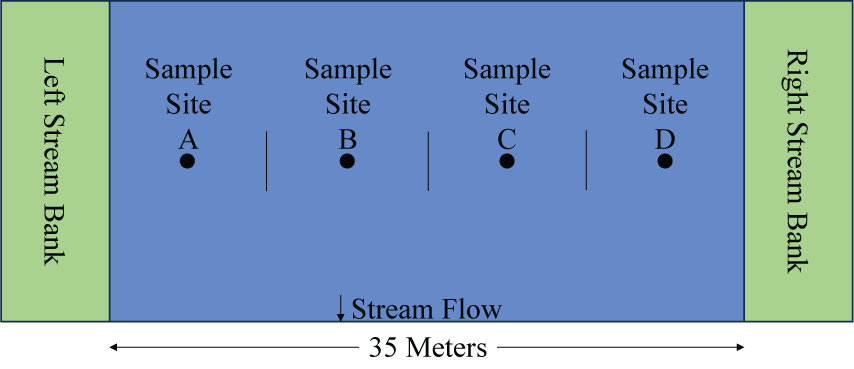
Schematic showing the collection locations of grab water samples used to evaluate the field performance of a bayluscide 20-percent suspension concentrate on the Indian River, Schoolcraft County, Michigan. Sample sites were centered in the, A, left descending bank quarter, B, mid-left descending quarter, C, mid-right descending quarter, and D, right descending bank quarter.
Triplicate water samples were collected in 20-milliliter (mL) glass scintillation vials immediately prior to the start of the lampricide application, at 30-minute intervals throughout the treatment, and again 30 minutes after the application ceased at hour 8. This final sampling point accounted for the time required for the lampricides to travel from the application site to the downstream collection site.
Approximately 500-mL grab samples of lampricide-free water were also collected directly above the application point at hours 0, 4, and 8. This water was used to prepare six control samples at these three time points. In addition, six field-fortified samples containing 15 µg/L niclosamide were prepared at hours 0 and 4, and six more containing 15 µg/L niclosamide and 1.5 mg/L TFM were prepared at hours 5 and 8. These samples were prepared at hour 5 rather than hour 4 to be consistent with the time it took for the lampricides to travel from the application point to the sample collection site.
Following collection, samples were solid phase extracted (SPE) for cleanup and preservation using 1 cubic centimeter Oasis HLB cartridges containing 30 milligrams (mg) of sorbent (Waters Corporation, Milford, Massachusetts). The SPE cartridges were conditioned with 2 mL of high-performance liquid chromatography (HPLC)-grade methanol under a gentle vacuum of 16–27 kilopascals (kPa), followed by a drying period of 1 minute under 50–57 kPa. Subsequently, 2 mL of sample or blank water was gently drawn through the cartridges. The samples were then gently eluted from the cartridges and directly into HPLC vials using 2 mL of eluent solution (0.1 percent ammonium hydroxide in HPLC-grade methanol). Vials were stored in a portable refrigerator at 4 degrees Celsius (°C) in the dark until they were transported to the Upper Midwest Environmental Sciences Center (La Crosse, Wisconsin) for analysis. Within 3 days of collection, samples were quantified on an Agilent 1260 HPLC (Agilent Technologies, Inc., Santa Clara, California) equipped with a Kinetex, 2.6 micrometer, EVO–C18, 50×2.1-millimeter liquid chromatography column (Phenomenex, Inc., Torrance, California) coupled to an Agilent 6460 triple quadrupole tandem mass spectrometer detector in electrospray ionization mode. The column compartment was set to 50 °C. The injection volume for all samples and standards was 1–4 microliters. Mobile phase solution A was prepared by combining 200 mL of liquid chromatography–mass spectrometry (LC–MS)-grade methanol, 800 mL of 18.2 megaohms water, and 385 mg of reagent-grade ammonium acetate. Mobile phase solution B was prepared by combining 1,000 mL of LC–MS-grade methanol and 385 mg of reagent-grade ammonium acetate. Using a flow rate of 0.60 milliliters per minute (mL/min), gradient chromatography was applied starting with an A:B ratio of 80:20. Upon sample injection, a 1.50-minute gradient was applied to reach a final A:B ratio of 20:80 that was held for 0.75 minutes. A 0.05-minute gradient was applied to return to the original A:B ratio of 80:20, where it remained for the duration of the 3.00-minute run. Detector settings are provided in table 2.
Table 2.
Instrument settings for Agilent 6460 triple quadruple tandem mass spectrometer used to quantify niclosamide and 3-(trifluoromethyl)-4-nitrophenol concentrations for a field performance evaluation of a bayluscide 20-percent suspension concentrate.[°C, degrees Celsius; L/min, liters per minute; PSI, pounds per square inch; m/z, mass divided by ion charge]
Data Analysis
Data from this study are available in Schueller and others (2025). Water quality and concentrations of niclosamide and TFM were summarized using simple descriptive statistics generated in statistical software R (ver. 4.4.1; R Core Team, 2024) within RStudio (ver. 513; RStudio Team, 2024) integrated development environment. Sample concentrations were corrected using percent recoveries from field-fortified control samples. To evaluate the lampricide application consistency across the width of the stream, triplicate grab samples at sites A through D (fig. 1) were first averaged and assessed independently prior to pooling to generate overall concentration profiles for niclosamide and TFM.
Results and Discussion
Stream discharge and water chemistry conditions in the Indian River during the field evaluation are summarized in table 3. Minimal variation was observed for these parameters between the lampricide application point and the sample collection site. As a result, no adjustments to the target concentrations of niclosamide or TFM were required due to changes in water chemistry. However, SC delivery was temporarily halted 30 minutes into the evaluation following the observation of a potential nontarget fish mortality event near the application hose. Lampricide delivery resumed at hour 1.5 after a deer carcass located upstream from the hose was removed. The carcass had created an eddy that caused localized pooling of SC, resulting in the mortality of several Ambloplites rupestris (Rafinesque, 1817; rock bass). Upon resuming treatment, the target niclosamide concentration was reduced to 55 percent of the sea lamprey MLC, or 6.18 μg/L, as a precautionary measure to prevent further nontarget impacts. At hour 3.5, the concentration was increased to 70 percent of the MLC (7.87 μg/L) to initiate co-application with TFM-HP Sea Lamprey Larvicide. Both niclosamide and TFM concentrations were maintained at 70 percent MLC for the remainder of the field trial. No additional fish mortality was observed.
Table 3.
Conditions in the Indian River, Schoolcraft County, Michigan, during a field performance evaluation of a bayluscide 20-percent suspension concentrate on October 9, 2024.[Data are from Schueller and others (2025). °C, degrees Celsius; mg CaCO3/L, milligrams as calcium carbonate per liter; ND, no data; NA, not applicable; ft3/s, cubic feet per second]
Mean test chemical recovery (±1 standard deviation) for field-fortified control samples was 114 (±3) percent for niclosamide and 106 (±3) percent for TFM. These recovery values were used to adjust the reported lampricide concentrations for water samples obtained at the sample collection site.
During the initial phase of the application, when SC was applied alone, the target concentration of 55 percent of the MLC (6.18 μg/L) was reached and slightly exceeded by hour 2.5, 1 hour after SC delivery resumed following the resolution of the unintended fish mortality event. Between hours 2.5 and 4, the mean niclosamide concentration (±1 standard deviation) was 6.7 (±0.3) μg/L. Although this value was approximately 8 percent above the 55 percent MLC target, concentrations were trending downwards and approaching the target prior to the co-application of the TFM-HP Sea Lamprey Larvicide at hour 4.
SC diluted readily with stream water using standard lampricide application protocols and equipment. This facilitated an even distribution of niclosamide across the stream width, as evidenced by the high degree of precision (less than 2 percent relative standard error) associated with each mean niclosamide concentration data point between hours 2.5 and 4 (fig. 2A).
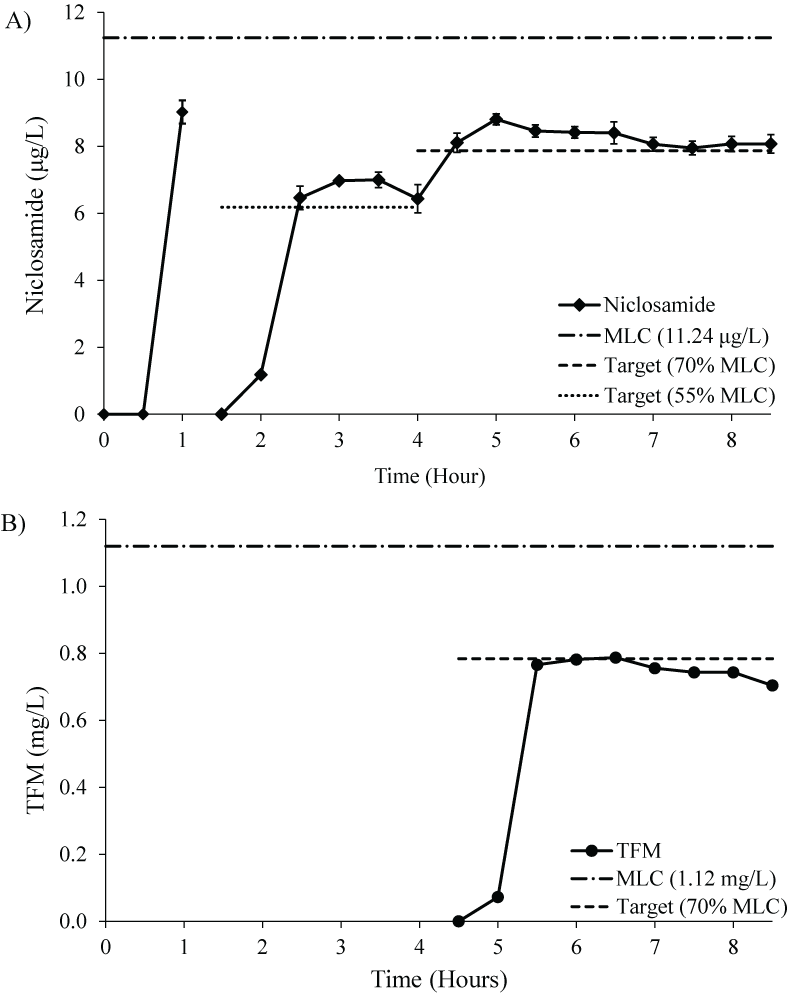
Plots showing the mean, A, niclosamide and, B, 3-(trifluoromethyl)-4-nitrophenol (TFM) concentrations of samples collected from the Indian River (Schoolcraft County, Michigan) during a field performance evaluation of a bayluscide 20-percent suspension concentrate (applied with and without TFM-HP Sea Lamprey Larvicide) that occurred on October 9, 2024. Application of the lampricides took place 1.8 kilometers upstream from the confluence with the Manistique River. Twelve samples were collected for each chemical constituent 0.8 kilometers downstream from the lampricide application point (table 1). Concentrations for niclosamide and TFM are given in micrograms per liter (μg/L) and milligrams per liter (mg/L), respectively. Error bars representing ±1 standard deviation are present for each datapoint but are not always visible owing to the size of the datapoints. Data are from Schueller and others (2025). [µg/L, micrograms per liter; MLC, minimum lethal concentration; %, percent; mg/L, milligrams per liter]
Similarly, SC combined readily with TFM-HP Sea Lamprey Larvicide, enabling the target concentration of 70 percent of the MLC to be reached within the first hour of the second 4-hour phase of the field evaluation. Target concentrations of both niclosamide and TFM were maintained at steady-state levels with high precision (fig. 2). Between hours 5.5 and 8, the mean (±1 standard deviation) concentrations of niclosamide and TFM were 8.2 (±0.2) μg/L and 0.75 (±0.03) mg/L, respectively (fig. 2). These values were within 5 percent of the target concentrations for both lampricides and resulted in an actual TFM-to-niclosamide application ratio of 100:1.09 by mass, closely aligning with the intended ratio of 100:1 by mass. In addition, lampricide distribution across the stream width was consistent during this period, as indicated by relative standard error values of less than 1.5 percent for both niclosamide and TFM. The field evaluation was concluded at hour 8, as USGS and FWS personnel determined that sufficient data had been collected to demonstrate that SC can be used to successfully execute a lampricide treatment within the standard 12-hour application timeframe.
Overall, the field evaluation demonstrated that SC is compatible with existing SLCP application protocols and equipment. Personnel reported that SC was easily diluted with stream water and mixed effectively with TFM-HP Sea Lamprey Larvicide. These observations align with the lampricide concentration profiles presented in figure 2, which show that target concentrations of niclosamide and TFM were achieved rapidly and with high precision, supporting the successful execution of the field application.
Summary
Petromyzon marinus (Linnaeus, 1758; sea lamprey) is a parasitic, invasive fish of the Laurentian Great Lakes. Since the late 1950s, the Great Lakes Fishery Commission has administered an integrated Sea Lamprey Control Program (SLCP) that relies extensively on the lampricidal chemicals 3-(trifluoromethyl)-4-nitrophenol (TFM) and niclosamide. The currently registered niclosamide formulation, a bayluscide 20-percent emulsifiable concentrate, contains the solvent N-methyl-2-pyrrolidone, which has been associated with worker safety concerns and has contributed to equipment degradation and clogging during application. To address these issues, the U.S. Geological Survey (USGS), in collaboration with Battell UK, developed a water-based alternative: a bayluscide 20-percent suspension concentrate (SC). However, before pursuing regulatory approval for SC as a lampricide, a field performance evaluation was conducted on October 9, 2024, on the Indian River, a tributary to the Manistique River in Schoolcraft County, Michigan. The objective was to assess the formulation’s compatibility with SLCP application procedures and equipment, and to evaluate its ability to deliver precise lampricide concentrations in a timely manner.
During the trial, SC was applied both independently and in combination with TFM. When applied alone, the formulation diluted readily with stream water, achieving the target niclosamide concentration within 1 hour of application. Moreover, concentrations remained within 8 percent of target values, with less than 5 percent variation across the width of the stream, demonstrating consistent and uniform distribution. When co-applied with TFM at a target mass ratio of 100:1 (TFM:niclosamide), SC mixed effectively with TFM, and target concentrations for both lampricides were achieved within 1 hour. Concentrations remained within 5 percent of target values and were evenly distributed across the stream transect, with less than 1.5-percent variation. These results support continued efforts by the USGS to pursue the registration and adoption of SC as a new tool for controlling invasive sea lamprey in the Great Lakes.
References Cited
Applegate, V.C., Howell, J.H., and Smith, M.A., 1958, Use of mononitrophenols containing halogens as selective sea lamprey larvicides: Science, v. 127, no. 3294, p. 336–338, accessed December 16, 2024, at https://doi.org/10.1126/science.127.3294.336.
Barber, J.M., and Van Kempen, T., 2024, Standard operating procedures for application of lampricides in the Great Lakes Fishery Commission integrated management of sea lamprey (Petromyzon marinus) control program: Great Lakes Fishery Commission, accessed March 7, 2025, at https://www.glfc.org/sop2024/Introduction.pdf.
Docker, M.F., Bravener, G.A., Garroway, C.J., Hrodey, P.J., Hume, J.B., Johnson, N.S., Lewandoski, S.A., Ogden, J.L., and Zollweg-Horan, E.C., 2021, A review of sea lamprey dispersal and population structure in the Great Lakes and implications for control: Journal of Great Lakes Research, v. 47, suppl. 1, p. S549–S569, accessed January 28, 2025, at https://doi.org/10.1016/j.jglr.2021.09.015.
Howell, J.H., King, E.L., Smith, A.J., and Hanson, L.H., 1964, Synergism of 5,2′-dichloro-4′-nitro-salicylanilide and 3-trifluormethyl-4-nitrophenol in a selective lamprey larvicide: Great Lakes Fishery Commission Technical Report no. 8., 21 p., accessed October 10, 2024, at https://www.glfc.org/pubs/TechReports/Tr08.pdf.
Howell, J.H., Lech, J.J., and Allen, J.L., 1980, Development of sea lamprey (Petromyzon marinus) larvicides: Canadian Journal of Fisheries and Aquatic Sciences, v. 37, no. 11, p. 2103–2107, accessed October 13, 2024, at https://doi.org/10.1139/f80-251.
Luoma, J.A., Schueller, J.R., Schloesser, N.A., Kirkeeng, C.A., and Wolfe, S.L., 2024, Comparative toxicity of emulsifiable concentrate and suspension concentrate formulations of 2′,5-dichloro-4′-nitrosalicylanilide ethanolamine salt: U.S. Geological Survey Open-File Report 2024–1037, 10 p., accessed September 9, 2024, at https://doi.org/10.3133/ofr20241037.
R Core Team, 2024, R—A language and environment for statistical computing, (ver. 4.1.1): R Foundation for Statistical Computing, Vienna, Austria, accessed March 31, 2025, at https://www.R-project.org/.
RStudio Team, 2024, RStudio—Integrated development for R (ver. 2024.12.1): RStudio, PBC, accessed May 14, 2024, at https://www.rstudio.com/. [Now available through Posit Software, PBC at https://posit.co/downloads/.]
Schueller, J.R., Kirkeeng, K.A., Luoma, J.A., Criger, L.A., Wood, A.M., and Carmosini, N., 2025, Data Release—Evaluation of bayluscide 20% suspension concentrate formulation field performance (Indian River, Schoolcraft County, MI): U.S. Geological Survey data release, https://doi.org/10.5066/P1ZIEH77.
Siefkes, M.J., Steeves, T.B., Sullivan, W.P., Twohey, M.B., and Li, W., 2013, Sea lamprey control—Past, present, and future, in Taylor, W.W., Lynch, A.J., and Leonard, N.J., eds., Great Lakes Fisheries policy and management—A binational perspective: East Lansing, Michigan, Michigan State University Press, p. 651–704.
Smith, B.R., and Tibbles, J.J., 1980, Sea lamprey (Petromyzon marinus) in Lakes Huron, Michigan, and Superior—History of invasion and control, 1936–78: Canadian Journal of Fisheries and Aquatic Sciences, v. 37, no. 11, p. 1780–1801, accessed September 12, 2024, at https://doi.org/10.1139/f80-222.
Sullivan, W.P., Burkett, D.P., Boogaard, M.A., Criger, L.A., Freiburger, C.E., Hubert, T.D., Leistner, K.G., Morrison, B.J., Nowicki, S.M., Robertson, S.N.P., Rowlinson, A.K., Scotland, B.J., and Sullivan, T.B., 2021, Advances in the use of lampricides to control sea lampreys in the Laurentian Great Lakes, 2000–2019: Journal of Great Lakes Research, v. 47, p. S216–S237, accessed May 14, 2024, at https://doi.org/10.1016/j.jglr.2021.08.009.
U.S. Environmental Protection Agency [EPA], 2022, Risk evaluation for N-methylpyrrolidone (NMP): U.S. Environmental Protection Agency web page, accessed March 2, 2026, at https://www.epa.gov/assessing-and-managing-chemicals-under-tsca/risk-evaluation-n-methylpyrrolidone-nmp-0.
U.S. Environmental Protection Agency [EPA], [undated], Details for bayluscide 20% emulsifiable concentrate: U.S. Environmental Protection Agency web page, accessed May 25, 2025, at https://ordspub.epa.gov/ords/pesticides/f?p=PPLS:8:12070295502710::NO::P8_PUID,P8_RINUM:39391,6704-92.
Glossary
The following glossary contains identifying information for all chemical compounds and registered formulations discussed in this report. Each compound entry includes a CAS registry number (RN), PubChem Chemical Identifier (CID), and systematic name from the International Union of Pure and Applied Chemistry (IUPAC). These identifiers and names are from the CAS database, available at https://commonchemistry.cas.org/.
For some compounds and all formulations, the associated U.S. Environmental Protection Agency (EPA) and (or) Health Canada Pest Management Regulatory Agency (PMRA) registration number (reg. no.) is given. These numbers are from the EPA’s Pesticide Product and Label System at https://ordspub.epa.gov/ords/pesticides/f?p=PPLS:1 and Health Canada’s Consumer Product Safety database at https://pr-rp.hc-sc.gc.ca/ls-re/index-eng.php.
Chemical Compounds
3-(trifluoromethyl)-4-nitrophenol
Also called “TFM” in this report. CAS RN: 88-30-2; PubChem CID: 6931; and IUPAC: 4-nitro-3-(trifluoromethyl)phenol
ammonium hydroxide
CAS RN: 1336-21-6; PubChem CID: 14923; and IUPAC: azanium;hydroxide
niclosamide ethanolamine salt
Also called “bayluscide” in this report. CAS RN: 1420-04-8; PubChem CID: 14992; IUPAC: 2-aminoethanol;5-chloro-N-(2-chloro-4-nitrophenyl)-2-hydroxybenzamide; EPA reg. no. 6704-88; PWRA reg. no. 25561
niclosamide
CAS RN: 50-65-7; PubChem CID: 4477; and IUPAC: 5-chloro-N-(2-chloro-4-nitrophenyl)-2-hydroxybenzamide
N-methyl-2-pyrrolidone
CAS RN: 872-50-4; PubChem CID: 13387; IUPAC: 1-methylpyrrolidin-2-one
Conversion Factors
International System of Units to U.S. customary units
Temperature in degrees Celsius (°C) may be converted to degrees Fahrenheit (°F) as follows:
°F = (1.8 × °C) + 32.
Supplemental Information
Concentrations of chemical constituents in water are in either milligrams per liter (mg/L) or micrograms per liter (µg/L).
Abbreviations
EC
bayluscide 20-percent emulsifiable concentrate
EPA
U.S. Environmental Protection Agency
FWS
U.S. Fish and Wildlife Service
GLFC
Great Lakes Fishery Commission
HPLC
high-performance liquid chromatography
MLC
minimum lethal concentration
PMRA
Health Canada Pest Management Regulatory Agency
SC
bayluscide 20-percent suspension concentrate
SLCP
Sea Lamprey Control Program
SOP
standard operating procedure
SPE
solid phase extraction
TFM
3-(trifluoromethyl)-4-nitrophenol
USGS
U.S. Geological Survey
For more information concerning the research in this report, contact:
Center Director, USGS Upper Midwest Ecological Sciences Center
2630 Fanta Reed Road
La Crosse, Wisconsin 54603
Or visit our website at
https://www.usgs.gov/centers/upper-midwest-environmental-sciences-center
Publishing support provided by the U.S. Geological Survey Science Publishing Network, Baltimore Publishing Service Center
Disclaimers
Any use of trade, firm, or product names is for descriptive purposes only and does not imply endorsement by the U.S. Government.
Although this information product, for the most part, is in the public domain, it also may contain copyrighted materials as noted in the text. Permission to reproduce copyrighted items must be secured from the copyright owner.
Suggested Citation
Carmosini, N., Schueller, J.R., Kirkeeng, C.A., Wood, A.M., Criger, L.A., and Luoma, J.A., 2026, Field performance evaluation of a bayluscide 20-percent suspension concentrate formulation (ver. 1.1, March 19, 2026): U.S. Geological Survey Open-File Report 2026–1067, 9 p., https://doi.org/10.3133/ofr20261067.
ISSN: 2331-1258 (online)
Study Area
| Publication type | Report |
|---|---|
| Publication Subtype | USGS Numbered Series |
| Title | Field performance evaluation of a bayluscide 20-percent suspension concentrate formulation |
| Series title | Open-File Report |
| Series number | 2026-1067 |
| DOI | 10.3133/ofr20261067 |
| Edition | Version 1.0: March 17, 2026; Version 1.1: March 19, 2026 |
| Publication Date | March 17, 2026 |
| Year Published | 2026 |
| Language | English |
| Publisher | U.S. Geological Survey |
| Publisher location | Reston, VA |
| Contributing office(s) | Upper Midwest Environmental Sciences Center |
| Description | Report: vii, 9; Data Release |
| Country | United States |
| State | Michigan |
| County | Schoolcraft County |
| Other Geospatial | Indian River |
| Online Only (Y/N) | Y |
| Additional Online Files (Y/N) | N |